
When should I rewrite, merge, redirect, or retire an underperforming page?
Short answer
Route on four inputs: does the query still have demand, does another page of yours compete for it, does the page have earned signals like links or citations, and does the intent still match your format. Demand plus no competing page plus intent mismatch means rewrite. Demand plus a competing page means merge. No demand plus earned signals means redirect. No demand and no signals means retire.
Gather four inputs per page
Everything below depends on these, and gathering them takes minutes per page.
Demand. Does the target query still have meaningful search volume and impressions? A page failing on a dead query is not underperforming, it's obsolete.
Overlap. Does another page on your site rank for the same query, or split impressions with this one? Check site:yourdomain.com plus the query.
Earned signals. Referring domains, internal links, and AI citations pointing at the URL. These are the assets that make a redirect worth doing rather than a delete.
Intent match. Does the current top ten still return your format? If the SERP moved from guides to comparison tables, more depth won't help.
Route each page through the tree
| Demand | Overlapping page | Earned signals | Action |
|---|---|---|---|
| Yes | No | Any | Rewrite to match current intent and depth |
| Yes | Yes | Weaker page has few | Merge the weaker into the stronger, redirect |
| Yes | Yes | Both strong | Differentiate by intent rather than merging |
| No | No | Yes | Redirect to the closest relevant page |
| No | No | No | Retire, return 410 |
| No | Yes | Any | Merge or redirect into the surviving page |
Two rows deserve expanding, because they're the ones teams get wrong.
Rewrite is the right call more often than it feels, but only when intent still matches your format or you're willing to change format. Adding a thousand words to a guide when the SERP now wants a comparison table is the most common wasted rewrite. Google's documentation on AI features is explicit that no separate optimisation exists for AI surfaces, so a rewrite that genuinely serves readers is the version that works in both places.
Differentiate is the row people skip. When two of your pages both have real signals and both rank, merging destroys one set of earned authority. Splitting them by intent, so one serves the informational query and one the commercial, usually beats consolidation.
Merging, done properly
Merging is the highest-value action here and the one most often botched.
Pick the destination on earned signals, not on which content you prefer. The URL with more referring domains and citations wins even if its content is weaker, because you can move the content and you cannot move the links.
Then fold the unique material from the weaker page into the stronger one rather than pasting it wholesale, 301 the weaker URL to the stronger, and update every internal link to point at the destination directly rather than through the redirect.
Retiring, and the 404 versus 410 question
Retire when demand is gone and nothing points at the URL. Content pruning genuinely helps when a site has accumulated hundreds of pages that dilute crawl budget and topical focus.
Use 410 rather than 404 for deliberate removal. It signals intent and is processed faster. Reserve 404 for pages that broke rather than pages you retired.
Before retiring, check one thing that isn't in most pruning checklists: whether the page is cited by AI surfaces. A page with negligible search traffic can be a consistent citation source, and that's earned presence you'd be deleting.
The input most audits still ignore
Traffic-based pruning misses a category of valuable page entirely.
Our own state of AI search research, covering more than 22,000 answers and 115,000 citation events, found presence is path-dependent: once a brand is mentioned for a prompt, next-observation mention probability is 83.2% on ChatGPT, 83.3% on Perplexity, and 84.2% on Google AI Mode, against roughly 10% after a miss.
A cited page holds its position with high reliability. Retiring one throws away an asset that was compounding, and re-earning that citation takes considerably longer than regaining a ranking. So citation status belongs in the decision tree alongside links, and for some pages it will be the only thing keeping them alive.
Build the routing as a workflow
The reason content audits stall is that gathering four inputs across two hundred pages by hand is a fortnight, and the resulting spreadsheet is stale before anyone acts on it.
Every input maps to a node. GSC Page Performance Summary and Page-Keyword Breakdown supply demand and overlap. Keyword-Page Breakdown returns every page a query sends clicks to, which is how cannibalisation surfaces without manual checking. Citation Watched Pages and citation-magnets supply earned AI signals. The Google Search node returns current SERP composition for the intent-match test.
The AEO Content Scorecard then scores each rewrite candidate on structure, freshness, claim density, proof integration, and claim-to-source mapping, which turns "rewrite this" into a specific brief.
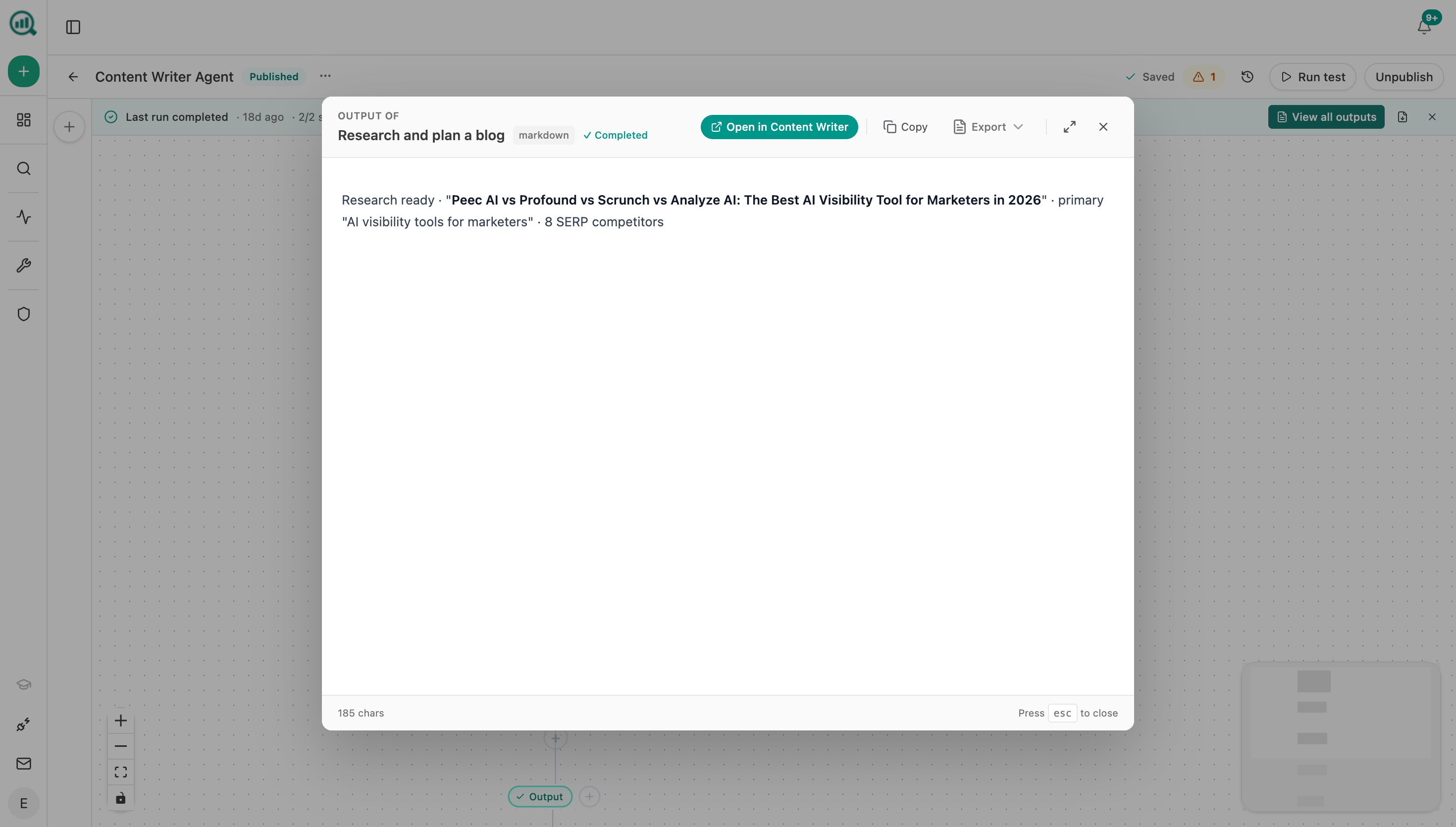
The audit agent:
Start (manual, with a URL list or sitemap as input) → Loop / For Each over URLs → GSC Page Performance Summary per URL → GSC Page-Keyword Breakdown per URL → GSC Keyword-Page Breakdown on the primary query (detect overlap) → Citation Watched Pages → Google Search node on the primary query (capture result types for intent match) → Code (assemble the four inputs and route each URL through the decision tree) → Conditional (rewrite candidates branch to scoring) → AEO Content Scorecard on the rewrite set → Prompt LLM (produce one action per URL with the reason, and a brief for each rewrite) → Excel export → Send Email to the content lead.
Two things make this genuinely useful. The Keyword-Page Breakdown step catches cannibalisation that page-level analysis never reveals, which is what routes pages to merge rather than rewrite. And branching rewrite candidates into the scorecard means the audit output is a set of briefs rather than a list of verdicts someone still has to research.
For pages routed to rewrite, the Content Optimizer picks them up through audit, brief, rewrite, and QA as a tracked pipeline.
FAQ
Related answers
- Is this page underperforming because of content or because it isn't indexed?
- How can I tell if search intent changed for a keyword I already rank for?
- Did a redirect or URL change lose us rankings?
- What's the highest-leverage SEO action I can take this week?
Want an audit that returns one action per URL with a brief attached? Start a free Analyze AI trial and point it at your sitemap.