
Did a competitor take my traffic by publishing a better answer?
Short answer
Identify who occupies the positions you lost, check when their page was published or substantially updated, and diff it against yours. Displacement has a specific signature: your position falls on specific queries while your impressions on those queries hold, and a single competitor appears above you across most of them. If the new occupant is different on every query, you have a broader problem than one competitor.
What displacement looks like
Competitive displacement looks different from technical loss, demand decline, and SERP absorption. Four things travel together:
Position fell on specific queries, not across the site. Technical problems hit whole templates, while competitors take individual positions.
Impressions on those queries held. Demand didn't change, the ordering did.
One competitor appears above you across most of the affected queries. If a different domain took each position, the cause is something about your page rather than one rival.
The timing matches a publication or update date on their side.
If all four hold, you were outranked. If impressions fell too, check demand first using How do I tell seasonality from a real SEO decline?.
Find out when their page changed
The most useful evidence is timing, and it's usually available.
Check the visible publication or update date on their page, then verify against the Wayback Machine, which shows both when the URL first appeared and how the content changed over time. A page that first appeared two weeks before your decline is a strong candidate. A page that's existed for three years and quietly gained 4,000 words last month is a different and more interesting finding.
Also check whether the URL is new or whether they repointed an existing one. A competitor consolidating three thin pages into one strong one produces displacement without any new URL appearing.
Diff their page against yours on six axes
Once you have the page, compare rather than admire. Six axes account for most displacement:
| Axis | What to check |
|---|---|
| Format | Is theirs a comparison table where yours is prose? Format mismatch beats quality. |
| Depth | Subtopics covered that yours omits entirely |
| Evidence | Original data, screenshots, testing they did and you didn't |
| Freshness | Last substantive update, not the displayed date |
| Structure | Whether an answer is extractable in the first hundred words |
| Internal support | How many of their own pages link to it |
Format is the axis people skip and it decides more outcomes than depth does. If the query now wants a comparison table, a better-written guide will keep losing. Google's documentation on AI features makes the same point from the other direction, noting that standard people-first content requirements govern AI surfaces too, so a format that serves readers badly loses on both.
Decide whether to compete or redeploy
Not every displacement is worth contesting, and treating them all as reclaim projects wastes a quarter.
Contest it when the query drives real revenue, the gap is closable with work you can actually do, and their authority advantage is modest.
Redeploy when they have a structural advantage you can't match, when the query's revenue contribution is marginal, or when the gap is original research you're not resourced to replicate.
Compute revenue per session for the affected query set before deciding. A high-volume informational query you lost may be worth less than a low-volume commercial one you're neglecting.
Check whether they took the citation too
Search rankings are only half the displacement picture now.
Our own state of AI search research, covering more than 22,000 answers and 115,000 citation events, found presence is path-dependent: once a brand is mentioned for a prompt, next-observation mention probability is 83.2% on ChatGPT, 83.3% on Perplexity, and 84.2% on Google AI Mode, against roughly 10% after a miss.
That stickiness cuts both ways. A competitor who displaces you in AI citations is harder to dislodge than one who outranks you, because the position tends to persist once established. Check whether the competitor who took your ranking also took your citation, because if they took both, the reclaim job is larger than a content refresh and more urgent than the traffic number suggests.
Run the displacement analysis
Doing this manually means checking SERPs by hand, then checking AI answers separately, then diffing pages. It's a day's work for twenty queries and nobody repeats it.
The Google Search node returns the current results for a query, so you can identify the position holder across your declining query set in one loop. The brand-vs-competitor recipe returns side-by-side visibility, sentiment, and citation comparison against tracked competitors, and rising-threats surfaces which rivals are gaining fastest across your prompt set.
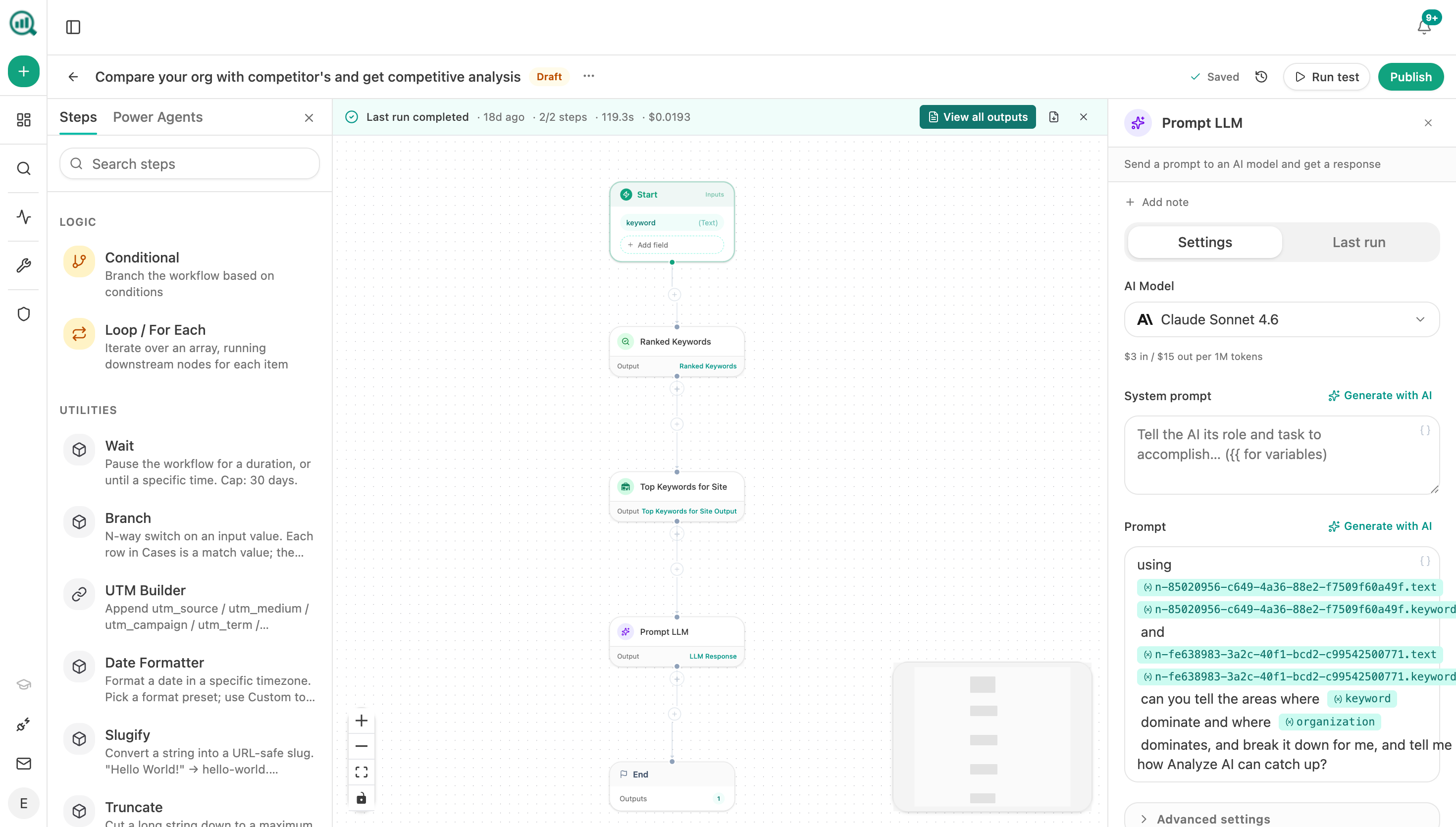
A monthly agent:
Start (schedule, monthly) → GSC Top Keywords for Site (queries with position loss over 3 places) → Loop / For Each over the top 30 → Google Search node per query (capture current position holders) → brand-vs-competitor recipe → rising-threats recipe → Citation Watched Pages → Code (count how often each competitor domain appears above you, and flag queries where the same domain took both the ranking and the citation) → Prompt LLM (name the displacing competitor per query cluster and state whether they took search, AI, or both) → Excel export → Send Email to the content lead.
The both-surfaces flag is the output that changes prioritisation. A competitor who took a ranking is a normal content project. One who took the ranking and the citation has compounding advantage on that topic, and that's where the refresh budget should go first.
FAQ
Related answers
- How can I tell if search intent changed for a keyword I already rank for?
- Which pages and queries explain most of my organic decline?
- When should I rewrite, merge, redirect, or retire an underperforming page?
- What's the highest-leverage SEO action I can take this week?
Want to know which competitor took your ranking and your citation? Start a free Analyze AI trial and track them side by side.