
How do I decide whether SEO is too slow for our current cash runway?
Short answer
Compare your runway against the payback window of each SEO sub-play rather than treating SEO as one timeline. Bottom-funnel commercial content pays back in 3 to 9 months and AI-search visibility on commercial prompts can move in 1 to 3, while top-funnel educational content takes 12 to 24. If your runway is under 9 months with no organic baseline, skip SEO entirely. Between 9 and 18 months, fund only the fast plays.
The mistake that ends this debate wrong
"Is SEO too slow" gets answered wrong because SEO gets treated as one activity with one timeline. It isn't. The sub-plays differ by a factor of eight:
| Sub-play | Time to first customer | Full payback |
|---|---|---|
| AI-search visibility on commercial prompts | 1 to 3 months | 3 to 6 months |
| Bottom-funnel commercial content | 2 to 4 months | 3 to 9 months |
| Comparison and alternative content | 2 to 5 months | 5 to 12 months |
| Product-adjacent JTBD | 3 to 6 months | 6 to 15 months |
| Top-funnel educational | 4 to 9 months | Often never direct |
| Category-defining thought leadership | 6 to 18 months | Assisted only |
Writing off "SEO" because thought leadership is slow also writes off the two plays at the top of that table, which can pay back inside almost any runway. Split before you decide.
The runway tiers
Assumes B2B SaaS with ACV between $2,000 and $30,000.
| Runway | Organic baseline | What to do |
|---|---|---|
| Under 6 months | Any | Maintain existing pages only. Redirect cash to paid, sales, product. |
| 6 to 9 months | None | Skip SEO. Buy demand with paid. |
| 6 to 9 months | Existing organic revenue | Fund AI-search visibility and bottom-funnel commercial only. |
| 9 to 18 months | Any | SEO as secondary bet. Bottom-funnel plus comparison content. |
| Over 18 months | Any | Full mix, including top-funnel and thought leadership. |
The pivot sits at 9 months because that's where bottom-funnel payback fits inside the runway with margin. Shorter than that and you're betting the company on rankings arriving on schedule, which is not a bet to take with payroll.
Why AI-search is the fastest organic play available
If your runway is short and you still want organic, AI-search visibility on high-intent commercial prompts moves faster than anything else in the table above.
Two findings from our own state of AI search research explain why.
Presence is sticky. Once your brand is mentioned in an AI answer for a prompt, next-observation mention probability is 83.2% on ChatGPT, 83.3% on Perplexity, and 84.2% on Google AI Mode. Break in once and you tend to stay.
You don't need all three surfaces. Mean domain overlap between ChatGPT and Perplexity is 0.05, and only 25.3% of matched prompt-days share even one cited domain. Winning on one surface is a legitimate strategy rather than a partial result.
Together those mean a focused effort on 20 to 40 commercial prompts across one or two surfaces can shift visibility inside a quarter, which beats most paid campaigns to break-even. Measure it properly though, because researchers argue visibility should be measured as a distribution across runs, prompts, and time rather than as one snapshot, and a single good week on a short runway is the easiest thing in the world to over-read.
Run the 60-day sprint
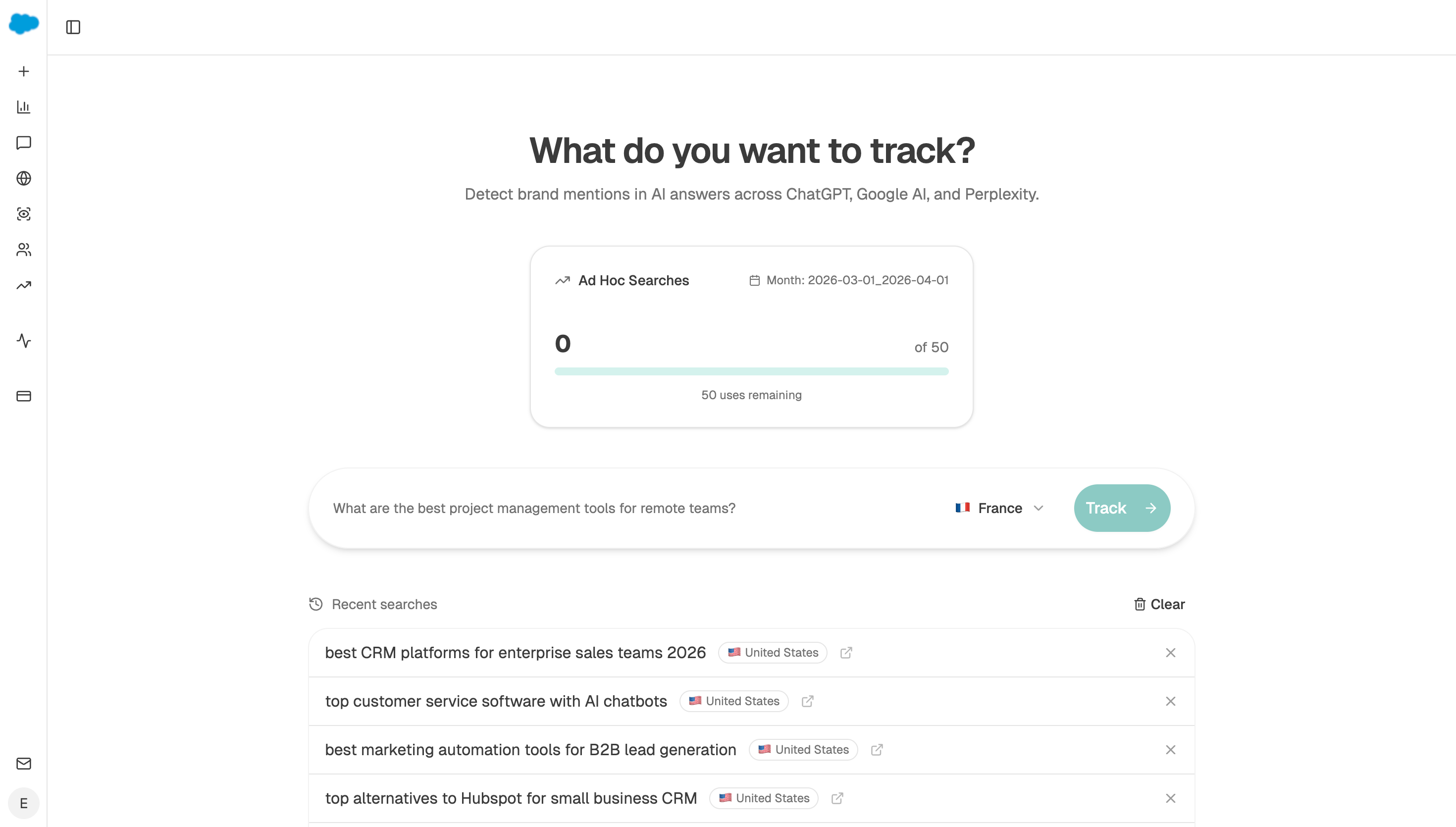
- Week 1. Identify 20 to 40 high-intent commercial prompts. Ad-hoc prompt search lets you check any single prompt across surfaces immediately, which is faster than waiting for a scheduled observation when you're building the initial list.
- Week 2 to 3. Audit which prompts already cite you using
unmentioned-prompts, which returns exactly the gap set rather than the full list. - Week 4 to 6. Update or produce 5 to 10 pages aimed at the uncovered prompts, optimised for citation rather than clicks.
- Week 7 to 8. Re-measure against the week 1 baseline.
The weekly tracking agent:
Start (schedule, weekly) → Visibility Score (per provider) → unmentioned-prompts recipe → competitor-gaps recipe → rising-threats recipe → workflow-memory (week 1 baseline) → Code (compute citation-rate delta against baseline, and flag prompts that moved from uncovered to cited) → Prompt LLM (report progress against the 60-day target) → Send Email to the founder.
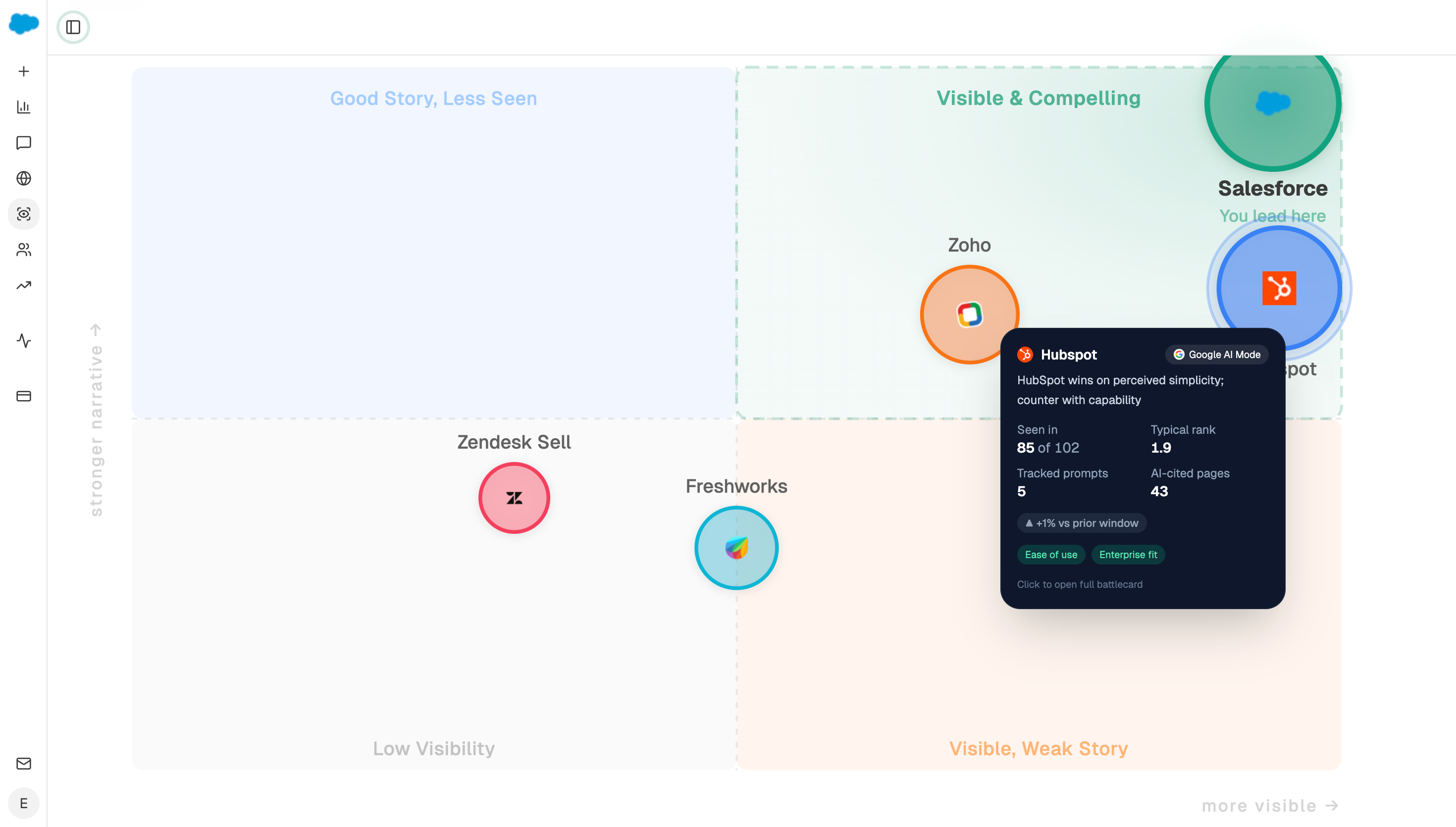
For a short-runway team the competitor-gaps recipe is the highest-value one in that chain, because it returns prompts where rivals are cited and you aren't. That's a target list ordered by winnability rather than by search volume, which is the right ordering when you have eight weeks rather than eight months.
FAQ
Related answers
- What is a realistic payback period for an SEO investment?
- How should I compare SEO customer-acquisition cost with paid acquisition?
- How do I defend my SEO and content budget to a CFO who wants a revenue forecast?
- How can I compare the expected value of SEO, paid search, partnerships, communities, and referrals?
Want an AI-search sprint that pays back inside the quarter? Start a free Analyze AI trial and set up prompt tracking, competitor gaps, and citation monitoring in an afternoon.