
Is AI-search visibility commercially meaningful enough to deserve its own budget?
Short answer
Yes in most B2B categories, at 10 to 20% of organic budget, but only if three things are true: your buyers research inside AI surfaces, your competitors are already being cited there, and you can measure branded-search or direct-traffic lift. If you can't measure the lift yet, fund a 3 to 5% measurement effort for a quarter rather than committing the full line on faith.
Define "meaningful" before you ask for money
"AI is the future" doesn't survive a budget review, so define meaningful in terms your CFO can check.
Three conditions, all testable this month:
- Buyers in your category use AI surfaces to research. Test with your signup survey. If nobody names ChatGPT or Perplexity, the channel hasn't reached your buyers yet.
- Competitors are already cited on your commercial prompts. Test by running 20 prompts manually. If nobody in your category appears, there's no share to win.
- You can detect branded-search or direct-traffic lift. If your analytics can't isolate this, you'll have no way to prove the budget worked.
Fail any of the three and the answer is measure first, fund later.
The three data points that make the case
From our own state of AI search research, analysing more than 22,000 answers and 115,000 citation events:
The surfaces are already citation-dense. Google AI Mode returns a citation-rich answer in 97.4% of matched B2B queries and Perplexity in 93.2%. When a buyer asks a category question, they see a source list whether you're on it or not. The only variable is whose name appears.
Winning compounds. Once a brand is mentioned for a prompt, next-observation mention probability is 83.2% on ChatGPT, 83.3% on Perplexity, and 84.2% on Google AI Mode, against roughly 10% after a miss. That's the compounding characteristic that made SEO worth funding, applied to a new surface.
Surfaces don't overlap. Mean domain overlap between ChatGPT and Perplexity is 0.05, with only 25.3% of matched prompt-days sharing even one cited domain. AI-search work is three parallel efforts, which is the structural reason it needs its own line rather than someone's spare capacity. Worth pairing with a caution when you present it: researchers argue visibility should be measured as a distribution across runs, prompts, and time rather than as one snapshot, so a single month's reading is not the evidence base for a budget request.
Where the honest answer is "not yet"
Two categories where a dedicated budget is premature, and pretending otherwise wastes real money.
Regulated categories. In healthcare, legal, and parts of financial services, AI models routinely decline to make vendor recommendations. You can win citations and still never appear in a recommendation, so the commercial return is thin regardless of effort.
Categories where competitors aren't cited either. If you run 20 commercial prompts and nobody in your category appears, buyer attention hasn't moved yet. You'd be building distribution for an audience that isn't there.
In both cases fund the measurement, not the optimisation. Track prompts, track competitors, watch branded search monthly, and escalate to a full line when the data shifts. See How do I tell if a GEO consultant or tool is selling snake oil?.
What the line actually covers
If you fund it, here's the split that works:
| Category | Share of the AI-search line |
|---|---|
| Prompt tracking and monitoring | 20 to 30% |
| Citation optimisation on existing pages | 30 to 40% |
| Net-new content for uncovered prompts | 20 to 30% |
| Measurement infrastructure | 10 to 15% |
Notice that citation optimisation on pages you already have is the largest slice. Most teams assume AI-search means writing new content, when the higher return is usually making existing ranking pages more extractable.
The one-slide case for your CFO
Three sections and nothing more.
Current state. Citation rate across 20 to 50 commercial prompts on three surfaces, plus your branded-search trend.
Competitive gap. Share of voice against three named competitors on the same prompts.
The compounding argument. Your own path-dependence data if you have a quarter of tracking, or the industry figures above if you don't.
A CFO won't fund "AI visibility" as a concept. They'll fund a 10 to 20% line framed as the same organic investment logic applied to a channel that's demonstrably moving.
Build the measurement first
Before the budget conversation you need the numbers you'll cite, and they need at least a quarter of history to mean anything.
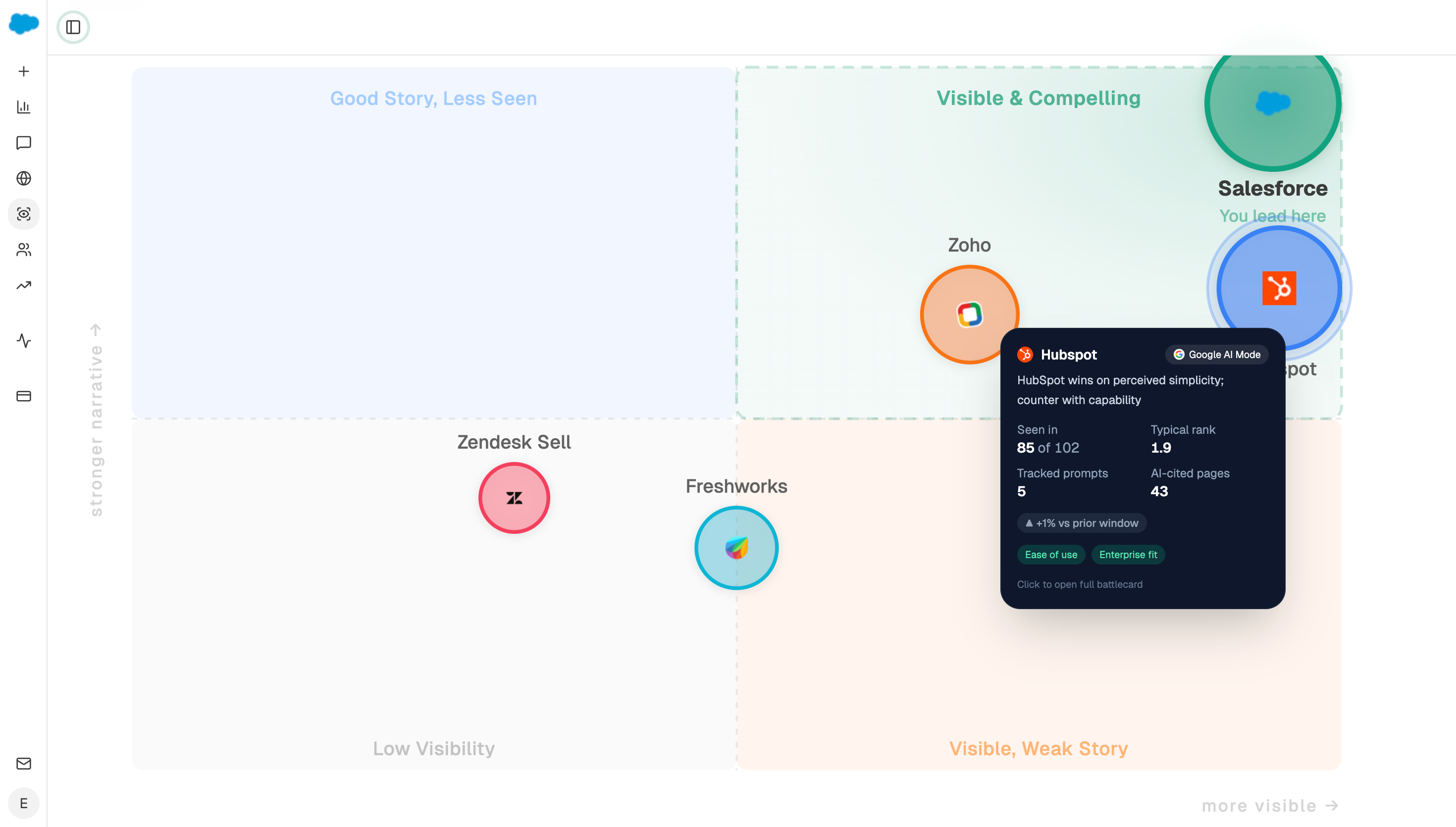
Four nodes cover the case. Visibility Score returns mention rate per provider with a daily trend, which gives you a distribution rather than a snapshot. model-blind-spots surfaces which surfaces know least about your brand, which is the evidence for the three-parallel-efforts argument. unmentioned-prompts returns the specific gap set, turning "we have low visibility" into a countable target list. And Get Perception Quadrant positions you against competitors on presence and narrative strength, which is what a CFO reads faster than a table.
The monthly measurement agent:
Start (schedule, 1st of month) → Visibility Score (per provider) → Citation Share → model-blind-spots recipe → unmentioned-prompts recipe → brand-vs-competitor recipe → Get Perception Quadrant → GSC Top Keywords for Site (branded regex) → HubSpot Search Contacts (survey answers) → workflow-memory (prior runs) → Code (compute citation-rate trend, correlate against branded-search movement at a 4 to 12 week lag, and test the three funding conditions) → Conditional (if fewer than three months of history, output the tracking state only and withhold a funding recommendation) → Prompt LLM (write the one-slide case) → DOCX export → Send Email to CMO and CFO.
The Conditional withholding a recommendation on thin history is deliberate. Asking for a budget line on six weeks of data is how GEO spend gets approved and then cut two quarters later, and a workflow that refuses to make the case early protects the case you'll make properly in month four.
FAQ
Related answers
- What evidence should I require before increasing our GEO budget?
- How should I budget for SEO when AI answers are reducing organic clicks?
- How can I value zero-click exposure when the buyer never visits our website?
Want to build the measurement case before you ask for the budget? Start a free Analyze AI trial and track your prompts, competitors, and citation share in one dashboard.