
How can I value zero-click exposure when the buyer never visits our website?
Short answer
You can't measure the click, so measure the three things the click would have caused: survey answers naming AI surfaces, branded search lift in the 4 to 12 weeks after visibility changes, and share of voice on tracked commercial prompts. Triangulate all three rather than trusting any one, and discount the branded-lift number by 30 to 50% for other causes. Agreement across three imperfect signals is stronger evidence than one clean-looking number.
Two wrong assumptions to drop first
The reflex is that zero-click exposure is unmeasurable and therefore worthless. Both halves are wrong.
It's not unmeasurable, because branded search, direct traffic, and survey answers all move when AI-search visibility moves. And it's not worthless, because AI answers are increasingly where buyers build their shortlist before typing any domain.
What's actually broken is that your attribution stack was designed for a click-based world. Applying it to a channel with no click returns zero, and zero drives bad budget decisions.
Our own state of AI search research found Google AI Mode returns a citation-rich answer in 97.4% of matched B2B queries and Perplexity mentions the tracked brand in 41.7%. Those buyers are seeing you. The referrer just doesn't survive the trip. Pew Research found that when an AI summary appears, users click a source link in only about 1% of visits, which is the single most useful external figure to put next to your own numbers when someone calls this channel unmeasurable.
Proxy 1: survey attribution
Add "how did you hear about us" at signup with ChatGPT, Perplexity, and Google AI Mode as named options rather than hidden behind "other."
This is your only ground-truth signal. It's imperfect, because people misremember and some skip it, but it's the closest thing to direct attribution the channel supports. You need 100 responses minimum before the number means anything, and 300 or more before you'd defend it in a board meeting.
Proxy 2: branded search lift
If your ChatGPT mention rate moves from 20% to 40% over a quarter and branded search rises 15% in the following two months with no paid campaign explaining it, the visibility is the most plausible cause.
Discount this number by 30 to 50% before reporting it, because PR, product launches, and natural category growth all move branded search too. Reporting the raw lift as AI-attributed is the fastest way to lose the argument when someone finds the competing explanation.
See How do I test whether an organic lift was real and not seasonal or brand-driven? for the isolation method.
Proxy 3: share of voice on named prompts
Not "AI visibility" as a floating percentage. Share of voice on 20 to 50 specific commercial prompts against three specific competitors.
Value this as brand equity rather than revenue, using paid media benchmarks in your category as the comparable rate. It's the same logic used to value PR placements, and CFOs already accept that framing.
Combining them into one number
| Proxy | Weight | Reported as |
|---|---|---|
| Survey attribution | 60 to 70% confidence | Directly attributable customers |
| Branded search lift | Discounted 30 to 50% | Estimated incremental revenue |
| Share of voice | Benchmark equivalent | Brand equity, not revenue |
Report the three separately in your dashboard and sum only the first two into an "AI-search contribution" figure. Folding share of voice into a revenue number is over-claiming, and one over-claim discredits the other two.
The compounding argument that closes the objection
The reason zero-click exposure is an asset rather than an impression is stickiness.
Our research found that once a brand is mentioned in an AI answer for a prompt, next-observation mention probability is 83.2% on ChatGPT, 83.3% on Perplexity, and 84.2% on Google AI Mode, against roughly 10% after a miss. The impression you earn today is far more likely to repeat next month without additional spend, because the surface is inclined to keep citing you.
That's a property display and programmatic never had, and it's usually the point where the "unmeasurable" objection stops.
Build the model
1. Set up prompt tracking. 20 to 50 commercial prompts across three surfaces, checked weekly.
2. Add the survey question with named AI options.
3. Pull 24 months of branded search volume from GSC. You need the history to detect a lift against seasonality.
4. Compute the three proxies quarterly.
5. Report as a fourth column beside sourced, influenced, and assisted revenue.
Automate it
Triangulation only works if the three proxies are computed on the same window with the same definitions, which is exactly what fails when they come from three separate exports.
Visibility Score, Citation Share, and Sentiment Score give you the exposure layer from one run. brand-vs-competitor supplies the share-of-voice benchmark against named rivals, which is what turns a floating percentage into a valuation input, and Get Visibility Events supplies the month-over-month movement that the branded-search lag analysis correlates against.
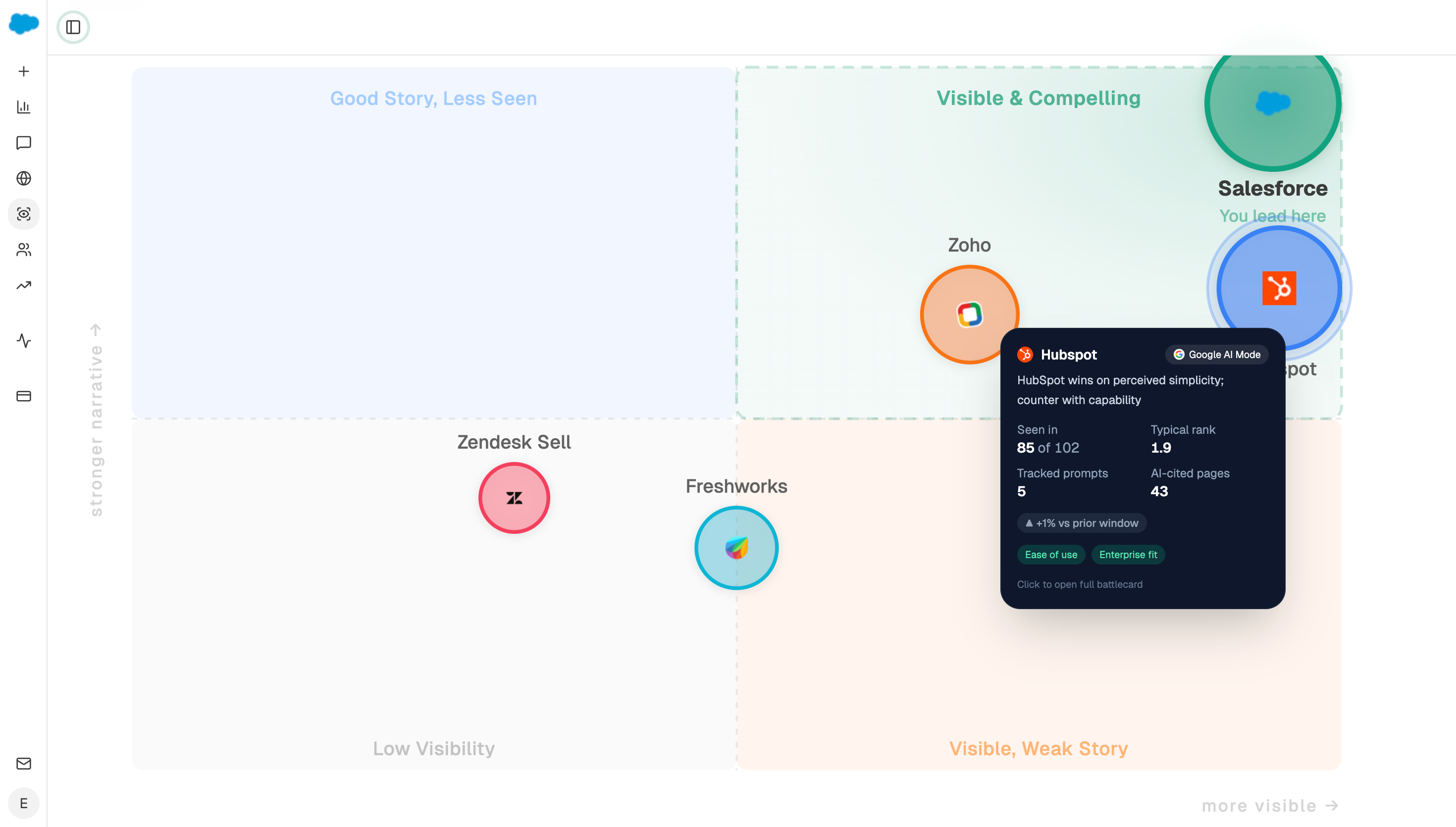
The monthly agent:
Start (schedule, 1st of month) → Visibility Score (per provider) → Citation Share → Sentiment Score → brand-vs-competitor recipe → Get Visibility Events → GSC Top Keywords for Site (branded regex, 24 months) → GA4 AI Traffic Overview → HubSpot Search Contacts (new customers and survey answers) → Code (compute AI-attributed customers from survey, discounted branded lift at 4, 8, and 12 week lags, and the share-of-voice equivalent value, each with its own confidence label) → Prompt LLM (report the three proxies separately, summing only the first two) → Excel export → Send Email to CMO.
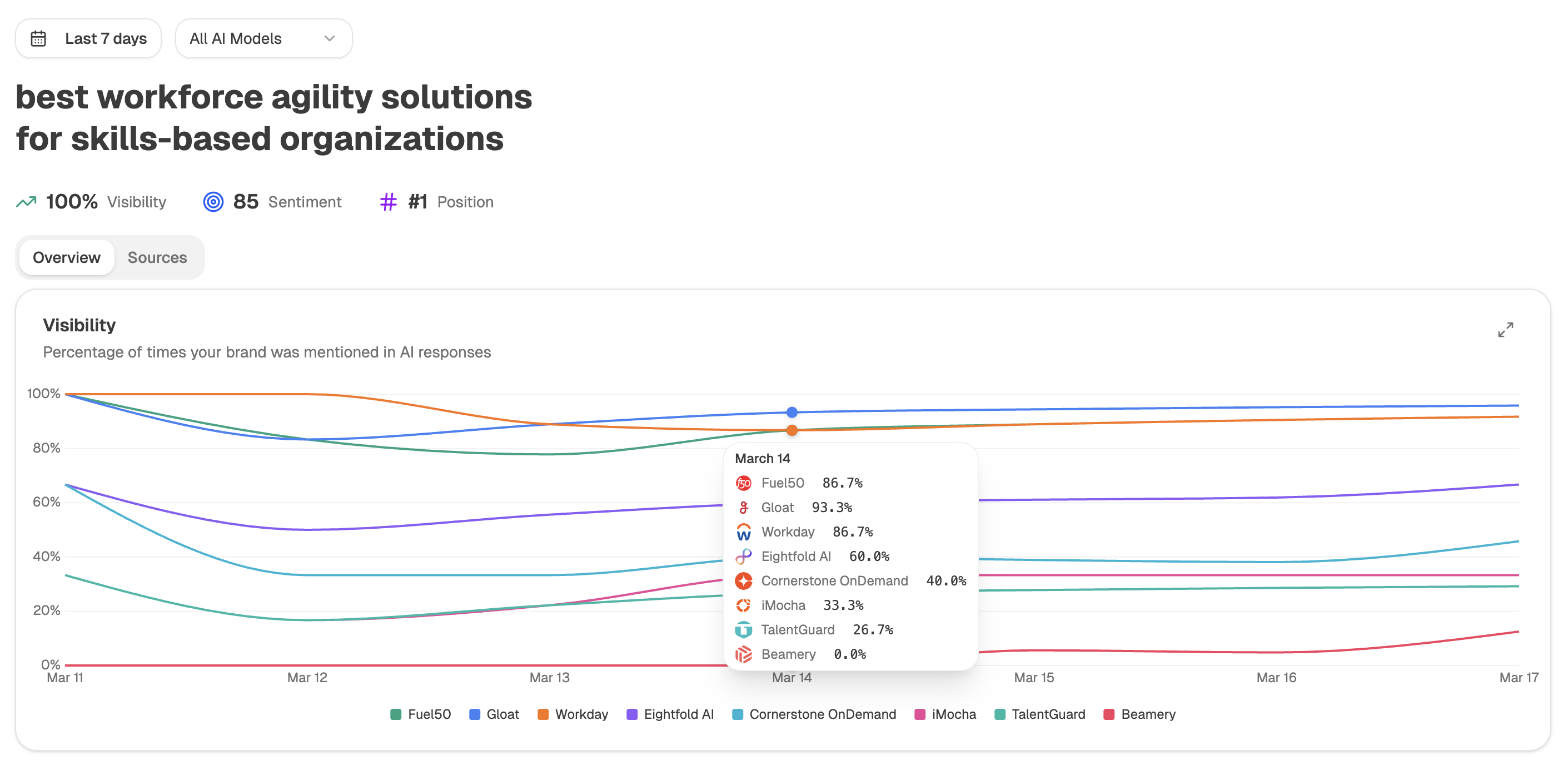
The instruction to sum only two of the three is encoded rather than left to whoever writes the summary. Folding share of voice into a revenue figure is the specific over-claim that discredits the other two proxies, and it happens most often in a quarter where the number needs to look good.
FAQ
Related answers
- Is AI-search visibility commercially meaningful enough to deserve its own budget?
- How can I build credible evidence that AI search is sending customers when there is no referrer?
Want to value zero-click AI exposure with numbers your CFO accepts? Start a free Analyze AI trial and track prompts, competitors, and branded-search lift in one dashboard.