
Should I cut content spending when traffic is growing but revenue is flat?
Short answer
Usually no, because the cause is almost always fixable without cutting. Check in this order: intent mix drift, then commercial-page conversion decline, then AI-search revenue misattributed to Direct, then product problems. Roughly 60% of cases resolve at the first check, which takes 15 minutes. Cutting before you run it kills the bottom-funnel pages producing pipeline alongside the top-funnel pages that aren't.
Run the 15-minute check first
Before anything else, bucket every article you published in the last 24 months by intent and compute the share per bucket per quarter.
If your top-funnel share climbed from roughly 40% to 70% while your commercial buckets stayed flat, you've found it. Top-funnel keywords carry higher volume, so traffic grows, but they convert at a fifth the rate of commercial content, so revenue doesn't follow.
This is the cause about 60% of the time, and the fix is a production rebalance rather than a cut. Redirect the next 60 to 90 days toward bottom-funnel and comparison pieces and the revenue line usually moves within a quarter.
See How do I prioritize content ideas by expected revenue and effort? for the reprioritisation method.
Second check: are your commercial pages converting worse?
If the intent mix looks healthy, pull conversion rate for your top 20 bottom-funnel pages over 12 months and compare last quarter to the prior three.
Down 15% or more with steady traffic means the pages need work, not more traffic. The usual causes:
- A competitor rewrote their comparison page and yours now reads weaker
- Your form or CTA changed without testing
- Pricing changed and the page didn't
- New content on the page diluted the primary CTA
This is a conversion-rate problem wearing a content-strategy costume. Cutting content budget makes it worse, because you'll have fewer resources to fix the pages that are already ranking.
Third check: is AI-search revenue landing in Direct?
Buyers discover you inside ChatGPT, Perplexity, or Google AI Mode, never click, then search your brand a week later. GA4 credits Direct or Branded. Your organic line stays flat while Direct climbs and nobody can explain why.
Our own state of AI search research, covering over 22,000 answers, found Google AI Mode returns a citation-rich answer in 97.4% of matched B2B queries and Perplexity mentions the tracked brand in 41.7%. Those are large surfaces already sending qualified visitors, and if you're not measuring them your organic revenue is understated by whatever share they represent. Pew Research found that when an AI summary appears, users click a source link in only about 1% of visits, so the exposure is far larger than the click count implies and the understatement is bigger than it looks.
The check: pull 12 months of Direct sessions, add a "how did you hear about us" question at signup, and cross-reference. If 25% of Direct customers name an AI surface, your content is producing more than your dashboard shows. See How can I estimate how much AI-influenced traffic is hidden in my Direct channel?.
Fourth check: is it actually a product problem?
If the first three come up clean, look at trial-to-paid conversion, sales cycle length, ACV drift, and churn over four quarters.
If any degraded, your content is doing its job and something downstream isn't. Cutting content won't fix that and will remove the pages still producing pipeline while you work on the real problem.
What the fix usually looks like
For teams that run all four checks honestly, the answer is rarely "cut 30%." It's typically three moves at once:
- Redirect 40% of upcoming production from top-funnel to bottom-funnel and comparison
- Run a conversion pass on the top 10 commercial pages
- Add AI-search attribution to the dashboard
That combination usually moves revenue within a quarter without changing total content spend, which is a better outcome than cutting and finding out two quarters later what you removed.
See Why is my SEO traffic growing while revenue stays flat? and Do generic educational blog posts still deserve budget?.
Run the diagnosis monthly instead of quarterly
Running the four checks once tells you where you stand. Running them monthly catches mix drift in the quarter it starts rather than the quarter after it costs you.
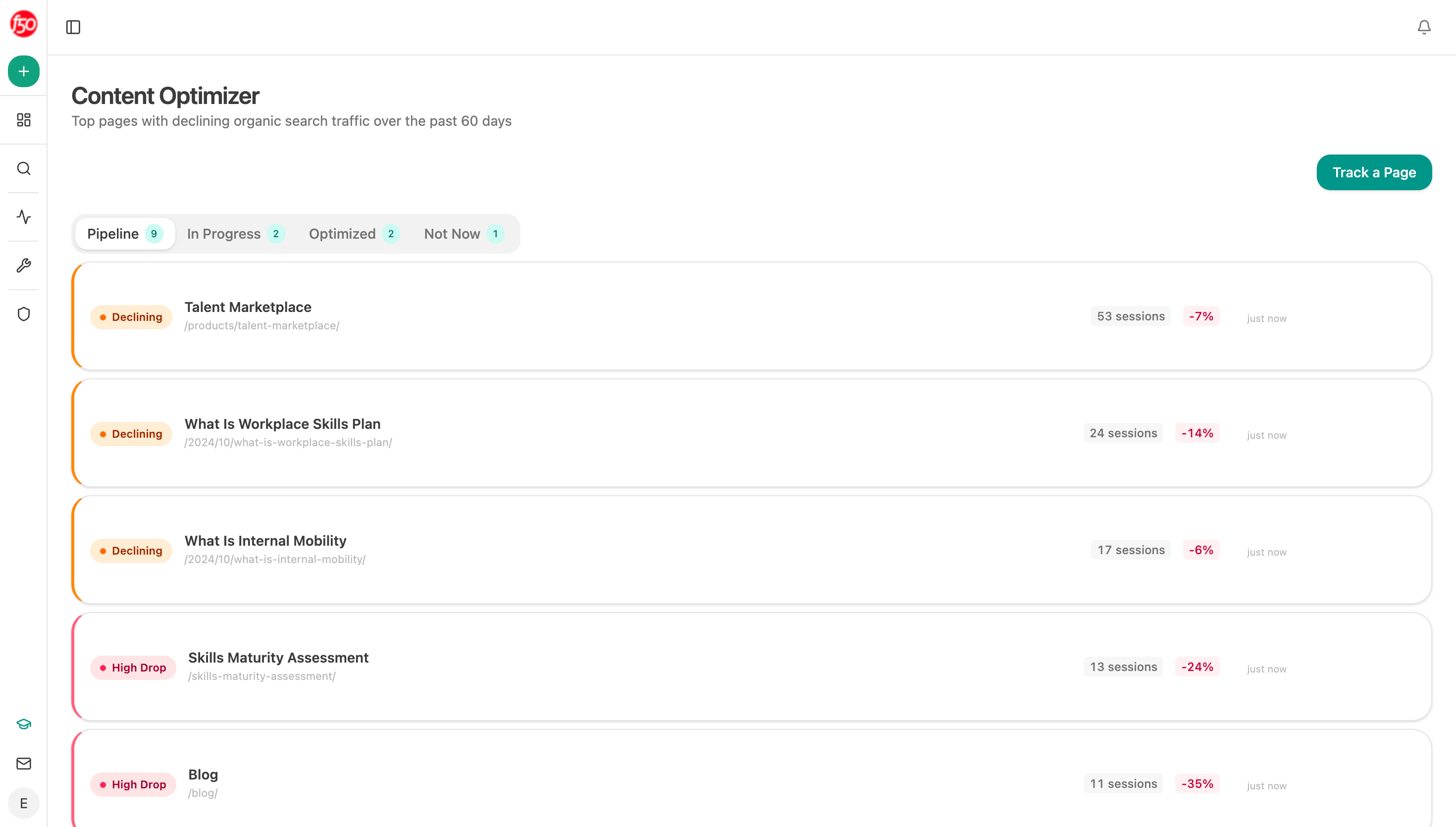
The funnel-coverage recipe classifies pages by funnel stage automatically, which turns the 15-minute intent-mix check into a single node and removes the reason it gets skipped. For the pages that rank but don't convert, the AEO Content Scorecard audits structure, freshness, claim density, proof integration, and claim-to-source mapping, which usually explains a conversion gap that traffic data can't.
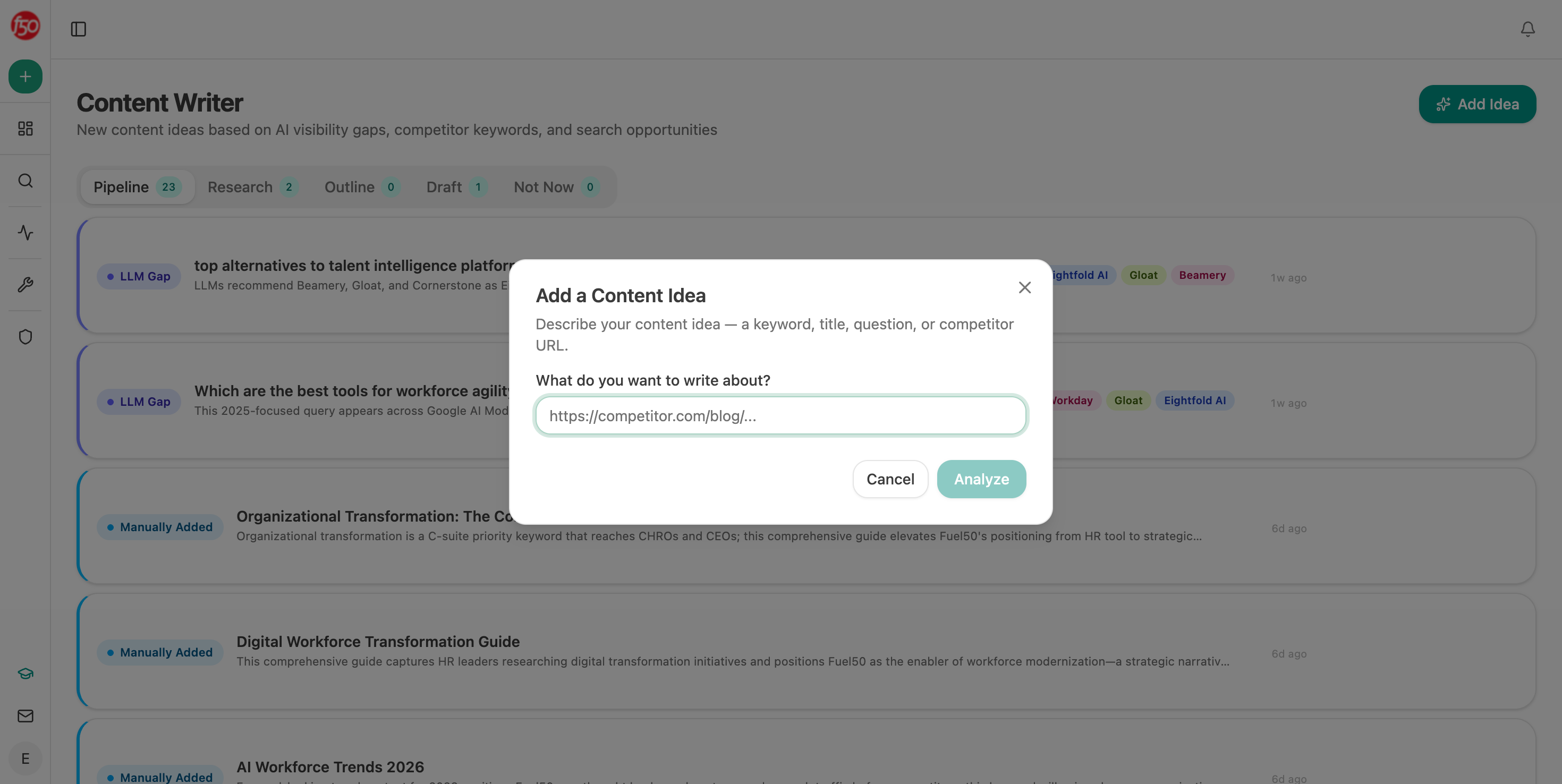
The monthly agent:
Start (schedule, 1st of month) → funnel-coverage recipe → GSC Page-Keyword Breakdown (top 50 pages) → GA4 AI Traffic Overview → HubSpot Get CRM Objects (opportunities last 90 days) → Code (compute intent-mix share per quarter, per-bucket conversion rates, and a Direct-channel anomaly flag) → Conditional (if top-funnel share moved more than 10 points, branch to the rebalance narrative) → Loop / For Each over commercial pages with falling conversion → AEO Content Scorecard per page → Prompt LLM (name which of the four diagnoses applies and list the specific pages) → Excel export → Send Email to CMO.
The Conditional on mix drift is the mechanism that matters. It means the report changes its own conclusion when the data changes, rather than presenting the same four checks every month and leaving interpretation to whoever reads it.
FAQ
Related answers
- Why is my SEO traffic growing while revenue stays flat?
- How can I tell whether our growth problem is acquisition, conversion, activation, or retention?
Want to diagnose your content mix in an afternoon instead of a quarter? Start a free Analyze AI trial and get funnel coverage, page-level conversion, and AI-referral attribution in one dashboard.