
How can I estimate how much AI-influenced traffic is hidden in my Direct channel?
Short answer
Split Direct by landing page depth, because nobody types a long blog URL from memory. Direct sessions landing on deep pages arrived from a source that stripped the referrer, and AI assistants are now the largest contributor to that bucket for most B2B sites. Size it against your pre-AI baseline, then validate the result with a signup survey rather than presenting the estimate on its own.
The logic behind the estimate
Direct means GA4 saw no referrer. Two very different behaviours produce that: someone typing your domain, and someone arriving from a source that stripped the referrer.
The two behaviours have a signature that separates them. Typed visits land on your homepage or a short branded URL. Referrer-stripped visits land wherever the link pointed, which is usually a deep page with a long slug nobody would reproduce from memory.
So deep-page Direct is your working proxy for hidden referral traffic. It's not purely AI, and the method below accounts for that.
Step 1: Pull the Direct landing page split
Build a Free-form Exploration in GA4:
- Dimensions: Landing page + query string
- Metrics: Sessions, Engaged sessions, Conversions
- Filter: Session default channel group exactly matches Direct
- Date range: Last 12 months
Sort by sessions. Now classify each landing page into two groups:
| Group | Examples | Interpretation |
|---|---|---|
| Shallow | /, /pricing, /login | Plausibly typed or bookmarked |
| Deep | /blog/long-article-slug, /compare/x-vs-y | Almost certainly referrer-stripped |
Total sessions in the deep group is your hidden referral pool.
Step 2: Subtract the non-AI referrer-strippers
Deep-page Direct isn't all AI. Email clients, PDFs, Slack links, and QR codes also strip referrers.
Estimate their share rather than ignoring it: compare deep-page Direct against your email send volume in the same period, check whether spikes align with newsletter sends, and look for landing pages that only appear in campaign contexts. Subtract that share, and what remains is your AI-influenced Direct estimate, always presented as a range.
Step 3: Baseline against a pre-AI period
The cleanest version of this estimate uses your own history. Pull deep-page Direct as a percentage of total sessions for a quarter in 2023, before assistant traffic was material, then compare it to the same metric today.
The delta between those two percentages is growth in referrer-stripped traffic that didn't exist before. It won't be entirely AI, but it's a far more defensible number than an absolute figure with no baseline, because it controls for whatever your normal deep-page Direct rate has always been.
Step 4: Validate with a survey, not with confidence
Every step above is inference. The only ground truth available is asking.
Add "how did you hear about us" at signup with ChatGPT, Perplexity, Gemini, and Claude as explicit named options. You need 100 responses before the number means anything and 300 before you'd defend it in a board meeting.
Then compare the two figures. If your landing-page method says 18% of Direct is AI-influenced and your survey says 22% of Direct customers name an AI surface, those numbers agreeing is what makes the estimate credible. If they diverge sharply, trust the survey and revisit your deep-page classification.
Why the hidden pool is large and growing
The reason this exercise matters is that AI answers frequently resolve without any click at all, so the traffic you can see is a fraction of the exposure you're getting.
Our own state of AI search research, covering more than 22,000 answers, found Google AI Mode returns a citation-rich answer in 97.4% of matched B2B queries and Perplexity in 93.2%. External work points the same way on click behaviour: Pew Research found that when an AI summary appears, users click a source link in only about 1% of visits.
The click you do receive is the visible tail of a much larger exposure, which is why the estimate should sit next to citation data rather than standing alone.
Build the estimate as a repeatable calculation
The risk with an inferred number is that it's computed slightly differently each quarter, so movement reflects your method rather than reality. The fix is to make the estimate a workflow rather than a spreadsheet.
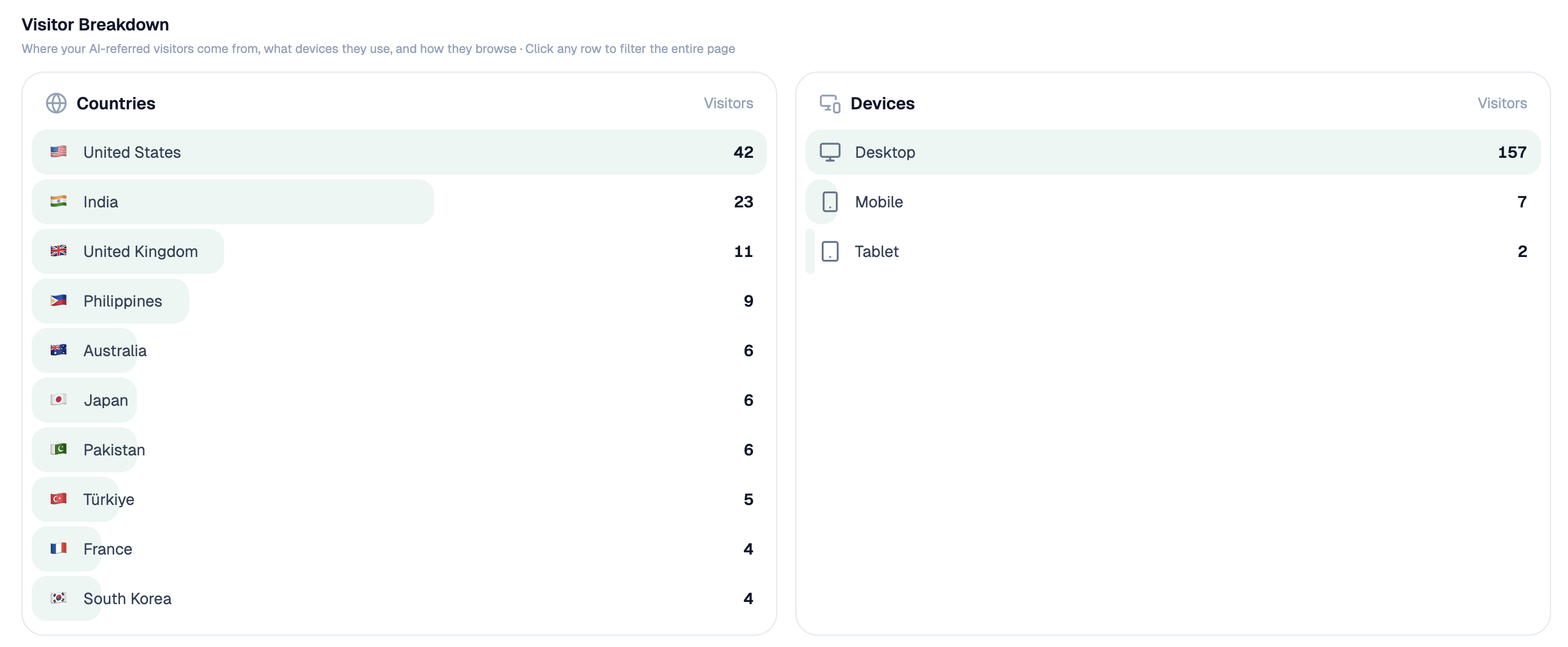
One dimension worth pulling first, because it supports the largest assumption in the whole method. Visitor Breakdown splits AI-referred visitors by device and country. If your identified AI traffic skews heavily desktop while your deep-page Direct skews mobile, that gap is consistent with mobile app taps stripping the referrer, which is the mechanism you're trying to size.
The monthly estimate agent:
Start (schedule, 1st of month) → GA4 AI Traffic Overview → AI Landing Pages → Page Breakdown → citation-magnets recipe → HubSpot Search Contacts (survey answers, last 90 days) → Code (classify landing pages shallow versus deep, compute deep-page Direct share, subtract an email and internal-tools allowance, apply the survey-derived factor, output a low and high bound) → Conditional (if survey responses under 100, suppress the factor and output the unadjusted range) → Prompt LLM (write the estimate with the method and both bounds stated) → Excel export → Send Email to CMO.
Three parts of that are doing real work.
The Code node holds the arithmetic, so the classification rule and the allowances are explicit and reviewable rather than re-described every month. Change the rule deliberately and you know it changed.
The Conditional is the honesty gate. Below 100 survey responses the correction factor isn't stable, and the agent refuses to publish one rather than producing a confident number from thin data.
The Excel export attaches to the run as an artifact, so when finance asks how you got there in six months you hand them the underlying series rather than rebuilding it from memory.
For the citation side that explains why the hidden pool exists at all, the same run pulls citation-magnets, so the report can name which pages are being cited most heavily and check whether their Direct sessions moved in step.
FAQ
Related answers
- Why does AI traffic show up as Direct in Google Analytics?
- How do I track ChatGPT traffic in GA4?
- How can I build credible evidence that AI search is sending customers when there is no referrer?
- How do I measure a buyer who found us in an AI answer but came back later through Google?
Want the visible and hidden halves of AI traffic in one dashboard? Start a free Analyze AI trial and connect GA4 to size what Direct is concealing.