
How do I put a number on "AI visibility" for a monthly report?
Short answer
Report four numbers on a fixed prompt set: mention rate (what share of answers name you), citation share (what share of cited links point to your domain), mention consistency (how reliably you reappear), and share of voice against three named competitors. Split each by AI surface, because ChatGPT, Perplexity, and Google AI Mode diverge enough that a blended figure hides every decision worth making.
Why one number can't work
"AI visibility" bundles four distinct things, and a single percentage forces you to pick one and silently discard the rest.
Being mentioned is not the same as being cited. A model can name you without linking to you, or cite your page while recommending someone else. Being mentioned once is not the same as being mentioned reliably, and the difference is the whole story for a brand that appears sporadically. And none of it means anything without a competitive denominator, because 30% mention rate is excellent in a crowded category and poor in a narrow one.
The four numbers
Mention rate. The share of answers on your tracked prompt set that name your brand. Report per surface.
Citation share. The share of citations across those answers linking to your domain versus competitors. This is the metric that maps most directly to content work.
Mention consistency. Given you were mentioned for a prompt last observation, how likely are you to be mentioned this one. This is the metric almost nobody reports and it changes how you resource the work.
Share of voice. Your mention rate against three named competitors on the identical prompt set.
Our own state of AI search research, analysing more than 22,000 answers and 115,000 citation events, shows why the per-surface split isn't optional:
| Surface | Brand mention rate | Citation presence | Avg. citations per answer |
|---|---|---|---|
| ChatGPT | 32.3% | 68.3% | 3.60 |
| Google AI Mode | 33.7% | 97.4% | 5.33 |
| Perplexity | 41.7% | 93.2% | 6.71 |
Perplexity mentions brands 9.4 percentage points more often than ChatGPT on the same prompt-day. Google AI Mode cites in nearly every answer while mentioning brands no more often than ChatGPT does. Blend those into "AI visibility: 36%" and you have deleted every actionable difference.
The same research found mention consistency runs 83.2% on ChatGPT after a mention versus 9.9% after a miss, with the pattern repeating on Google AI Mode (84.2% vs 11.5%) and Perplexity (83.3% vs 12.1%). Visibility is sticky in both directions, which is the single most useful fact to put in front of a CMO.
Fix the prompt set before you measure
The numbers are only comparable month to month if the denominator holds still.
Build 30 to 60 prompts phrased the way buyers actually ask, weighted toward commercial intent rather than definitional questions. Then freeze the set for at least a quarter. Adding prompts mid-quarter changes the denominator and every trend line becomes meaningless.
When you do revise the set, recompute the prior month under the new set and report both, so the change is visible rather than absorbed.
Measure repeatedly, not once
Because presence is lumpy, a single weekly reading is a draw from a distribution rather than a measurement. Researchers make this point directly, arguing visibility should be treated as a distribution across runs, prompts, and time.
Practically: observe weekly, report the monthly average, and show the range alongside it. A month reported as "38%, ranging 31 to 44 across four observations" is honest and stops a low week from triggering a panic.
How to generate the four numbers in Analyze AI
This is where the platform does the measurement rather than you assembling it, because each of the four maps to a native node.
Visibility Score returns the percentage of AI prompt results mentioning your brand across selected providers and a date range, with totals, a daily trend, and a per-brand breakdown. That's mention rate and its distribution in one call.
Citation Share returns the percentage of AI citations linking to your domain versus competitors.
Sentiment Score returns average sentiment 0 to 100 across results, which is the fifth number worth carrying once the first four are stable, because being mentioned negatively is a different situation from not being mentioned.
Get Perception Quadrant positions every tracked brand on a two-dimensional quadrant of presence against narrative strength, combining visibility, rank, sentiment, and proof signals, and returns coordinates plus takeaway copy. For an executive audience this often communicates more in one image than the four numbers do in a table.
Get Visibility Events returns month-over-month visibility shifts per provider, which is the movement rather than the level.
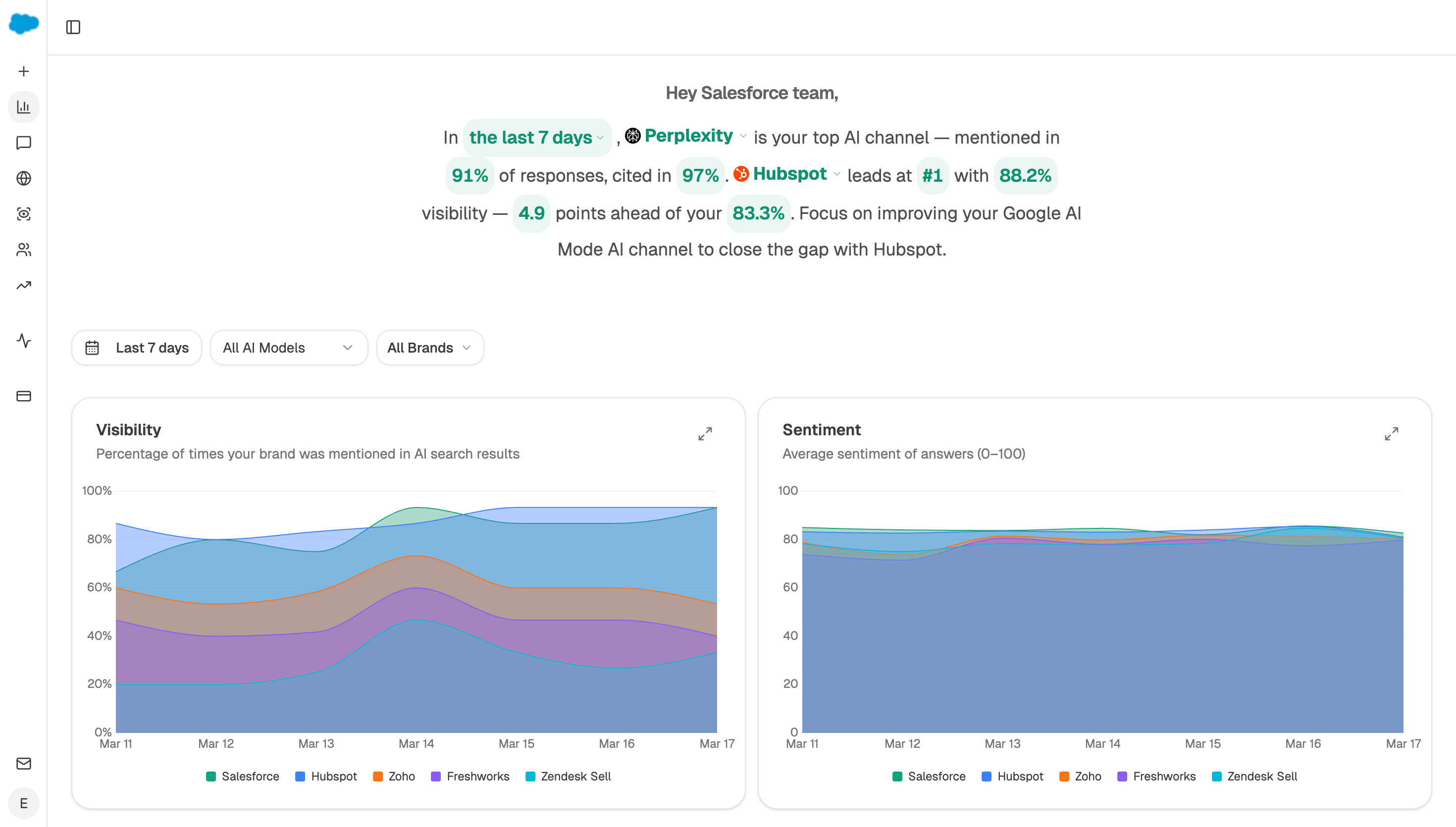
For the competitive denominator, the brand-vs-competitor recipe returns side-by-side visibility, sentiment, and citation comparison against tracked competitors, and rising-threats surfaces which competitors are gaining fastest.
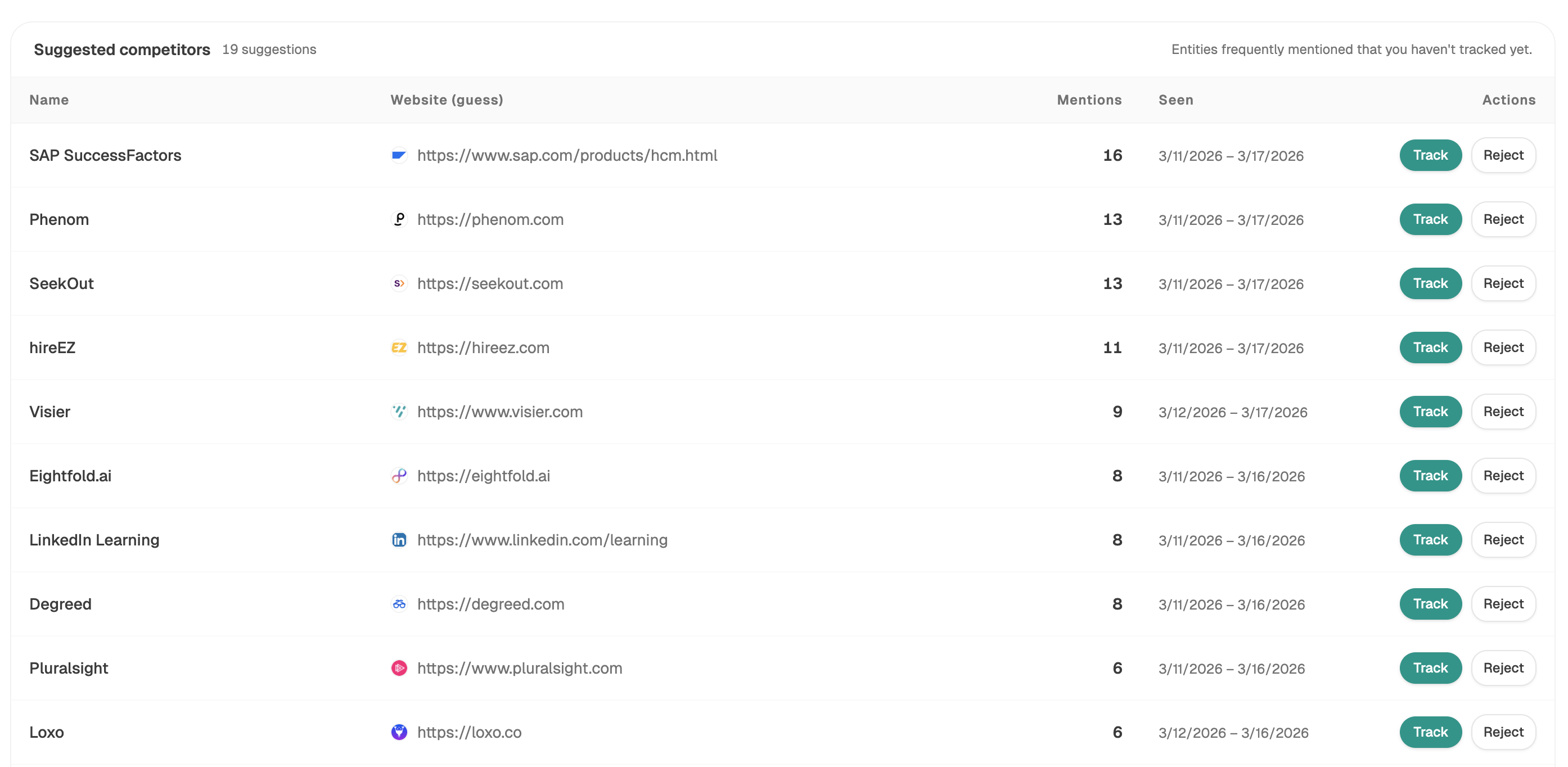
The monthly report agent:
Start (schedule, 1st of month) → Visibility Score (per provider, 30d) → Citation Share → Sentiment Score → Get Perception Quadrant → Get Visibility Events → brand-vs-competitor recipe (three named competitors) → rising-threats recipe → workflow-memory (last three runs) → Code (compute mention consistency from the observation series, and the monthly average plus range per metric) → exec-one-pager recipe → Prompt LLM (write the report, flag whether movement is real or within the observed range) → DOCX export → Send Email to leadership.
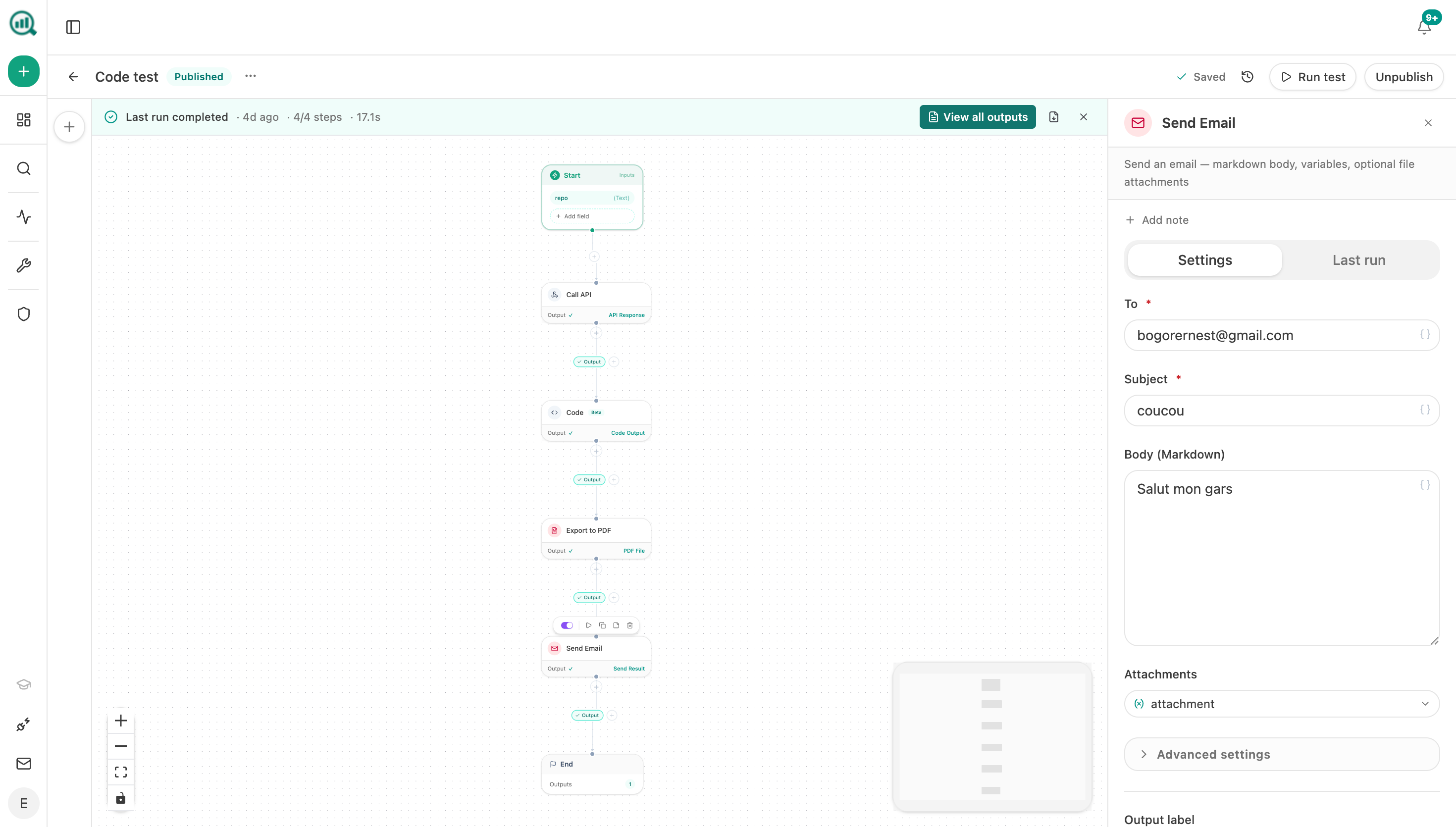
Two things make this genuinely repeatable rather than a monthly rebuild. The workflow-memory step gives the agent access to its own prior runs, so mention consistency is computed from a real observation series rather than a single snapshot. And the DOCX export attaches as an artifact to the run and to the agent's artifact library, so the version leadership saw in March is retrievable in September.
If you want the number to reach people faster than monthly, a webhook agent triggered from a Slack command returns the current four numbers on demand, which is the difference between a CMO asking in a meeting and waiting for the report.
FAQ
Related answers
- Which organic and AI-search metrics belong on an executive dashboard?
- How do I report direct versus assisted value from AI search?
Want the four numbers generated and emailed every month? Start a free Analyze AI trial and build your prompt set in an afternoon.