
What can Google Search Console's new generative-AI performance report actually show me?
Short answer
It shows impressions broken down by page, country, device, and date for AI Overviews, AI Mode, and generative AI features in Discover. It does not show clicks, click-through rate, or query data, and it has no history before mid-May 2026. Treat it as a visibility report rather than a performance report: it answers how often you appear in Google's AI surfaces with precision, and leaves what that's worth for you to triangulate elsewhere.
What shipped
Google launched the report on 3 June 2026 as a dedicated view separate from the standard Performance report, covering generative AI features on Search and in Discover.
You'll find it as a Generative AI section alongside the standard Search results view inside Performance. It counts an impression whenever a URL from your site appears within an AI Overview, AI Mode, or an AI-generated feature in Discover.
The dimensions available:
| Dimension | Available |
|---|---|
| Impressions | Yes |
| Pages | Yes |
| Countries | Yes |
| Devices | Search only, not Discover |
| Dates | Hourly, daily, weekly, monthly |
| Clicks | No |
| CTR | No |
| Queries | No |
The five limits that shape how you use it
No click data. The most consequential absence. Without clicks you cannot compute CTR for AI appearances, so you can see visibility and not its traffic value. Google has said it will introduce additional metrics over time without committing to clicks specifically.
No query data. You can see which pages appeared but not which queries triggered them, which limits how far you can take content decisions from the report alone.
No history. Data starts from mid-May 2026 with no backfill, so year-over-year comparisons aren't possible yet and won't be for a while.
This is a breakout, not new data. AI impressions were already counted in your overall performance totals and remain there. Your aggregate numbers don't change, and you should not add this report's impressions to your standard Performance report impressions.
Phased rollout. Google is releasing it to a subset of properties for testing. If you don't have it yet, that's expected rather than a configuration problem.
One further caveat worth knowing before anyone tries to optimise ranking inside an answer: all links within an AI Overview share a single position, so there's no per-link ranking signal to work with.
What it's genuinely good for
Despite the limits, four things become possible that weren't before.
Confirming you appear at all. Previously this required third-party tools or manual spot checks. Now it's a first-party count.
Identifying which pages Google's AI treats as source material. The page-level breakdown tells you which of your URLs the system reaches for, which is a content signal you can act on even without query data.
Tracking directional movement. Once you have a few months, impression trend by page shows whether AEO work is landing.
Segmenting by country and device. Useful for multi-market teams, since AI feature rollout and behaviour vary by region.
The practical read: it answers "am I visible in Google's AI?" and leaves "what is that worth?" to you.
How to fill the gaps
Three gaps, three different instruments.
For click impact, run a CTR comparison between queries where an Overview appears and matched queries where it doesn't, holding position constant. Method in How do I measure the impact of AI Overviews on my site's clicks?.
For query-level insight, you need prompt-level tracking, because Google isn't going to give you the queries and the questions people ask an assistant aren't the same shape as search queries anyway.
For the surfaces beyond Google, the report covers Google's AI only. ChatGPT, Perplexity, and Claude are outside it entirely, and they behave differently. Our own state of AI search research, covering more than 22,000 answers, found Perplexity mentions tracked brands in 41.7% of matched B2B answers versus 32.3% on ChatGPT, and that mean domain overlap between ChatGPT and Perplexity is just 0.05, with only 25.3% of matched prompt-days sharing even one cited domain. Winning in Google's AI tells you very little about the others.
How Analyze AI complements the report
The clean division is that Google's report tells you how often you appear in Google's AI, and prompt-level tracking tells you what was said, on which question, and who appeared alongside you across every major surface.
Where that matters most is the query gap. Search Console shows a page earned 4,000 AI impressions. Prompt tracking shows which questions produced them, whether the answer recommended you or merely cited you, and which competitors were named in the same response.
Prompt Responses and Prompt Volumes return the raw executions and the share mentioning your brand. Citation Pages and Citation Domains return the full citation graph, showing where AI systems cite you and where they cite competitors instead.
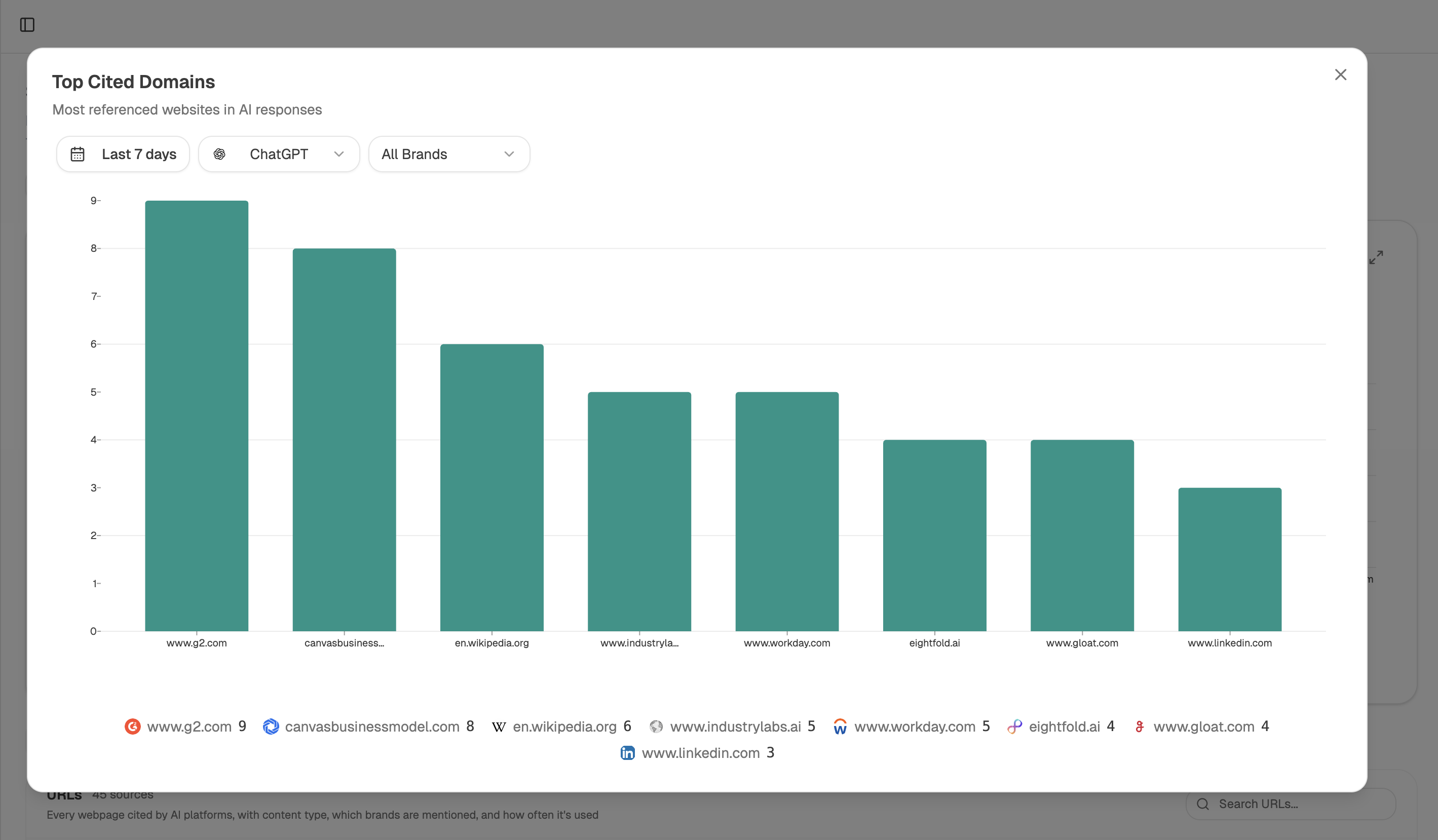
For the pages Google's report flags as AI source material, the AEO Content Scorecard audits each one for structure, freshness, claim density, proof integration, and claim-to-source mapping, which is the closest thing to a diagnostic for why one page gets used and a similar one doesn't.
A monthly agent that combines both sides:
Start (schedule, 1st of month) → GSC Top Pages for Site → GSC Page Performance Summary (daily series on the pages appearing in AI features) → citation-magnets recipe → uncited-pages recipe → Prompt Responses (tracked commercial set) → Loop / For Each over the top 20 AI-visible pages → AEO Content Scorecard per page → Prompt LLM (join Google impression data to prompt-level citation data, flag pages with high AI impressions but weak scorecards) → Excel export → Send Email to the SEO lead.
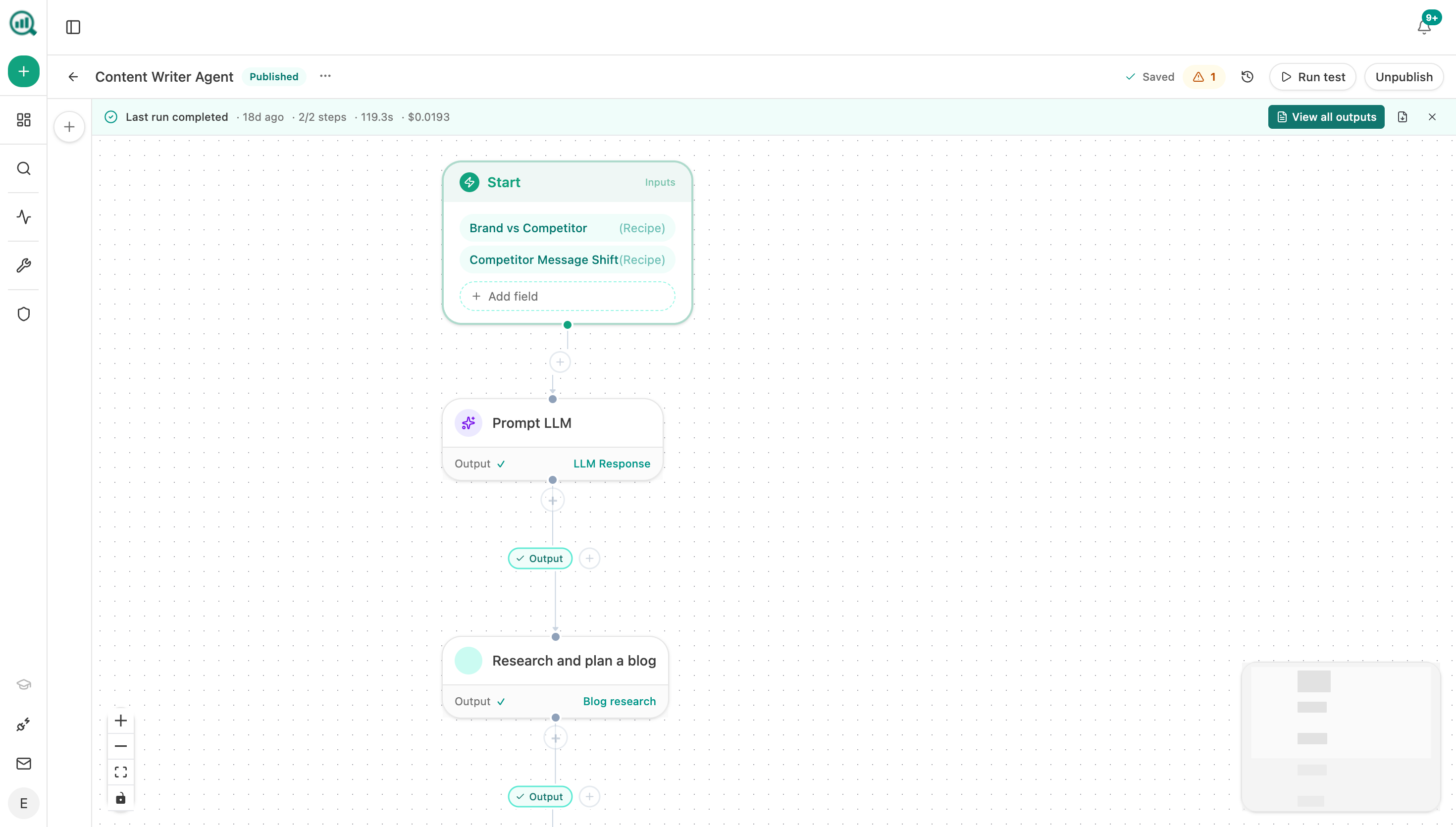
The pages that come back with high Google AI impressions and a weak AEO score are the most actionable list this analysis produces. Google is already reaching for them, which means small structural improvements compound quickly rather than requiring new content.
FAQ
Related answers
- How do I measure the impact of AI Overviews on my site's clicks?
- How do I put a number on "AI visibility" for a monthly report?
Want Google's impression data joined to prompt-level citation data? Start a free Analyze AI trial and connect GSC alongside your tracked prompts.