
What do I report when the CEO wants one attribution number but the evidence is probabilistic?
Short answer
Give them the number. Lead with your central estimate, put the range immediately beside it, and state the one assumption most likely to move it. Refusing to produce a figure because the evidence is probabilistic reads as evasion and costs you more credibility than being wrong within a stated range ever will. What you must never do is give a precise number and reveal the uncertainty only when challenged.
Why "it's complicated" is the wrong answer
A CEO asking for one number is asking a resource-allocation question: is this worth what we're spending. They're not asking for methodological purity.
Answer with a lecture on multi-touch attribution and three things happen. They conclude marketing can't measure itself, they discount your future numbers, and they make the decision anyway using whatever figure someone else supplied.
Every other function reports under uncertainty. Finance forecasts, sales commits a pipeline number they know is soft, product estimates delivery dates. All of them give a number with a confidence attached. Marketing refusing to do the same is the anomaly.
The three-part answer
The central estimate. One figure, stated first, in the unit they asked for. "Organic contributed about $2.1M in closed-won revenue last quarter."
The range, immediately after. "The defensible band is $1.8M to $2.4M." Not in a footnote, not on the appendix slide. In the next sentence, before anyone asks.
The load-bearing assumption. Name the single input most likely to move the number. "That range mostly reflects whether we count assisted touches at 35% or 45%."
Three sentences. A CEO can act on that, and it's honest.
Pick the central estimate deliberately
The number you lead with should be the most conservative figure you'd defend, not the midpoint and not the best case.
Two reasons. Being revised upward later is a good conversation and being revised downward is a bad one. And a conservative headline gives you room to show the fuller picture as supporting detail, which is more persuasive than starting high and retreating.
If your defensible band is $1.8M to $2.4M, lead with $1.8M and describe the upside as upside.
Pre-commit to how the number will change
The thing that converts a probabilistic estimate into a trusted one is saying in advance what would move it.
"This number will get more precise as our survey sample crosses 300 responses, and it will move if we change the influence weight, which we won't do this year." Now the CEO knows the figure is managed rather than negotiated, and a revision next quarter reads as the process working rather than as marketing changing its story.
The corollary is that you cannot adjust the weight to make a quarter look better. One discovered adjustment ends the credibility of every number you produce afterwards.
Separating what's counted from what's inferred
The one distinction worth making explicit, because it's what a CFO will probe.
| Component | Basis | How to say it |
|---|---|---|
| Sourced revenue | Counted from first-touch records | "We can trace this directly" |
| Influenced pipeline | Derived using a fixed weight | "This uses a 40% weight we set from our median touch count" |
| AI-influenced revenue | Inferred from survey and lag | "This is an estimate, and here's the method" |
Never sum across all three into one headline. Lead with sourced, because it's the number that survives an audit, and present the rest as the fuller picture.
That third row matters more each quarter. Our own state of AI search research, covering more than 22,000 answers, found Google AI Mode returns a citation-rich answer in 97.4% of matched B2B queries and Perplexity in 93.2%, while Pew Research found that when an AI summary appears, users click a source link in only about 1% of visits. A growing share of contribution is structurally uncountable, so the habit of labelling estimates as estimates is what keeps the countable numbers trusted.
How Analyze AI keeps the framing consistent
The failure mode over four quarters isn't the number, it's the framing drifting. A different person writes the summary, the caveat gets dropped one month, and the following quarter's caveat reads as new bad news.
Two capabilities hold the framing steady.
The exec-one-pager recipe returns a pre-shaped executive summary with insights and risks already structured, so the report starts from a consistent skeleton rather than a blank page each month.
Inject Brand Context pulls named blocks from the Brand Vault into the prompt. For this report the relevant blocks are CLAIMS_MESSAGING_RULES and DISALLOWED_PHRASES, which is where you encode the rules about how attribution language is allowed to be worded. If your rule is that estimates must carry a range in the same sentence, that lives in the vault and applies to every generated report automatically.
A monthly chain:
Start (schedule, 1st of month) → HubSpot Get CRM Objects (closed-won, sourced and influenced fields) → GA4 AI Traffic Overview → share-of-voice recipe → exec-one-pager recipe → Code (compute central estimate, range, and sensitivity to the weight) → workflow-memory (retrieve the last three runs) → Inject Brand Context (CLAIMS_MESSAGING_RULES, DISALLOWED_PHRASES) → Prompt LLM (write the three-part answer, flag whether movement came from performance or from method) → DOCX export → Send Email to CEO and CFO.
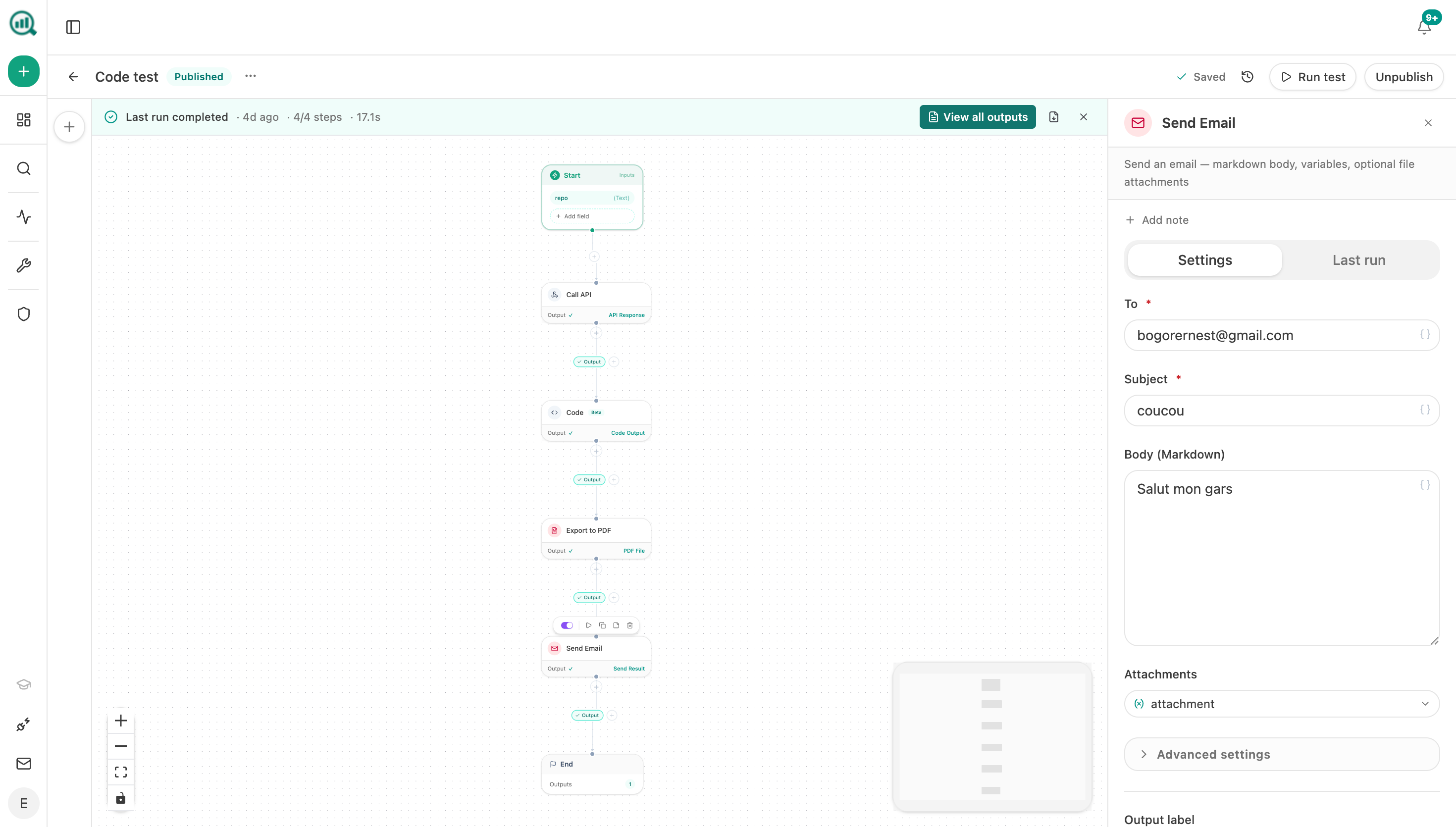
The workflow-memory step is what lets the report say "this moved because deal volume rose, not because we changed anything," which is precisely the sentence that keeps an estimated figure in the board pack quarter after quarter.
FAQ
Related answers
- How do I measure organic-influenced pipeline without claiming false precision?
- What can I honestly claim from an SEO before-and-after analysis?
- Which organic and AI-search metrics belong on an executive dashboard?
Want an executive report that frames uncertainty the same way every month? Start a free Analyze AI trial and build it once as an agent.