
Which attribution model should I use for a long B2B buying journey?
Short answer
Run first-touch and last-touch side by side rather than choosing between them, and add an influenced-pipeline view as a third column. Single-model attribution fails on long B2B journeys because a deal with 30 touches across six people has no single cause. The gap between what first-touch credits and what last-touch credits is more informative than either number, because it shows you which channels create demand and which ones harvest it.
Why each model fails alone
First-touch credits the channel that created awareness and ignores everything that closed the deal. It systematically overvalues top-funnel content and undervalues sales-enabling material.
Last-touch does the reverse, and on B2B journeys it almost always credits branded search or Direct, because that's how buyers return once they've decided. It tells you where deals finish, which is rarely where they were won.
Linear spreads credit evenly across touches, which assumes a whitepaper download and a pricing-page visit contributed equally. They didn't.
Time-decay weights recent touches more heavily, which is defensible for short cycles and actively misleading for 9-month enterprise deals where the early framing did the persuading.
Data-driven models require conversion volume most B2B companies don't have. Below a few hundred conversions per month the model fits noise, and it's a black box, so you can't explain the number when someone challenges it.
What to run instead
Three columns, each answering a different question.
| Column | Question it answers | Weight |
|---|---|---|
| First touch | Which channel created awareness | 100% to the first channel |
| Last touch | Which channel closed the deal | 100% to the final channel |
| Influenced | Which content the committee consumed | 30 to 50% of deal value, divided across touching pages |
Pick your influenced weight from average touches per deal: under 8 touches means 45 to 50%, 8 to 20 means 35 to 45%, over 20 means 30 to 35%. Fewer touches means each one carried more of the persuasion. Set it once and freeze it, because weights that move on demand turn the report into an argument.
Full method in How should I value content that influences a deal but doesn't create the lead?.
The gap is the finding
Once you have first and last side by side, look at where they disagree.
A channel that scores high on first-touch and low on last-touch is a demand creator. Top-funnel content and AI-search visibility usually sit here. Cutting them because last-touch shows nothing is the most common expensive mistake in B2B marketing.
A channel scoring high on last-touch and low on first-touch is a demand harvester. Branded search and Direct live here. They look extraordinary on last-touch and create almost nothing, so scaling them rarely produces the growth the report implies.
A channel scoring high on both is doing real work across the journey, and it's where incremental budget goes first.
The touch your models will never see
Every model above operates on recorded touches. A large share of B2B awareness now happens inside an AI answer that produces no session at all.
Our own state of AI search research, covering more than 22,000 answers, found Google AI Mode returns a citation-rich answer in 97.4% of matched B2B queries and Perplexity in 93.2%. Pew Research found that when an AI summary appears, users click a source link in only about 1% of visits.
So your first-touch column will over-credit branded search and Direct on deals where an AI answer did the actual introducing. Add a survey question at signup to size the correction rather than assuming the models caught it. See How do I combine "how did you hear about us?" answers with analytics data?.
Presenting it without starting a fight
Three columns invite the question "so which one is right?" Answer it before it's asked.
State plainly that each column answers a different question, that no single number exists for a 30-touch deal, and that the disagreement between columns is the analysis rather than a flaw in it. Show one worked example: a real deal, its first touch, its last touch, and the pages in between. One concrete journey does more to settle the debate than any methodology slide.
Then never change the weights to make a quarter look better. That's the move that costs you the credibility of every future number.
How Analyze AI supports the multi-model view
Analyze AI contributes two things this analysis is otherwise missing: the AI-search touch that your models can't record, and the reporting automation that keeps three columns from becoming a quarterly spreadsheet nobody rebuilds.
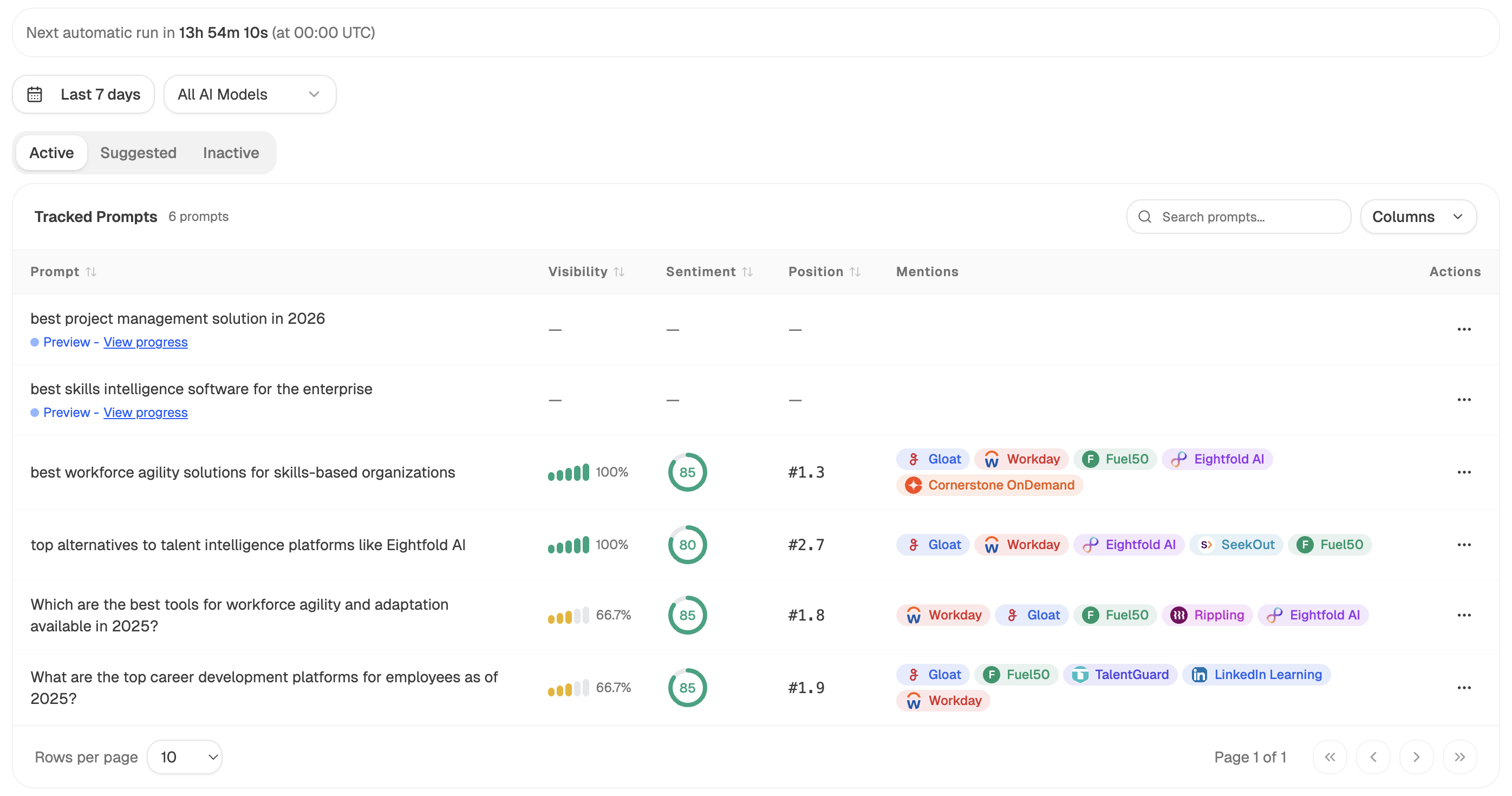
On the first, prompt-level tracking tells you whether AI surfaces were positioned to introduce you during the window your first-touch column attributes to branded search. When citation share on your commercial prompts rises and branded-search first-touch rises 4 to 12 weeks later, that lag is the missing touch showing itself indirectly.
On the second, HubSpot's 26-node surface covers contact and deal search, association, and note creation, so the three-column report assembles from live records rather than exports. Where this gets genuinely useful is the Code node, which runs custom JavaScript in an isolated context with defined input and output variables. Influenced-pipeline weighting is exactly the kind of arithmetic that's awkward to express in prompt instructions and trivial in ten lines of code, and putting it in a Code node means the weighting is version-controlled rather than re-described every month.
A workable chain:
Start (schedule, 1st of month) → HubSpot Get CRM Objects (closed-won last 4 quarters, with first-touch, last-touch, and survey fields) → HubSpot Search Contacts (page-view history per associated contact) → Code (apply the frozen influenced weight, divide credit across touching pages) → share-of-voice recipe → Prompt LLM (build the three columns, flag creator versus harvester channels, note the AI correction) → DOCX export → Send Email to CMO and CFO.
The DOCX export is deliberate here. This report goes into board packs, and an export artifact attached to the run means the version leadership saw is reproducible three months later when someone questions a number.
FAQ
Related answers
- How do I separate first-touch, assisted, and last-touch organic revenue?
- How should I value content that influences a deal but doesn't create the lead?
- How do I report marketing contribution when a B2B sale has many touches and decision-makers?
- How do I measure organic-influenced pipeline without claiming false precision?
Want the AI-search touch your attribution models can't record? Start a free Analyze AI trial and track citations alongside your CRM data.