

![Featured image for AI Engines Rarely Name the Same Brands [2026 Study]](/_next/image?url=https%3A%2F%2Fwww.datocms-assets.com%2F164164%2F1785857601-03-cross-engine-consensus.png&w=3840&q=75)

Summarize this blog post with:


We analyzed 22,295 AI answers across ChatGPT, Perplexity, and Google AI Mode to understand how much the three engines agree with each other on the same question. Do they mention the same brands? Do they cite the same websites? If they disagree, which pair looks most alike?
The dataset covers 115,843 citation events, 460 distinct B2B prompts, and 37 tracked organizations. For this piece we look at the sample where all three engines answered the same prompt on the same day. We call each of these a same-day observation. Our sample has 5,755 same-day observations across 413 unique tracked prompts, meaning each prompt was observed on roughly 14 different days on average over a study window of a few months. That gives us a three-way comparison instead of a global average that mixes different prompt panels.
Here are the questions we set out to answer:
- On the same generic B2B prompt on the same day, how often do all three engines mention the same tracked brand?
- How often do they all miss the brand?
- How much do the three engines overlap on which websites they cite for the same prompt?
- Which two engines look most alike?
- Does “brand named explicitly in the prompt” change the picture?
- What does this mean for a marketer measuring AI visibility?
The three engines mostly do not agree with each other. On generic prompts, 47% of the time the tracked brand appears in zero of the three engines. Only 15% of the time it appears in all three. And when the engines do answer, they cite almost completely different websites. ChatGPT and Perplexity share about 5% of the domains they cite for the same prompt. ChatGPT and Google AI Mode share 6%. The pair that looks most alike, Perplexity and Google AI Mode, still only shares 13%. There is no shared source pool underneath the three engines, so there is no single content strategy that reaches all three at once.
Table of Contents
TL;DR
- On a generic B2B prompt on the same day, how often does the tracked brand appear in all three engines? 14.6% of the time. Two engines: 15.5%. One engine: 22.8%. Zero engines: 47.2%. Measured on 5,372 same-day observations of generic-context prompts.
- What if the prompt names the brand explicitly? 92.4% of the time all three engines mention it. Explicit brand naming inside the prompt is the strongest single predictor of unanimous cross-engine mention. Generic prompts do not get this behavior.
- How much overlap is there in the websites each pair of engines cites for the same prompt? ChatGPT and Perplexity: mean Jaccard 0.05, 25.3% of same-day observations share at least one domain. ChatGPT and Google AI Mode: 0.06 and 26.5%. Perplexity and Google AI Mode: 0.13 and 56.8%.
- Which pair is most alike? Perplexity and Google AI Mode. Their domain overlap is roughly twice as high as either paired with ChatGPT. Both engines live-retrieve for almost every answer.
- Which engine is the odd one out? ChatGPT. Both of its pairings sit at the bottom of the overlap range.
- What should marketers do about this? Track ChatGPT, Perplexity, and Google AI Mode as three separate positions on the same tracked prompt panel. A brand tracked on one engine only is not being tracked at all.
47% of the Time, Zero of Three Engines Mention Your Brand
We took the same-day observations across the three engines and counted, for each generic-context prompt on each day, how many of the three engines mentioned the tracked focal brand at least once in the answer.
| Engines that mentioned the brand | Share of same-day observations | Observations |
|---|---|---|
| All three | 14.6% | 782 |
| Two | 15.5% | 830 |
| One | 22.8% | 1,225 |
| Zero | 47.2% | 2,535 |
Almost half of the time on a generic B2B prompt, none of the three engines names the tracked brand. Only about one in seven same-day observations produces unanimous cross-engine mention. Being visible on one engine gives you almost no information about whether you are visible on the other two.
The “generic” qualifier matters. These 5,372 same-day observations are prompts where the buyer did not name the specific brand in the query. When the prompt does name the brand explicitly, the picture flips completely. All three engines mention the named brand 92.4% of the time on 383 brand-named same-day observations. Explicit brand naming inside the prompt is the strongest single predictor of unanimous cross-engine mention we found in the data.
That distinction is where a lot of “AI visibility” measurement goes wrong. If your tracked prompt panel is heavy on “what is Salesforce” or “review of HubSpot” style prompts, your visibility numbers will look strong across all three engines. If your panel is heavy on “best CRM for enterprise sales teams” or “top project management tools” style prompts, your numbers will spread across zero, one, two, and three engines the way our data shows. The generic prompts are the ones a buyer types when they do not already know your brand, and those are the prompts where you need to earn the mention.
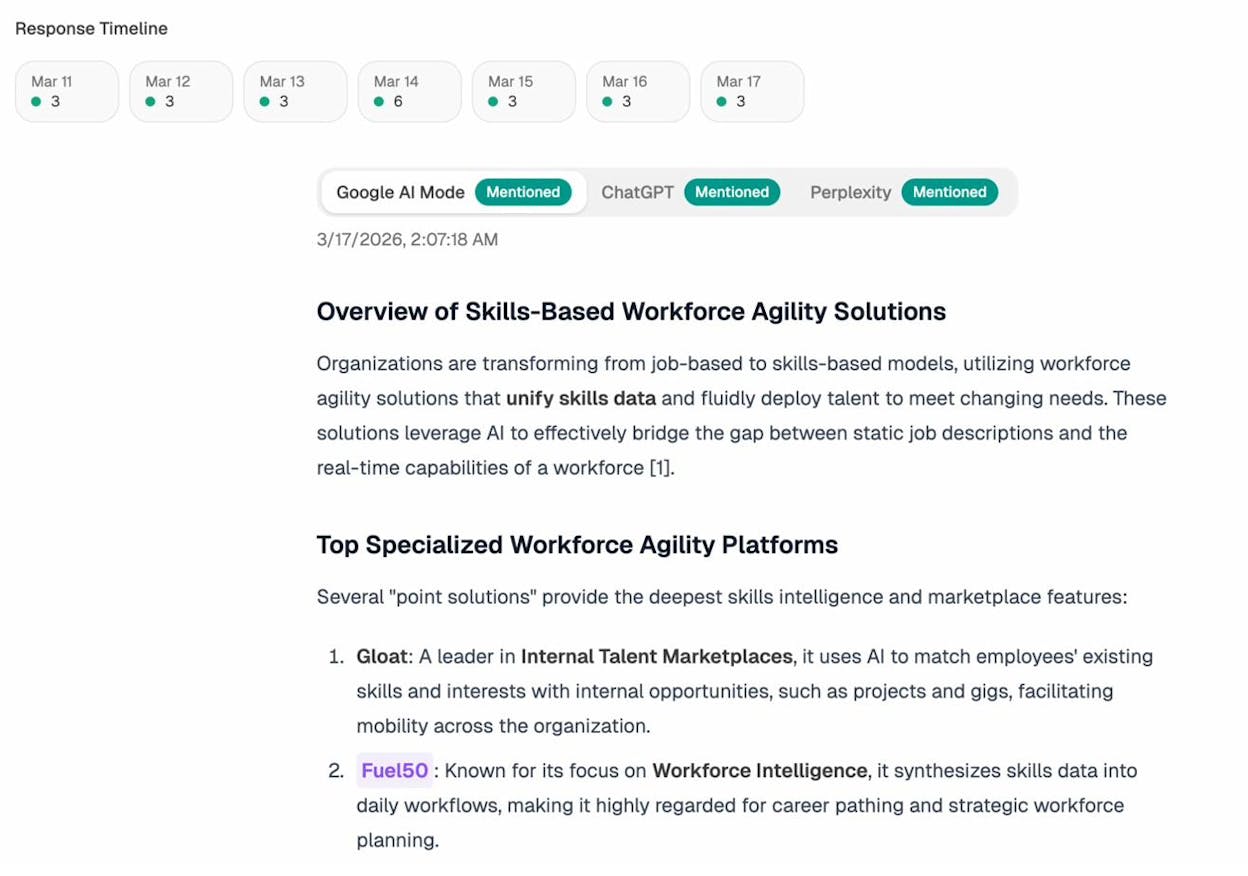
Response Timeline view showing the same prompt asked across ChatGPT, Perplexity, and Google AI Mode with per-engine mention status on the same day
The Three Engines Are Reading Different Internets
Cross-engine consensus on brand mention is one measurement. Cross-engine consensus on which websites the engines actually cite when they answer is a different measurement, and it is even more dispersed.
We used the Jaccard coefficient to measure domain overlap per prompt per pair on any given day. Jaccard is the size of the intersection divided by the size of the union. A Jaccard of 1 means the two engines cite the exact same set of domains. A Jaccard of 0 means they share no domains at all.
| Engine pair | Mean domain Jaccard | Share of same-day observations sharing at least 1 domain | Sample |
|---|---|---|---|
| ChatGPT and Perplexity | 0.05 | 25.3% | 5,646 |
| ChatGPT and Google AI Mode | 0.06 | 26.5% | 5,713 |
| Perplexity and Google AI Mode | 0.13 | 56.8% | 5,745 |
On a typical B2B observation, ChatGPT and Perplexity share about 5% of the cited domains between them, out of a union of about 7.6 domains. That works out to less than half a domain in common. Three out of every four same-day observations between ChatGPT and Perplexity have zero domain overlap at all. The number is barely higher between ChatGPT and Google AI Mode.
Domain overlap is more dispersed than brand overlap for a straightforward reason. Two engines can arrive at the same brand mention through completely different citation paths. Engine A might cite G2 and TechCrunch on its way to naming HubSpot. Engine B might cite HubSpot’s own site and a Reddit thread. Both engines end up naming HubSpot in the answer, but the underlying source diet is completely disjoint. Content strategies that live entirely on one type of source will be visible on the engines that pull from that source type and invisible on the ones that pull from different types.
Perplexity and Google AI Mode Are the Odd Pair
Two of the three pair comparisons cluster around Jaccard 0.05 to 0.06. Perplexity and Google AI Mode sit at 0.13, more than twice as high as either pair involving ChatGPT.
Perplexity and Google AI Mode also share at least one domain on 56.8% of same-day observations, versus 25.3% and 26.5% for the ChatGPT pairs. On more than half of the same B2B prompts on the same day, Perplexity and Google AI Mode agree on at least one source they both cite. ChatGPT agrees with either of them only about a quarter of the time.
The pattern connects back to the citation-behavior finding from earlier in this series. Perplexity and Google AI Mode both live-retrieve for almost every answer. ChatGPT leans on training data and only retrieves when its retrieval layer triggers. Two engines that both retrieve live from the open web on similar queries end up pulling from partially overlapping domain pools. An engine that answers mostly from training data will draw from a fundamentally different distribution. The Perplexity-Google AI Mode 0.13 Jaccard is the co-retrieval signal. The ChatGPT-anything 0.05 to 0.06 Jaccard is what the training-data-first approach looks like.
For content strategy, this maps to two source strategies. A page optimized for live retrieval will pick up visibility on Perplexity and Google AI Mode together, with the Perplexity-Google overlap providing some cross-engine transfer. A page optimized for training-data presence has to be earned through the kind of durable third-party mentions that end up in ChatGPT’s parametric knowledge months later. Doing both is what a real cross-engine strategy looks like.
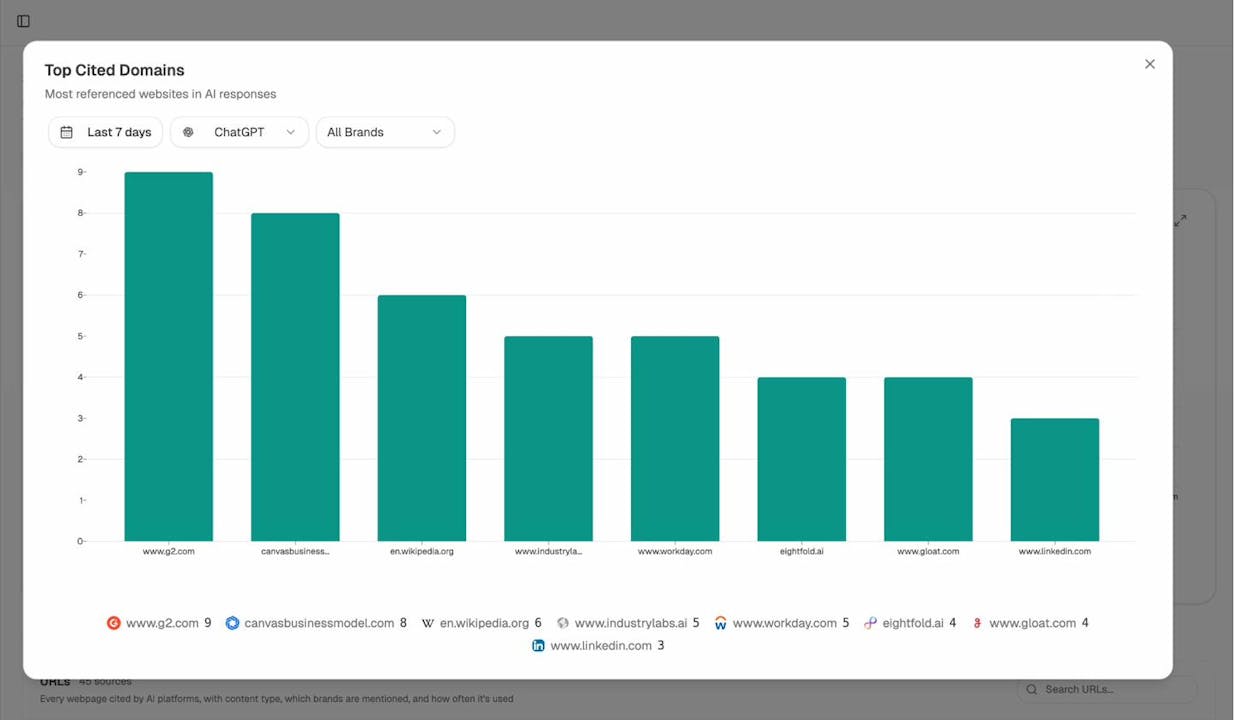
Top Cited Domains view filtered by engine, showing how the ranked cited domain lists differ across ChatGPT, Perplexity, and Google AI Mode
How This Compares to Other Public Studies
Cross-engine citation overlap has been measured a lot in the last twelve months. The numbers vary widely because the studies measure different things at different scales. Here is where our numbers fit.
Averi analyzed 680 million citations across ChatGPT and Perplexity and reported 11% domain overlap. Passionfruit confirmed 12% across three engines in a March 2026 replication. Our per-observation Jaccard of 0.05 for ChatGPT and Perplexity is lower than Averi’s aggregate 11%. The two numbers measure different things. Averi’s 11% is the domain-share overlap at the whole-dataset level, which counts a domain once regardless of how many prompts it appears on. Our 0.05 is the per-observation Jaccard, which asks how often the two engines agree on citations for the same specific question. Both numbers are compatible. Engines can share 11% of their domain universe in aggregate and still share only 5% of citations on any given prompt.
Writesonic studied 161,286 prompts across ChatGPT, Gemini, Perplexity, and Google AI Overviews and reported that only 3.8% of sources are universal across all four engines. No pair in their study cleared a Jaccard of 0.25. Perplexity and Google AI Overviews were the highest at 0.237. ChatGPT and Gemini were the lowest at 0.119. ChatGPT’s average Jaccard across the other three engines was 0.13, which they called the lowest of any engine. Our finding matches. ChatGPT sits at the bottom of the overlap range in our data too.
BrightEdge analyzed five AI engines across ten industries and reported pairwise source overlap ranging from 16% to 59%. Gemini and Google AI Mode shared only 27%. Google AI Mode and AI Overviews shared 59%. The important finding in their study is that source overlap ran 16 to 59%, but brand-mention overlap ran a tighter 36 to 55%. In other words, engines disagreed more about sources than about brands. Our data adds a nuance to that finding. In B2B generic prompts, cross-engine brand agreement is lower than the industry average because the specific focal brand a marketer cares about often does not appear on any of the three engines. The 14.6% all-three-mention rate we found sits well below the 36 to 55% brand-mention overlap BrightEdge reports because we are measuring one specific brand per prompt, not the whole bag of brands the engines named together.
Foglift studied 1,373 AI answers and found brand-mention agreement between engine pairs ranging from 85.5% to 98.4%, while citation-domain overlap dropped as low as 2.7%. That matches the well-known industry frame that engines agree more on brands than on sources. Our data complicates the frame. If you slice for a specific focal brand in a B2B generic prompt, engines agree far less often. On roughly half of the same-day observations we measured, all three engines missed the focal brand. The industry framing assumes you are always asking “which brands do the engines mention,” which is a bag-of-brands question. The marketer’s question is “which engines mention my brand,” which is a focal-brand question. The two questions produce very different consensus rates.
The pattern across all four studies is consistent once you separate the two measurement units. Aggregate-level domain overlap runs 11 to 59% depending on the engine pair and the scale. Per-observation Jaccard runs much lower, 0.05 to 0.24, because most citations do not repeat exactly on the same query. Bag-of-brands mention overlap runs 36 to 98%. Focal-brand mention overlap runs 15% for all-three-agree and 47% for all-three-miss. Which number is right depends on what question you are actually asking.
What This Means For How You Measure AI Visibility
Three things follow from the cross-engine consensus data.
The first is that AI visibility is a three-position portfolio. Reporting it as a single blended number hides the three positions. If your dashboard averages across ChatGPT, Perplexity, and Google AI Mode, you are stacking very different underlying positions into one score. A brand at 40% on Perplexity, 5% on ChatGPT, and 30% on Google AI Mode has a blended score of 25%, but the real story is that ChatGPT is a specific problem that needs a specific fix. Reporting the average obscures the fix.
The second is that a brand tracked on one engine only is not actually being tracked. Because being on one engine tells you almost nothing about being on the other two, a ChatGPT-only tracked prompt panel is measuring the ChatGPT-only slice of the marketer’s visibility. It is not measuring “AI visibility.” The 47% all-three-miss and 22.8% one-engine-only findings both say the same thing. Any single-engine snapshot is a partial view.
The third is that content assets have to be earned separately for each engine’s source diet. The Perplexity-Google AI Mode 0.13 domain overlap says that even the two most-aligned engines share only 13% of citations. A team that puts everything into third-party mentions on legacy media will pick up ChatGPT-relevant training-data signal. A team that puts everything into first-party pages with dense, factual content will pick up Perplexity and Google AI Mode retrieval. Neither strategy on its own covers all three engines.
The Engine Breakdown view is built specifically to make this three-position portfolio visible. It shows per-engine mention rate, per-engine citation share, and per-engine trajectory on the same tracked prompt panel, so a marketer can see whether the ChatGPT gap and the Google AI Mode gap are the same problem or two different ones.
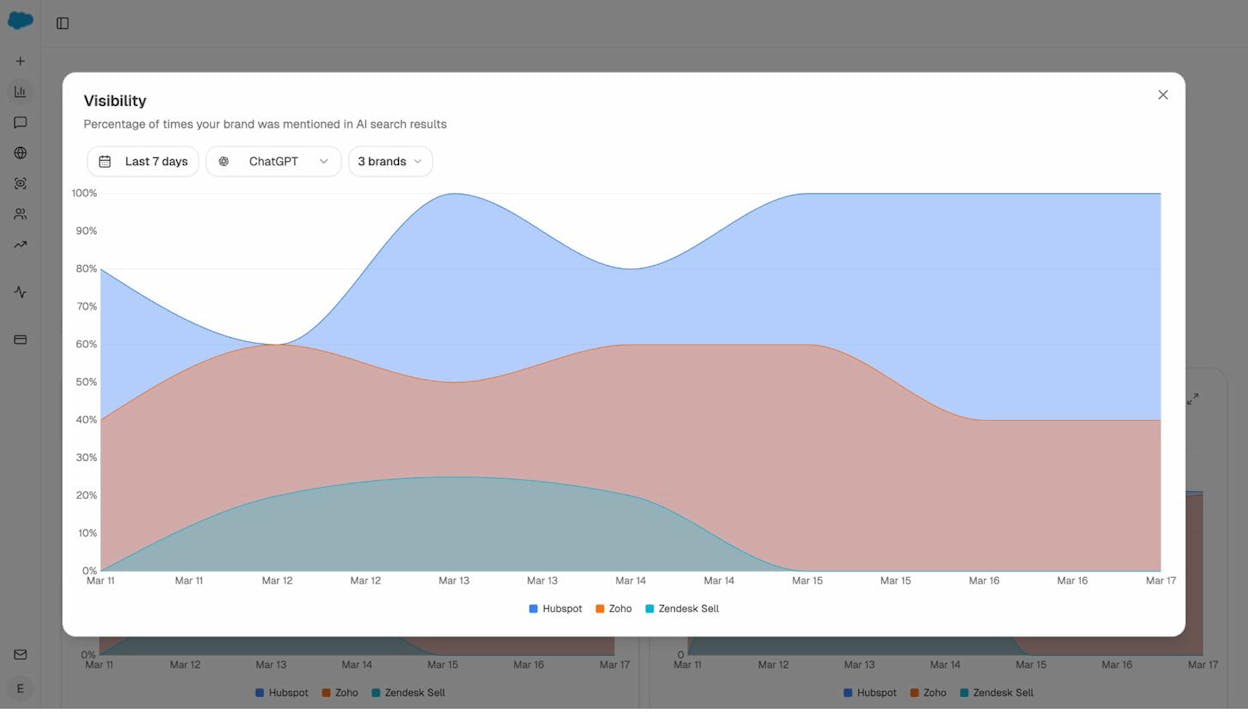
Engine Breakdown view showing per-engine visibility trajectories side by side for the same tracked brand across the same prompt panel
The Citation Analytics view solves the domain-diet question. For each engine, it shows the specific domains that engine cited when answering your tracked prompts, so you can compare the ChatGPT source diet against the Perplexity and Google AI Mode source diets on the same prompts. If your Perplexity numbers are healthy on prompts where ChatGPT is empty, the domains cited on those Perplexity answers are the map of what to earn next.
The Bigger Story
The “one AI strategy” pitch is a myth. There is no single content asset, no single distribution motion, and no single measurement dashboard that covers all three of ChatGPT, Perplexity, and Google AI Mode at once. The industry press pushes back on this by pointing out that engines agree more on brands than on sources, which is true at the bag-of-brands level. It is not true at the focal-brand level a marketer actually cares about. For a specific brand on a specific generic B2B prompt, 47% of the time none of the three engines mentions it, and only 15% of the time all three do.
The three positions are not fully independent. Perplexity and Google AI Mode share enough retrieval overlap that a page earning citations on one has meaningful transfer to the other. ChatGPT is its own game. Its 0.05 Jaccard with Perplexity and 0.06 with Google AI Mode says that whatever earns ChatGPT visibility is decoupled from what earns Perplexity and Google AI Mode visibility, so it needs its own strategy.
This finding sits alongside the two earlier pieces in the State of AI Search series. In the persistence piece, we showed that within one engine over time, brand visibility is stable at 83%. Once you win a spot on ChatGPT, you keep it. In the citation-presence piece, we showed that Google AI Mode cites a source in 97% of answers versus ChatGPT’s 68%. Google AI Mode is the widest citation surface. Put the three together and the picture is this. Cross-engine consensus is rare, within-engine positions are durable, and Google AI Mode is the most retrievable engine. The strategy that follows is to build a tracked prompt panel across all three engines, treat each engine as its own position to defend, and prioritize the engine where you have the shortest path to the first win.
The rest of this State of AI Search series will unpack the other structural patterns we found in the same dataset. Later pieces look at how broad the citation ecosystem is (7,058 unique cited domains, top-10 share only 11 to 13%), how domain authority relates to citation frequency (near zero at the page level), and how the engines behave differently on YouTube and Reddit citations.
The finding to hold onto from this piece is the simple one. Ask the same B2B question on ChatGPT, Perplexity, and Google AI Mode on the same day, and 47% of the time your brand appears in zero of them. That is the real starting point for anyone building an AI visibility program, and it is the reason a single-engine dashboard is a false read.
This research was conducted using Analyze AI, which tracks brand visibility, citation share, and cross-engine agreement across ChatGPT, Perplexity, Google AI Mode, and every other major AI engine.

Ernest

Ibrahim
![Featured image for The State of AI Search in B2B [2026]](/_next/image?url=https%3A%2F%2Fwww.datocms-assets.com%2F164164%2F1785857899-16-state-of-ai-search-b2b-2026.png&w=3840&q=75)

![Featured image for Google AI Mode Cites Sources in 97% of Answers [2026]](/_next/image?url=https%3A%2F%2Fwww.datocms-assets.com%2F164164%2F1785857495-02-citation-presence.png&w=3840&q=75)
![Featured image for ChatGPT Pulls 69% of Citations from Brand Sites [2026]](/_next/image?url=https%3A%2F%2Fwww.datocms-assets.com%2F164164%2F1785857882-15-source-family-mix.png&w=3840&q=75)