

![Featured image for Google AI Mode Cites Sources in 97% of Answers [2026]](/_next/image?url=https%3A%2F%2Fwww.datocms-assets.com%2F164164%2F1785857495-02-citation-presence.png&w=3840&q=75)

Summarize this blog post with:


We analyzed 22,295 AI answers across ChatGPT, Perplexity, and Google AI Mode to understand how often each engine includes a source in its answer, how many sources it includes, and whether citation-rich answers also tend to mention brands more.
The dataset covers 115,843 citation events, 460 distinct B2B prompts, and 37 tracked organizations. For this piece we look at the 5,755 same-day observations where all three engines answered the same prompt on the same day. That covers 413 unique prompts, each observed on roughly 14 different days on average over a study window of a few months. Working from same-day observations gives us a fair three-way comparison instead of a global average that mixes different prompt panels together.
Here are the questions we set out to answer:
- How often does each engine include at least one citation in its answer?
- How many citations does each engine include on average?
- Do the engines that cite more sources also mention brands more often?
- Are longer answers more source-heavy, or less?
- Which engine is the highest-probability citation channel for B2B?
- What does this mean for a marketing team allocating time across three engines?
Google AI Mode cites a source in 97% of answers. ChatGPT cites a source in 68%. The gap is 30 points on the same prompt on the same day. But Google AI Mode does not mention brands more often than ChatGPT does. The two engines are statistically tied on brand mention rate. Citation presence and brand mention are not the same KPI, and the engine that cites the most sources is not the engine that mentions the most brands.
Table of Contents
TL;DR
- How often does each engine include a citation? Google AI Mode: 97.4% of answers. Perplexity: 93.2%. ChatGPT: 68.3%. Measured on the same 5,755 same-day observations.
- How many citations per answer? Perplexity averages 6.7, Google AI Mode 5.3, ChatGPT 3.6. Perplexity cites almost twice as many sources per answer as ChatGPT.
- Which engine mentions brands most often? Perplexity (41.7% of answers). Google AI Mode (33.7%) and ChatGPT (32.3%) are statistically tied. The 95% confidence interval for the Google-vs-ChatGPT gap crosses zero.
- Which engine writes the longest answers? ChatGPT, at about 3,361 characters. Google AI Mode averages 2,574 characters. Perplexity averages 2,447.
- Do citation presence and brand mention move together? No. Google AI Mode is 30 points ahead of ChatGPT on citation presence and effectively even with ChatGPT on brand mentions.
- What should marketers do about this? Treat citation presence and brand mention as two separate KPIs. Do not skip Google AI Mode from your tracking panel just because your SEO team does not own it yet.
Google AI Mode Cites a Source in 97 Out of 100 B2B Answers
We took the same-day observations across the three engines and asked one question. For each answer, did the engine include at least one citation?
| AI surface | Citation presence | Avg citations per answer | Avg answer length (chars) |
|---|---|---|---|
| Google AI Mode | 97.4% | 5.33 | 2,574 |
| Perplexity | 93.2% | 6.71 | 2,447 |
| ChatGPT | 68.3% | 3.60 | 3,361 |
Google AI Mode cites at least one source in almost every answer. Perplexity is close behind at 93%. ChatGPT cites a source in only about two out of every three answers on the same prompts. On 5,755 same-day observations, roughly 1,800 of them produced a ChatGPT answer with zero citations, versus about 150 for Google AI Mode.
The difference comes from a design choice. Perplexity and Google AI Mode retrieve live sources for almost every answer and cite them by default. ChatGPT answers from what the model already knows and cites external sources only when its retrieval layer surfaces something worth linking to. The result is that Google AI Mode is the highest-probability citation channel in B2B AI search right now by a wide margin.
For a marketer, the direct implication is that if your dashboard tracks only ChatGPT, you are ignoring the engine that is most likely to link out to any source at all. Every serious B2B tracked prompt panel should include Google AI Mode as a first-class engine.
But Google AI Mode Doesn’t Mention Brands Any More Than ChatGPT Does
You would expect the engine that cites the most sources to also mention the most brands. The data goes the other way.
| AI surface | Brand mention rate | Citation presence |
|---|---|---|
| Perplexity | 41.7% | 93.2% |
| Google AI Mode | 33.7% | 97.4% |
| ChatGPT | 32.3% | 68.3% |
Perplexity mentions the tracked brand in 41.7% of answers. Google AI Mode and ChatGPT come in about eight points lower at 33.7% and 32.3%. The Google-vs-ChatGPT gap of 1.4 points is inside the 95% confidence interval, which means we cannot rule out that the two engines mention brands at the same rate on this sample.
So Google AI Mode leads by 30 points on citation presence and ties with ChatGPT on brand mention rate. The two KPIs measure different things. Citation presence measures whether the answer links out at all. Brand mention rate measures whether the answer names your brand in the text of the response. An answer can be full of citations that all point to Wikipedia, Reddit, and generic industry guides without ever naming a single vendor.
If you are trying to get cited, Google AI Mode is the easiest engine to win. If you are trying to get named in the answer text, Perplexity is the highest-yield engine and Google AI Mode and ChatGPT are effectively tied for second place.
The Three Engines Are Making Three Different Trades
Put the three numbers together and each engine has its own profile.
ChatGPT writes long answers with few sources. About 3,361 characters and 3.6 citations, which is one citation for every 933 characters of output. It is the engine that talks the most and cites the least.
Google AI Mode writes shorter answers with more sources. About 2,574 characters and 5.3 citations, which is one citation for every 486 characters. It is the engine that is most consistently backed by external sources.
Perplexity writes the shortest answers with the most sources. About 2,447 characters and 6.7 citations, which is one citation for every 365 characters. It is also the engine that mentions the tracked brand most often.
The three trades line up with three different retrieval philosophies. ChatGPT leans on what the model already knows and cites external sources only when it needs to. Google AI Mode and Perplexity retrieve live sources for almost every answer and use those sources to build the response. For content strategy this means each engine is winnable with a different asset. To win on ChatGPT you need to be in the training data or produce content that ChatGPT’s retrieval layer picks up on a targeted subset of prompts. To win on Google AI Mode and Perplexity you need to be a live retrievable citation right now.
The character-to-citation ratio is also a useful sanity check for content depth. A page that gets cited by Perplexity has to compete with 6.7 other sources in an answer that is only 2,447 characters long, which is about 400 words. That means each source contributes on average one sentence worth of information to the final answer. A page cited by ChatGPT has less competition but has to hold up over a much longer answer where the model is filling in most of the content from memory. The pages that win on both engines tend to be short, dense, and extractable rather than long, narrative, and comprehensive.
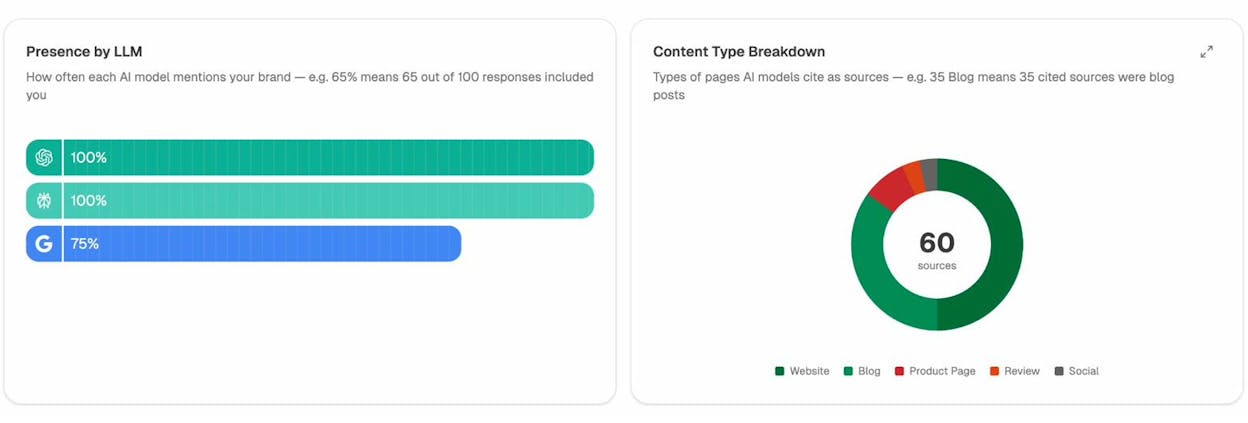
The Presence by LLM view showing per-engine mention rates side by side with the content-type mix of the sources each engine cites
How This Compares to Other Public Studies
Public studies on Google AI Mode citation behavior land in a wide range because they measure different things. Here is where our numbers fit.
Averi.ai ran 50 B2B SaaS queries through Google AI Mode and reported 23 sources per answer. That is roughly four times our 5.3 figure. The difference is what counts as a “source.” Averi’s number includes the fan-out sub-queries Google AI Mode runs behind the scenes, so a single visible answer is credited with every source across every sub-query. Our figure counts sources that appear in the answer itself. Both numbers are correct for what they measure. If you want to know how deeply Google AI Mode is retrieving from the web, use Averi’s 23. If you want to know how many sources will actually appear in front of the reader, use our 5.3. For a marketer choosing between the two, the visible number is usually the one that matters. Fan-out sources may inform the answer, but only the 5.3 that make it into the response are candidates for driving a click.
Ahrefs found that Google AI Overviews and Google AI Mode share only 13.7% of the URLs they cite for the same query, even though they reach semantically similar conclusions about 86% of the time. Their finding sits next to ours. AI Overviews and AI Mode are two different citation surfaces even though they are both Google. Our 97% citation-presence number applies to AI Mode specifically. A brand tracked in AI Overviews and a brand tracked in AI Mode will show different results, so both need their own row in your dashboard.
SE Ranking reported that over 60% of domains and 80% of URLs disappear between Google AI Mode runs for the same query. That is the churn number. Ours is the presence number. Both are compatible. Google AI Mode cites almost every time, but the specific sources it cites shift from one run to the next. The right takeaway is that presence is stable and the URL layer is volatile. A citation strategy anchored to a specific URL will lose. A citation strategy anchored to a specific brand-plus-topic pattern that many URLs cover will win.
Zenith analyzed ChatGPT B2B queries and found that ChatGPT prefers direct sources over intermediaries by 11.1 points versus Google, including competitor websites and encyclopedic sources. That finding lines up with ours. ChatGPT retrieves less often overall, and when it does retrieve, it goes to direct sources instead of aggregators.
The pattern across all four studies is consistent once you separate what is being measured. Citation presence, citation count, citation churn, and citation source type are four different questions, and public numbers only line up when you compare like with like.
What This Means For How You Design Your AI Search Coverage
Three things follow from the 97% citation-presence rate on Google AI Mode.
The first is that Google AI Mode belongs on every B2B tracked prompt panel. If you are tracking only ChatGPT because that is where your team started, you are cutting yourself off from the engine most likely to cite any source at all. This is separate from the “which engine drives the most buyer research” question. Even if your customers spend most of their time in ChatGPT, Google AI Mode is where the citation surface is widest and the entry cost per citation is lowest.
The second is that citation presence and brand mention need to be tracked as two separate metrics. A dashboard that reports “we appear in 33% of Google AI Mode answers” is telling you about brand mentions. It is not telling you whether Google AI Mode ever cites your site as a source when it answers those prompts. The two numbers can move in opposite directions. This is why the Citation Analytics view splits mention rate from citation rate rather than blending them into a single visibility score.
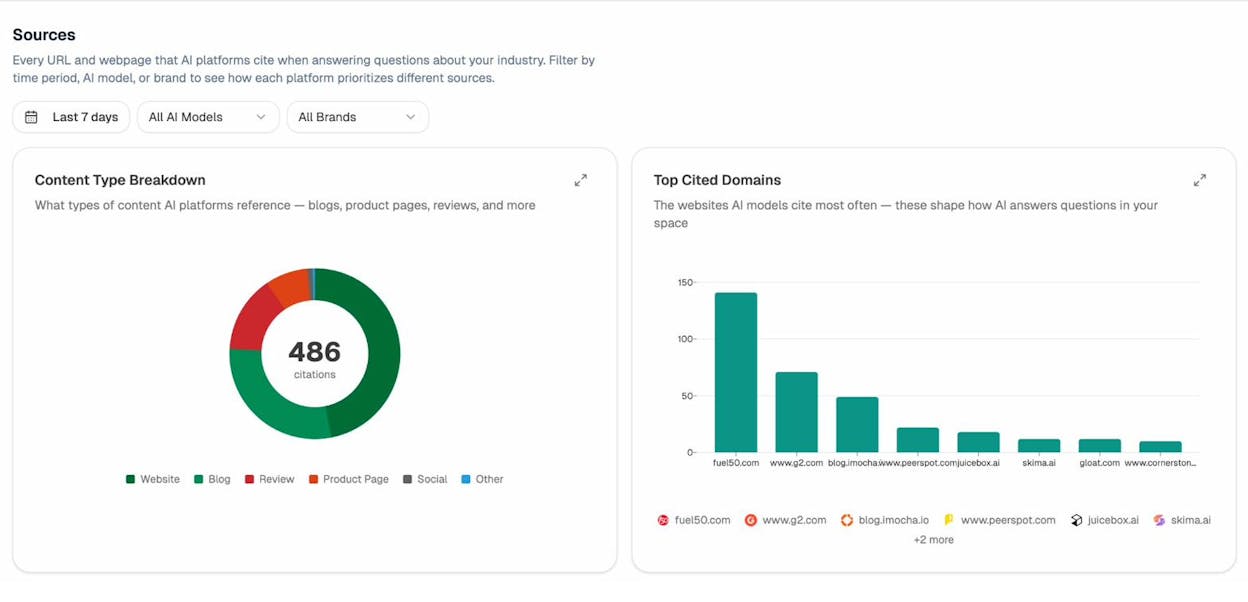
Citation Analytics view showing per-engine citation rates alongside brand mention rates on the same tracked prompt panel
The third is that engine selection changes the content asset that earns you the citation. Google AI Mode and Perplexity retrieve live for almost every answer, so they reward fresh, factually dense, well-structured pages that are easy to extract from. ChatGPT retrieves less often, so a ChatGPT-first strategy has to invest more in getting the brand named inside third-party content that is already in the training data. The Engine Breakdown view surfaces this difference directly. If your Perplexity and Google AI Mode citation numbers are healthy but your ChatGPT numbers are not, the fix is off-site presence in the sources ChatGPT recognizes. If ChatGPT is fine and Google AI Mode is empty, the fix is your own site’s retrievability.
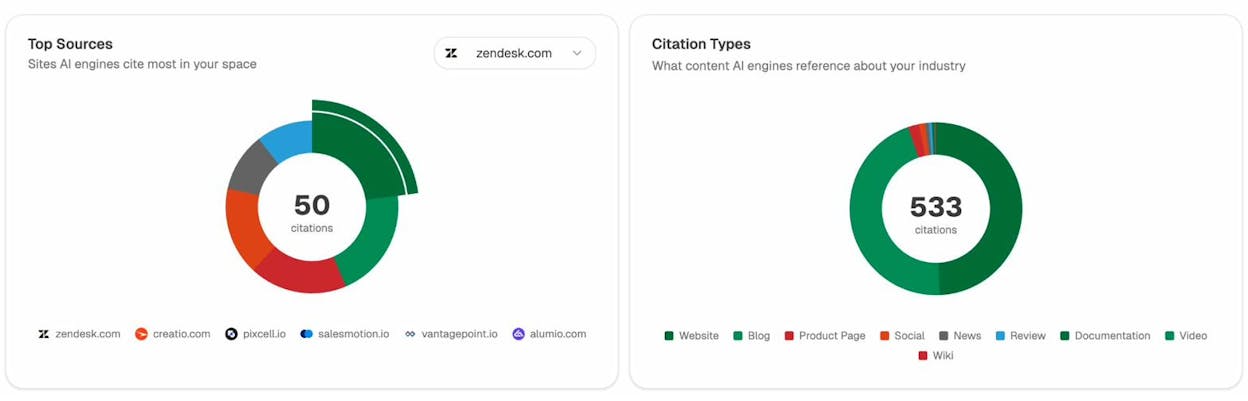
Engine Breakdown view showing per-engine citation and mention rates side by side on the same tracked prompt panel
The Bigger Story
Most B2B AI-search coverage in 2026 is still ChatGPT-first. The dashboards are ChatGPT-first. The agency pitches are ChatGPT-first. The optimization guides are ChatGPT-first. Our data says the engine that gives you the highest odds of being cited at all is not ChatGPT. It is Google AI Mode.
Part of the reason Google AI Mode is skipped is that SEO teams have been trained to think of it as a Google product that will be covered by their existing Google-focused workflow. That is not how it plays out on the ground. Google AI Mode has its own citation pool, its own retrieval pipeline, and its own churn profile that Google Search Console does not surface. If your only view into Google AI Mode is your regular GSC report, you cannot see the 97% citation-presence rate that this engine is actually running at. You have to run your own tracked prompts through it directly. That is the practical difference between an “AI is a Google feature” mindset and a tracked-prompt-panel mindset.
That does not mean marketers should drop ChatGPT. ChatGPT is still the engine that a large share of buyers use for research, and being mentioned there matters. But Google AI Mode has moved from an experimental surface to a durable citation channel, and it is easier to win a citation on Google AI Mode than on ChatGPT by a factor of about 1.4x. Any B2B team that has not added Google AI Mode to its tracked prompt panel is leaving citation growth on the table.
Perplexity is a separate story. It is the engine that cites the most sources per answer and mentions the tracked brand most often. If your ideal customer profile includes technical buyers who prefer dense, sourced answers, Perplexity is probably where you are underinvested. The mention-rate gap of eight points versus Google AI Mode and ChatGPT is not statistical noise. It is a real difference that shows up on the same 5,755 same-day observations we used for every other number in this piece.
The rest of this State of AI Search series will unpack the other structural patterns we found in the same dataset. Later pieces look at how brand mention persistence works over time (once a brand is in an AI answer it stays in about 83% of the time), how broad the citation ecosystem is across 7,058 unique cited domains, and how often the three engines agree on the same prompt on the same day (47% of the time none of them mentions the tracked brand, and only 15% of the time all three do).
The finding to hold onto from this piece is the simple one. Google AI Mode cites a source in 97 out of 100 B2B answers. ChatGPT cites a source in 68 out of 100. If you are picking which engine to invest in first, Google AI Mode is the widest citation surface and the shortest path to the first win.
This research was conducted using Analyze AI, which tracks brand visibility, citation share, and answer content across ChatGPT, Perplexity, Google AI Mode, and every other major AI engine.

Ernest

Ibrahim
![Featured image for The State of AI Search in B2B [2026]](/_next/image?url=https%3A%2F%2Fwww.datocms-assets.com%2F164164%2F1785857899-16-state-of-ai-search-b2b-2026.png&w=3840&q=75)

![Featured image for AI Engines Rarely Name the Same Brands [2026 Study]](/_next/image?url=https%3A%2F%2Fwww.datocms-assets.com%2F164164%2F1785857601-03-cross-engine-consensus.png&w=3840&q=75)
![Featured image for Longer AI Answers Cite Fewer Sources [2026 Study]](/_next/image?url=https%3A%2F%2Fwww.datocms-assets.com%2F164164%2F1785857782-10-length-vs-citations.png&w=3840&q=75)