
Are high AI-referral conversion rates meaningful when the traffic volume is tiny?
Short answer
Not until you have roughly 100 conversions in the group, and most sites reporting a dramatic AI conversion rate have fewer than 20. Below that threshold the confidence interval is wide enough that a 6% rate and a 2% rate are statistically indistinguishable. Report absolute conversion counts and the trend instead, and hold the rate comparison until the sample supports it.
Why a small sample produces a big number
Conversion rate on low volume is dominated by whichever few conversions happened to land in the window.
Take 150 AI sessions with 9 conversions. That's a 6% rate, which looks excellent next to a 1.8% organic rate. But the 95% confidence interval on 9 conversions from 150 sessions runs roughly from 3% to 11%. Three of those nine conversions arriving a week later, outside your reporting window, would have made it 4%. Nothing about visitor quality changed. Only the window did.
This is why AI conversion rates tend to swing violently month to month on sites that haven't reached volume, and why a rate that looks stable for two months often collapses in the third.
The threshold, and where you actually are
| Conversions in the group | What you can honestly say |
|---|---|
| Under 20 | Report counts only. No rate comparison. |
| 20 to 50 | Directional at best. State the interval alongside any rate. |
| 50 to 100 | Comparison becomes usable with caveats. |
| Over 100 | Rate is stable enough to compare and to act on. |
The rule of thumb is roughly 100 conversions per group before a rate comparison holds up. For most B2B sites, AI referral volume sits in low single-digit percentages of total sessions, which means reaching 100 AI conversions typically takes 6 to 12 months.
Check where you are before you build the comparison. If you're under 20, the honest report is a count and a trend line.
The measurement principle underneath
This isn't only a sample-size problem. It's a measure-once problem, and it's well documented in AI-search measurement specifically.
Research on measuring AI visibility argues that one-off observations are unreliable and visibility should be treated as a distribution across runs, prompts, and time rather than as a single reading. The same logic applies downstream to conversion: one month's rate on thin volume is a single draw from a distribution, not a measurement of the channel.
Our own state of AI search research applies this to visibility rather than conversion, and found the same instability at the answer level. Once a brand is mentioned in an AI answer for a prompt, next-observation mention probability is 83.2% on ChatGPT versus 9.9% after a miss. Presence is path-dependent and lumpy, which means the traffic it produces arrives in bursts rather than smoothly. Lumpy traffic makes small-sample rates even less reliable than the raw statistics suggest.
What to report before you hit the threshold
Four things that are honest and still useful.
Absolute conversion counts by channel, with the trend. "AI referrals produced 4, then 7, then 11 conversions over three months" is a real finding. It says nothing misleading and shows direction.
Volume times rate, not rate alone. A 6% rate on 200 sessions is 12 conversions. A 1.8% rate on 40,000 sessions is 720. Presenting both prevents the rate from implying a revenue contribution it doesn't have.
Engagement signals, which stabilise faster than conversion. Engaged session rate and average engagement time reach usable sample sizes far sooner than conversions do, because every session contributes to them.
Citation volume as the leading indicator. Citations accumulate much faster than conversions, so trend in citation share tells you whether the channel is growing months before the conversion data can.
Pooling, and its one condition
You can reach the threshold sooner by pooling, but only in ways that don't destroy the comparison.
Pooling across a longer date range is fine. Pooling across AI sources is usually fine if you're answering "does AI convert well" rather than "which assistant converts best." Pooling across landing pages is where it breaks, because page mix is the largest confounder in the whole analysis. If your AI traffic concentrates on comparison pages and your organic traffic concentrates on top-funnel guides, pooling pages compares page intent rather than channel quality.
Hold landing page constant, pool everything else.
Track the leading indicator while conversions accumulate
Conversions are the slowest signal you have. Citations accumulate far faster, so they tell you whether the channel is growing months before the conversion data can support a rate.
Visibility Score is built for this, returning not just a headline percentage but the totals behind it and a daily trend, plus a per-brand breakdown. The trend is the part that matters here, because it gives you a distribution rather than a single reading, and a distribution is what makes a month-over-month change interpretable.
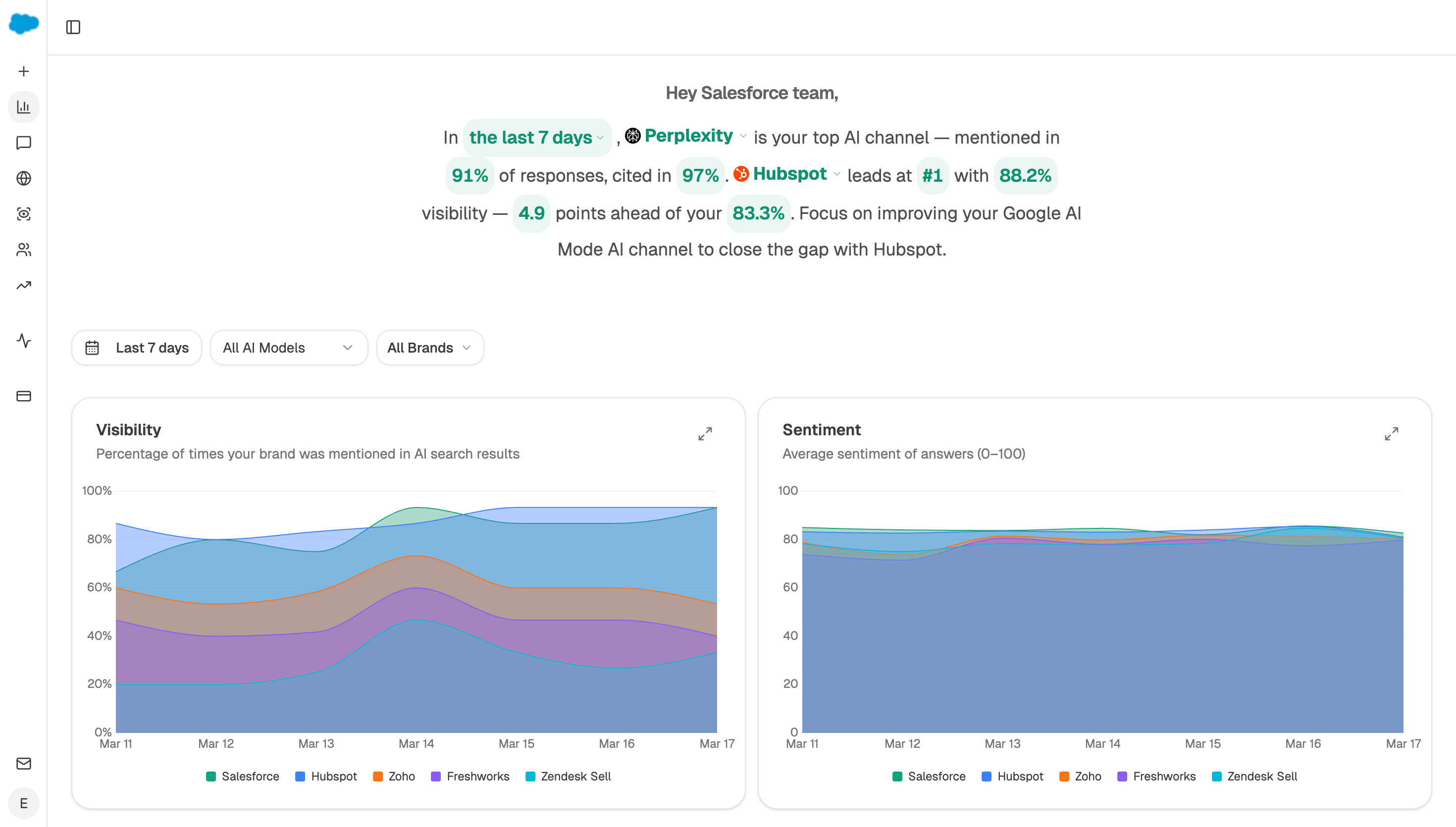
That matters because presence is lumpy. Our own state of AI search research found that once a brand is mentioned for a prompt, next-observation mention probability is 83.2% on ChatGPT versus 9.9% after a miss. Traffic arriving from that pattern comes in bursts, which makes small-sample conversion rates even less stable than the raw statistics suggest.
The reporting agent, with the suppression rule encoded rather than left to judgement:
Start (schedule, 1st of month) → Visibility Score (per provider, with daily trend) → Citation Share → AI Landing Pages → HubSpot Get CRM Objects (conversions last 90 days) → workflow-memory (previous three runs) → Code (count conversions per group, compute the observed range across runs, and set a publish flag only when the group exceeds 100 conversions) → Conditional (below threshold, output counts and trend only) → Prompt LLM (report absolute counts, engagement rate, and citation trend as the leading indicator) → Send Email to CMO.
workflow-memory is what turns this from a snapshot into a series. Because the agent can read its own prior runs, it can say whether this month's figure sits inside the normal observed range or genuinely moved, which is the distinction that stops a thin month triggering a strategy change.
The Conditional enforces the discipline permanently. Once the rule lives in the workflow, nobody has to remember to caveat the number under deadline pressure.
FAQ
Related answers
- Do AI-referred visitors actually convert better than search visitors?
- How can I estimate how much AI-influenced traffic is hidden in my Direct channel?
- How do I put a number on "AI visibility" for a monthly report?
Want a report that flags when your AI sample is too thin to trust? Start a free Analyze AI trial and track citations as your leading indicator while conversions accumulate.