
Do AI-referred visitors actually convert better than search visitors?
Short answer
Reported AI conversion rates are usually higher, but a large part of that gap is measurement artefact rather than visitor quality. Three things inflate it: tiny sample sizes, a survivorship effect where only the highest-intent AI users click at all, and branded-visit contamination. Run the comparison on your own data with the controls below before repeating any headline multiple, and expect the real gap to be smaller than the raw numbers suggest.
Why the raw comparison overstates the gap
Before running the test, understand the three effects working on it. Each one pushes AI conversion rate up without AI visitors being better buyers.
Survivorship. Most AI answers resolve without a click. Pew Research found that when an AI summary appears, users click a source link in only about 1% of visits. The people who do click are the small minority who wanted more than the answer gave them, which is an unusually motivated group. You're comparing a self-selected high-intent slice against all of organic search.
Small samples. AI referral volume is still low single-digit percentages of sessions for most B2B sites. A handful of conversions on a few hundred sessions produces a dramatic-looking rate with a confidence interval wide enough to drive a truck through. See Are high AI-referral conversion rates meaningful when the traffic volume is tiny?.
Branded contamination. Many AI-referred visits happen after the user already named your brand in their prompt. Those are branded-intent visits and should be compared against branded organic search, not against all organic search. Comparing them to non-brand organic guarantees a flattering result.
Our own state of AI search research measures citation and brand-mention behaviour rather than downstream conversion, so we don't publish a cross-client conversion multiple. Anyone quoting a precise one should be asked what their sample size and their branded split were.
Run the comparison properly
Step 1. Build the Exploration. Dimensions: Session default channel group, Session source / medium, Landing page + query string. Metrics: Sessions, Engaged sessions, Conversions. Filter to AI Assistant, Organic Search, and Direct, over 6 to 12 months.
Step 2. Separate branded from non-branded on both sides. Homepage and pricing entries skew branded, deep content entries skew non-brand. Compare like with like.
Step 3. Match on landing page. Take your top 10 pages receiving both AI and organic traffic and compare per page, not in aggregate. Page mix is the largest confounder in the whole analysis.
Step 4. Check the volume threshold first. Roughly 100 conversions per group before a rate comparison is stable. Below that, report raw counts.
Step 5. Include the invisible AI traffic. A large share of AI visits land in Direct, and excluding them biases your sample toward desktop web users. See How can I estimate how much AI-influenced traffic is hidden in my Direct channel?.
What tends to hold up
After applying those controls, two findings usually survive on B2B sites.
AI-referred visitors do arrive further along. They've typically had the category explained to them already, so they skip the educational stage. This shows as higher engagement on commercial pages and shorter paths to a demo request.
The gap shrinks substantially once branded intent is separated. Much of the apparent advantage is that AI referrals over-index on branded, bottom-funnel intent. Compared against branded organic search rather than all organic, the difference narrows considerably.
What doesn't hold up is a stable multiple. Any claim that AI traffic converts a specific number of times better than search is describing one site's page mix and sample, not a property of the channel.
The framing that survives a CFO conversation
Don't lead with a conversion multiple. Lead with volume times rate, which is the number that actually affects revenue.
A 6% conversion rate on 200 sessions produces 12 conversions. A 1.8% rate on 40,000 sessions produces 720. The rate comparison flatters AI and the absolute contribution does not, and your CFO will find that out. Presenting both yourself is what keeps the channel credible while it scales.
Run the page-matched comparison properly
The comparison lives or dies on holding the landing page constant, and that's exactly the view AI Landing Pages provides. Each row carries sessions, citations, engagement rate, bounce, duration, and conversions for a single URL, with the AI sources that sent the traffic shown against it.
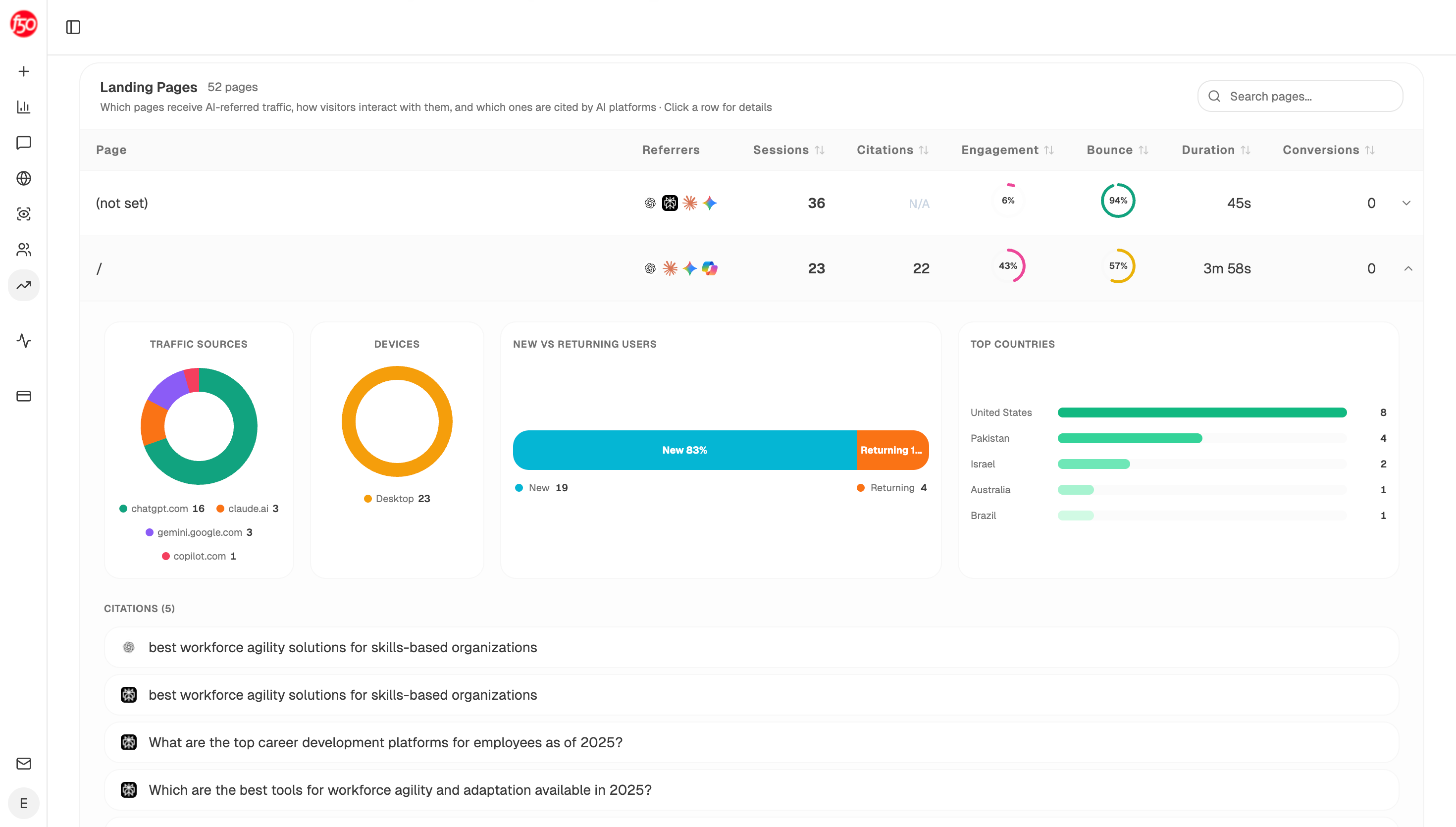
That structure removes the largest confounder before you start. Comparing AI conversion rate to organic conversion rate across your whole site compares page mix. Comparing them on the same twelve pages compares visitor quality, which is the question you actually asked.
Page Breakdown then splits a single page's performance across AI sources, so you can see whether a Perplexity visitor and a ChatGPT visitor behave differently on the same content. They often do, and a blended AI number hides it.
The monthly agent, with the sample-size discipline built in:
Start (schedule, 1st of month) → AI Landing Pages (12 months) → Page Breakdown (top 20 pages receiving both AI and organic traffic) → GSC Page-Keyword Breakdown (to separate branded from non-brand entries) → HubSpot Get CRM Objects (deals by landing page) → Code (compute conversion rate per page per channel, split branded and non-brand, and count conversions per group) → Conditional (if any group has fewer than 100 conversions, mark that page inconclusive rather than reporting a rate) → Prompt LLM (report volume times rate alongside the rate itself) → Excel export → Send Email to CMO.
The Conditional is the part worth copying. Most published AI-conversion multiples come from groups too small to support them, and building the suppression rule into the workflow stops a thin month producing a number someone screenshots into a board deck.
Reporting volume times rate in the same output is the other safeguard, because a 6% rate on 200 sessions and a 1.8% rate on 40,000 sessions tell opposite stories about where the revenue is.
FAQ
Related answers
- Are high AI-referral conversion rates meaningful when the traffic volume is tiny?
- How can I estimate how much AI-influenced traffic is hidden in my Direct channel?
- How do AI crawlers distort my traffic and conversion-rate reporting?
- How do I track ChatGPT traffic in GA4?
Want a page-matched AI versus organic conversion comparison on your own data? Start a free Analyze AI trial and connect GA4 to run it properly.