
How can I build credible evidence that AI search is sending customers when there is no referrer?
Short answer
Build a case from four independent signals rather than one metric: signup survey answers naming AI surfaces, deep-page Direct sessions that nobody types from memory, lagged branded-search lift following citation gains, and sales-call mentions logged in your CRM. None is conclusive alone. Four signals pointing the same direction is stronger evidence than a single number that looks precise, and it's an argument a finance team will actually accept.
Accept the constraint, then work around it
You will not get referrer-level proof for most AI-driven customers. Assistants strip referrers, most answers produce no click, and awareness often happens weeks before any visit.
Teams respond in two bad ways: declaring the channel unmeasurable, or inventing a confident number that collapses under audit. The third option is triangulation, the standard approach wherever direct attribution is structurally impossible, and one brand and PR budgets have run on for decades.
Signal 1: the signup survey
Add "how did you hear about us" at signup, with ChatGPT, Perplexity, Gemini, and Claude as explicit named options rather than hidden inside "other."
This is your only ground truth, and the sole signal capturing awareness that never produced a session. You need 100 responses before it means anything and 300 before defending it in a board meeting, weighted at 60 to 70% confidence rather than treated as fact.
Signal 2: deep-page Direct
Nobody types a long blog URL from memory, so Direct sessions landing on deep pages arrived from a source that stripped the referrer.
Build a GA4 Exploration filtered to Direct with Landing page + query string as the dimension, separating plausibly-typed homepage entries from deep content URLs. Compare that share against a pre-AI baseline quarter from 2023, and the delta is growth in referrer-stripped traffic that didn't exist before. Full method in How can I estimate how much AI-influenced traffic is hidden in my Direct channel?.
Subtract your best estimate for email, Slack, and PDF referrals, and present what remains as a range.
Signal 3: lagged branded-search lift
This is the signal most teams skip and the one that tends to convince finance, because it's the hardest to explain away.
Track citation share on your commercial prompts and branded search volume monthly, then look for citation gains followed by branded-search gains 4 to 12 weeks later. The mechanism is simple: someone sees your brand in an answer, doesn't click, and searches your name later when they're ready. The lag is the consideration window.
Our own state of AI search research, covering more than 22,000 answers, supports why this compounds: once a brand is mentioned in an AI answer for a prompt, next-observation mention probability is 83.2% on ChatGPT, 83.3% on Perplexity, and 84.2% on Google AI Mode, against roughly 10% after a miss. Visibility persists, so exposure accumulates over exactly the multi-week window where the lagged lift appears.
This is also why a single reading proves nothing. Research on measuring AI visibility argues that one-off observations are unreliable and visibility should be treated as a distribution across runs, prompts, and time. Track the lag across several months before claiming the pattern.
Discount the lift 30 to 50% for PR, launches, and category growth. Reporting it raw is how the argument gets dismantled. See How do I test whether an organic lift was real and not seasonal or brand-driven?.
Signal 4: what buyers say on sales calls
Add a required CRM field capturing where the prospect first encountered you, filled by the rep after discovery.
Sales calls surface detail no survey captures: which assistant, what they asked, which competitors appeared alongside you. That detail is often worth more than the attribution itself. Make the field required, because reps skip optional ones.
Combine them without over-claiming
| Signal | Confidence | Report as |
|---|---|---|
| Signup survey | Moderate, weight 60 to 70% | Directly attributable customers |
| Deep-page Direct | Bounded estimate | Range, never a point |
| Lagged branded lift | Correlational, discounted | Estimated incremental revenue |
| Sales-call mentions | Qualitative, high detail | Supporting evidence and prompt intelligence |
Sum only the first and third into a revenue figure. Deep-page Direct is a bound rather than a count, and sales mentions are corroboration. Folding all four into one number is over-claiming, and one over-claim discredits the other three.
The sentence that works with a CFO: four independent methods, each with different failure modes, agree AI search contributes between X and Y. That holds up when tested. A false-precision number does not.
Assemble all four signals from one run
The reason this case usually fails isn't the evidence. It's that four signals arrive from four places at four different times, so by the quarterly review they disagree and the argument collapses into a debate about which number is right.
Producing all four from a single scheduled run fixes that, because they share a date range and a definition by construction.
Start (schedule, 1st of month) → Citation Share and Visibility Score (per provider, with trend) → brand-vs-competitor recipe (three named competitors) → Get Visibility Events → GA4 AI Traffic Overview and AI Landing Pages → GSC Top Keywords for Site (branded regex, 24 months) → HubSpot Get CRM Objects (new customers, survey answers, rep-logged source) → Code (compute survey share, deep-page Direct bound, lagged branded correlation, and the share-of-voice benchmark, each with its own confidence label) → exec-one-pager recipe → Prompt LLM (write the case with each signal's evidence standard stated, and sum only the two that may be summed) → DOCX export → Send Email to CMO and CFO.
Two choices in that chain carry the argument.
The exec-one-pager recipe returns a pre-shaped executive summary with insights and risks structured, so framing stays identical month to month. That consistency prevents a caveat dropping out one quarter and reappearing the next as apparent bad news.
The DOCX export becomes an artifact attached to the run and the agent's artifact library, so when someone questions the range two quarters later you retrieve what leadership actually saw.
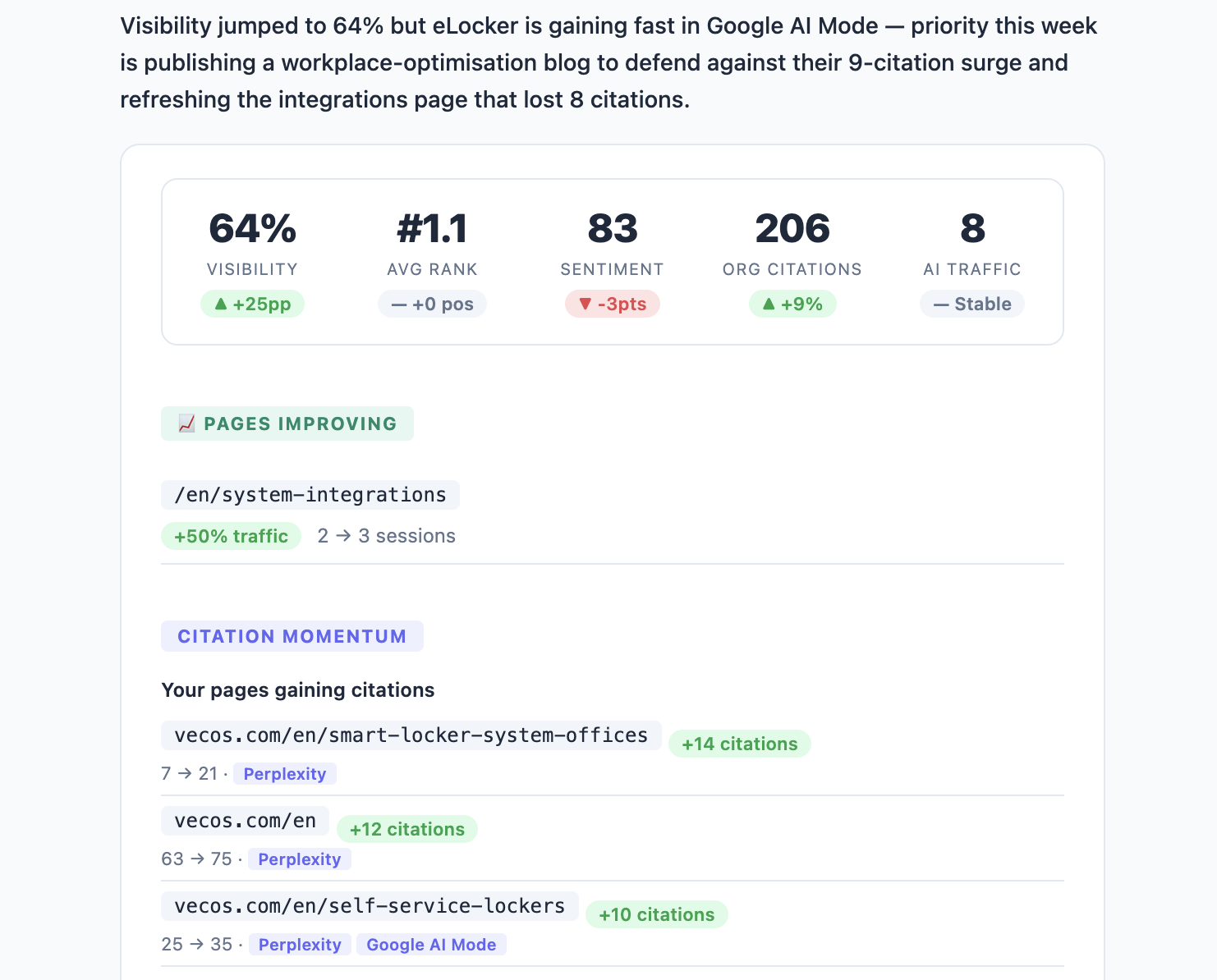
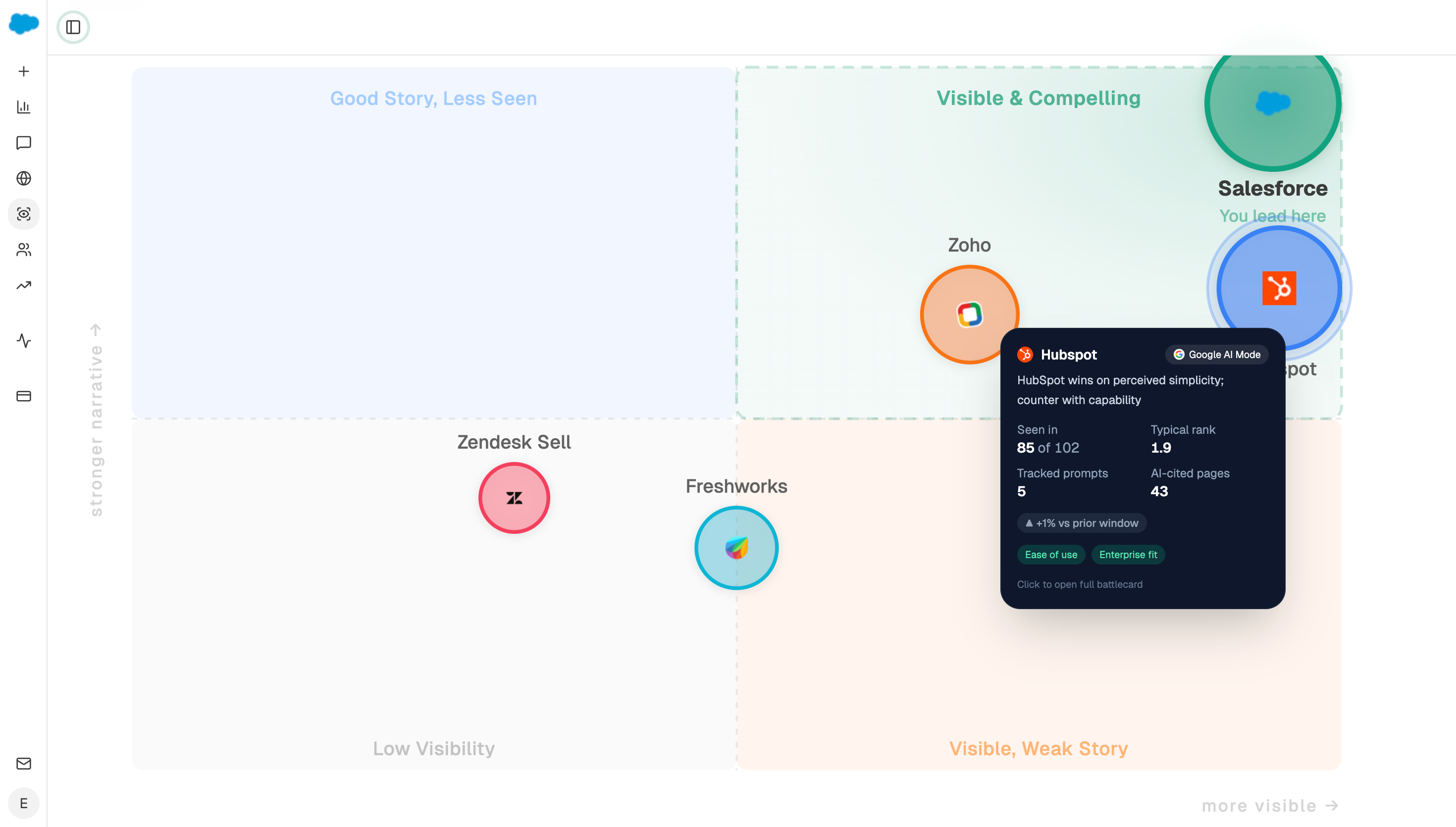
For the layer that makes the case land in a room, ad-hoc prompt search runs a live query during the meeting and shows the answer citing you, with the competitors named alongside. A CFO who sees the mechanism once usually stops asking for referrer-level proof of it.
FAQ
Related answers
- How can I estimate how much AI-influenced traffic is hidden in my Direct channel?
- How do I measure a buyer who found us in an AI answer but came back later through Google?
- How can I value zero-click exposure when the buyer never visits our website?
- What do I report when the CEO wants one attribution number but the evidence is probabilistic?
Want all four evidence signals assembled from one source every month? Start a free Analyze AI trial and connect GA4, GSC, and your CRM.