
How do I diagnose why a page declined before rewriting it?
Short answer
Answer three questions in order. Did we change something? Did a competitor change something? Did the result page itself change? Most teams skip straight to rewriting, which fixes the third cause by accident and the first two never. Each of the three has a different fix, and only one of them is a rewrite.
Question one: did we change something?
Start on your own side, because it is the fastest to rule out and the most embarrassing to miss.
Check the date the decline began and line it up against your own history. Look for a redesign, a template change, a URL change, a migration, a new internal linking pattern, or an edit to the page itself. Your CMS revision history and your deploy log answer this in ten minutes.
Also check whether the page is still indexed and still returns 200. A surprising share of "content decay" is a page that quietly stopped being crawlable, which is covered in is this page underperforming because of content or because it isn't indexed.
If the drop is a step rather than a slope, it is almost certainly this. Slopes are content. Steps are changes.
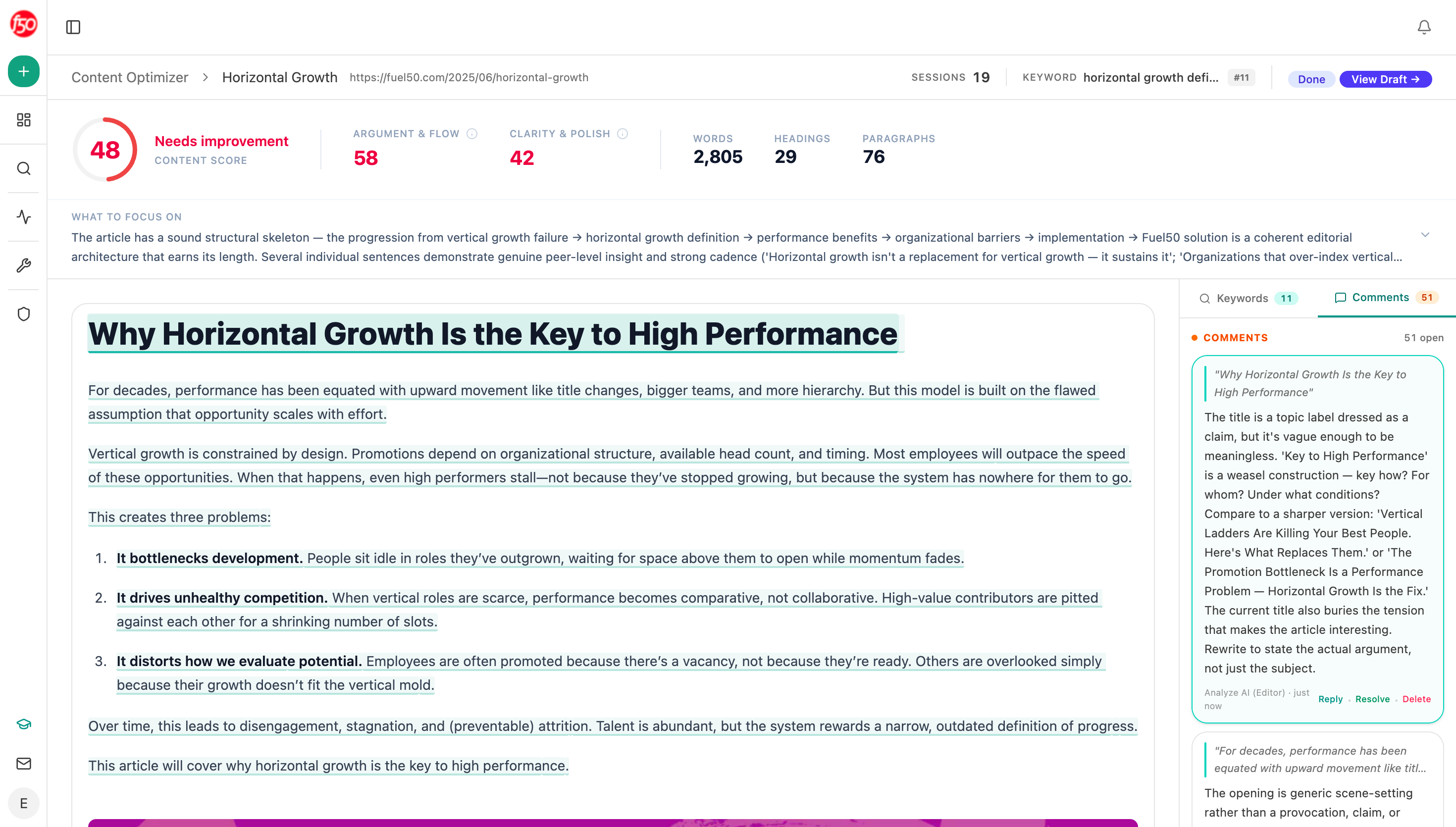 Fetching the live page is how you check what the page actually says now, which is often not what the last brief specified.
Question two: did a competitor change something?
Now look outward. Pull the current top ten for your main query and compare it against who ranked when you were doing well.
Three things to note. Whether a new page entered above you, whether an existing competitor rewrote theirs, and whether the ones above you are the same type of page you are.
The last one is the important one. If you are an article and the top five are now comparison pages or tools, you have not been outwritten, you have been outmatched on format, and rewriting your article better will not help. How do I compare my declining page with the pages that now win the SERP covers that comparison properly.
Question three: did the result page change?
This is the one people miss, and it is increasingly the answer.
Your position can be unchanged while your clicks halve, because the page around you changed. A new feature block, a richer snippet from a competitor, or an AI summary above the results all take clicks without touching your rank.
The check is quick. In Search Console, filter to the query and compare average position against click-through rate over the same period. Position flat and click-through down means the surroundings changed. And when an AI summary is present, Pew Research found people clicked a source link in about 1% of visits, which is enough to explain a large fall on its own.
| What you see | What it means | What fixes it |
|---|---|---|
| Step drop, one page | You changed something | Undo or repair it |
| Slope, several similar pages | Content ageing | Refresh |
| Position down, new pages above | A competitor moved | Match or beat their page |
| Position flat, clicks down | The result page changed | Title, snippet, or accept it |
| Two of your pages alternating | You are competing with yourself | Merge |
Check the AI side separately
A page can be declining in AI answers for reasons that never show in Search Console, and the reverse also happens.
Analyze AI's Citation Pages shows which pages assistants pull from, and citation-decay-alert returns pages losing citations faster than traffic. If a page is holding its ranking but has stopped being cited, something newer is answering the question better, and you have found the cause before the ranking moved.
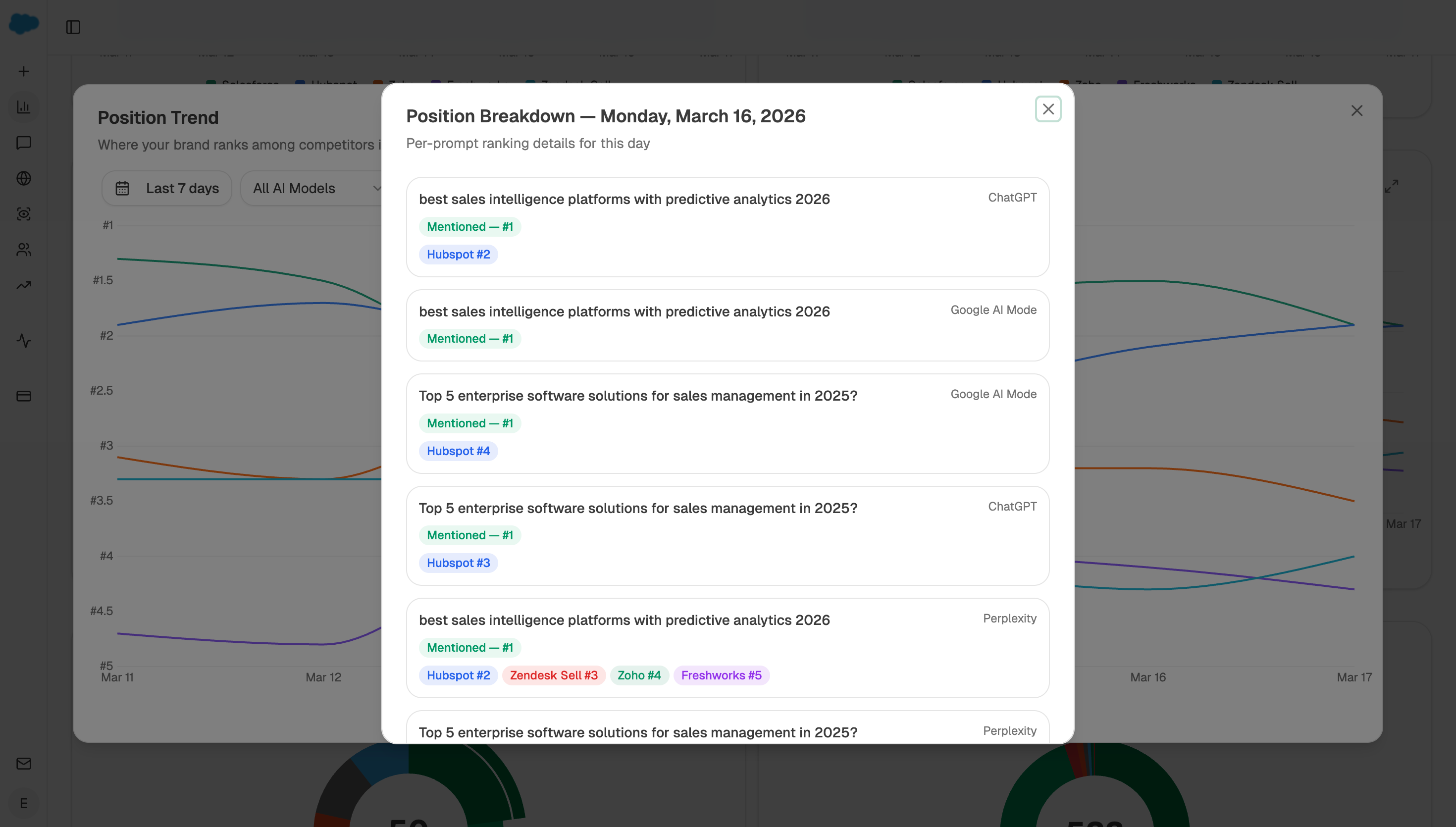 The per-prompt breakdown shows which answers you appear in on a given day, which is where an AI-side decline becomes visible.
Write the diagnosis into the brief
Whatever you find, record it before anyone starts writing. A refresh brief that says "traffic is down, make it better" produces a longer version of the same page.
A brief that says "position held at 4, click-through fell 38% after an AI summary appeared, competitors unchanged" produces a completely different piece of work, and it gives you something to measure against afterwards. That is the argument in what should a content-refresh brief contain.
Run the three questions as one agent
Start (manual, the page URL as short-text) → GSC Page-Keyword Breakdown for position and click-through over 16 months → Google Search returning the current top ten and their page types → Content Optimizer fetching your live page → citation-decay-alert and Citation Pages for the AI side → Prompt LLM matching the pattern to one of the five rows above → Export Markdown as a diagnosis note.
Producing a diagnosis note rather than a recommendation is deliberate. A tool that jumps to "rewrite this" removes the step where someone notices the page is fine and the result page moved.
FAQ
Related answers
- How do I spot content decay before it becomes a big traffic loss?
- How do I compare my declining page with the pages that now win the SERP?
- What should a content-refresh brief contain?
- How do I find pages that compete with each other?
Diagnose before you rewrite
Analyze AI checks your page, the result page, and your AI citations together, then returns the cause rather than a guess.
Start your free trial