
How do I find pages that compete with each other?
Short answer
Look for queries where more than one of your URLs has appeared over time, and specifically where Google keeps swapping between them. Alternation is the giveaway. Two pages both ranking steadily for the same query is usually fine. Two pages taking turns means neither one owns the intent, and you are splitting the signal.
Pull the queries with more than one of your URLs
Search Console has the answer and it takes about half an hour to extract.
- Export the Queries report for the last 6 months.
- For each query, use the Keyword-Page breakdown to list every URL of yours that appeared for it.
- Keep queries where two or more of your URLs appeared and total impressions are over about 100.
- For each of those, pull the monthly split so you can see which URL ranked in which month.
Step four is the one that matters. Two URLs appearing across six months could be two stable pages serving related intents, which is fine. What you are hunting for is the pattern where URL A ranks in January and March, URL B in February and April, and the average position for both is worse than either achieved alone.
Analyze AI does the extraction in one step with the Keyword-Page Breakdown node, which returns every page of yours picking up a given query.
Read the three patterns
| What the monthly data shows | What it means | What to do |
|---|---|---|
| Both URLs stable, different positions | Two intents, coexisting | Leave alone |
| URLs alternating month to month | Neither owns it | Merge or differentiate |
| One URL falling as another rises | A handover, usually fine | Watch, then retire the loser |
| Both falling since a new page launched | The new page split the topic | Merge back |
The last row is the most preventable and the most common. Someone published a second page on a question you already ranked for, and both have declined since. Checking before publishing avoids it entirely, which is how do I build a topic cluster without cannibalizing my own pages.
Confirm it is really competition
Two checks stop you merging pages that were never in conflict.
Do the two pages actually target the same thing? Search each page's own primary query and compare the top ten. If four or more of the same URLs appear in both result sets, the queries want the same thing. Fewer, and your two pages are serving genuinely different searchers.
Did the decline start when the second page launched? Line the dates up. If page A was already falling before page B existed, you have decay rather than cannibalisation, and how do I diagnose why a page declined before rewriting it is the right read.
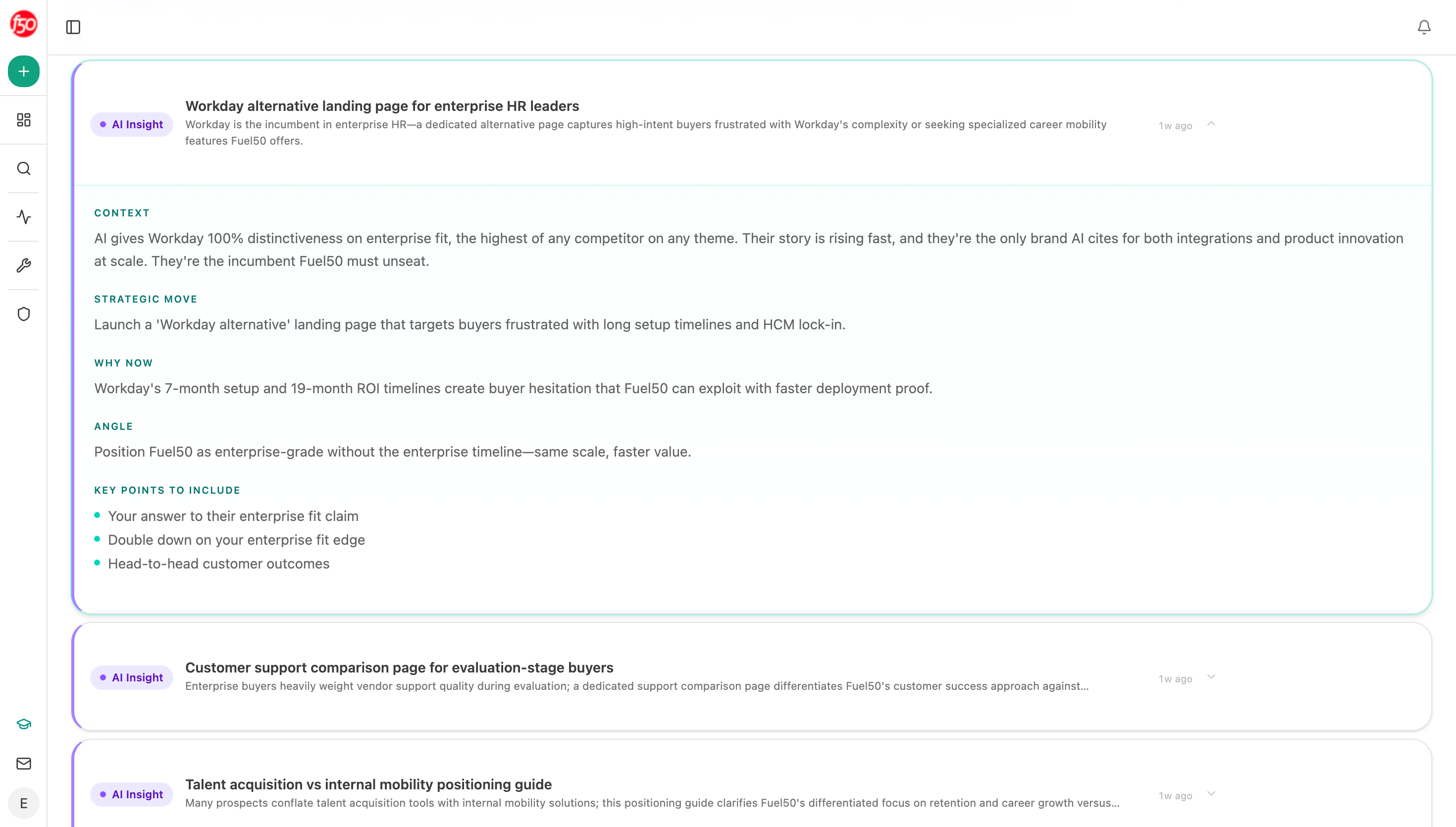 Keeping the target intent recorded against each page is what makes the "are these really the same" check answerable later.
Check the AI side, where the rule is different
Competition works differently in AI answers, and it changes what you should do.
Assistants select passages rather than ranking one URL per site, so two of your pages can both be cited in the same answer without either being penalised. In our own state of AI search research, answers used an average of 3.60 citations on ChatGPT, 6.71 on Perplexity and 5.33 on Google AI Mode across 5,755 matched prompt-days.
What still hurts is splitting your evidence. Two half-complete pages each hold half the proof, and neither is the obvious thing to quote. So merging is usually right for both channels, for two different reasons: you are splitting your ranking on Google and your evidence in assistants.
Analyze AI's Citation Pages shows which of the two pages assistants actually use, which is a useful tie-break when the Search Console data is ambiguous.
Do not mistake a changing result page for competition
One pattern looks exactly like cannibalisation and is not.
If both your URLs are losing clicks while their positions hold, nothing is competing. The result page changed around you, and when an AI summary appears Pew Research found a source link was clicked in about 1% of visits, which is enough to halve two pages at once.
Check position before you check clicks. Positions holding with clicks falling is a result-page problem. Positions swapping is a you problem.
Run the detection monthly
Start (schedule, monthly) → GSC Keyword-Page Breakdown for all queries over 100 impressions → Code node grouping by query and keeping any with two or more of your URLs → Loop computing the month-by-month URL split and flagging alternation → Google Search comparing the top ten for each page's own primary query → Citation Pages showing which page assistants cite → Conditional separating real competition from coexistence → Export CSV with a recommendation per pair.
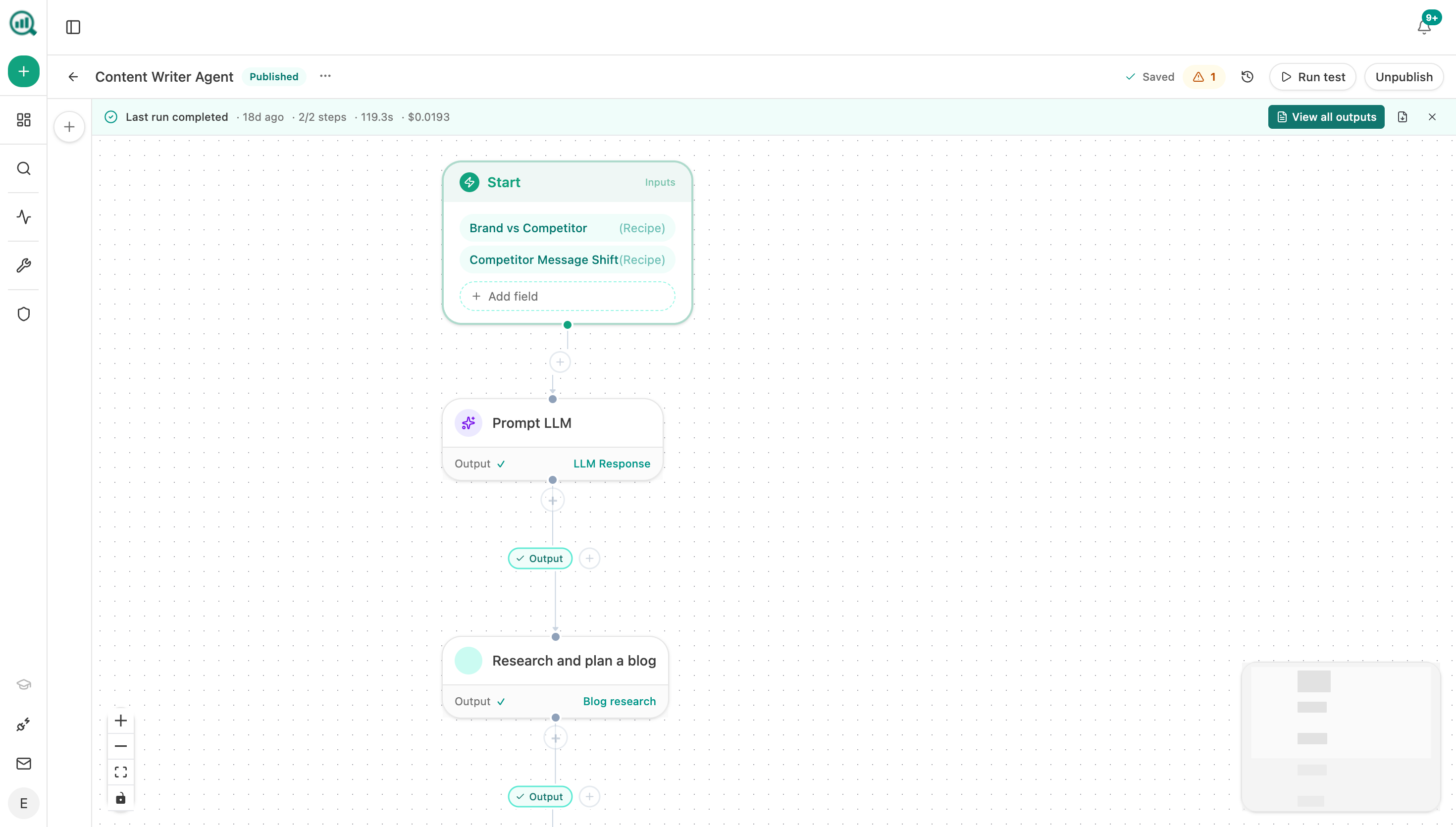 Running the detection as a scheduled agent means new cannibalisation is caught in the month it appears rather than at the next audit.
Flagging on alternation rather than on co-occurrence is what keeps the output small. Co-occurrence alone returns hundreds of harmless pairs. Alternation returns the handful where you are genuinely bidding against yourself.
FAQ
Related answers
- Which of two overlapping pages should win?
- How do I build a topic cluster without cannibalizing my own pages?
- When is deleting or redirecting old content better than updating it?
- How do I diagnose why a page declined before rewriting it?
Find the pages bidding against each other
Analyze AI groups your queries by the URLs that ranked for them and flags the pairs that keep swapping places.
Start your free trial