
How do I keep a client's knowledge base from drifting out of date?
Short answer
Agree what counts as the source of truth, then watch that rather than the pages. A client's knowledge base drifts because their product changes and nobody tells you. Set up a monthly check that compares the published pages against the agreed source, and route every proposed change through the client's own approval so you are never the one asserting what is true.
Agree the source of truth first
Everything else depends on this, and it is the step agencies skip because it feels like paperwork.
Write down where the current truth lives for each category: pricing, features, limits, integrations, security posture, contract terms. It might be a page on their site, a spreadsheet, a product owner, or a release note feed. Name the artefact and name the person.
Without this you end up in the worst position available, which is guessing what is current on behalf of a client and being wrong in public on their domain.
In Analyze AI this becomes the client's Brand Vault, holding blocks such as PRODUCTS_FEATURES, DIFFERENTIATORS, COMPETITOR_CONTRAST, PROOF_POINTS, CLAIMS_MESSAGING_RULES and DISALLOWED_PHRASES, kept per client. Once it exists you have something to check pages against rather than an opinion.
Watch for the four kinds of drift
Knowledge bases go stale in predictable ways, and each has a different detector.
| Drift | How it happens | How to catch it |
|---|---|---|
| Product drift | A feature ships or is deprecated | Compare pages against the vault monthly |
| Price drift | Packaging changes and nobody says | Watch their pricing page for changes |
| Competitive drift | A rival relaunches, comparisons go stale | Track the competitors named in their content |
| Link drift | Their site restructures | Crawl internal links after any change |
Price drift is the one that embarrasses everyone, because a wrong price is caught by a prospect and reported back to your client as your mistake. Put a change detector on their pricing page specifically.
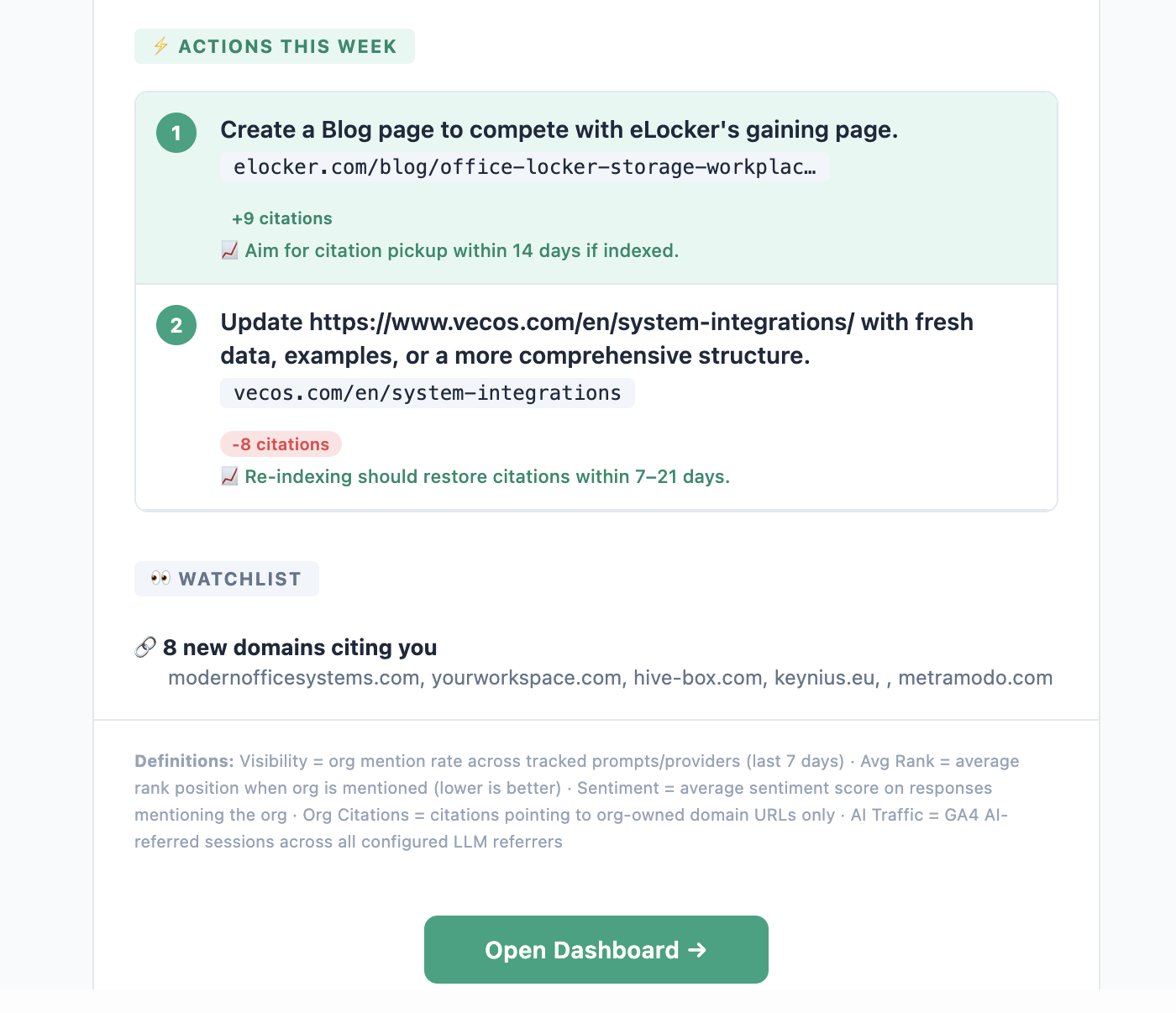 A scheduled digest per client is what turns drift monitoring into something that arrives rather than something someone remembers to do.
Run one agent per client
The multi-client version is where this gets practical.
Start (schedule, monthly, one agent per client) → Get Sitemap for that client's URL list → Web Page Scrape on their pricing and product pages to detect changes since last run → Inject Brand Context pulling that client's vault → Content Optimizer fetching knowledge base pages and returning what they currently claim → Prompt LLM diffing claims against the vault → proof-gaps recipe for unsupported statements → workflow-memory recipe holding last month's state → Export DOCX as a per-client change pack → Send Notification to the account team.
workflow-memory is what makes this a drift detector rather than an audit. Comparing this month against last month tells you what changed, which is the actionable half. A full audit every month produces the same list and gets ignored by the third send.
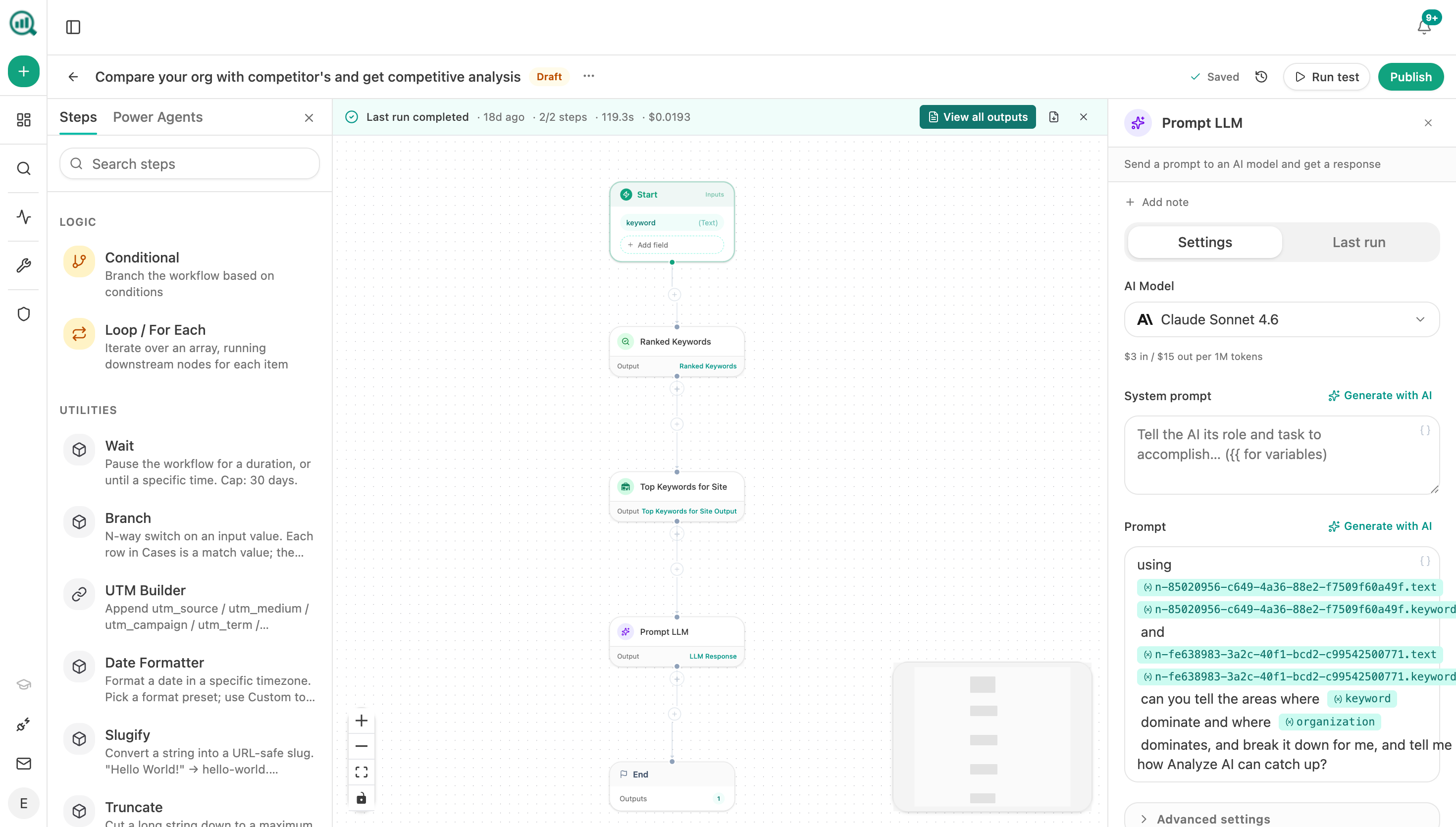 One agent per client, with that client's context injected, is what keeps the checks separate without rebuilding the workflow each time.
Never publish a factual change without the client
This is the governance point and it protects both sides.
You can draft the change. You should not decide that their pricing is now different, or that a feature exists. Route every factual edit through their named owner, with the proposed change, the reason, and the source you compared against.
Practically that means the agent stops at an export and a notification rather than writing to their CMS. Analyze AI has write nodes for WordPress, Notion, Sanity and Contentful, and on client work the sensible default is to leave them out of the chain until a specific category has earned it. The operating model is the same one in how do I maintain hundreds of pages without giving AI full publishing access.
Report drift as part of the retainer
Drift monitoring is easy to do and easy to get no credit for, because nothing visible happens when it works.
Report it monthly with three numbers: pages checked, discrepancies found, changes approved and shipped. Over two quarters that becomes a defensible line item, and it is far easier to renew than an equivalent spend on new articles.
Add the citation view alongside it. Analyze AI's Citation Pages shows which of the client's pages assistants use as sources, and a stale claim on a cited page is being repeated to people who never visit the site. Google's AI features documentation confirms eligibility follows ordinary indexing, so any page they publish is potentially being read this way.
FAQ
Related answers
- How do I maintain hundreds of pages without giving AI full publishing access?
- How do I find the outdated stats, links, and product claims across my content?
- How do I build a reusable library of approved claims and proof points?
- Who should own content maintenance after publication?
Catch client drift before their prospects do
Analyze AI runs one agent per client, diffs their pages against their own source of truth, and hands you a change pack to approve.
Start your free trial