
Is there a tool that suggests updates I can approve, instead of auto-rewriting everything?
Short answer
Yes, and the useful ones share four properties. They show you a diff rather than a replacement page, they attach a reason to every suggestion, they scope changes to the specific problem instead of rewriting around it, and they leave the original recoverable. A tool missing any of those is an auto-rewriter with a confirmation dialog.
Check the four properties
Whatever you build or buy, test it against these before you point it at a real library.
Does it show a diff? You need the changed lines, not a new version of the page. Reviewing a full rewrite means rereading the article, which nobody sustains past the first ten pages.
Does every suggestion carry a reason? "This figure is from 2023 and your claims library says the current one is X" is checkable in seconds. A suggestion with no reason forces you to investigate before you can decide, which costs more than making the edit yourself.
Is the change scoped? A tool asked to update a statistic should change the statistic and the sentence around it. If it returns a reworked section, it has decided things you did not ask it to decide, and the review is now an edit.
Can you undo it? Both the individual change and the batch. Without that you will not run it on anything that matters.
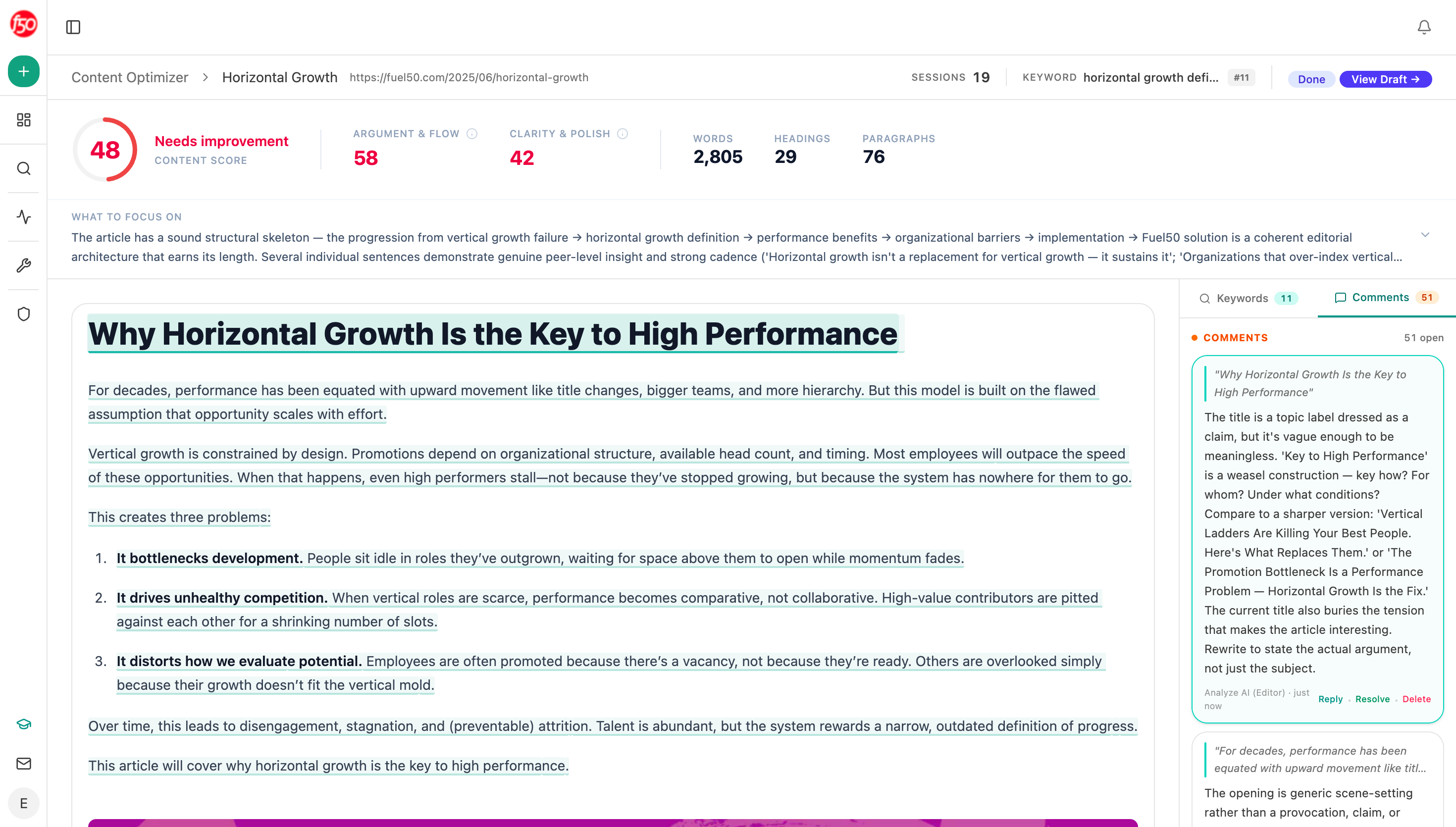 Comments sitting against specific passages are the reviewable form: you see what is being questioned and why, not a replacement article.
Know why full rewrites go wrong
The failure is not usually quality. It is that a rewrite silently removes what was working.
A page that ranks and gets cited has specific things doing that work: a worked example, a table, an opening that answers the question in forty words. A model improving flow deletes them without knowing they mattered, and the page reads better and performs worse.
That risk is real for citations in particular. In our own state of AI search research, page authority barely predicted citation across the 4,824 pages we checked, so the citation came from what the page says rather than from the domain. Rewrite the passage and you may lose the citation while the ranking looks unchanged for months. Google's AI features documentation confirms eligibility follows ordinary indexing, so nothing warns you that a page stopped being useful as a source.
Scoped edits avoid this by construction. They cannot delete what they were not asked to touch.
Ask what it uses as a source of truth
This is the question that separates a useful suggester from a plausible one.
A tool suggesting that your pricing is out of date needs to know what your pricing is. If it is inferring from the page itself or from a model's memory, its suggestions will be confident and wrong.
In Analyze AI that source is the Brand Vault, holding blocks such as PRODUCTS_FEATURES, DIFFERENTIATORS, COMPETITOR_CONTRAST, PROOF_POINTS, CLAIMS_MESSAGING_RULES and DISALLOWED_PHRASES. The Inject Brand Context node pulls those into the step that generates suggestions, so a proposed change is measured against what you have said is currently true. The proof-gaps recipe works the other way, listing pages making claims with nothing behind them.
Without a source of truth you get grammar suggestions. With one you get "this page says fourteen integrations and your vault says twenty-two."
Build the review flow around batches
The tool matters less than the flow around it, and one thing dominates: group suggestions by finding type rather than by page.
Fourteen pages quoting an old price is one decision. The same fourteen presented page by page is fourteen investigations, and the reviewer gives up around page six.
Group first, then review. That single change is usually the difference between a maintenance programme that runs and one that stalls, and it is the operating model in how do I maintain hundreds of pages without giving AI full publishing access.
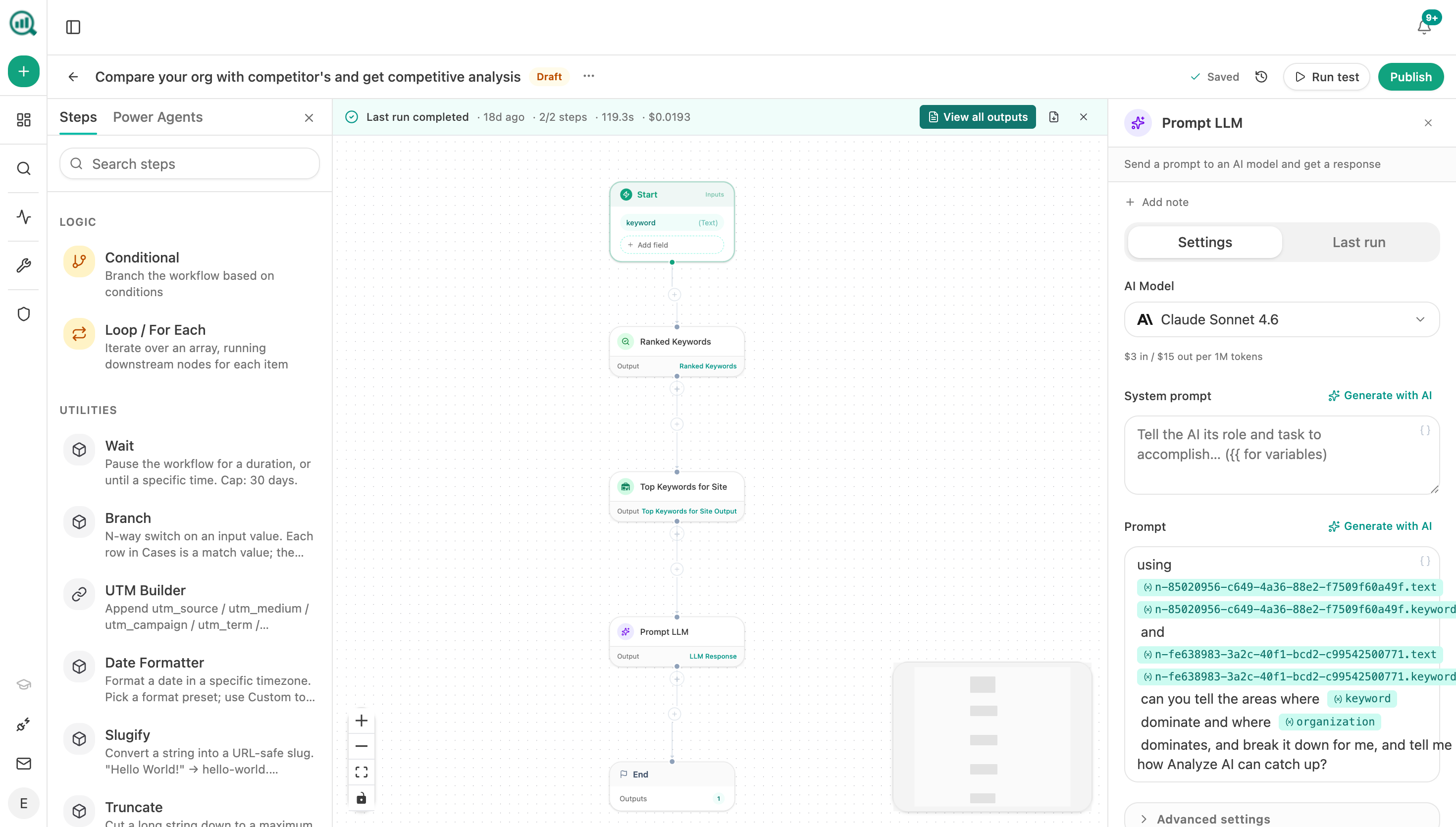 Suggestions are generated in a Prompt LLM step with your brand context injected, which is what gives each one a checkable reason.
Wire it up
Start (schedule, weekly) → stale-content and audit-findings recipes for pages with known issues → Content Optimizer fetching each page → Inject Brand Context pulling current claims and rules → Prompt LLM producing scoped edits with a reason and a source for each → proof-gaps recipe checking the suggestions themselves for unsupported claims → Code node grouping suggestions by finding type across pages → Export DOCX as a review pack → Send Notification.
Running proof-gaps over the suggestions rather than only over the pages is worth copying. It catches the case where the tool proposes a confident new claim you cannot evidence, which is the failure mode nobody checks for because the suggestion looks like an improvement.
FAQ
Related answers
- How do I maintain hundreds of pages without giving AI full publishing access?
- How do I find the outdated stats, links, and product claims across my content?
- How do I build a reusable library of approved claims and proof points?
- How do I record exactly what changed in a refresh so I can prove it worked?
Get suggestions you can check in ninety seconds
Analyze AI proposes scoped edits with a reason and a source attached, grouped by finding type, and never publishes on its own.
Start your free trial