
Why did my page lose its AI citations, and how do I win them back?
Short answer
Put the citation line next to the traffic line first. If citations fell and traffic held, something newer answers the question better and your ranking has not caught up. If both fell together, it is an ordinary content or indexing problem. If citations fell right after you edited the page, you deleted the passage that was being quoted, which is the most common and most fixable cause.
Read the two lines together
The diagnosis comes from the relationship between them, not from either alone.
| Citations | Traffic | Most likely cause |
|---|---|---|
| Down | Flat | A better answer appeared. Your ranking will follow |
| Down | Down | Ordinary decay, or the page stopped being indexed |
| Down | Flat, right after an edit | You removed the cited passage |
| Flat | Down | Not a citation problem. The result page changed |
The third row is the one worth checking first if you have refreshed recently, because it is self-inflicted and reversible.
Analyze AI's citation-decay-alert recipe returns pages losing citations faster than they lose traffic, which is the first row detected automatically. Citation Pages gives you the per-page history to line up against Search Console.
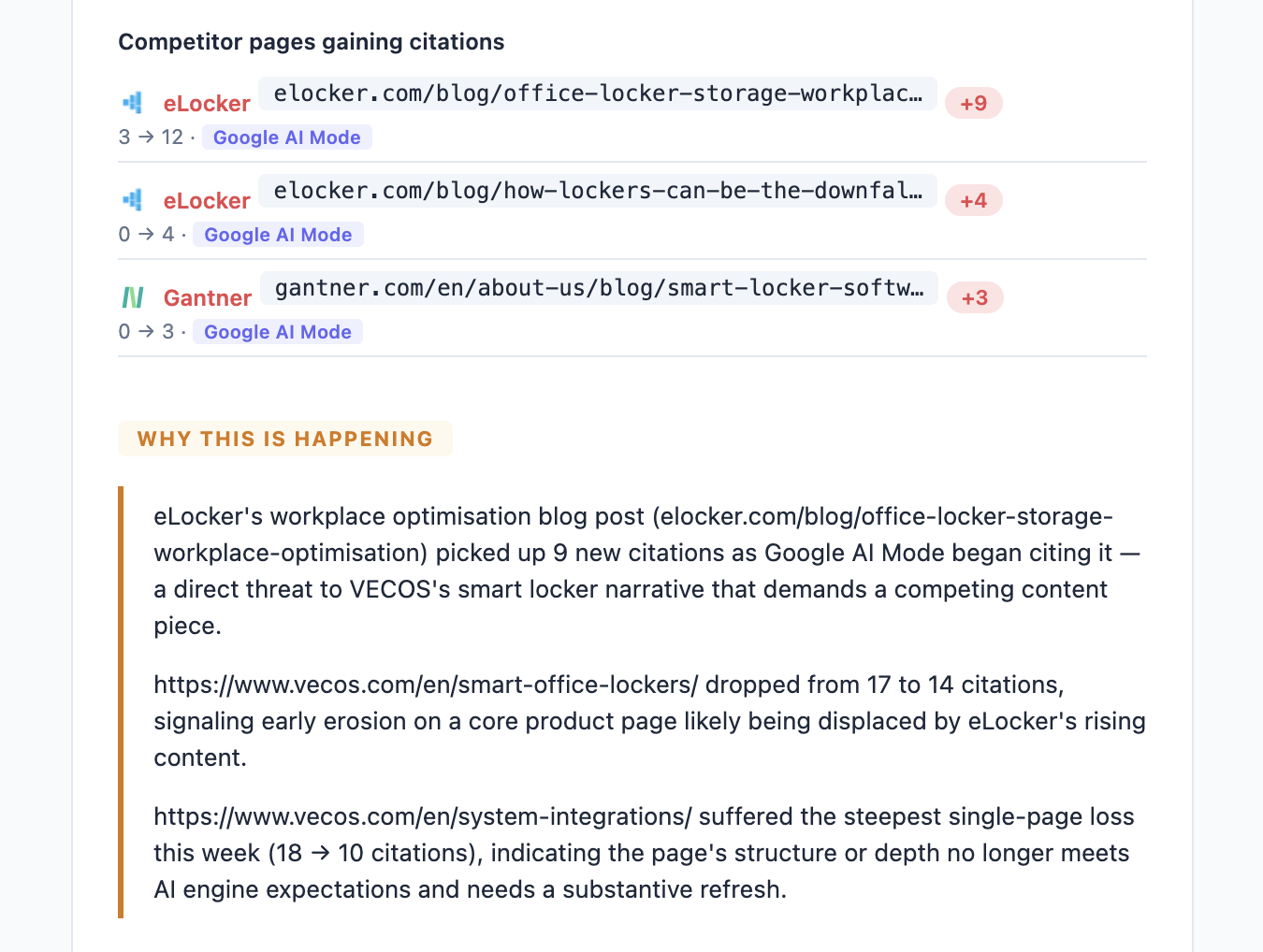 The digest pairs your losses with the competitor pages that gained, which usually answers the question before you start investigating.
Check whether you deleted what was being quoted
If the drop follows an edit, this is almost certainly it.
Pull the previous version of the page and compare it against the current one. You are looking for a specific removal: a table, a worked example, a definition in the first hundred words, a figure with a source. Assistants quote passages, so removing the passage removes the reason to cite you.
This is why a refresh brief should list what must not change, which is the field described in what should a content-refresh brief contain.
The fix is to put it back, in a form that can be lifted cleanly. Restore the table, restore the number with its source and date, and answer the question in the opening rather than building to it.
Find out who is being cited instead
If nothing changed on your side, someone else changed on theirs.
Run the question through Analyze AI's Ad Hoc Prompt Searches and read what the answer was built from. The Sources view lists the pages and domains behind the answers, and competitor-sources returns pages that cite a rival and have never cited you.
Then compare their page against yours on what is extractable rather than on length: do they answer in the first hundred words, do they have a number you lack, is there a table where you have prose.
The encouraging part is that this is winnable regardless of your size. Our own state of AI search research examined 4,824 cached pages and found a site's strength was a poor guide to whether its pages were cited. And the ecosystem is broad: across 7,055 cited domains, the top ten held only 12.2% of ChatGPT citations, 11.1% of Perplexity and 13.1% of Google AI Mode.
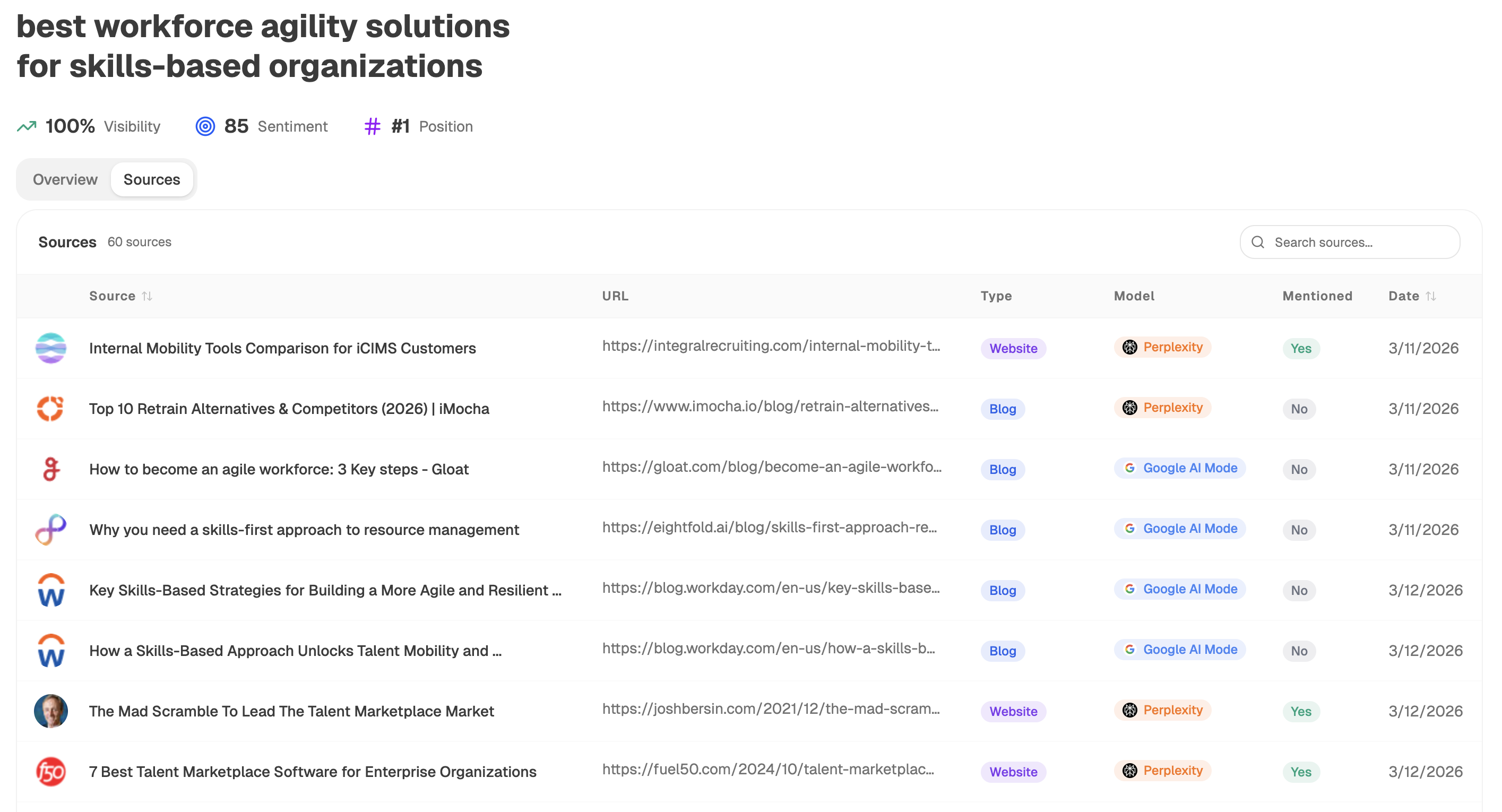 Reading the answers per provider shows which pages replaced yours, and whether the loss happened on one surface or all three.
Rule out the boring causes before rewriting
Two mechanical explanations account for a share of citation losses and neither needs a writer.
The page stopped being indexed. Google's AI features documentation explains that eligibility follows ordinary indexing, so a page that fell out of the index is simply unavailable as a source. Check the URL in Search Console before anything else.
The URL moved. A migration, a merge, or a redirect chain can take a cited page out of circulation until the new address is recrawled. That is one of the reasons to run a link check after any restructure, covered in how do I find internal links that went stale after site changes.
Expect recovery to be slow and sticky
One finding shapes how patient to be.
In our research, mentions were strongly path-dependent: after a mention, the next observation mentioned the same brand about 83% of the time across all three surfaces, and after a miss it recovered only 10% to 12% of the time. Presence sticks, and so does absence.
Practically that means two things. A restored passage will not bring citations back next week, so give it four to six weeks. And there is no point waiting a miss out, because absence does not correct itself.
Start (schedule, weekly) → citation-decay-alert recipe for pages losing citations faster than traffic → Citation Pages for per-page history → GSC Page-Keyword Breakdown for the traffic line over the same window → Web Page Scrape capturing the current version to diff against the last capture → Prompt LLM matching the pattern to one of the four rows → competitor-sources for who is cited instead → Send Notification with the cause named.
Diffing against the last captured version is the part worth building, because the self-inflicted cause is both the most common after a refresh and the only one you can fix the same afternoon.
FAQ
Related answers
- How do I spot content decay before it becomes a big traffic loss?
- How do I compare my declining page with the pages that now win the SERP?
- What should a content-refresh brief contain?
Find out what replaced you in the answer
Analyze AI tracks citations per page, diffs your edits against the last version, and shows which pages are being cited instead.
Start your free trial