

![Featured image for Longer AI Answers Cite Fewer Sources [2026 Study]](/_next/image?url=https%3A%2F%2Fwww.datocms-assets.com%2F164164%2F1785857782-10-length-vs-citations.png&w=3840&q=75)

Summarize this blog post with:


Longer AI Answers Cite Fewer Sources [2026 Study]
We analyzed 22,295 AI answers across ChatGPT, Perplexity, and Google AI Mode to test one of the intuitive assumptions in AI-visibility strategy. Do longer AI answers contain more citations?
The intuitive expectation is yes. A longer answer has more room for source material, so a longer answer should reference more sources. Our data says the intuitive expectation is inverted at the engine level. The engine that writes the longest answers is the engine that cites the fewest sources. And within each engine, answer length is roughly flat regardless of citation count. Citation density appears to be a fixed characteristic of each engine, and it does not scale with answer size.
The dataset covers 115,843 citation events, 460 distinct B2B prompts, and 37 tracked organizations. For this piece we use the same-day matched comparison, which restricts the analysis to 5,755 same-day observations where all three engines answered the same prompt on the same day. Matched comparison controls for the effect of prompt and day, so the engine-level differences we report are not confounded by which prompts each engine answered.
Here are the questions we set out to answer:
- What are the average answer length and citation count on each engine?
- Do longer answers within a single engine contain more citations?
- Which engine has the highest citation density (citations per character)?
- What does this pattern tell us about how each engine synthesizes answers?
- What are the practical implications for a content marketer choosing how long their AI-optimized content should be?
ChatGPT produces the longest AI answers in our matched sample, at an average of 3,361 characters. It cites the fewest sources per answer, at 3.60. Perplexity produces the shortest answers, at 2,447 characters. It cites the most sources per answer, at 6.71. Google AI Mode sits between them, at 2,574 characters and 5.33 citations. The correlation across engines is negative. Longer answers cite fewer sources. Within each engine, citation counts are roughly stable across answer lengths, so the effect operates between engines rather than being driven by long individual answers on one engine.
Table of Contents
TL;DR
- How long are AI answers on each engine? ChatGPT: 3,361 characters average. Google AI Mode: 2,574. Perplexity: 2,447. ChatGPT is 37% longer than Perplexity.
- How many sources does each engine cite per answer? Perplexity: 6.71. Google AI Mode: 5.33. ChatGPT: 3.60. Perplexity cites 86% more sources than ChatGPT despite producing shorter answers.
- What is the citation density (chars per citation)? Perplexity: 365 characters between citations. Google AI Mode: 483. ChatGPT: 933. Perplexity is 2.5x more citation-dense than ChatGPT.
- Do longer answers within one engine contain more citations? No. Citation counts are roughly flat across length buckets within each engine. The between-engine gap is what drives the relationship.
- What is the sample? 5,755 same-day matched observations across 413 unique prompts. The three engines answered the same prompt on the same UTC day, so prompt effects are controlled.
- What should marketers do about this? Stop assuming that longer content gives AI engines more citation slots. Citation density is a fixed engine trait. Focus on making content extractable rather than long.
The Engine Writing the Longest Answers Cites the Fewest Sources
The matched-comparison numbers tell the core story in one table.
| Engine | Avg answer length (chars) | Avg citations per answer | Chars per citation |
|---|---|---|---|
| ChatGPT | 3,361 | 3.60 | 933 |
| Google AI Mode | 2,574 | 5.33 | 483 |
| Perplexity | 2,447 | 6.71 | 365 |
The pairwise differences are all statistically significant. The 95% confidence intervals for the ChatGPT-vs-Perplexity length gap sit at 774 to 1,055 characters. The 95% confidence intervals for the ChatGPT-vs-Perplexity citation gap sit at 2.7 to 3.5 fewer citations per answer. Both gaps are firmly non-zero on a 5,755-observation matched sample.
The intuitive read is that longer answers should have more citations because they have more room to reference sources. Our data says the opposite is true at the engine level. Perplexity’s shorter answers pack 6.71 citations into an average of 2,447 characters. ChatGPT’s longer answers spread 3.60 citations across an average of 3,361 characters. The reader gets a citation every 365 characters on Perplexity and a citation every 933 characters on ChatGPT. Perplexity is 2.5x more citation-dense per character than ChatGPT is.
Google AI Mode sits in the middle on both measurements, but it leans toward Perplexity’s citation-dense pattern. At 483 characters between citations, Google AI Mode is closer to Perplexity than to ChatGPT. That fits the general observation from other studies that Google AI Mode inherits the citation-heavy discipline of Google’s search infrastructure while producing more conversational answer text than Perplexity does.
Within Each Engine, Length Does Not Buy You Citations
The engine-level pattern raises a specific follow-up question. Within a single engine, does a longer answer contain more citations than a shorter one? If yes, marketers would still have a reason to encourage AI engines to produce longer answers about their brand. If no, the citation count is a fixed engine trait and length is essentially decoupled from citation opportunity.
We looked at how citation counts vary across mention buckets for each engine, using the same buckets from our earlier mention-density piece. The mention buckets sort answers by how many times the focal brand is named, and each bucket has its own average length and average citation count.
| Perplexity mention bucket | Avg answer length | Avg citations |
|---|---|---|
| 0 mentions | 2,491 chars | 6.63 |
| 1 mention | 2,380 chars | 7.07 |
| 2 mentions | 2,360 chars | 6.34 |
| 3-4 mentions | 2,437 chars | 6.57 |
| 5+ mentions | 2,529 chars | 6.78 |
Perplexity’s citation count sits between 6.3 and 7.1 across every length bucket. The 5+ mention answers are 38 characters longer than the zero-mention answers, which is about 1.5%. The citation count is essentially flat.
| ChatGPT mention bucket | Avg answer length | Avg citations |
|---|---|---|
| 0 mentions | 3,498 chars | 3.35 |
| 1 mention | 3,504 chars | 3.97 |
| 2 mentions | 3,003 chars | 3.81 |
| 3-4 mentions | 2,975 chars | 4.24 |
| 5+ mentions | 3,477 chars | 3.56 |
ChatGPT’s citation count sits between 3.4 and 4.2 across every length bucket. Answer lengths range between 2,975 and 3,504 characters, and the citation count does not track that variation.
The consistent picture is that each engine has a fixed citation density that does not scale with answer size. Perplexity puts a citation every 350 to 400 characters no matter how long the answer is. ChatGPT puts a citation every 800 to 1,000 characters no matter how long the answer is. Google AI Mode sits in between at around 480 characters. If you got ChatGPT to write a 5,000-character answer about your brand, our data predicts it would still only cite about 5 sources. If you got Perplexity to write a 5,000-character answer, our data predicts it would cite about 14. The engine chooses the density. The answer length does not change it.
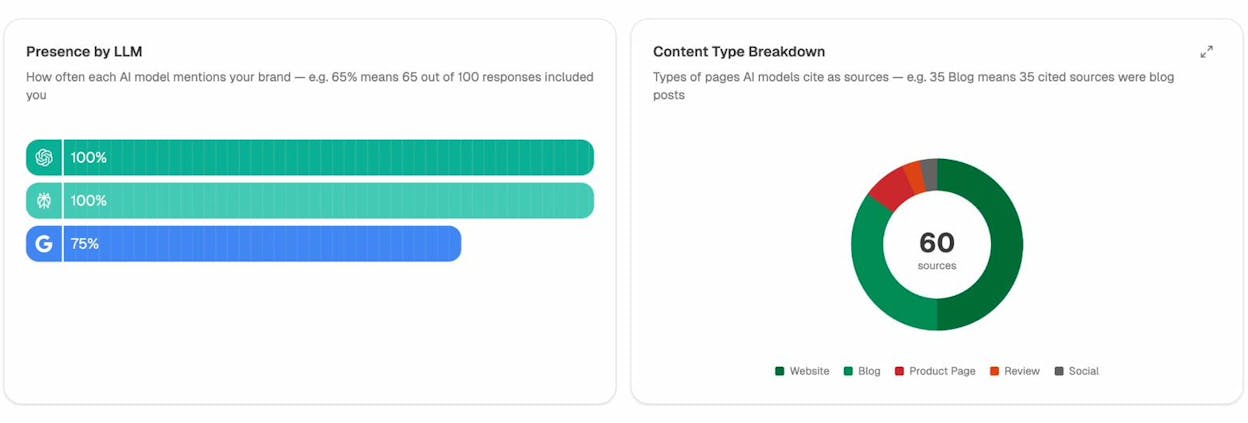
Prompts view showing per-answer citation counts and answer previews across the three engines
Why the Engines Behave This Way
The pattern reflects three different design choices that shape how each engine synthesizes answers.
Perplexity was built as a citation-first answer engine. Every claim in a Perplexity answer tries to have a source attached, and the interface displays inline numbered citations after almost every substantive statement. That design constraint produces a compressed answer where every 350 to 400 characters carries a source anchor. There is not much room for uncited prose because the design discourages it.
ChatGPT was built as a conversational assistant. Live-retrieval was added later, and citations are still an optional addition rather than a design core. ChatGPT tends to write in a more narrative, essay-style voice with descriptive passages, transitions, and synthesis paragraphs that carry no explicit source anchors. The extra length reflects essay-style prose rather than additional source material. When ChatGPT does cite, it cites sparingly, because much of the answer content is synthesized from training data or model reasoning rather than retrieved passages.
Google AI Mode inherits from Google’s search infrastructure. It has been built to cite because its parent product ranked pages, and citation is the natural expression of a ranking system inside a synthesized answer. But its answer style is more conversational than Perplexity’s, so it ends up between the two on both length and citation density. That in-between position appears across every metric we measured in this dataset.
For a marketer, the design difference means that “give the AI more content to work with” does not produce more citations. The engine will retrieve the sources it retrieves regardless of how much content is available, and it will fit its own citation density into whatever answer length its design produces. Making your content longer to give the AI more citation slots is optimizing for an assumption that does not match how the engines actually behave.
How This Compares to Other Public Studies
Length-vs-citation is a relatively unstudied relationship in the public research. Most studies report either length or citations, and few pair them at the engine level. Here is where our finding fits.
Whitehat SEO analyzed 118,000 AI-generated answers and reported that Perplexity averages 21.87 citations per response, Google AI Mode averages 8.34, Claude averages 5.67, and Copilot averages 6.89. Their absolute numbers are much higher than ours (our matched sample gives Perplexity 6.71 and Google AI Mode 5.33), and the difference reflects different deduplication methodology. Whitehat SEO appears to count each URL reference as a citation, while our sample deduplicates URLs within a single answer. Both approaches are valid. The direction of the finding is what matches. Perplexity cites the most. Their ChatGPT number is not reported directly, but their broader description is consistent with our finding that ChatGPT cites least.
Leapd reported that Perplexity averages 21.87 citations per response, “the highest of any major” AI engine, and that Perplexity cites “nearly three times as many sources per response as ChatGPT.” Their 3x multiplier is close to our 86% higher rate (6.71 vs 3.60 = 1.86x, so 86% higher). The exact multiplier depends on deduplication, but the pattern holds. Perplexity cites much more than ChatGPT per answer on both samples.
Semrush analyzed 5,000 keywords across 150,000 citations and reported that “commercial queries trigger responses about 2x longer than informational ones.” Their finding is a within-engine query-type effect on length. Our finding is a between-engine architectural effect on the length-to-citation relationship. Both effects exist in parallel. Commercial queries produce longer answers on any engine, and independently, the engine you are on determines how many citations fit in a given length. A commercial query on ChatGPT produces a long answer with modest citation count. The same commercial query on Perplexity produces a shorter answer with substantially more citations.
Averi reported that Google AI Mode cites in 76.3% of responses and Perplexity visits about 10 pages per query while citing 3 to 4 of them. Their 3 to 4 citations for Perplexity sits below our 6.71 matched average and below the Whitehat/Leapd 21.87. The variance across studies for Perplexity specifically is wide, ranging from 3.4 to 21.87 depending on methodology. Our 6.71 sits at the lower end because we deduplicate URLs within an answer and use a B2B matched sample. What is consistent across every study is that Perplexity cites more per answer than ChatGPT does.
The pattern across all four studies is consistent. The direction always favors Perplexity for citation count. The absolute numbers vary based on how “citation” is counted. And the length-versus-citation angle we report here is not directly measured elsewhere, so our finding on citation density as a fixed engine trait is a novel contribution to the public conversation.
What This Means for Content Strategy
Three things follow from the citation-density pattern.
The first is that content length is not the mechanism for earning more AI citations. If your content strategy has been to write longer articles thinking AI engines will pull more citations from a longer source, our data says the engines do not scale citations with length. Perplexity will cite the same 350-character-per-citation density whether it pulls from a 1,000-word article or a 5,000-word article. ChatGPT will cite the same 900-character-per-citation density either way. The content quality and extractability drive whether you get cited at all. The content length does not drive how many times you get cited across the answer.
The second is that Perplexity is the engine where a single well-optimized page can compound the most citation impact. Because Perplexity’s citation slots come at three times the density of ChatGPT’s, a page that earns a Perplexity citation gets more surrounding source-material real estate to be discussed alongside. The Citation Analytics view shows per-page citation counts across engines, so a marketer can see whether the same page earns more citation events on Perplexity than on ChatGPT, and calibrate content investment accordingly.
The third is that measuring citation-per-answer requires calibrating against the engine’s baseline density. Reporting “we got 4 citations in this Perplexity answer and 4 in this ChatGPT answer” hides that 4 citations on Perplexity is below the 6.7 average while 4 citations on ChatGPT is above the 3.6 average. The AI Visibility Tracking view surfaces per-engine citation baselines so the reporting compares apples to apples across engines with different citation densities.
To make the calibration concrete, a page cited in three Perplexity answers and three ChatGPT answers looks like equal performance on the surface, but the two numbers mean different things. Three Perplexity citations put your page in the top half of citation counts for those answers. Three ChatGPT citations put your page above the average, because ChatGPT’s baseline is 3.6. The same absolute count reflects stronger performance on ChatGPT because the citation slots are scarcer per answer. Reporting citation counts without the engine baseline hides that asymmetry, so the team ends up either underweighting ChatGPT wins or overweighting Perplexity ones without noticing.
The Bigger Story
The industry has spent 2025 and 2026 telling marketers that longer, more comprehensive content earns more AI visibility. That framing rests on an assumption our data contradicts. Answer length is not the mechanism for citation count. Citation density is a fixed engine characteristic that does not scale with answer size. Making your content longer to give ChatGPT more citation opportunity is optimizing for a lever that does not exist. What actually earns citations is extractability, freshness, and mention density on third-party sources, which we covered in earlier pieces in this series.
This finding stacks with the other State of AI Search pieces. Cross-engine consensus is rare, so per-engine citation-density baselines are the right unit of comparison. Website authority does not predict citations at the page level, so a long, high-DR page does not automatically produce more citation events either. The citation ecosystem is broad across 7,058 domains, so citation-per-answer is only one measurement layer of visibility. And Perplexity produces mention-dense answers about 2x as often as ChatGPT does, which stacks with its citation-density advantage to make Perplexity the highest-yield channel for both mentions and citations per successful appearance.
The rest of this State of AI Search series unpacks the other structural patterns we found in the same dataset. Later pieces look at how prompt phrasing changes brand-mention probability, how industry-specific mention rates vary across categories, and how the specific perception labels the AI attaches to your brand differ across engines.
The finding to hold onto from this piece is the simple one. The engine writing the longest answers cites the fewest sources. Citation density is a fixed engine trait. Focus on making content extractable rather than long. Report citation counts per engine relative to that engine’s baseline, so the comparison is fair.
This research was conducted using Analyze AI, which tracks brand visibility, per-answer citation counts, and answer-length benchmarks across ChatGPT, Perplexity, Google AI Mode, and every other major AI engine.

Ernest

Ibrahim
![Featured image for The State of AI Search in B2B [2026]](/_next/image?url=https%3A%2F%2Fwww.datocms-assets.com%2F164164%2F1785857899-16-state-of-ai-search-b2b-2026.png&w=3840&q=75)

![Featured image for Google AI Mode Cites Sources in 97% of Answers [2026]](/_next/image?url=https%3A%2F%2Fwww.datocms-assets.com%2F164164%2F1785857495-02-citation-presence.png&w=3840&q=75)
![Featured image for Perplexity Mentions Brands Most Densely [2026 Study]](/_next/image?url=https%3A%2F%2Fwww.datocms-assets.com%2F164164%2F1785857765-09-mention-density.png&w=3840&q=75)