

![Featured image for Perplexity Mentions Brands Most Densely [2026 Study]](/_next/image?url=https%3A%2F%2Fwww.datocms-assets.com%2F164164%2F1785857765-09-mention-density.png&w=3840&q=75)

Summarize this blog post with:


Perplexity Mentions Brands Most Densely [2026 Study]
We analyzed 22,295 AI answers across ChatGPT, Perplexity, and Google AI Mode to measure not just whether each engine mentions a brand, but how many times it names that brand within a single answer. Presence and density are two different measurements. An engine can name your brand once in a long answer where the mention disappears into the middle of a paragraph, or it can name your brand five times across the response so the reader cannot miss it.
The dataset covers 115,843 citation events, 460 distinct B2B prompts, and 37 tracked organizations. For this piece we look at every stored answer and count the number of distinct focal-brand mentions inside that answer, then bucket the answers by mention count.
Here are the questions we set out to answer:
- How often does each engine name your brand zero, one, two, three-to-four, or five-plus times in a single answer?
- Which engine produces the highest share of mention-dense answers?
- What do mention-dense answers look like in terms of length and citation count?
- Which prompt types drive mention-density?
- What does this mean for how marketers should think about engine prioritization?
Perplexity produces mention-dense answers about 2x more often than ChatGPT and 3x more often than Google AI Mode, when we look at the 5+ mention bucket. That is a real difference. But most Perplexity answers, 58.5% of them, still do not mention the brand at all. The mention-density advantage operates inside the subset of answers where Perplexity names the brand. It does not describe overall visibility. Once Perplexity decides to name a brand, it names that brand more times than the other engines would. That is a specific kind of value, and it is different from the “does Perplexity give me more visibility” question.
Table of Contents
TL;DR
- What share of answers mention the brand five or more times? Perplexity: 10.6%. ChatGPT: 5.6%. Google AI Mode: 3.7%. Perplexity produces mention-dense answers roughly 2x as often as ChatGPT and 3x as often as Google AI Mode.
- What share of answers do not mention the brand at all? Perplexity: 58.5%. ChatGPT: 66.5%. Google AI Mode: 65.2%. Perplexity misses less often, but every engine misses the brand on the majority of B2B answers.
- What is the mean mention count per answer? Perplexity: 1.38. ChatGPT: 0.97. Google AI Mode: 0.79. The averages are much closer than the 5+ tail suggests.
- Are mention-dense answers longer or shorter? Roughly the same length as answers with fewer mentions. Perplexity’s 5+ mention answers average 2,529 characters versus 2,491 for its zero-mention answers.
- Which prompt types drive the highest mention density? Recommendation and shortlist prompts, which explicitly ask the AI to name and describe brands.
- What should marketers do about this? Treat Perplexity as the “prominence channel” for the answers where you already appear, and treat presence as a separate battle where all three engines still miss you the majority of the time.
The 5+ Mention Bucket Is Where the Engines Split Most
We counted the number of distinct focal-brand mentions inside each answer and bucketed the answers by mention count.
| Mention count | ChatGPT share | Perplexity share | Google AI Mode share |
|---|---|---|---|
| 0 | 66.5% | 58.5% | 65.2% |
| 1 | 10.1% | 12.2% | 15.8% |
| 2 | 9.0% | 7.5% | 7.7% |
| 3-4 | 8.8% | 11.2% | 7.6% |
| 5+ | 5.6% | 10.6% | 3.7% |
The zero-mention bucket sits at 58 to 67% across all three engines. The engines split most widely at the 5+ mention bucket, where Perplexity is at 10.6%, ChatGPT at 5.6%, and Google AI Mode at 3.7%. That is a 3x range at the extreme end.
The single-mention bucket looks different. Google AI Mode leads at 15.8%, then Perplexity at 12.2%, then ChatGPT at 10.1%. Google AI Mode is more likely to mention the brand exactly once. Perplexity is more likely to mention the brand many times. ChatGPT sits in the middle of both distributions.
The mean-per-answer numbers reflect this compressed picture. Perplexity averages 1.38 mentions per answer, ChatGPT averages 0.97, and Google AI Mode averages 0.79. The mean gap between Perplexity and ChatGPT is 0.41 mentions, which sounds modest. The 5+ bucket gap is much wider because the extra mentions cluster in a tail of answers where Perplexity names the brand repeatedly.
What Mention-Dense Answers Actually Look Like
One reasonable question about mention density is whether mention-dense answers are just longer or more source-heavy, in which case the extra mentions would be an artifact of answer size. Our data says they are not.
| Perplexity mention bucket | Answers | Avg citations | Avg length (chars) |
|---|---|---|---|
| 0 mentions | 4,364 | 6.63 | 2,491 |
| 1 mention | 913 | 7.07 | 2,380 |
| 2 mentions | 559 | 6.34 | 2,360 |
| 3-4 mentions | 835 | 6.57 | 2,437 |
| 5+ mentions | 792 | 6.78 | 2,529 |
Perplexity answers with 5+ mentions are 38 characters longer than zero-mention answers, which is about a percent of the answer size. Citation counts are also nearly flat across mention buckets. The mention density is not a length effect. It is a stylistic effect. Perplexity chooses to name the brand more times within a similar-length, similarly-cited answer.
The pattern on ChatGPT is different.
| ChatGPT mention bucket | Answers | Avg citations | Avg length (chars) |
|---|---|---|---|
| 0 mentions | 5,089 | 3.35 | 3,498 |
| 1 mention | 770 | 3.97 | 3,504 |
| 2 mentions | 690 | 3.81 | 3,003 |
| 3-4 mentions | 675 | 4.24 | 2,975 |
| 5+ mentions | 427 | 3.56 | 3,477 |
ChatGPT’s 5+ mention answers are about the same length as its zero-mention answers, so length is not the driver on ChatGPT either. But ChatGPT’s total answer length runs about 40% longer than Perplexity’s across every bucket, so a mention on ChatGPT is more diluted by surrounding text. A brand named twice in a 3,000-character ChatGPT answer sits at about one mention per 1,500 characters. A brand named twice in a 2,400-character Perplexity answer sits at about one mention per 1,200 characters. Even at the same mention count, the reader-facing density is different.
Recommendation and Shortlist Prompts Drive Most of the Density
Mention density is not evenly distributed across prompt types. The engines produce very different mention counts depending on what the prompt is asking for.
The clearest pattern is that “recommendation” and “shortlist” prompt archetypes drive the highest mention density on Perplexity. When a buyer asks Perplexity for a top-5 CRM shortlist or a specific brand recommendation, Perplexity’s answer format lists the brands, describes each one, and often circles back to name the same brand again in a comparison or summary section. That structure produces 5+ mention counts for the brands that make the list.
Comparison and pricing prompts show a similar pattern but with a narrower brand set. When a prompt asks Perplexity to compare two specific brands, the answer names each brand many times, but only two brands. So the mention-density lift is concentrated in a small number of tracked brands per answer.
Research and how-to prompts produce lower mention density across all three engines. When the buyer asks how something works, the AI describes the mechanism and mentions brands only as examples. Those examples usually get one or two mentions each. Reaching the 5+ mention bucket on a research prompt is rare.
ChatGPT follows the same directional pattern but at lower absolute levels. On recommendation/shortlist prompts, ChatGPT names the top brands, but its longer answers spread the mentions out across more descriptive text, so the mention density per brand stays lower than Perplexity’s. The 5+ mention bucket on ChatGPT is roughly half of Perplexity’s rate on the same prompt archetypes.
For a marketer, this means the mention-density story is not a general “Perplexity is more brand-forward” claim. It is a specific claim about recommendation and shortlist prompts. If those prompt archetypes make up most of your tracked panel, Perplexity is where the mention-density lift lands hardest. If your panel is heavier on research and how-to prompts, the mention-density gap between engines is smaller.
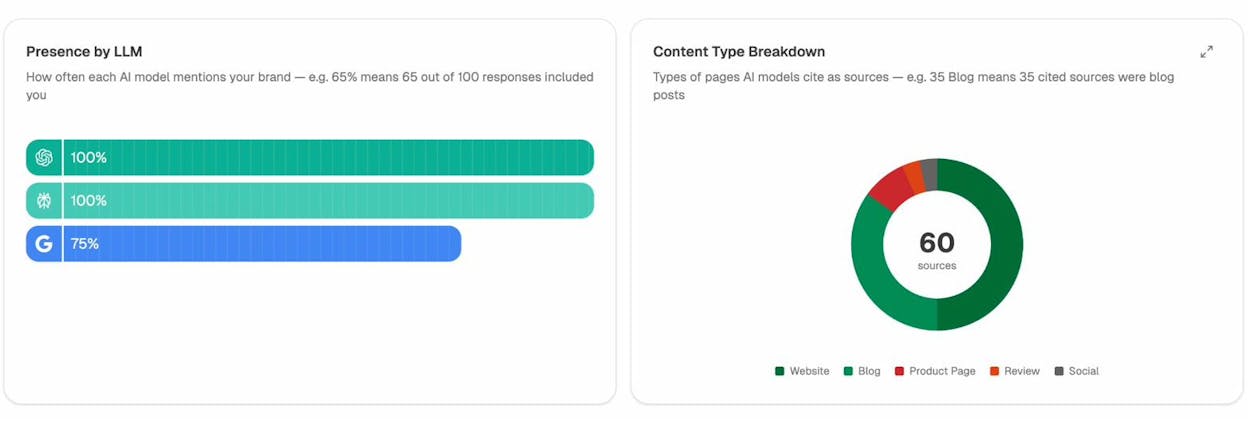
Prompts view showing per-answer brand mentions across the three engines with mention count labels
How This Compares to Other Public Studies
Mention density has been studied indirectly through position, share of voice, and citation frequency in the last twelve months. Almost no public study reports the specific mention-count distribution we report here. Ours is the first per-engine mention-bucket breakdown that we could find. Here is how our finding fits with adjacent measurements.
BrightEdge reported that 86% of Perplexity’s brand mentions land in position 5 or earlier in a list, versus the longer shortlists ChatGPT produces. BrightEdge is measuring position rather than density, but their finding points at the same underlying behavior. Perplexity keeps brand mentions concentrated early and repeats them, while ChatGPT spreads mentions across a longer list. Their 86% early-position finding is compatible with our 10.6% five-plus-mention rate on Perplexity. Both are measuring the “Perplexity puts brands prominently” pattern from different angles.
Discovered Labs and Whitehat SEO reported that Perplexity averages 21.9 citations per response versus ChatGPT’s 10.4. That citation-count difference is bigger than our within-B2B 6.7 versus 3.6 average, because their sample includes a broader mix of consumer and B2B prompts. The direction matches. Perplexity is heavier on both citations and, as our data shows, mentions of the specific brands those citations point at. The two effects reinforce each other. More citations, more mentions per answer, more prominent brand presence when the brand appears.
Leapd reported a 46x difference in brand citation rates across platforms, with ChatGPT at 0.59% and Perplexity at 13.05%. Their “brand citation rate” is defined differently than our mention rate. Their number represents brand mentions inside citations, while ours is brand mentions inside the answer text. Both point at Perplexity being more brand-forward, but the specific numbers reflect different denominators. Our 41.7% Perplexity mention rate on the same prompt-day, from the citation-presence piece, is closer to a direct visibility measurement.
SparkToro found that there is less than a 1% chance ChatGPT returns the same list of brand recommendations twice for the same prompt, but that frequency of appearance across many runs is stable. That finding sits next to ours. Individual response randomness is high, but aggregate patterns like mention density are stable enough to measure. A single ChatGPT answer might name your brand five times or zero times, but across 1,000 answers, the 5.6% five-plus-mention rate we found is a real property of the engine.
The pattern across all four studies is consistent. Perplexity is more brand-forward at every measurement layer. It cites more sources per answer, positions brands earlier in lists, mentions brands more often, and produces mention-dense answers about 2x as frequently as ChatGPT does. That is a real difference. But it happens inside the subset of answers where Perplexity names the brand at all, which is only 42% of Perplexity answers in our B2B sample.
What This Means for How You Prioritize Engines
Three things follow from the mention density data.
The first is that Perplexity is best understood as the prominence channel. When Perplexity names your brand, it does so more visibly than the other engines. If you already have a solid Perplexity mention rate, mention-density optimization is where the incremental gain sits. Getting Perplexity to name your brand a second or third time within the same answer produces a stronger reader impression than getting a single mention. That reader impression matters if the buyer skims Perplexity as a shortlist tool, which is a common Perplexity use case.
The practical consequence for click-through is worth naming. A brand mentioned once in a 2,400-character Perplexity answer competes with roughly six other citations and eight other topics for the reader’s attention. A brand mentioned five times in the same answer occupies more of the reader’s field of view and shows up in the summary or conclusion where the skim reader lands. The difference between one mention and five mentions is not linear in reader-impact terms. Five mentions read as a recommendation. One mention reads as a name-drop.
The second is that presence and prominence are separate problems, and marketers should measure them separately. Reporting “we appear in 42% of Perplexity answers” hides whether those appearances are single-mention flybys or five-plus-mention prominent recommendations. The Prompt Tracking view surfaces per-answer mention counts alongside the mention rate, so a marketer can see the density breakdown per tracked prompt. That density number is what tells you whether you are being casually name-checked or actively recommended.
The third is that recommendation and shortlist prompts are where the density lift compounds. If your buyers are asking “best X for Y” style questions, Perplexity is likely producing the mention-dense answers we measured. If your buyers are asking “how does X work” style research questions, the mention-density advantage is much smaller. The AI Visibility Tracking view lets you split your tracked prompt panel by archetype so the recommendation/shortlist density can be reported separately from the research-question density.
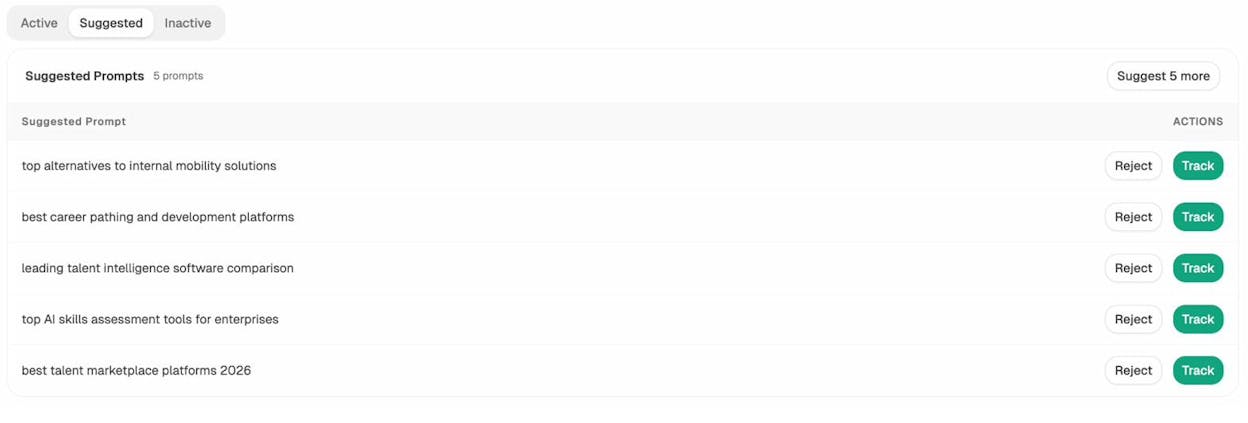
Prompts drill-down view showing per-prompt mention counts and citation source lists across the three engines
The Bigger Story
The industry has spent 2026 telling marketers that Perplexity is the highest-yield channel for AI brand visibility. Our data says that framing is partly right and partly overstated. Perplexity is more brand-forward than the other engines at every measurement layer. It produces mention-dense answers at 2x the ChatGPT rate. It positions brands earlier in lists. It cites more sources per answer. Once your brand is in the Perplexity answer, Perplexity does more for you than the other engines would.
The overstatement is that most Perplexity answers still do not mention the brand at all. 58.5% zero-mention rate is not dramatically better than ChatGPT’s 66.5% or Google AI Mode’s 65.2%. The presence battle on Perplexity is not fundamentally easier than the presence battle on the other engines. What is different is the reward once you win the presence battle.
That reframes the strategy. The right sequence is presence first, then prominence. Get Perplexity to name your brand at all through the mechanisms we covered in the top-domains piece and the YouTube/Reddit pieces. Then optimize for the mention-density lift by owning the recommendation and shortlist prompt archetypes. That two-stage progression matches how Perplexity actually behaves. A single-stage “just get on Perplexity” pitch skips the density step, where a lot of the actual reader impact sits.
This finding stacks with the other pieces in the State of AI Search series. Cross-engine consensus is rare, so Perplexity’s density is a per-engine advantage that will not transfer directly to ChatGPT or Google AI Mode. Cited-page sentiment does not predict AI-answer sentiment, so density and sentiment are two different levers to pull. And the top 10 domains cover only 12% of citations, so the source pool feeding those mention-dense Perplexity answers is broader than a top-10 list captures. Sequencing matters. Presence first, then prominence, on top of a per-engine source portfolio.
The one nuance for anyone reporting to a CMO is that mention density does not translate to click-through in the same way that a search-result ranking does. A five-mention Perplexity answer produces a stronger reader impression, but the reader still has to click one of the citation chips to reach your site, and Perplexity’s answer format holds many readers inside the answer itself. So mention density is best reported as a “share of voice inside the answer” metric rather than as a traffic proxy. The traffic question is a separate measurement layer that our earlier citation-presence piece covered under the 97% Google AI Mode citation rate.
The rest of this State of AI Search series unpacks the other structural patterns we found in the same dataset. Later pieces look at how answer length relates to citation count, how prompt phrasing changes brand-mention probability, and how the specific perception labels the AI attaches to your brand differ across engines.
The finding to hold onto from this piece is the simple one. Perplexity produces mention-dense answers about 2x as often as ChatGPT and 3x as often as Google AI Mode. Once you appear on Perplexity, you appear prominently. Optimize presence first. Optimize for mention density second. Report both metrics separately.
This research was conducted using Analyze AI, which tracks brand visibility, per-answer mention density, and citation share across ChatGPT, Perplexity, Google AI Mode, and every other major AI engine.

Ernest

Ibrahim
![Featured image for The State of AI Search in B2B [2026]](/_next/image?url=https%3A%2F%2Fwww.datocms-assets.com%2F164164%2F1785857899-16-state-of-ai-search-b2b-2026.png&w=3840&q=75)

![Featured image for Prompt Type Changes AI Mention Rate 17 Points [2026 Study]](/_next/image?url=https%3A%2F%2Fwww.datocms-assets.com%2F164164%2F1785857825-12-prompt-archetypes.png&w=3840&q=75)
![Featured image for B2B AI Mention Rates Range 9% to 70% by Category [2026]](/_next/image?url=https%3A%2F%2Fwww.datocms-assets.com%2F164164%2F1785857809-11-industry-variance.png&w=3840&q=75)