

![Featured image for Brands Keep AI Answer Spots 83% of the Time [2026 Study]](/_next/image?url=https%3A%2F%2Fwww.datocms-assets.com%2F164164%2F1785857208-01-persistence.png&w=3840&q=75)

Summarize this blog post with:


We analyzed 22,295 AI answers across ChatGPT, Perplexity, and Google AI Mode to understand whether brand visibility in AI search is stable across repeated observations or shifts from one query to the next.
The dataset covers 115,843 citation events, 460 distinct B2B prompts, and 37 tracked organizations. We looked at consecutive observations of the same prompt on the same surface to see whether a brand mentioned once tends to appear again, and whether a missed brand tends to keep getting missed.
Here are the questions we set out to answer:
- Does a brand mentioned in an AI answer today tend to be mentioned again next time the same prompt is asked?
- If a brand is missed today, does it tend to stay missed?
- Does the persistence rate differ between ChatGPT, Perplexity, and Google AI Mode?
- How long do mention streaks last, and how often do they run for weeks?
- Do the three engines agree with each other on the same prompt on the same day?
- What does all this mean for how often marketing teams should be checking AI visibility?
The pattern is the same on all six questions. Brand visibility in AI search is stable. If a brand is in an AI answer this week, it will still be in the answer next week about 83% of the time. If a brand is missing this week, it will still be missing next week about 88% of the time. That holds on ChatGPT, Perplexity, and Google AI Mode.
Table of Contents
TL;DR
- Does being mentioned today predict being mentioned next time? Yes. When ChatGPT mentions a brand on the last stored observation of a prompt, the next stored observation mentions it again 83.2% of the time. Perplexity comes in at 83.3%. Google AI Mode comes in at 84.2%.
- Does being missed today predict being missed next time? Also yes, and even more strongly. ChatGPT misses again 90.1% of the time after a miss. Perplexity misses again 87.9% of the time. Google AI Mode misses again 88.5% of the time.
- How large is the gap between “in the answer” and “out of the answer”? About 8x on all three engines. Being in the answer today makes you around eight times more likely to be in the next answer than a brand that was missed today.
- Which engine is most stable? Google AI Mode, by a small margin (84.2% after a mention).
- How long are streaks? The median mention streak is one observation. But 31 to 34% of streaks run for three or more consecutive observations, and 17 to 20% run for seven or more. The longest streak in our data was 78 consecutive Perplexity observations for a single brand-prompt pair.
- Do the three engines agree on the same prompt on the same day? Partly. Raw agreement is 73 to 81%. Cohen’s kappa (which corrects for random overlap) sits between 0.44 and 0.58, meaning moderate to substantial agreement, not full alignment.
- What should marketers do about this? Report AI search visibility as a persistent position rather than a one-off event, and treat quarterly checks as inadequate for change detection.
The Same Brands Keep Showing Up (And The Same Brands Keep Missing)
We took every stored observation of every prompt on every surface, sorted them into consecutive pairs, and asked one question. Given whether a brand was mentioned in observation N, what happens in observation N+1?
Here is what we found across the three surfaces.
| AI surface | Previous state | Next-observation mention rate | Sample |
|---|---|---|---|
| ChatGPT | Mentioned | 83.2% | 649 pairs |
| ChatGPT | Not mentioned | 9.9% | 1,034 pairs |
| Perplexity | Mentioned | 83.3% | 731 pairs |
| Perplexity | Not mentioned | 12.1% | 974 pairs |
| Google AI Mode | Mentioned | 84.2% | 690 pairs |
| Google AI Mode | Not mentioned | 11.5% | 932 pairs |
The engine barely changes the persistence. ChatGPT holds at 83.2%, Perplexity at 83.3%, Google AI Mode at 84.2%. Being in the answer on one engine gives you almost the exact same odds of being in the next answer as being in the answer on the other two.
The miss rate is stronger than the mention rate on all three engines. A brand missing from today’s answer will still be missing next observation 88 to 90% of the time. That is higher than the 83% chance that a mentioned brand stays mentioned. So absence is stickier than presence. Once you fall out of an AI answer, you are more likely to stay out than a mentioned brand is to stay in.
The Gap Between “In” and “Out” Is About 8x
Look at the two numbers side by side. A brand that is in the answer today has an 83% chance of being in the answer next time. A brand that is missing today has a 10% chance of being in the answer next time. A mentioned brand is roughly eight times more likely to appear again than a missing brand is to break in.
The 8x gap is why this is measurable at all. If AI answers reshuffled at random every time, both rows of the table would show a similar mention rate and today’s snapshot would tell you nothing about what next week’s snapshot will look like. Instead the two rows are 8x apart, which means today’s snapshot is a strong guide to next week’s.
The 8x gap also changes how to report AI visibility internally. The usual sentence is “our brand appeared in 42% of prompts this week.” A better sentence is “we hold 42% of prompt positions and will keep about 83% of them next week, and the 58% we don’t hold will stay lost 88 to 90% of the time unless we act.” That puts a real number on what a mention is worth and what a miss is costing.
Streaks Are Longer Than One Snapshot Suggests
The 83% number covers one step from today to next time. String many one-step observations together and you get streaks. A streak is a run of consecutive observations where a brand keeps appearing without dropping out.
Here is the streak profile across the three surfaces.
| AI surface | Median streak | Mean streak | Share of streaks 3+ obs | Share of streaks 7+ obs | Longest streak |
|---|---|---|---|---|---|
| ChatGPT | 1 | 4.0 | 31.9% | 17.0% | 63 |
| Google AI Mode | 1 | 4.0 | 34.2% | 20.2% | 32 |
| Perplexity | 1 | 3.7 | 30.8% | 17.4% | 78 |
Half of all mention streaks last exactly one observation before the brand drops out, which is what the median column shows. The mean column shows something different. The average streak runs about four observations, because the streaks that make it past the first two tend to keep going. About one in three streaks lasts three or more observations, and one in five lasts seven or more.
The long streaks show how far the persistence can run. On ChatGPT, one brand held a mention streak of 63 consecutive stored observations for a single prompt. On Google AI Mode, the longest streak was 32. On Perplexity, one brand held a 78-observation streak. Those are not isolated outliers. Between 17 and 20% of all streaks in our data run for seven or more consecutive observations, which for most tracked prompt panels means weeks of continuous mention.
Most streaks are short because most starting positions are borderline. The brand appears once, drops out, and stays out. But the streaks that survive the first two or three observations tend to keep running for a long time. That is why the median (1) and the mean (about 4) are so far apart.
The Engines Agree More Than You’d Expect (But Not Fully)
The 83% number measures stability within one engine over time. The next question is stability across engines. On the same prompt on the same day, how often do the three engines agree about whether a brand appears?
| Surface A | Surface B | Same-day observations | Raw agreement | Cohen’s kappa |
|---|---|---|---|---|
| ChatGPT | Google AI Mode | 5,755 | 81.5% | 0.58 |
| ChatGPT | Perplexity | 5,755 | 73.2% | 0.44 |
| Perplexity | Google AI Mode | 5,755 | 73.4% | 0.44 |
Raw agreement of 73 to 81% sounds high, but most of that comes from prompts where all three engines miss the brand together. Cohen’s kappa strips out that random overlap. A kappa of 0 means agreement no better than chance. A kappa of 1 means perfect agreement. Our three pairs land between 0.44 and 0.58, which is moderate to substantial agreement, not full alignment.
ChatGPT and Google AI Mode are the most-aligned pair at 0.58. Perplexity is the odd one out in both of its pairings at 0.44. If you are picking two engines to track first, ChatGPT and Google AI Mode will give you a more consistent read on the same brand than either paired with Perplexity.
How This Compares to Other Public Studies
The 83% persistence rate cuts against the way most other public studies describe AI search visibility. Here is why the numbers differ.
Searchable.com reported that “only 30% of brands visible in one AI answer remain visible in the next” from a study of 230,000 prompts and 100 million citations. Their 30% is much lower than our 83%. The likely reason is that they compare across engines and prompt families, which broadens the base. We compare within the same engine and the same prompt, which is the unit that matters when you are building a tracked prompt panel.
Semrush studied 50,000 brands in ChatGPT and reported that only 15% of AI search categories have a clear brand winner, with 85% being “unsettled” or “emerging”. This is category ownership, not per-prompt persistence. A category can have three or four brands each holding 30 to 40% persistent positions and still not have a “clear winner” by their definition. The two findings are compatible once you separate the two units of measurement.
Digital Authority Partners published an AI Visibility Gap Study reporting that 66% of URLs cited in week 1 were gone by week 4, with 87% of query-platform pairs falling below their stability threshold. Their unit is URLs, not brands. URLs churn even when brand mentions are stable, because engines can cite different pages of the same brand for the same question. This aligns with a Writesonic analysis showing only 7% of cited sources overlap between GPT-5.4 and GPT-5.3. The URL layer is churning. The brand layer, in our data, is not.
Visionary Marketing reported that “once won, an AI citation persists at the same brand for an average of 41 days before drifting”. This is the closest published number to our finding. Their 41-day duration is a direct measurement of the same underlying phenomenon we describe as 83% next-observation persistence, just expressed as a duration rather than a probability. Different measurement, same story.
All four studies point at the same thing once you separate the two layers. Citation URLs churn from week to week. Brand mentions do not. If you are a marketer, measure at the brand layer.
What This Means For How You Measure AI Search Visibility
Three things follow from an 83% persistence rate.
The first is how often to check. If this week’s answer has an 83% chance of matching next week’s, checking every day is overkill and checking every quarter misses too much. Weekly is the natural cadence, which is why the Weekly Email Digests view covers a rolling seven-day window. A week is long enough to surface real changes and short enough that nothing important slips by.
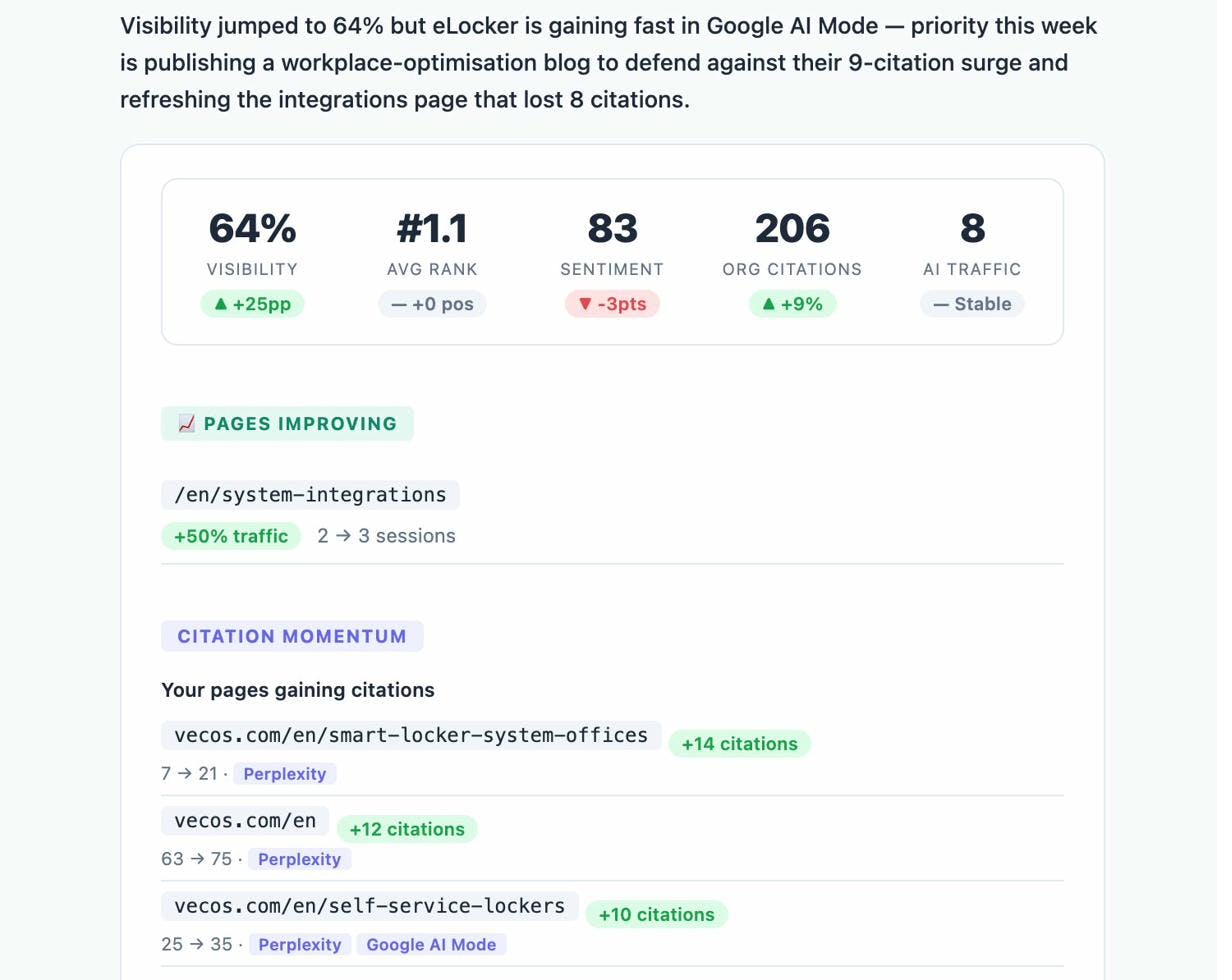
Weekly Email Digest showing a rolling seven-day view of brand mention changes across engines
The second is how to report it. AI visibility is more like a search ranking than a PR mention. You hold a position most weeks and occasionally lose it. So the sentence you want in your board report is not “we won a mention this week.” It is “we hold this position 83% of the time and are losing it 17% of the time to these three competitors on these five prompts.” That matches how the same executives already think about SEO share of voice.
The third is how quickly to act on a miss. Missing brands do not autocorrect. If you are not in the answer this week, you have an 88 to 90% chance of still not being in the answer next week, and the week after that, and the week after that. Every week you wait to fix a missing prompt is a week the odds work against you.
Prompt Tracking and Engine Breakdown are where you see the 83% number in your own data. Prompt Tracking shows the current mention rate for every prompt across every engine, plus the history of that mention across the last N observations. That history is what tells you which prompts are stable wins you can leave alone and which prompts are missing this week and need remediation. If you hold position on 60 out of 100 tracked prompts and lose position on 5 per week, the persistence math tells you exactly where to spend your remediation time.
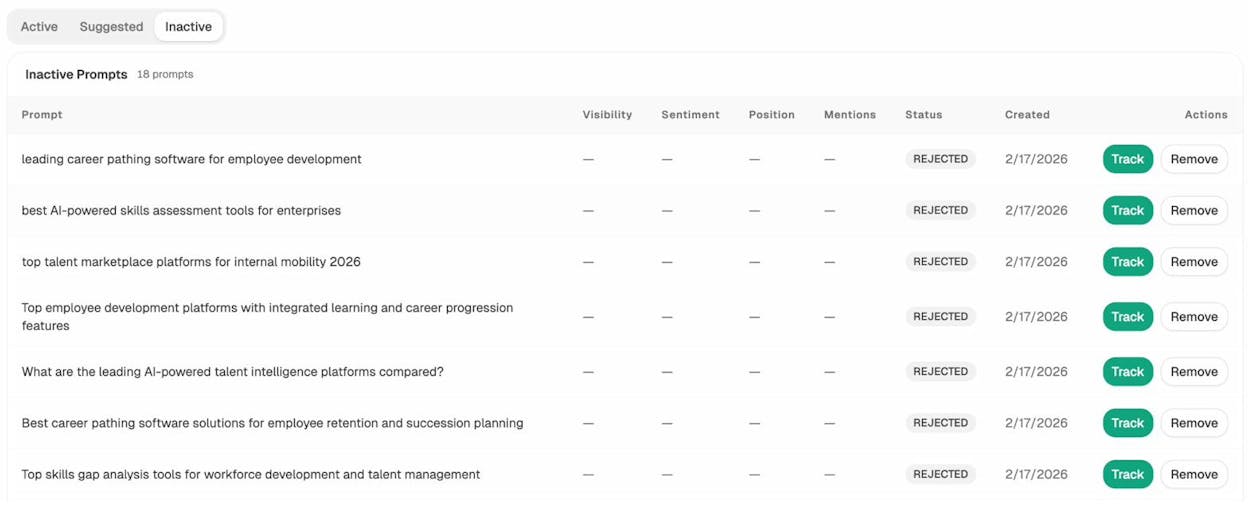
Prompt Tracking dashboard showing per-prompt mention history across ChatGPT, Perplexity, and Google AI Mode
Engine Breakdown splits that same read by engine. Because ChatGPT and Google AI Mode agree with each other more than either agrees with Perplexity, a Perplexity gap that opens up while ChatGPT and Google AI Mode stay stable is almost certainly a Perplexity-specific retrieval problem, not a category-wide one. The remediation is different in each case. Fixing a retrieval problem means changing the sources Perplexity can find. Fixing a category-wide problem means changing the brand signals themselves.
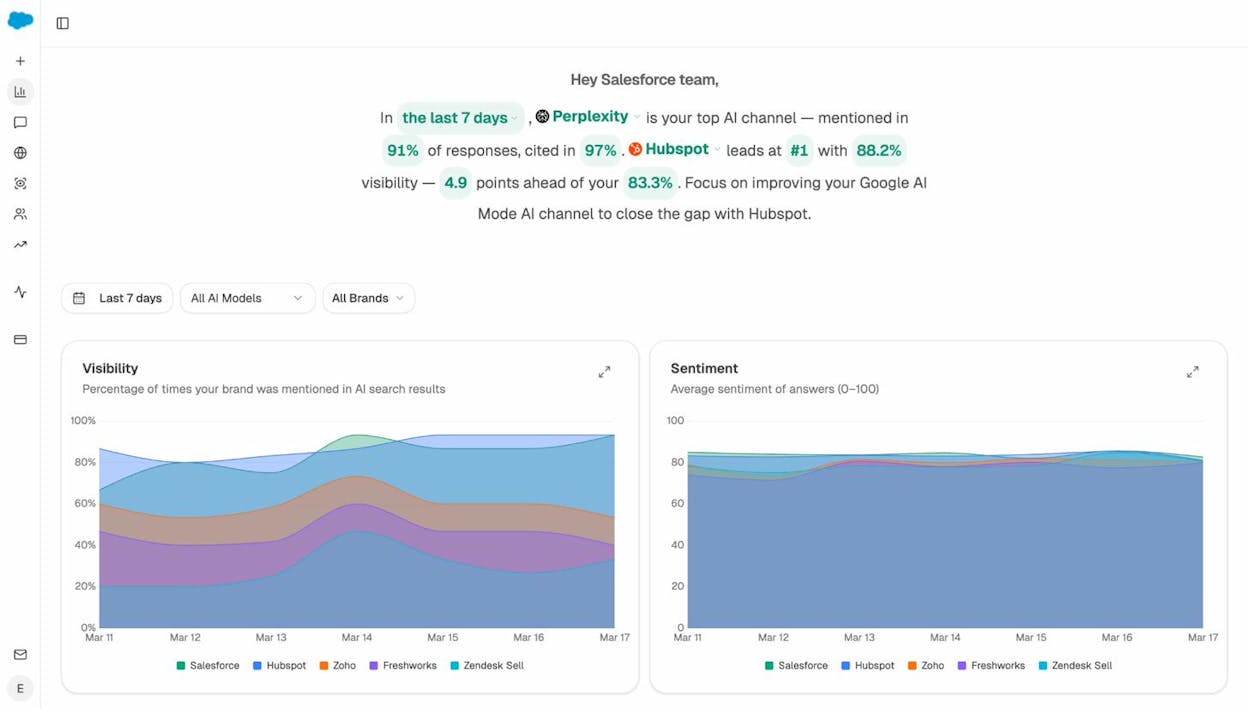
Engine Breakdown view isolating brand mention rates per engine on the same prompt panel
The Bigger Story
Most AI search coverage tells a story of instability. That story sells emergency retainers. It sells rebranded pitch decks. It does not help marketers build durable programs.
The instability is real, but only at the URL layer. The URLs cited by AI engines change from week to week, and any study that measures them will report churn. The brand layer is different. Once a brand holds a mention position for a prompt, it holds that position 83% of the time going forward. Once a brand loses a position, it stays lost about 88 to 90% of the time. Those two facts are compatible. They just require different measurement.
For teams that already invest in SEO and content, this is good news. The same brand signals that earn Google rankings also earn AI mention positions, and both compound over time. AI search does not reset every week. It rewards patience and punishes neglect the same way organic search does. That is why we treat AI visibility as an additional organic channel, not a replacement for SEO.
The rest of this State of AI Search series unpacks the other structural patterns we found in the same dataset. Later pieces look at how broad the citation ecosystem is (7,058 unique cited domains, top-10 share only 11 to 13%), how often each engine cites any source at all (Google AI Mode 97% of B2B answers, ChatGPT 68%), and how often the three engines agree on the same prompt on the same day (47% of the time none of them mentions the tracked brand).
The finding to hold onto from this piece is the simple one. When a brand wins its spot in an AI answer, it keeps that spot about 83% of the time. Everything else about AI search strategy follows from that.
This research was conducted using Analyze AI, which tracks brand visibility across ChatGPT, Perplexity, Google AI Mode, and every other major AI engine.

Ernest

Ibrahim
![Featured image for The State of AI Search in B2B [2026]](/_next/image?url=https%3A%2F%2Fwww.datocms-assets.com%2F164164%2F1785857899-16-state-of-ai-search-b2b-2026.png&w=3840&q=75)

![Featured image for Google AI Mode Cites Sources in 97% of Answers [2026]](/_next/image?url=https%3A%2F%2Fwww.datocms-assets.com%2F164164%2F1785857495-02-citation-presence.png&w=3840&q=75)
![Featured image for Source Type Shifts AI Mention Rate 33 Points [2026]](/_next/image?url=https%3A%2F%2Fwww.datocms-assets.com%2F164164%2F1785857866-14-source-family-transfer.png&w=3840&q=75)