

![Featured image for Source Type Shifts AI Mention Rate 33 Points [2026]](/_next/image?url=https%3A%2F%2Fwww.datocms-assets.com%2F164164%2F1785857866-14-source-family-transfer.png&w=3840&q=75)

Summarize this blog post with:


We analyzed 22,295 AI answers across ChatGPT, Perplexity, and Google AI Mode to test whether all cited sources move the brand mention rate equally, or whether different source families produce very different mention outcomes in the answers that cite them. The finding is that source family matters a lot. When an AI cites a brand’s own website or a directory listing, the answer mentions that brand at a much higher rate than the panel average. When an AI cites a community forum or an editorial explainer, the answer mentions the brand at a lower rate than the panel average. The full range is 33 percentage points across source families.
The dataset covers 115,843 citation events, 460 distinct B2B prompts, and 37 tracked organizations. For this piece we split the citation ecosystem into six source families (brand websites and product pages, editorial and educational content, lists and comparisons and reviews, community and social platforms, directories and marketplaces, and any citations at all) and measured how the presence or absence of each family in the answer’s citation list correlated with the mention rate for the tracked focal brand.
Here are the questions we set out to answer:
- Does citing a brand’s own website correlate with the AI naming that brand in the answer?
- Do editorial and community sources produce the same lift as brand-owned sources?
- Which source families have the largest and smallest effects on measured mention rate?
- What is the mechanism behind the different effects? Are they causal, or are they correlated by design?
- What does this pattern mean for how a marketer should think about their earned-media source portfolio?
Getting a brand’s own website into the answer’s citation list correlates with a 15.8-percentage-point higher mention rate for that brand in the same answer. Getting a directory or marketplace page cited correlates with a 23.9-point higher mention rate. Getting community and social sources cited correlates with a 9.2-point lower mention rate. Editorial and list sources produce small negative effects (-2.5 and -4.1 pp). The pattern is that commercial sources (owned websites and paid directories) travel with brand mentions, while topical sources (community, editorial, lists) do the opposite. That describes a mechanistic property of how AI engines build answers rather than a strategic instruction, and its practical implications are more about source portfolio composition than about specific tactical moves.
Table of Contents
TL;DR
- How much does source family swing brand mention rate? 33 percentage points across the full range. Directories cited: 60.2% mention rate. Community cited: 28.8%. The range within the broad-sample families (excluding directories, which has only 25 prompts) is still about 14 percentage points.
- Which sources travel with brand mentions? Brand websites and product pages (+15.8 pp mention rate lift when cited), directories and marketplaces (+23.9 pp, small sample).
- Which sources don’t? Community and social platforms (-9.2 pp when cited), lists and comparisons and reviews (-4.1 pp), editorial and educational content (-2.5 pp).
- What is the sample? 13,785 answers cite a brand website (from 445 prompts). 9,843 cite editorial content (367 prompts). 8,588 cite lists (238 prompts). 3,323 cite community sources (244 prompts). Only 269 answers cite directories (25 prompts), so that number should be read as directional.
- Is this a causal relationship? Partially. The AI cites a brand’s own website because it has already decided to feature that brand, so the correlation is partly mechanical. What is not mechanical is the community and editorial numbers, where the presence of the source in the citation list actually correlates with a lower mention rate.
- What should marketers do about this? Prioritize getting the brand’s own website and directory profiles into the citable pool. Recognize that community and editorial coverage builds topical context but does not directly translate to brand mentions in the AI answer.
Brand Websites and Directories Are the Two Families That Travel With Mentions
The full source-family table.
| Source family | Answers citing family | Prompts with family | Mention rate WITH | Mention rate WITHOUT | Effect (pp) |
|---|---|---|---|---|---|
| Directories and marketplaces | 269 | 25 | 60.2% | 36.3% | +23.9 |
| Websites and product pages | 13,785 | 445 | 42.6% | 26.8% | +15.8 |
| Editorial and educational | 9,843 | 367 | 35.2% | 37.7% | -2.5 |
| Lists and comparisons and reviews | 8,588 | 238 | 34.1% | 38.2% | -4.1 |
| Community and social | 3,323 | 244 | 28.8% | 38.0% | -9.2 |
The directories row shows the biggest effect at +23.9 percentage points, but the sample is small (269 answers from 25 prompts), so it should be read as directional. Directories in our data means G2, Capterra, TrustRadius, and similar review or listing platforms where a brand has a formal profile. The mechanism is that AI engines cite these platforms specifically when they need a canonical vendor page for a named brand, so the citation and the mention travel together almost by design.
The websites row is much better sampled. 13,785 answers across 445 prompts cite at least one brand website or product page. When a brand’s own website appears in the citation list, the answer mentions that brand 42.6% of the time. When no brand website is cited, the mention rate drops to 26.8%. That is a 15.8-percentage-point lift on a broad-sample finding.
The three topical source families produce zero or negative effects. Editorial and educational content cited: -2.5 pp. Lists and comparisons: -4.1 pp. Community and social: -9.2 pp. The community and social effect is the largest of the three and is the most surprising. When a Reddit thread or a LinkedIn post appears in the answer’s citation list, the answer’s mention rate for the focal brand is 9.2 points lower than when no community source is cited. Community citations correlate with the answer moving away from brand-naming, toward topical description.
Why Commercial Sources Travel With Mentions
The correlation between brand-website citations and brand mentions has a partly mechanistic explanation. When an AI engine decides to name a brand in its answer, it reaches for that brand’s own website as a canonical source of information about the brand. The mention and the citation appear together in the same answer because they are two expressions of the same underlying decision by the model to feature that brand.
That partial mechanism does not make the finding unactionable. Two practical implications still hold.
The first is that getting the brand’s own website into the AI’s retrievable pool is prerequisite to the brand being mentioned by name in answers where retrieval happens. If the AI cannot find your official website when it wants to cite you, it either uses a third-party source that describes you (which may or may not name you) or it does not name you at all. Both outcomes reduce your measured mention rate. Making sure your website is crawlable, indexable, and topically strong on your category matters as a floor condition for AI mentions.
The second is that the correlation is not one-to-one. The 42.6% mention rate on answers with brand-website citations means that even when the AI does cite the brand’s site, it still fails to name the brand about 57% of the time. There is a substantial share of answers where a brand website is cited but the brand is not mentioned in the answer text. Those are answers where the AI used the brand website as a topical reference (e.g., the brand’s blog post about a category topic) without featuring the brand as a named entity. This is closer to how community and editorial sources get used.
The directories and marketplaces family follows a similar logic at a stronger magnitude. G2 profiles, Capterra pages, and similar directory listings are structured around named brands. When the AI cites those pages, it is drawing on content that is already brand-anchored. The 60.2% mention rate on answers with directory citations is the highest we measured for any source family.
Why Topical Sources Don’t Travel With Mentions
The negative effects on community, editorial, and list sources have a different mechanism. These sources are cited by the AI when it needs topical context, category explanation, or user discussion. The pages themselves rarely name specific brands as primary subjects, so the AI reaching for these sources is not a signal that it plans to feature specific brands in the answer.
We covered this specifically for two of the three families in earlier pieces. In our Reddit brand-mention piece, only 4.1% of cited Reddit pages actually name the focal brand. In our YouTube and Reddit piece, only 3.3% of cited YouTube pages name the brand. Both findings are consistent with the community and social row above. When those sources are cited, the answer takes the shape of topical explanation rather than brand recommendation.
Editorial and educational sources produce a smaller negative effect (-2.5 pp) because they sit closer to the middle of the topical-versus-branded axis. An educational explainer about “how to choose a CRM” mentions vendor names as examples, but only some of the time and only some of the vendors. So the presence of editorial content in the citation list correlates with a small drop in any specific brand’s mention rate, because the answer is being built from a broader topical frame rather than a targeted brand list.
Lists and comparisons produce -4.1 pp. These sources do name brands (that is their content type), but they name many brands in a comparative frame. When the AI cites a “top 10 CRMs” article, the answer will discuss the category and reference multiple vendors. Any specific focal brand’s chance of being named is diluted by the multi-brand structure of the source. A -4.1-pp effect on a broad sample of 8,588 answers reflects that dilution.
The overall pattern is that AI answers built from commercial sources concentrate on specific brands. AI answers built from topical sources describe categories. Which type of answer the AI produces depends on which source family it retrieves from, and different retrievals produce different mention rates for any specific brand.
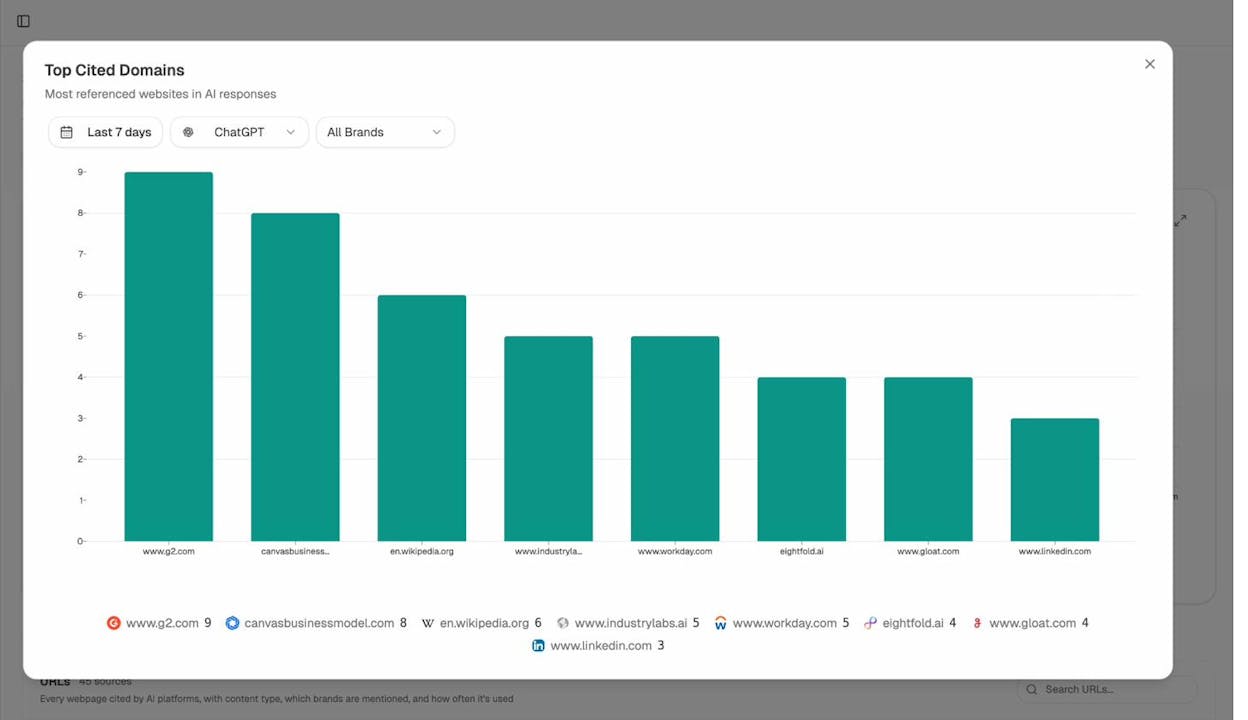
Sources dashboard showing the split of cited sources by content family for one tracked brand’s prompt panel
How This Stacks With the Reddit and YouTube Findings
The source-family split reinforces what we found for two specific community platforms in earlier pieces.
The Reddit brand-mention piece showed that only 4.1% of cited Reddit threads actually name the focal brand. The YouTube and Reddit piece showed only 3.3% of cited YouTube pages name the focal brand. The current source-family analysis extends that pattern to the full community and social category and shows an additional dimension. Even when we consider the answer around the community citation, the mention rate for any specific brand is 9.2 points lower than average. So community citations do not carry brand mentions on the cited page (Reddit 4%, YouTube 3%) AND they correlate with the AI answer moving away from brand-naming as a whole (-9.2 pp).
That is a double subtraction for a marketer expecting community coverage to drive AI brand mentions. Getting a Reddit thread cited does not name your brand on that thread, and it correlates with the surrounding answer being less brand-focused than average. Both effects operate in parallel. Community coverage builds topical authority for the category, but it does not translate directly to your brand being named more.
The mirror version of this stack is the brand-website result. When the AI cites your own site, the mention rate is 42.6%, 15.8 points above the baseline. The citation and the mention travel together. This is what a “citation” was in the traditional SEO era: a link to your site was directly tied to your site’s visibility. In the AI era, that direct relationship only holds for commercial sources. For topical sources, the mechanism inverts.
How This Compares to Other Public Studies
The source-family question has been studied in the last year, though most public studies focus on which sources get cited most rather than which sources correlate with brand mentions. Here is where our finding fits.
Yext analyzed 6.8 million AI citations and reported that 86% of AI citations come from brand-managed sources such as websites and listings. Their finding is aligned with our result on brand websites and directories driving mentions. If 86% of citations come from brand-managed sources and brand-managed sources are the two families that correlate positively with brand mentions, then the citation ecosystem is structured to push mention rates upward for brands that have their own crawlable pages and directory profiles. The Yext finding gives us a large-scale confirmation from a different sample.
BrightEdge reported that AI-answer sentiment skews strongly positive across all engines and that recommendation and comparison queries produce heavier brand exposure than informational prompts. Their finding fits alongside ours as a different framing of the same phenomenon. Comparison and recommendation queries pull the AI toward brand-focused answers. Informational queries pull the AI toward topical answers. The source families the AI selects match that split.
Peec AI reported that structured content formats (comparisons, tables, lists, rankings) surface more brands than open-ended questions. That direction matches our finding that lists and comparisons cited produces near-zero-to-slightly-negative effects on any specific brand’s mention rate, because these formats surface many brands rather than concentrating on one. Peec AI’s finding is about the total number of brands surfaced. Ours is about any single specific brand’s mention rate. Both hold simultaneously.
Ahrefs found across 75,000 brands that brand mentions on third-party pages correlate 0.664 with AI citation rates, three times the correlation with backlinks. Ahrefs’s finding is at the correlation level across brands. Our source-family finding is at the mechanism level within answers. The two operate on different scales but point at the same conclusion. Brand-forward third-party sources (which cluster in the websites and directories families for citation counting) are what carry mentions. Content-forward third-party sources (community, editorial) build topical presence but not direct mentions.
The pattern across these studies is consistent with our finding. Commercial sources are the mention-carrying family. Community and editorial sources are the topic-carrying family. A marketer’s source portfolio needs both, but they serve different purposes and produce different mention-rate impacts.
What This Means for Source Portfolio Design
Three things follow from the source-family data.
The first is that a marketer’s owned website is the highest-leverage single asset for AI mention rates. Not because writing more blog posts will directly move the number, but because the AI’s decision to cite a brand’s site is tied to its decision to name the brand in the answer. Making sure your official website and product pages are crawlable, indexable, and topically strong is the floor condition for AI to name you. The Citation Analytics view shows which of your own pages get cited most on your tracked prompts, so you can see whether the AI is finding the pages you want it to find.
The second is that directory and marketplace profiles carry disproportionate weight relative to their share of the citation ecosystem. Only 269 answers in our 22,295-answer sample cite a directory or marketplace page, but the answers that do produce a 60.2% mention rate. G2, Capterra, TrustRadius, and category-specific directories are worth investing in on this basis alone, and the AI Content Optimizer can help audit whether the AI is retrieving your directory profiles for your tracked prompts.
The third is that community and editorial investments serve a different purpose from what the industry pitch often implies. The prevailing message from 2025 is that seeding brand content on Reddit and getting mentioned in editorial pieces will lift AI visibility. Our data says those sources do not directly move brand mention rate on the AI answer side. They serve topical-authority and category-presence purposes that build the aggregate signal Ahrefs measured at 0.664 correlation. But the transmission from a specific Reddit thread to a specific AI mention is much weaker than the pitch suggests, and community coverage should be budgeted as a topical-authority investment rather than as a direct mention-driving one.
The Bigger Story
The industry has treated AI citations as a single category, ranking domains by how often they appear as sources and recommending marketers optimize for the top-cited domains. Our data says the citation-to-mention transfer varies substantially by source family, and treating all citations as equivalent hides the mechanism that actually drives brand mentions.
The reframe is to split source portfolio work into two distinct programs. The commercial program covers your owned website, product pages, and directory profiles, and is measured directly by mention-rate lift when those sources are cited. The topical program covers community, editorial, and comparison content, and is measured through slower aggregate signals like third-party mention count and category authority. Both programs matter, but conflating them into a single “get more AI citations” pitch produces a strategy that overinvests in one and underinvests in the other.
This finding stacks with the other pieces in the State of AI Search series. Cross-engine consensus is rare, so per-engine source-family effects also matter. Category mention rates range from 9% to 70%, so the source mix that matters for one category will not transfer to another. Community citations do not name the brand (4.1% Reddit, 3.3% YouTube), and now we see they also correlate with the surrounding answer being less brand-focused. And commercial sources carry mentions in a partly mechanistic way that a marketer can influence through basic website hygiene and directory profile management.
The finding to hold onto from this piece is the simple one. When AI cites your own website or a directory profile, it is 16 to 24 percentage points more likely to name your brand in the answer. When AI cites community or editorial content, it is 3 to 9 percentage points less likely to name your brand. Split your source portfolio work into commercial and topical programs. Measure the two separately. Understand that the AI’s citation of a source and its mention of a brand are related but not equivalent, and that the relationship depends on the source family.
This research was conducted using Analyze AI, which tracks brand visibility, citation share, and per-source-family mention rate correlations across ChatGPT, Perplexity, Google AI Mode, and every other major AI engine.

Ernest

Ibrahim
![Featured image for The State of AI Search in B2B [2026]](/_next/image?url=https%3A%2F%2Fwww.datocms-assets.com%2F164164%2F1785857899-16-state-of-ai-search-b2b-2026.png&w=3840&q=75)

![Featured image for ChatGPT Pulls 69% of Citations from Brand Sites [2026]](/_next/image?url=https%3A%2F%2Fwww.datocms-assets.com%2F164164%2F1785857882-15-source-family-mix.png&w=3840&q=75)
![Featured image for Domain Authority Does Not Predict AI Citations [2026 Study]](/_next/image?url=https%3A%2F%2Fwww.datocms-assets.com%2F164164%2F1785857675-04-authority.png&w=3840&q=75)