

![Featured image for Prompt Type Changes AI Mention Rate 17 Points [2026 Study]](/_next/image?url=https%3A%2F%2Fwww.datocms-assets.com%2F164164%2F1785857825-12-prompt-archetypes.png&w=3840&q=75)

Summarize this blog post with:


We analyzed 22,295 AI answers across ChatGPT, Perplexity, and Google AI Mode to test how much the type of prompt a marketer tracks changes the mention rate they will measure. If your tracked prompt panel is heavy on comparison and recommendation prompts, the number you report will look very different from a panel heavy on research and how-to prompts. The engines behave differently across archetypes, and the best-performing archetype varies by engine.
The dataset covers 115,843 citation events, 460 distinct B2B prompts, and 37 tracked organizations. Each prompt was classified into an archetype based on the query pattern. We focused this analysis on the three prompt archetypes with broad enough samples to make a claim: Comparison and alternatives (82 to 89 prompts across engines), Recommendation and shortlist (65 to 71 prompts), and Research and how-to (54 prompts). The other archetypes in our data (Pricing and value, standalone Recommendation, standalone Comparison) sit at 1 to 6 prompts each and cannot support a standalone claim. We flag those thin-sample archetypes but do not build the article’s conclusions on them.
Here are the questions we set out to answer:
- How much does the AI mention rate vary across prompt archetypes on the same engines?
- Which archetype produces the highest mention rate on each engine?
- Does the same archetype win on every engine, or is the pattern engine-specific?
- What are the citation counts and answer characteristics that go with each archetype?
- What does this mean for how a marketer should design their tracked prompt panel?
Recommendation prompts on Perplexity produce a 41.2% mention rate. Research and how-to prompts on ChatGPT produce a 24.5% mention rate. That is a 16.7-percentage-point spread, and it comes from the same underlying question type asked in a different framing on a different engine. If a marketing team ran their tracked panel entirely on recommendation prompts and their competitor ran theirs entirely on research prompts, both teams would report accurate measurements of their own panels, and their measured mention rates would differ by more than 15 points before either team did anything to improve. Panel design is a much bigger lever than most marketing dashboards acknowledge.
Table of Contents
TL;DR
- How much does prompt archetype shift the mention rate? Up to 17 percentage points. Perplexity on recommendation prompts averages 41.2%. ChatGPT on research prompts averages 24.5%. Every archetype-engine pair sits somewhere between those two extremes.
- Which archetype produces the highest mention rate? Recommendation and shortlist on Perplexity (41.2%). Comparison and alternatives on Perplexity (37.0%). Comparison and alternatives on Google AI Mode (34.7%). All three sit substantially above the research and how-to rates.
- Does the same archetype win on every engine? No. ChatGPT and Google AI Mode both mention brands more on comparison prompts than on recommendation prompts. Perplexity does the opposite. The best archetype for measuring your brand’s AI visibility is engine-dependent.
- What is the sample per archetype? Comparison and alternatives: 82-89 prompts per engine. Recommendation and shortlist: 65-71 prompts per engine. Research and how-to: 54 prompts per engine. Pricing and value archetype in our data has only 4-6 prompts per engine and cannot support a standalone claim.
- What should marketers do about this? Design your tracked panel with a deliberate archetype mix that matches how your buyers actually search, so your measured mention rate reflects real buyer behavior rather than an artifact of which prompt types you happened to add to the panel.
Prompt Archetype Shifts Mention Rate by 8 to 17 Percentage Points
The archetype-by-engine table for the three broad-sample archetypes.
| Archetype | ChatGPT | Google AI Mode | Perplexity |
|---|---|---|---|
| Comparison and alternatives | 33.0% | 34.7% | 37.0% |
| Recommendation and shortlist | 25.1% | 31.2% | 41.2% |
| Research and how-to | 24.5% | 25.4% | 29.0% |
Comparison and alternatives averages about 35% across the three engines. Recommendation and shortlist averages about 32%. Research and how-to averages about 26%. So on average, comparison prompts produce a mention rate that is 9 percentage points higher than research prompts. Recommendation prompts produce a mention rate that is 6 percentage points higher than research prompts. Both effects are substantial relative to the underlying rates.
The per-engine numbers show the pattern is not uniform. Perplexity has the widest spread across archetypes at 12.2 percentage points (41.2% recommendation minus 29.0% research). Google AI Mode has a 9.3-point spread. ChatGPT has a 8.5-point spread. Perplexity is the most sensitive to prompt archetype, and ChatGPT is the least sensitive.
The extreme corners of the table matter for panel design. If your tracked panel is dominated by recommendation prompts and you measure primarily on Perplexity, your reported mention rate will land near the top of the range (41.2%). If your panel is dominated by research prompts and you measure primarily on ChatGPT, your reported mention rate will land near the bottom (24.5%). Both are legitimate measurements of the panels they measure. Neither generalizes to your actual buyer’s mention rate without knowing what your buyer actually asks.
The Best Archetype Varies by Engine
The archetype ranking by engine looks different in a way that has practical consequences.
| Engine | Best archetype | Second-best archetype | Worst archetype |
|---|---|---|---|
| ChatGPT | Comparison and alternatives (33.0%) | Recommendation and shortlist (25.1%) | Research and how-to (24.5%) |
| Google AI Mode | Comparison and alternatives (34.7%) | Recommendation and shortlist (31.2%) | Research and how-to (25.4%) |
| Perplexity | Recommendation and shortlist (41.2%) | Comparison and alternatives (37.0%) | Research and how-to (29.0%) |
ChatGPT and Google AI Mode both produce the highest mention rate on comparison prompts. Perplexity produces the highest mention rate on recommendation prompts. Research prompts are the lowest-mention-rate archetype on all three engines.
The mechanism behind the ChatGPT and Google AI Mode pattern is that comparison prompts ask the AI to enumerate and describe alternatives, which forces the model to name each brand explicitly. Recommendation prompts ask the AI to identify a top choice or shortlist, which can be answered by naming fewer brands with more description per brand. On ChatGPT and Google AI Mode, which lean toward longer answers with fewer citations, comparison prompts produce more brand names simply because the answer format lists more of them.
Perplexity’s pattern is different because Perplexity’s answer format on recommendation prompts is a numbered shortlist with citation attribution for each entry. When Perplexity is asked to recommend, it defaults to a structured list that gives each recommended brand its own paragraph and citation. Comparison prompts on Perplexity produce more integrated prose without the same list structure. So on Perplexity, recommendation prompts produce more brand names because the answer format is more list-heavy.
The practical implication is that measuring your Perplexity visibility on a comparison-heavy panel will understate your true Perplexity performance. Measuring your ChatGPT visibility on a recommendation-heavy panel will understate your true ChatGPT performance. The archetype and engine choices interact.
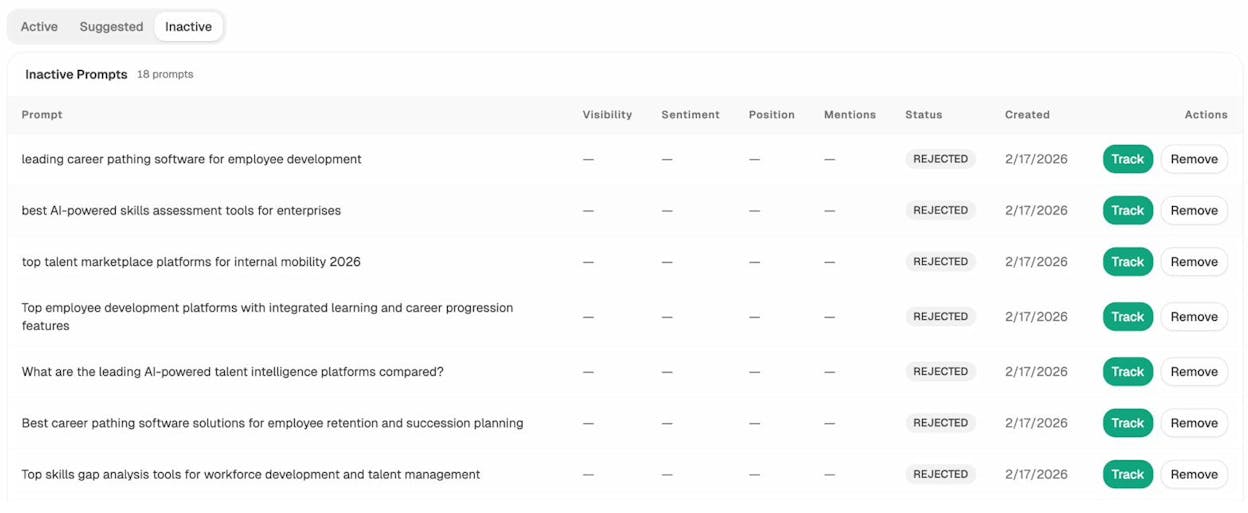
Prompts view showing the archetype tag and per-engine mention data for each tracked prompt in the panel
Citations and Answer Length Vary With Archetype Too
The mention-rate table is only one axis. Citation counts and answer length also vary by archetype, and the pattern reinforces the practical difference between the archetypes.
| Archetype | Engine | Avg citations | Avg answer characters |
|---|---|---|---|
| Comparison and alternatives | ChatGPT | 4.38 | 3,546 |
| Comparison and alternatives | Google AI Mode | 4.41 | 2,645 |
| Comparison and alternatives | Perplexity | 5.51 | 3,061 |
| Recommendation and shortlist | ChatGPT | 3.43 | 3,475 |
| Recommendation and shortlist | Google AI Mode | 4.70 | 2,522 |
| Recommendation and shortlist | Perplexity | 5.56 | 2,610 |
| Research and how-to | ChatGPT | 3.02 | 3,197 |
| Research and how-to | Google AI Mode | 3.83 | 2,467 |
| Research and how-to | Perplexity | 4.54 | 2,871 |
Comparison prompts pull the most citations on average across engines. Research prompts pull the fewest. That matches the mention-rate pattern. Prompts that ask the AI to compare or recommend force the model to reach for source material to attribute each brand claim. Prompts that ask the AI to explain a process or a mechanism let the model synthesize from training data with fewer explicit source anchors.
The Perplexity comparison prompt result is a specific outlier worth noting. Perplexity answers comparison prompts with an average of 5.51 citations and 3,061 characters, which is longer than its typical answer length of 2,447 characters. So Perplexity is doing extra work on comparison prompts, retrieving more sources and writing a longer answer. That extra work produces a lower mention rate (37.0%) than its recommendation-prompt output (41.2%). The additional source material on comparison prompts distributes across more brands, so any single brand’s mention density comes out lower.
The ChatGPT research-prompt result deserves the opposite kind of attention. At 3,197 characters and 3.02 citations, ChatGPT is producing its typical long answer but reaching for even fewer sources than usual. A ChatGPT research prompt gets one citation every 1,060 characters on average, which is above ChatGPT’s baseline of 933 chars per citation from our length-vs-citations piece. This is the archetype-engine combination where a marketer’s tracked prompt panel measures the sparsest possible citation environment. It is also the archetype-engine combination where mention rate is lowest in absolute terms. Panels loaded with ChatGPT research prompts will report the most conservative visibility number for a brand across every measurable dimension.
How This Compares to Other Public Studies
The prompt-archetype question has been studied at scale in the last twelve months. Our finding is consistent with the broad direction of that research while adding specific per-engine and per-archetype numbers.
Peec AI analyzed 37,804 AI responses across ChatGPT, Gemini, Perplexity, Google AI Overviews and Google AI Mode and reported that comparison, table, list, and ranking prompt formats consistently surface more brands than open-ended questions, with a +20% average visibility lift for ranking prompts. Their +20% is a lift in the number of brands surfaced. Our finding is on the specific brand’s mention rate. Both point at the same underlying behavior. Structured retrieval prompts produce more brand exposure than open-ended synthesis prompts. Their specific finding that “polished keyword-style prompts and casual conversational questions often surfaced the same brands” is consistent with our data as well. Wording differences within an archetype do not swing the mention rate as much as the archetype choice itself does.
Conductor’s 14,000-prompt research study reported that “AI brand recommendations aren’t random. They’re predictably inconsistent, and the predictor isn’t industry size. It’s query intent.” Their finding at the aggregate level is the same as ours at the archetype level. Query intent (or archetype) is a much stronger predictor of brand mention behavior than industry, model, or persona. Our data pins the size of the effect at 8 to 17 percentage points depending on the engine, which is significant enough to change how a panel should be built.
BrightEdge reported that “recommendation and comparison queries produce much heavier brand exposure than pure informational prompts,” and specifically recommended that teams segment prompt sets by intent so they can see whether transactional and comparative queries are driving the lift. That is the practical implication our data supports. Without archetype segmentation on a tracked panel, informational-heavy panels will report suppressed mention rates that are not comparable to comparison-heavy panels.
Peec AI on prompt format separately reported that “asking for a comparison, table, list, or ranking consistently surfaces more brands than open-ended questions” with keyword-style prompts producing up to +25% average visibility versus conversational prompts. Their +25% figure again describes the number of brands the AI surfaces rather than the specific brand’s mention rate. Both effects operate in parallel. Structured prompt formats surface more brands (Peec AI). Recommendation and comparison archetypes lift the specific-brand mention rate (our finding).
The pattern across all four studies is consistent. Prompt archetype is a real driver of AI brand mention behavior. Recommendation and comparison prompts consistently produce higher brand exposure than research or informational prompts. Our archetype-by-engine numbers add specificity to that established pattern, particularly the engine-dependent ranking of which archetype wins on which engine.
What This Means for Your Tracked Prompt Panel Design
Three things follow from the archetype-variance data.
The first is that a tracked panel should have a deliberate archetype mix that matches how your buyers actually search. If your buyers ask 60% recommendation prompts and 40% research prompts, that is the mix your panel should have. Loading your panel with recommendation prompts because they produce higher mention rates is measuring the wrong thing. You would be measuring what the AI does when asked for recommendations, which is not the same as measuring what the AI does when your buyer actually asks. The Prompt Tracking view surfaces mention rates per archetype so a marketer can see whether the panel’s archetype mix reflects real buyer behavior.
The second is that comparisons between panels or across periods need to control for archetype mix. If your Q3 panel was 40% recommendation and your Q4 panel is 60% recommendation, the Q4 mention rate will look higher even if the underlying AI behavior did not change. Reporting mention rate by archetype separately, and then aggregating with fixed archetype weights, produces comparisons that are actually comparable across periods. The AI Visibility Tracking view provides that per-archetype breakdown so the aggregate does not hide compositional shifts.
The third is that engine prioritization should account for the archetype-engine interaction. If your buyers heavily use recommendation-style queries and your product panel skews that way, Perplexity is likely the highest-yield engine for your visibility program. If your buyers heavily use comparison queries, Google AI Mode and ChatGPT will show more of your mention rate. The wrong engine-archetype pairing understates your true visibility in the same way that the wrong archetype mix does.
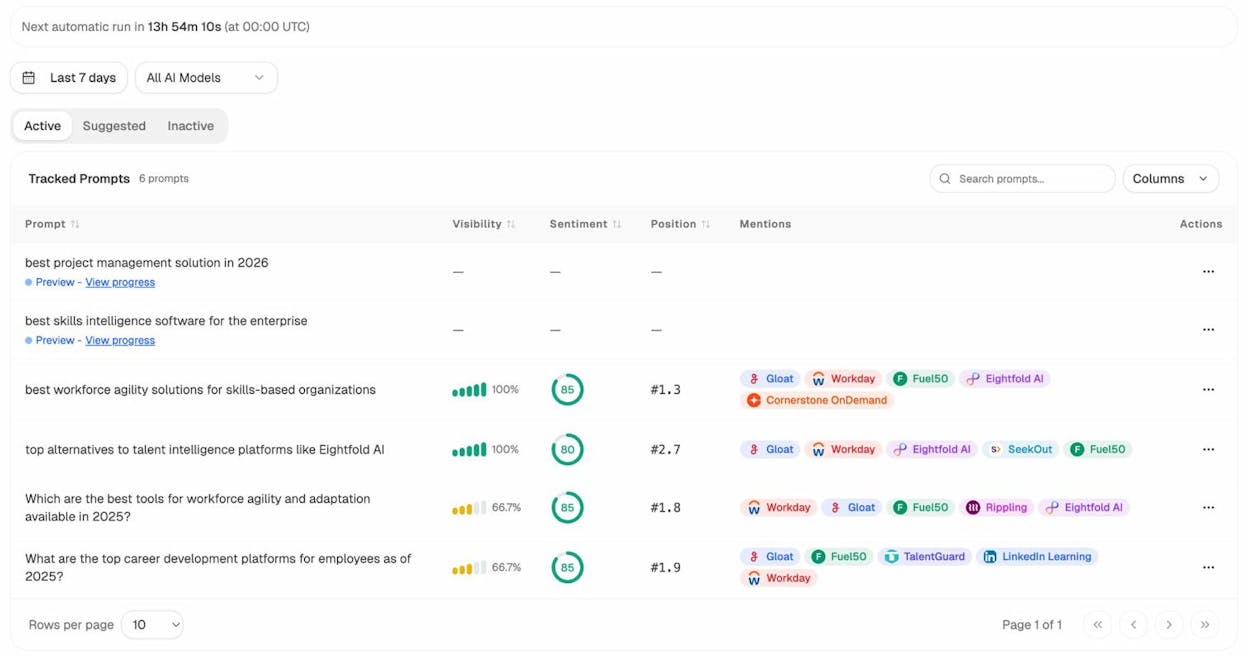
Prompts drill-down view showing per-prompt mention data across the three engines with archetype and industry tags
The Bigger Story
Marketing teams have been reporting a single “AI mention rate” number for their brand for the last two years. Our data says that number is compositional. It reflects the archetype mix of the tracked panel more than it reflects any underlying property of the brand. Two teams tracking the same brand with different archetype-heavy panels would report mention rates that differ by 10 to 15 percentage points, and both would be accurate for their panels while neither would generalize.
That reframes the reporting layer. The right number to report is the per-archetype mention rate, presented alongside the archetype mix of the panel, so the composition is visible. The single aggregate number is a rollup that hides the mechanism. Publishing “our AI mention rate is 32%” without saying “on a panel that is 40% recommendation, 40% comparison, and 20% research prompts” hides the biggest driver of the specific number.
This finding stacks with the other pieces in the State of AI Search series. Cross-engine consensus is rare, so per-engine benchmarking is required. Category mention rates range from 9% to 70%, so category-specific numbers are the right unit. And archetype adds a third axis of variance that operates on top of engine and category. Reporting a single blended number without breaking on any of these three dimensions is a compressed measurement that hides most of the actionable variance.
The rest of this State of AI Search series folds the remaining structural findings into practical guidance. Later work covers how prompt construction (specifically the presence or absence of a brand name in the prompt) changes the measured mention rate substantially, and how a marketer should design a tracked prompt panel that captures both prompted and unprompted visibility for their specific category.
The finding to hold onto from this piece is the simple one. Prompt archetype shifts mention rate by 8 to 17 percentage points across the three broad-sample archetypes we could measure. Comparison and recommendation prompts produce substantially higher mention rates than research prompts on every engine. The specific best-performing archetype differs between Perplexity and the other two engines. Design your tracked panel to match your buyers’ real archetype mix. Report mention rate per archetype so the composition is visible.
This research was conducted using Analyze AI, which tracks brand visibility, per-archetype mention rates, and citation counts across ChatGPT, Perplexity, Google AI Mode, and every other major AI engine.

Ernest

Ibrahim
![Featured image for The State of AI Search in B2B [2026]](/_next/image?url=https%3A%2F%2Fwww.datocms-assets.com%2F164164%2F1785857899-16-state-of-ai-search-b2b-2026.png&w=3840&q=75)

![Featured image for Prompt Design Shifts AI Mention Rate 60 Points [2026]](/_next/image?url=https%3A%2F%2Fwww.datocms-assets.com%2F164164%2F1785857842-13-prompt-construction.png&w=3840&q=75)
![Featured image for B2B AI Mention Rates Range 9% to 70% by Category [2026]](/_next/image?url=https%3A%2F%2Fwww.datocms-assets.com%2F164164%2F1785857809-11-industry-variance.png&w=3840&q=75)