

![Featured image for Prompt Design Shifts AI Mention Rate 60 Points [2026]](/_next/image?url=https%3A%2F%2Fwww.datocms-assets.com%2F164164%2F1785857842-13-prompt-construction.png&w=3840&q=75)

Summarize this blog post with:


We analyzed 22,295 AI answers across ChatGPT, Perplexity, and Google AI Mode to test how much the construction of the prompt itself changes the mention rate a marketing team will measure. Not the archetype the prompt falls into and not the category the prompt sits in, but the specific structure of the prompt sentence. Does it name a brand? How long is it? How many buyer-intent angles does it carry? Each of these levers pulls the measured mention rate in ways that a single aggregate number does not reveal.
The dataset covers 115,843 citation events, 460 distinct B2B prompts, and 37 tracked organizations. For this piece we look at how prompt-level features (brand presence, length, angle count, angle type) interact with the measured mention rate. Every number we report describes what the panel produces, and this piece is written as guidance for how a marketer should assemble that panel so the number the panel produces actually reflects real AI-discovery behavior.
Here are the questions we set out to answer:
- How much does explicitly naming a brand in the prompt change the measured mention rate?
- Does making a generic prompt longer produce a higher mention rate?
- Does adding more buyer-intent angles to a short prompt produce a higher mention rate?
- Which specific angle types produce the biggest mention rate lifts?
- What does all of this mean for how a marketer should design a tracked prompt panel?
Naming the brand in the prompt adds about 60 percentage points to the adjusted mention rate. Doubling the word count of a generic prompt has no reliable effect on mention rate. Adding buyer-intent angles to short generic prompts produces a 40-point swing across the angle-count range, from about 41% mention rate at zero angles to about 81% at three or more. These structural findings are not intended as prompt tricks a marketer should use to inflate their reported number. They are the specific compositional levers a marketer needs to understand so their panel measures what it is supposed to measure.
Table of Contents
TL;DR
- How much does naming the brand in a prompt lift the mention rate? About 60 percentage points on adjusted terms. Raw mention rates on branded prompts (where a specific brand is named in the query) approach 100%. Raw mention rates on generic prompts vary by length and angle count.
- Does making generic prompts longer help discovery? No. Doubling the word count produces a -4.3-percentage-point adjusted effect with a confidence interval that crosses zero. Longer generic prompts do not produce higher mention rates in our data.
- What lifts mention rate within short generic prompts? Buyer-intent angle count. Prompts with 3 or more angles show a 81% mention rate. Prompts with 0 angles show a 41% mention rate. That is a 40-point difference within the short-prompt subset.
- Which specific angle types matter most? Use case and audience angles (+25.9 pp lift). Recommendation and best-of angles (+16.7 pp lift). Geography and locality angles (+13.5 pp lift). Feature and process angles are near zero.
- What should marketers do about this? Separate the panel into prompted and unprompted tracks. Use unprompted prompts for real discovery measurement. Design the unprompted panel to match how buyers actually phrase their queries, including the mix of angles and lengths they naturally use. Report both tracks separately.
Naming Your Brand in the Prompt Adds 60 Percentage Points
The single largest lever on the measured mention rate is whether the prompt explicitly names the brand being measured. The adjusted association from our regression, controlling for engine, prompt length, industry, and organization, is +60.4 percentage points with a 95% confidence interval of 46.2 to 74.6 percentage points. That is a large, statistically robust effect.
The raw numbers underneath the regression tell the story more concretely.
| Prompt length (branded) | Prompts | Mention rate |
|---|---|---|
| 6-8 words | 1 | 100.0% |
| 9-12 words | 6 | 100.0% |
| 13-20 words | 4 | 99.6% |
| 21-35 words | 39 | 61.0% |
| 36+ words | 7 | 96.8% |
When you write a prompt that includes the brand name, the AI engine reaches essentially 100% mention rate on the shortest branded prompts, dropping to a still-high 61 to 97% on longer branded prompts. Compare that to the generic prompt table.
| Prompt length (generic) | Prompts | Mention rate |
|---|---|---|
| 1-5 words | 6 | 34.2% |
| 6-8 words | 24 | 61.6% |
| 9-12 words | 14 | 51.7% |
| 13-20 words | 34 | 19.6% |
| 21-35 words | 131 | 10.6% |
| 36+ words | 7 | 11.3% |
Generic prompts in the 21-35 word band (which is the modal length category in our panel) mention the brand only 10.6% of the time. Branded prompts in the same length band mention the brand 61% of the time. That is roughly a 50-percentage-point raw gap on the same word-count band, which the adjusted regression estimates as +60 points once other confounds are controlled.
The consequence for panel design is straightforward. Any tracked prompt panel that mixes prompted queries (“What do people say about Salesforce?”) with unprompted queries (“What is the best enterprise CRM?”) will produce a mention rate that reflects the mix rather than the underlying discovery behavior. The prompted queries drag the number up. The unprompted queries drag it down. A panel that is 50% prompted will report a mention rate about 30 points higher than a panel that is fully unprompted, and neither number means what a stakeholder assumes it means.
Prompt Length Is Not the Lever
The intuitive follow-up assumption is that longer prompts produce more brand mentions because they carry more information for the AI to work with. The data does not support that assumption on unbranded prompts.
Our regression estimate for doubling the word count of a generic prompt is -4.3 percentage points with a 95% confidence interval of -22.1 to +13.5. The interval crosses zero, so the effect is indistinguishable from no effect. Making a 15-word prompt into a 30-word prompt does not reliably produce higher mention rates in our sample.
The raw data shows the same pattern with an inverted-U shape. Generic prompts at 6-8 words produce a 61.6% mention rate. Generic prompts at 13-20 words produce a 19.6% rate. Generic prompts at 21-35 words produce a 10.6% rate. Longer generic prompts actually produce lower mention rates on average, though the effect is not statistically robust once other prompt features are controlled.
The mechanism appears to be that longer generic prompts introduce more constraints and qualifiers, which narrows the set of brands the AI considers a match. A 30-word buyer prompt like “Which enterprise CRM works best for a manufacturing company with 500 sales reps that needs deep Salesforce Marketing Cloud integration and offline mobile support” is highly specific, so the AI’s answer set narrows to the small number of vendors that fit that exact spec. A 6-word prompt like “best CRM for enterprise sales” pulls a broader answer set that includes more brands.
The consequence for panel design is that padding a prompt with detail does not measure discovery better. It measures a narrower discovery question. Real buyer queries are often short, and a tracked panel that reflects that reality will report a mention rate that matches what buyers actually see.
Angle Count Is the Lever Within Short Prompts
The one prompt-structure variable that reliably lifts mention rate on short generic prompts is the number of distinct buyer-intent angles the prompt carries. We classified each short generic prompt by how many angles it contained, where an angle is a specific intent signal such as a use case, an audience, a comparison request, a geographic constraint, or a feature specification.
| Angles in short generic prompt | Prompts | Mention rate |
|---|---|---|
| 0 angles | 6 | 41.5% |
| 1 angle | 14 | 45.2% |
| 2 angles | 14 | 51.1% |
| 3 or more angles | 10 | 81.0% |
The mention rate climbs from 41.5% at zero angles to 81.0% at three or more angles. That is a 40-percentage-point range within the short-prompt subset. Adjusted for prompt length and engine, each additional angle in a short generic prompt produces a +18.7 percentage-point mention rate lift (95% CI 0.2 to 37.3 pp).
The mechanism is that angles narrow the buyer’s intent enough that the AI has a specific enough question to name specific brands as candidates. A zero-angle prompt like “best software” is too broad to reach for named brands with confidence. A three-angle prompt like “best CRM for small B2B SaaS teams under $10M ARR” is specific enough that the AI can produce a named shortlist.
The angle-type breakdown tells us which specific angles drive the biggest lifts.
| Angle type | Prompts with angle | Mention rate lift |
|---|---|---|
| Use case / audience | 7 | +25.9 pp |
| Recommendation / best | 22 | +16.7 pp |
| Geography / local | 10 | +13.5 pp |
| Feature / capability | 6 | +3.3 pp |
| Process / how-to | 20 | +0.4 pp |
Use case and audience angles produce the largest lift (+25.9 pp), followed by recommendation and best-of angles (+16.7 pp) and geography angles (+13.5 pp). Feature and process angles produce near-zero effects. The pattern makes sense. Angles that anchor the AI’s answer to a specific buyer group or a ranking task pull the AI toward naming brands. Angles that describe a feature or a workflow leave the AI in explanation mode where brand names are less central.
The angle-type sample sizes are small (6 to 22 prompts per angle), so these should be read as directional patterns rather than precise benchmarks. The direction is clear enough to inform panel design, but the specific per-angle magnitudes will move with a larger sample.
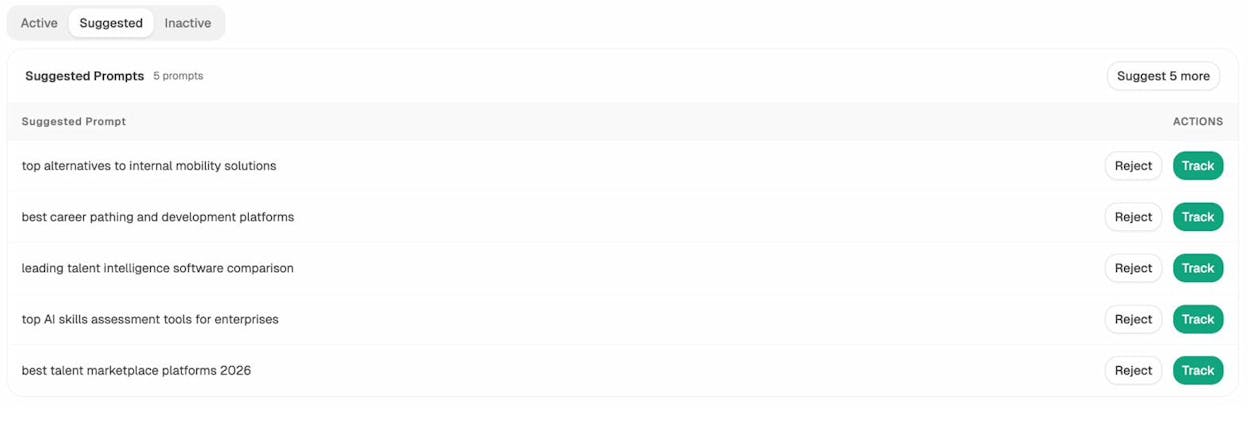
Prompts view showing per-prompt tagging with angle types and buyer intents
How to Design a Tracked Prompt Panel
The panel-design guidance that follows from these findings is not “write prompts that inflate your mention rate.” Buyers do not write prompts to inflate marketers’ dashboards. The guidance is how to build a panel that measures what a marketer actually needs to know, given how the prompt-construction variables affect the numbers.
The first split is between prompted and unprompted panels. A prompted panel contains queries that name your brand explicitly. It measures how the AI describes your brand when the query has already surfaced it. A prompted mention rate of 95% means the AI recognizes your brand and can talk about it when asked. It does not mean buyers are finding you. Report prompted mention rate as a “confirmed appearance” metric with a high floor. Do not report it as a discovery number.
An unprompted panel contains generic queries that describe your buyer’s problem, use case, or category. It measures the actual discovery behavior of the AI on your specific category. The unprompted mention rate is the number that matters for AI visibility strategy, and it is the number that reflects whether the AI will surface your brand when a buyer asks. Report unprompted mention rate as the primary discovery metric. Track it separately from the prompted rate.
Within the unprompted panel, the length and angle mix should match how your buyers actually phrase their queries. If your buyers ask short, angle-heavy questions like “best CRM for small B2B SaaS teams under $10M ARR,” your panel should have prompts like that. If your buyers ask longer, more descriptive queries, your panel should have those. The mention rates you measure will reflect the specific prompt structures in the panel, so the panel structure has to reflect real buyer behavior for the number to mean anything.
For most B2B categories, the unprompted panel should contain 30 to 60 prompts phrased the way buyers actually search. A rough split by angle count of about 40% two-angle prompts and 40% three-angle prompts, with the remaining 20% split between single-angle and zero-angle broad discovery prompts, tracks how buyers actually build their queries in most product categories we have observed. The Prompt Tracking view supports both panel tracks and reports mention rates separately per angle count, so a marketer can see whether the panel’s angle mix matches the intended composition.
How This Compares to Other Public Studies
The prompt-structure question has been studied at scale in the last twelve months. Our finding is consistent with the broad direction while adding specific per-lever effect sizes.
Peec AI analyzed 37,804 AI responses across ChatGPT, Gemini, Perplexity, Google AI Overviews and Google AI Mode and concluded that “polished keyword-style prompts and casual conversational questions often surfaced the same brands.” Their finding describes wording style rather than brand naming or angle count. It sits alongside ours as a specific claim that the exact word choice matters less than the structural features of the prompt. Marketers rewriting the same query in slightly different wording will get roughly the same brand mentions. Marketers adding buyer intent angles or naming brands explicitly will get very different mention rates.
Peec AI on a separate prompt-format study reported that concise, keyword-style prompts produce up to +25% average visibility versus conversational prompts. That direction matches our finding that longer generic prompts do not help mention rates, and that short prompts with clear angles produce the highest mention rates within the generic set.
Conductor reported that query intent is a stronger predictor of AI brand recommendation consistency than industry, model, or persona. Our angle-type findings sit next to that. Different intent angles produce different lifts, and use case and audience angles produce the strongest effects in our data.
BrightEdge recommended that “teams segment prompt sets by intent so they can see whether transactional and comparative queries are driving the lift” so that reporting does not blur weak and strong demand signals. Our panel-design guidance is a specific implementation of that recommendation. Split the panel by whether the brand is prompted, then split the unprompted panel further by angle count and angle type, so the aggregate mention rate is meaningfully decomposed for the reader.
The pattern across these studies is consistent. Prompt structure matters. Wording style matters less. Panel design has to account for both. Our specific effect sizes (+60 pp for brand naming, +18.7 pp per additional angle in short prompts, +25.9 pp for use case angles) add compositional benchmarks to the qualitative direction the industry has already established.
The Bigger Story
Marketing teams have been reporting single AI-visibility numbers for their brands for two years now. Our data on prompt construction closes the loop on what those single numbers actually measure. They measure the panel more than they measure the brand. Panel composition drives the aggregate mention rate by more than any real underlying visibility change would in most quarters. A team that adjusts their panel by adding branded prompts, or by shortening their prompts, or by weighting toward two-angle prompts, will see their aggregate mention rate move for reasons that have nothing to do with the brand’s actual AI visibility.
The reframe is to stop treating the panel as a static input to a reporting KPI, and to start treating it as an instrument that has to be calibrated and disclosed. The equivalent in traditional analytics is disclosing your GA4 tracked-event definitions when you report site conversions. The equivalent in survey research is disclosing your sample frame when you report a percentage. Marketing teams reporting AI visibility should disclose the panel composition (prompted share, angle count mix, archetype mix, engine coverage) alongside the aggregate number, so a stakeholder reading the report knows what the number reflects.
This finding stacks with the other pieces in the State of AI Search series. Cross-engine consensus is rare (so panel engine coverage matters). Category mention rates range from 9% to 70% (so panel category context matters). Archetype shifts mention rate by 8 to 17 points (so panel archetype mix matters). And prompt construction shifts it by another 40 to 60 points depending on the lever pulled. Combined, panel composition explains most of the variance in reported mention rates across teams. The underlying brand-visibility signal is a smaller share of the observed number than most dashboards suggest.
The finding to hold onto from this piece is the simple one. Prompt structure shifts measured mention rate by 40 to 60 percentage points depending on the lever. Build your unprompted panel to match real buyer behavior. Track prompted and unprompted separately. Disclose the panel composition when you report the aggregate. Skip the temptation to design prompts that inflate the number, and design them to reflect what buyers actually ask instead.
This research was conducted using Analyze AI, which tracks brand visibility with support for prompted and unprompted panel tracks, angle-count breakdowns, and per-engine reporting across ChatGPT, Perplexity, Google AI Mode, and every other major AI engine.

Ernest

Ibrahim
![Featured image for The State of AI Search in B2B [2026]](/_next/image?url=https%3A%2F%2Fwww.datocms-assets.com%2F164164%2F1785857899-16-state-of-ai-search-b2b-2026.png&w=3840&q=75)

![Featured image for Prompt Type Changes AI Mention Rate 17 Points [2026 Study]](/_next/image?url=https%3A%2F%2Fwww.datocms-assets.com%2F164164%2F1785857825-12-prompt-archetypes.png&w=3840&q=75)
![Featured image for B2B AI Mention Rates Range 9% to 70% by Category [2026]](/_next/image?url=https%3A%2F%2Fwww.datocms-assets.com%2F164164%2F1785857809-11-industry-variance.png&w=3840&q=75)