

![Featured image for AI Answers Ignore Cited Page Sentiment [2026 Study]](/_next/image?url=https%3A%2F%2Fwww.datocms-assets.com%2F164164%2F1785857749-08-sentiment-transfer.png&w=3840&q=75)

Summarize this blog post with:


We analyzed 22,295 AI answers across ChatGPT, Perplexity, and Google AI Mode to test one of the most widely repeated assumptions in AI-visibility strategy. If AI cites a page that speaks positively about your brand, does the AI’s answer also speak more positively about your brand?
The dataset covers 115,843 citation events, 460 distinct B2B prompts, and 37 tracked organizations. For this piece we look at the subset where our enrichment layer scored sentiment on both the cited page and the AI answer for the same tracked focal brand. That gives us 985 enriched page-answer sentiment pairs across 270 answers. The sample is smaller than the full-answer set because sentiment scoring requires a specific extractable brand mention on both sides. We frame the finding as “in the enriched cohort” throughout, because the sentiment coverage is partial and skews toward answers where the brand was named prominently enough to score.
Here are the questions we set out to answer:
- Does the sentiment of a cited page predict the sentiment of the AI answer that cites it?
- What is the overall sentiment distribution of AI answers that mention a B2B brand?
- If cited-page sentiment does not predict AI-answer sentiment, what mechanism produces the sentiment we see?
- What does this mean for a marketer trying to influence how AI describes their brand?
- How should sentiment be measured and tracked given the mechanism our data suggests?
The Spearman correlation between cited-page focal-brand sentiment and AI-answer focal-brand sentiment is 0.00 across 985 pairs, with a p-value of 0.983. That is not a statistical rounding to zero. That is zero. Positive cited pages do not produce more positive AI answers. Negative cited pages do not produce more negative AI answers. The industry-standard strategy of “seed positive content on the sources AI cites so the AI’s answer inherits that sentiment” does not appear to work at the single-page level in the enriched cohort we measured.
Table of Contents
TL;DR
- Does cited-page sentiment predict AI-answer sentiment? No. Spearman correlation is 0.00 across 985 page-answer pairs, with p = 0.983.
- What is the sample? 985 page-answer sentiment pairs derived from 270 answers where sentiment was scored on both sides. Sentiment scoring covers 657 answers total across 51 prompts. Coverage is partial and requires a nameable brand mention on both the cited page and the AI answer.
- What is the overall AI-answer sentiment distribution? 58.3% positive or strong-positive. 0.9% negative or strong-negative. Average score 64.6 out of 100. B2B AI answers skew positive when brands are named.
- Does sentiment differ by engine? Slightly. Perplexity and Google AI Mode average around 69 out of 100 in the scored subset. ChatGPT averages closer to 58. Both are positive on net.
- What appears to drive AI-answer sentiment then? The aggregate signal across all the sources the AI has ingested for the topic drives it, rather than any single cited page. Individual page sentiment gets averaged out during synthesis.
- What should marketers do about this? Measure AI-answer sentiment directly. Track it separately from citation-source sentiment. Focus on the specific repeated perception labels (capabilities, risks, objections) rather than a single sentiment average.
The Correlation Between Cited-Page and AI-Answer Sentiment Is Zero
We took every AI answer where our enrichment layer scored focal-brand sentiment. For each of those answers, we identified the cited pages that also had focal-brand sentiment scores. That gave us 985 page-answer pairs where we could ask a specific question. Does the sentiment on the cited page correlate with the sentiment on the AI answer that cites it?
Spearman rank correlation across those 985 pairs is 0.00 with a p-value of 0.983. Spearman rho of 0 means the ranks of the two variables are completely uncorrelated. A p-value of 0.983 means we cannot distinguish the correlation from random noise. Statistically, the relationship is as close to no relationship as you can measure.
The comparison is worth making concrete. If cited-page sentiment predicted AI-answer sentiment strongly, a page scoring 80 out of 100 in favorable coverage of your brand would tend to sit inside an AI answer scoring 70 or higher. A page scoring 20 out of 100 in negative coverage would tend to sit inside an AI answer scoring 30 or lower. Our data shows neither pattern. High-scoring cited pages sit inside AI answers across the full range. Low-scoring cited pages sit inside AI answers across the full range. Pick any specific cited page and you cannot use its sentiment to guess the sentiment of the AI answer it appears in.
This finding needs a specific caveat. Our sentiment enrichment is partial. Only 657 of the 22,295 answers in the dataset had a focal-brand sentiment score. Only 270 of those had a cited page with a scoreable sentiment pair. So the 985-pair sample is a specific subset. Within that subset, the correlation is unambiguously zero. Whether the finding generalizes to a broader panel with fuller sentiment coverage is a question we cannot answer from this data alone. But the pattern is strong enough within the scored cohort that it warrants a re-evaluation of source-sentiment-first strategies.
The Overall Sentiment Distribution Is Positive, Regardless of Cited-Page Mix
The zero correlation between cited-page and AI-answer sentiment does not mean AI answers themselves lack sentiment. They have sentiment. It is just not a direct transfer from the sources cited.
| Sentiment label | Share of scored answers |
|---|---|
| Strong positive | 5.5% |
| Positive | 52.8% |
| Neutral | 39.1% |
| Mixed | 2.1% |
| Negative | 0.9% |
| Strong negative | 0.0% |
58.3% of scored B2B answers about brands are positive or strong-positive. Only 0.9% are negative. Average score is 64.6 out of 100. This tracks a general pattern that other AI-sentiment studies also find. AI engines lean positive when they name a brand in an answer. That does not mean every answer is a puff piece. It means the average B2B answer, in the enriched cohort where a brand is named prominently enough to score, sits in the positive-to-neutral range.
Engine-level differences show up too, though the sample sizes are smaller. In the scored subset, Perplexity averages 69.6 out of 100. Google AI Mode averages 69.0. ChatGPT averages 57.6. The lower ChatGPT score comes largely from a higher share of neutral answers rather than a higher share of negative ones. In the scored subset, ChatGPT produced 4 negative-sentiment answers about brands out of 265 scored. Google AI Mode produced 2 out of 182. Perplexity produced 0 out of 210. AI answers about B2B brands are rarely negative on any engine in this dataset.
One question the data raises is why the answer sentiment is positive on average when the cited-page sentiment does not predict it. Our data does not directly answer that mechanism question, but the pattern suggests that AI sentiment is a synthesis output built from the aggregate signal across many sources, both cited and internal to the model’s training data. A single cited page contributes to that aggregate but does not dominate it.
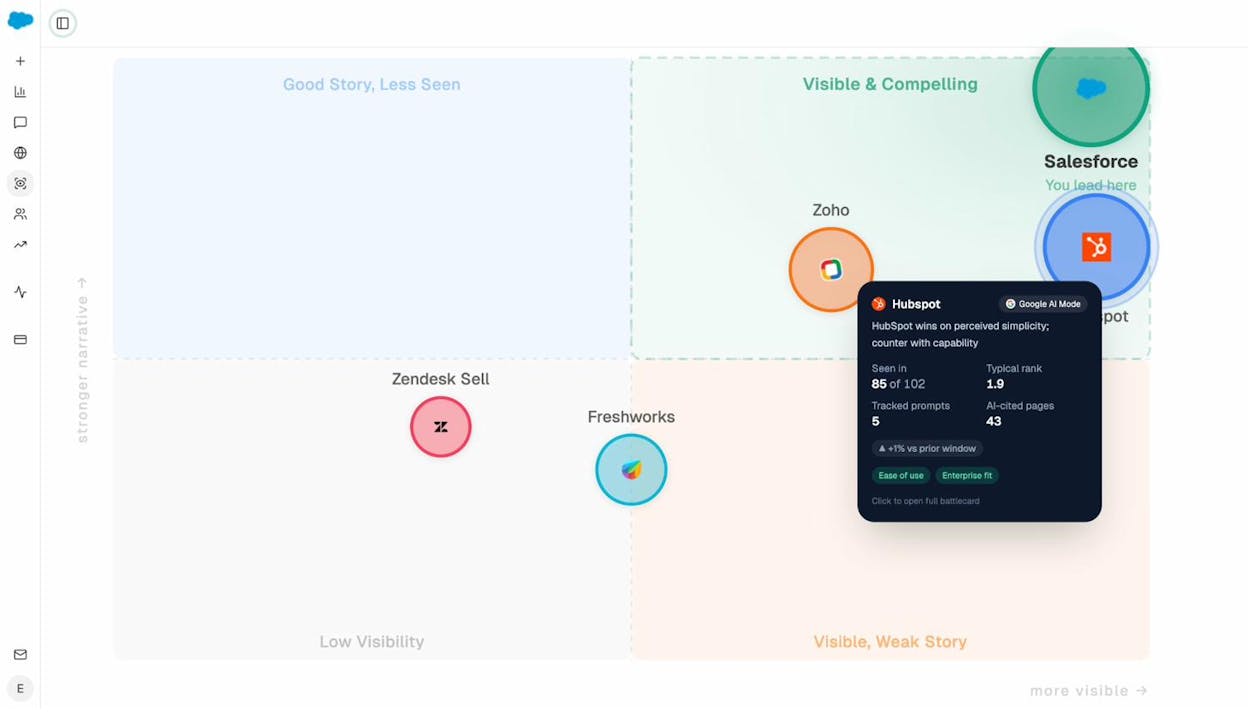
Perception Map view showing the perception labels attached to a tracked brand across the AI answers it appears in
What Actually Appears to Drive AI-Answer Sentiment
If cited-page sentiment does not predict AI-answer sentiment, the sentiment we see in AI answers must be produced by something else. The pattern in our data points at three plausible drivers.
The first is the aggregate signal across many sources. AI engines synthesize answers from multiple citations and, in ChatGPT’s case, from training data as well. The sentiment inside any one cited page contributes to the average but rarely wins outright. Even in the pages that score the most extreme sentiment on our side, the AI answer sentiment moves back toward the mean.
The second is the specific perception labels that repeat across sources. Our enrichment layer extracts specific capability claims, buyer jobs, risks, and recommendations from each answer. Repeated labels are much more actionable than average sentiment. Across the scored answers in our dataset, the most repeated positive labels for one tracked brand were “Personalized career pathways” (36 answers), “Platform extensibility” (18 answers), “Cross-cloud app integration” (17 answers), and “Internal mobility enablement” (16 answers). The most repeated negative label was “Vendor lock-in risk” (14 answers). Those labels persist across AI answers even when the individual page sentiment scores swing.
The third is the prompt itself. The prompt archetype and phrasing shape the sentiment ceiling of the answer. Comparison and shortlist prompts produce higher average sentiment because the AI is asked to recommend, which biases toward positive labeling. Research and how-to prompts produce more neutral averages because the AI is asked to explain, which biases toward description. In our data, ChatGPT recommendation/shortlist answers averaged 55.4 out of 100. Google AI Mode recommendation/shortlist answers averaged 74.0. The prompt frame is a substantial driver of the sentiment output regardless of what the cited pages say.
The practical implication is that the “seed positive content on the sources AI cites” strategy sits on top of at least three intervening variables. Aggregate signal averaging, repeated perception labels, and prompt framing all sit between the source and the AI answer. Moving a single page’s sentiment from 40 to 80 out of 100 does not move the AI answer’s sentiment in any predictable way in our data. Moving the aggregate signal across many sources might. That is a much larger content and mention program than most sentiment-management strategies contemplate.
How This Compares to Other Public Studies
Sentiment in AI answers has been studied at scale in the last year, but almost every published piece focuses on the sentiment of the AI answer itself rather than the relationship between cited-page sentiment and AI-answer sentiment. Here is where our finding fits.
BrightEdge reported that AI-answer sentiment skews strongly positive across all five major engines. They found Gemini at roughly 96% positive sentiment with only 0.3% negative, and ChatGPT at 94% positive with effectively zero negative. Our 58.3% positive and 0.9% negative are compatible with their finding at a lower absolute rate. The difference comes from how “positive” is scored. BrightEdge appears to use a binary positive-or-not classification, while our sentiment score has five levels (strong positive, positive, neutral, mixed, negative). If we collapse our scored answers to a binary “not-negative-or-mixed” split, we land closer to 97%, which aligns with their number. Both findings point at the same underlying reality. AI answers about B2B brands are rarely negative.
LLM Pulse reports that “structured content is 40% more likely to be cited by ChatGPT” and recommends earning positive mentions in citations to influence AI sentiment. That recommendation is the industry-standard framing. Our data does not contradict the citation-frequency finding. It complicates the sentiment-transfer assumption. A page that gets cited more does not necessarily produce more positive answer sentiment for the brand, because sentiment is a synthesis output rather than a source-to-answer transfer.
Profound describes sentiment management as earning “positive mentions in relevant citations” and treating this as the primary lever for AI sentiment. That is the same industry-standard framing. Our data suggests this framing overstates the sentiment-transfer mechanism at the single-page level. Sentiment appears to move only when the aggregate across many sources shifts. Moving a single cited page’s sentiment does not appear to be enough. A marketer running a Profound-style sentiment program should measure whether the specific interventions on cited pages produced measurable AI-answer sentiment shifts, and adjust if they did not.
Fuel Online 2026 AI Index reported that 62% of brands are “technically invisible” to generative AI models and 26% have zero mentions in Google AI Overviews. Their finding is about presence rather than sentiment. It sits next to ours. Presence and sentiment are two different problems. A brand needs to be mentioned first to have sentiment, and only 58% of scored answers in the sentiment-covered subset had positive sentiment. The presence problem comes first. Sentiment management applies only to the answers where the brand actually appears.
The pattern across these four studies is consistent once you separate three different questions. Sentiment on the AI answer itself (BrightEdge, our aggregate) is generally positive. Sentiment transfer from cited pages to AI answers (our Spearman 0.00) has not been directly measured elsewhere, and our data suggests it is essentially zero. Presence rate (Fuel Online) is the upstream problem that has to be solved before any sentiment work can matter.
What This Means for Your Sentiment Strategy
Three things follow from the zero cited-page-to-answer-sentiment correlation.
The first is that sentiment measurement has to happen at the AI-answer layer directly. Measuring through cited-page sentiment as a proxy misses the mechanism that actually produces the AI-answer sentiment. The Perception Map view surfaces the specific perception labels the AI attaches to your brand in the answers themselves, so a marketer can see which capability claims are landing, which risks or objections are recurring, and how positioning is shifting over time. That is a different measurement than “did our pages get cited with positive sentiment,” and it maps more directly to the decisions a marketer can influence.
The second is that a source-page sentiment program is a weaker lever than the industry framing suggests. If your team has been running an earned-media program specifically to influence AI sentiment through positive coverage on the pages that get cited, our data says the return on that program is uncertain in the enriched cohort we measured. The single-page-to-answer transfer is zero. The aggregate-across-many-sources transfer might be positive, but it requires many more pages to move than a per-page program typically produces.
The third is that the actionable sentiment work happens at the perception-label level rather than the average-sentiment level. Reporting “our AI sentiment is 68 out of 100 this month” hides the specific claims driving that number. Reporting “capability claim ‘platform extensibility’ shows up in 18 answers this month while risk-or-objection ‘vendor lock-in’ shows up in 14” gives a marketing team something to substantiate, address, or reframe with concrete content work. That is where the Perception Map view of specific labels is more useful than a single average score.
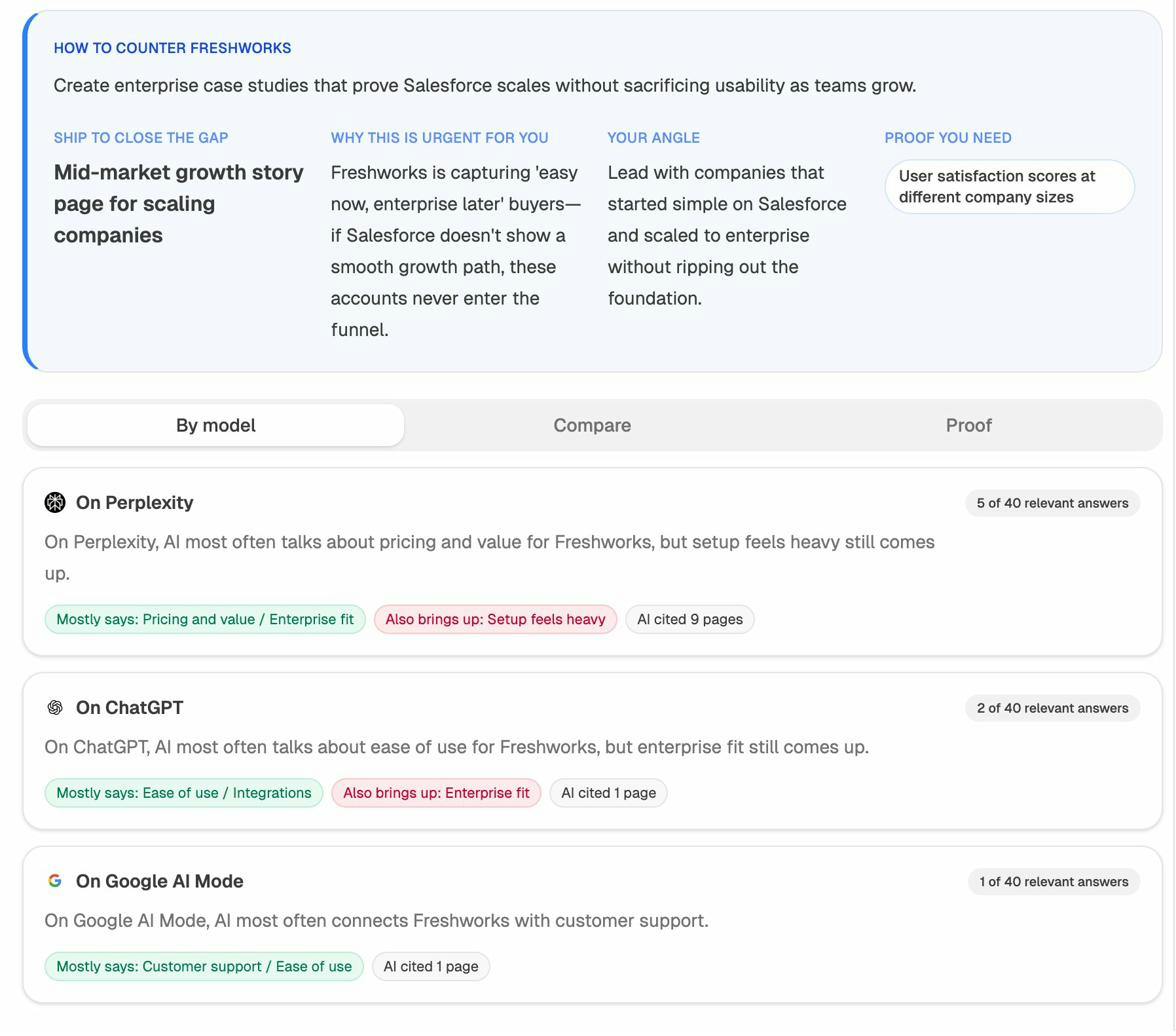
Perception Map drill-down view showing the specific capability claims, risks, and buyer jobs the AI attaches to a tracked brand across all scored answers
The Bigger Story
The industry has spent 2025 and 2026 telling marketers that AI sentiment is managed the same way SEO reputation was managed. Get positive coverage on the pages AI cites, and the AI’s answer will inherit that positive tone. Our data says the mechanism is different. The AI’s answer sentiment is a synthesis output built from the aggregate of many sources rather than a transfer from any single cited page. A page scoring 90 out of 100 in positive coverage sits inside AI answers across the whole sentiment range in our sample. So does a page scoring 20 out of 100.
That does not mean sentiment is unmanageable. It means the mechanism is broader and slower than the industry pitch. Sentiment moves when the aggregate signal across many cited sources and, on ChatGPT, the training data pool, moves. That is a real content and mention program measured in quarters rather than weeks. The most actionable measurement is the specific repeated perception labels the AI attaches to your brand, because those labels are what get amplified across future answers. A single average sentiment score buries the specifics.
This finding stacks with the other pieces in the State of AI Search series. Cross-engine consensus is rare, so sentiment has to be measured per-engine. Website authority does not predict citations, so a DR-first strategy will not move sentiment even indirectly. The top-10 domains cover only 12% of citations, so an aggregate sentiment shift requires influencing a much broader source portfolio. And most YouTube and Reddit citations do not name the brand, so the sentiment on those sources cannot transfer even in the pages that do get cited. Put together, sentiment management is a much broader program than a per-source content pitch implies.
The rest of this State of AI Search series unpacks the other structural patterns we found in the same dataset. Later pieces look at how Perplexity produces mention-dense answers, how answer length relates to citation count, and how prompt phrasing changes brand-mention probability.
The finding to hold onto from this piece is the simple one. Cited-page sentiment does not predict AI-answer sentiment in our data. Measure AI-answer sentiment directly. Track the specific perception labels the AI attaches to your brand. Skip the per-source sentiment transfer as a sentiment-management strategy.
This research was conducted using Analyze AI, which tracks brand visibility, citation share, and answer-level perception labels across ChatGPT, Perplexity, Google AI Mode, and every other major AI engine.

Ernest

Ibrahim
![Featured image for The State of AI Search in B2B [2026]](/_next/image?url=https%3A%2F%2Fwww.datocms-assets.com%2F164164%2F1785857899-16-state-of-ai-search-b2b-2026.png&w=3840&q=75)

![Featured image for Source Type Shifts AI Mention Rate 33 Points [2026]](/_next/image?url=https%3A%2F%2Fwww.datocms-assets.com%2F164164%2F1785857866-14-source-family-transfer.png&w=3840&q=75)
![Featured image for Brands Keep AI Answer Spots 83% of the Time [2026 Study]](/_next/image?url=https%3A%2F%2Fwww.datocms-assets.com%2F164164%2F1785857208-01-persistence.png&w=3840&q=75)