

![Featured image for YouTube Barely Exists in ChatGPT AI Answers [2026 Study]](/_next/image?url=https%3A%2F%2Fwww.datocms-assets.com%2F164164%2F1785857709-06-youtube-by-engine.png&w=3840&q=75)

Summarize this blog post with:


YouTube Barely Exists in ChatGPT AI Answers [2026 Study]
We analyzed 22,295 AI answers across ChatGPT, Perplexity, and Google AI Mode to measure how often each engine cites YouTube and Reddit. The two platforms sit at the top of every industry list of “the sources AI cites most,” and both have become common line items in earned-media strategy. What we found is that the per-engine incidence is wildly asymmetric, and the industry’s blended numbers hide the split.
The dataset covers 115,843 citation events, 460 distinct B2B prompts, and 37 tracked organizations. Every YouTube or Reddit URL that appeared in any answer was counted, deduplicated within a single answer so that the same URL cited twice in one response counts once.
Here are the questions we set out to answer:
- What share of answers on each engine cites at least one YouTube URL?
- What share of answers on each engine cites at least one Reddit URL?
- Does the presence of a YouTube or Reddit citation predict a brand mention?
- Which prompt types drive the highest YouTube citation rates?
- What does this mean for a marketer allocating video-content and community-content budget?
YouTube incidence is where the split shows up hardest. Perplexity cites YouTube in 9.2% of B2B answers. Google AI Mode cites YouTube in 7.5%. ChatGPT cites YouTube in 0.01%. That is not a decimal-place typo. Across 7,651 ChatGPT answers in our dataset, exactly one cited a YouTube URL. Reddit is more balanced, at 2.9 to 4.2% across all three engines. And the presence of a YouTube or Reddit citation does not meaningfully change the probability that the answer mentions your brand.
Table of Contents
TL;DR
- What share of answers cites YouTube? ChatGPT: 0.01% (1 out of 7,651). Google AI Mode: 7.5% (540 out of 7,181). Perplexity: 9.2% (683 out of 7,463).
- What share of answers cites Reddit? ChatGPT: 4.2% (325 out of 7,651). Perplexity: 3.6% (267 out of 7,463). Google AI Mode: 2.9% (205 out of 7,181).
- Does citing YouTube predict a brand mention? No. Adjusted co-occurrence sits at -0.03 with a 95% confidence interval that crosses zero.
- Does citing Reddit predict a brand mention? Also no. Adjusted co-occurrence sits at +0.02 with a 95% confidence interval that crosses zero.
- How often does a cited YouTube page actually name the focal brand? Only 3.3% of enriched YouTube source instances name the brand. Most YouTube citations serve as topical references rather than brand endorsements.
- What should marketers do about this? Build video content for Perplexity and Google AI Mode. Do not expect ChatGPT to cite YouTube directly. Treat Reddit as a broader-utility investment that shows up on every engine at similar rates.
YouTube Is a 9% Channel on Perplexity, a 7% Channel on Google AI Mode, and a Zero Channel on ChatGPT
We counted, for each engine, the share of stored answers that included at least one YouTube URL in the citation list.
| Engine | Answers | Answers citing YouTube | Share |
|---|---|---|---|
| Perplexity | 7,463 | 683 | 9.15% |
| Google AI Mode | 7,181 | 540 | 7.52% |
| ChatGPT | 7,651 | 1 | 0.013% |
The Perplexity and Google AI Mode numbers are consistent with what live-retrieval engines do. Both engines actively retrieve from a search index at answer time, and YouTube is one of the domains their retrieval pipelines return for B2B queries where a video would help. When they cite YouTube, they typically cite one specific URL, and the URL is the video that best matches the query.
The ChatGPT number is the story. Across 7,651 answers, one cited YouTube. This tracks a design choice. ChatGPT does not natively render or retrieve YouTube URLs the way Perplexity and Google AI Mode do. When ChatGPT’s browsing layer surfaces a page, that page is usually a text page. Video shows up in ChatGPT answers as descriptive prose about the video rather than as a link to the video itself. The consequence for a marketer is that your YouTube content will not be cited by ChatGPT no matter how well it is produced.
That does not mean YouTube content has zero value for ChatGPT visibility. YouTube mentions of your brand still flow into ChatGPT’s training data over time, and Ahrefs’s 75,000-brand study reported that YouTube mentions correlate with AI visibility at 0.737 across ChatGPT, AI Mode, and AI Overviews. The point is that the transmission path is different. On Perplexity and Google AI Mode, a good video earns a direct citation this week. On ChatGPT, a good video plus enough third-party mentions earns brand recognition inside the model over months.
Reddit Is a 3 to 4% Channel Across All Three Engines
Reddit does not show the same asymmetry.
| Engine | Answers | Answers citing Reddit | Share |
|---|---|---|---|
| ChatGPT | 7,651 | 325 | 4.25% |
| Perplexity | 7,463 | 267 | 3.58% |
| Google AI Mode | 7,181 | 205 | 2.85% |
ChatGPT actually cites Reddit slightly more often than the other two engines, which cuts against the common industry framing that Reddit dominates Perplexity. In our B2B sample, all three engines cite Reddit at roughly similar rates. The differences are small enough that a marketer should treat Reddit as a cross-engine investment rather than a Perplexity-specific play.
The absolute rate matters too. 3 to 4% is not the “Reddit is 40% of AI citations” number the industry frequently reports. The 40% figure comes from consumer-heavy datasets where Reddit dominates recommendation queries. Our B2B dataset finds Reddit at a much lower share because B2B buyers ask different kinds of questions and B2B AI engines pull from different source pools when they answer. If your category is B2B SaaS, “get on Reddit” is a reasonable investment with moderate returns. It is not the top move it is often pitched as.
Citing YouTube or Reddit Does Not Predict a Brand Mention
We ran a regression to test whether the presence of a YouTube or Reddit citation in an answer changed the probability that the same answer would mention the focal tracked brand, after controlling for engine, prompt, and organization.
| Signal | Estimated effect on brand-mention probability | 95% confidence interval |
|---|---|---|
| YouTube cited in answer | -0.031 | -0.100 to +0.037 |
| Reddit cited in answer | +0.019 | -0.029 to +0.067 |
Both estimated effects sit near zero, and both confidence intervals cross zero. Practically, the presence of a YouTube or Reddit citation tells you nothing about whether the answer mentioned your brand. This has real consequences for how the data is read. When an industry piece says “Perplexity cites YouTube in 38.7% of its citations, so make YouTube content to appear in Perplexity answers,” the implicit assumption is that YouTube citations bring brand mentions with them. In our data, they do not.
The mechanism is that YouTube and Reddit citations are usually topical. The AI engine cites the video because the video explains the topic well. The brand may or may not be named on the video, and most of the time it is not. Our enrichment cohort confirms this pattern. Across 1,161 cited YouTube pages where we could check whether the video mentioned the focal brand, only 3.3% did. The other 96.7% were cited for their topical value alone.
For a marketer, this splits the target. If you want to earn a YouTube citation on Perplexity, you make a topically strong video that AI engines will retrieve for a specific query. If you want your brand named in the resulting AI answer, that is a separate content problem, and the fact that your video was cited does not solve it.
Prompt Types That Drive YouTube Citations
The overall YouTube incidence hides a lot of prompt-level variation. Some prompt archetypes drive much higher YouTube citation rates than the 7 to 9% average.
| Prompt archetype | Answers | Share citing YouTube |
|---|---|---|
| Pricing / value | 79 | 31.6% |
| Developer & productivity software | 45 | 22.2% |
| Beauty & hair products | 1,742 | 14.0% |
| Comparison / alternatives | 1,435 | 7.9% |
| Research / how-to | 1,584 | 5.0% |
| Recommendation / shortlist | 2,461 | 3.0% |
Pricing and product-demo queries drive the highest YouTube citation rates because a good video demo is one of the most direct answers to those queries. Developer tooling drives the second-highest rate because developer content on YouTube is often the best available walkthrough of a specific setup. Comparison and alternatives queries drive moderate rates because YouTube is a common site of vendor-versus-vendor comparison content. Recommendation and shortlist queries drive lower rates because those queries are answered better by lists on review sites and blogs than by videos.
The takeaway is that YouTube is a category-specific channel. If you sell developer tooling or a product with meaningful visual differentiation, YouTube is a top-tier retrieval surface for Perplexity and Google AI Mode. If you sell a service or a category where the answer is primarily textual, YouTube is a lower-yield investment. Publishing a YouTube video is not a universal AI-visibility move. It is a move for specific categories and specific prompt archetypes.
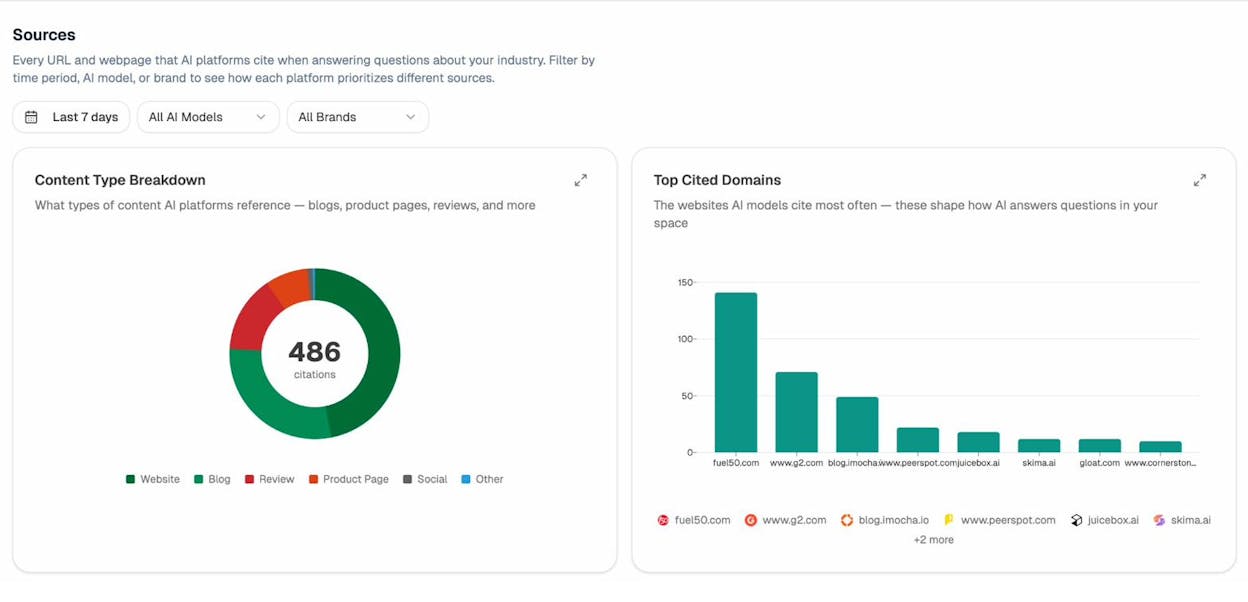
Sources dashboard showing the mix of content types AI engines cite for one tracked brand’s prompt panel, including the share of citations that come from video content
How This Compares to Other Public Studies
The YouTube-in-AI question has been studied at scale in the last twelve months. Our finding sits inside a specific corner of the published landscape.
OtterlyAI ran a YouTube citation study across 100 million citation instances covering six AI platforms. They reported that Perplexity accounts for 38.7% of all YouTube citations across AI platforms, Google AI Overviews accounts for 36.6%, and ChatGPT contributes just 4.4%. Gemini and Microsoft Copilot each account for less than 1%. Their ChatGPT-YouTube share of 4.4% is consistent with our 0.01% ChatGPT-YouTube incidence once you separate the two units. Their 4.4% is ChatGPT’s share of all YouTube citations across all platforms. Our 0.01% is the share of ChatGPT answers that cite YouTube. If you take a small share of a large denominator (all YouTube citations) and divide by ChatGPT’s total answer volume, both numbers point at the same conclusion. ChatGPT rarely cites YouTube.
5W Public Relations reported that YouTube captures 23.3% of Google AI Overview citations. That is a much higher number than our 7.5% for Google AI Mode, and the difference is important to understand. Google AI Overviews and Google AI Mode are two different citation surfaces even though they are both Google. The Ahrefs study we referenced in our cross-engine consensus piece found that the two surfaces share only 13.7% of the URLs they cite for the same query. 5W’s 23% applies to AI Overviews specifically. Our 7.5% applies to AI Mode specifically. Both are correct for what they measure.
Weglot ran 180 queries across three LLMs and found that Gemini and Claude often embed YouTube videos as recommended content without treating them as citation sources. When they explicitly asked the models for citations, YouTube’s citation rate dropped substantially. That is the browsing-versus-source distinction. Our data is drawn from explicit citation sets, which matches Weglot’s low-YouTube branch and explains why our ChatGPT number sits at 0.01% rather than the higher rates that show up when video embeds are counted as citations.
Peec AI analyzed 30 million sources across five AI engines and ranked YouTube as the second most-cited domain overall, behind Reddit. Their ranking is compatible with ours in a specific way. Our YouTube citation count of 1,224 answers is the largest single-domain count in our dataset, matching YouTube’s #1 or #2 position in most industry rankings. But the position is not the point. YouTube being the #2 most-cited domain in aggregate does not tell you that YouTube is 9% of Perplexity answers and 0.01% of ChatGPT answers. The per-engine incidence is where the strategy sits.
The pattern across all four studies is consistent once you separate per-engine incidence from cross-engine aggregate share. Aggregate rankings say YouTube is a top-2 AI citation source. Per-engine incidence says YouTube is a Perplexity and Google AI Mode play with essentially no direct citation surface on ChatGPT. A marketer building a video strategy needs the per-engine number. The aggregate ranking is the wrong unit for the decision.
What This Means for Your Video and Community Content Strategy
Three things follow from the per-engine incidence data.
The first is that a YouTube strategy for AI visibility only pays off on Perplexity and Google AI Mode. If your ideal customer profile lives mostly in ChatGPT, YouTube video production will not earn direct citations on that surface. The mechanism you can influence on ChatGPT is brand mentions on third-party pages that end up in the training data, and YouTube contributes to that indirectly by being one of the domains reviewers and reference articles link to. But do not budget for YouTube expecting a ChatGPT citation to arrive.
The second is that when YouTube does earn a citation on Perplexity or Google AI Mode, the citation is a topical reference. The 3.3% brand-on-page rate on cited YouTube URLs means most cited videos do not name the brand at all. If your goal is a brand mention in the AI answer, video content is a supporting asset. The direct move is to earn the mention through the third-party site where AI engines pull the brand-context passage from, and video plays a reinforcing role there. The Citation Analytics view shows the specific pages that get cited alongside your brand on your tracked prompts, and that page-level view is where the mention-versus-citation split gets actionable.
The third is that Reddit is a more evenly distributed investment. Its 3 to 4% incidence across all three engines is smaller than the industry press claims, but the cross-engine consistency means a genuine Reddit presence contributes to visibility on every engine rather than one. That is a fundamentally different investment profile than YouTube. YouTube is a category-specific bet on two engines. Reddit is a broad bet on all three.
For teams building a specific video plan, the YouTube SEO guide covers the structural production choices that earn citations on retrieval-based engines, which are the same choices that OtterlyAI’s finding pointed at when they reported that long-form (10 to 20 minutes) videos with structured chapters are cited far more often than Shorts or view-heavy but shallow content.
The Bigger Story
The industry has spent 18 months telling B2B marketers that YouTube is a top-tier AI citation channel. Our data says the truth is more specific. YouTube is a top-tier channel on Perplexity and Google AI Mode. It is a rounding error on ChatGPT. And even when it does get cited, only 3.3% of the cited videos name the brand, so the citation is a topical link rather than a brand endorsement. Any marketer who allocated the whole video budget expecting YouTube citations to lift ChatGPT visibility is measuring a strategy that cannot pay out that way.
This finding stacks with the other pieces in the State of AI Search series. Cross-engine consensus is rare, so the video strategy has to be per-engine. Google AI Mode cites a source in 97% of answers, so the retrieval-heavy engines are where a well-produced video actually lands. The citation ecosystem is broad, so YouTube is one of 7,058 domains rather than a shortcut to universal visibility. And within-engine positions are durable at 83%, so a video that earns a Perplexity citation this week keeps it most weeks going forward. The per-engine incidence data is what tells you where to invest the video budget so those durability compounds show up on the right dashboard.
The rest of this State of AI Search series unpacks the other structural patterns we found in the same dataset. Later pieces look at how Perplexity produces mention-dense answers, how sentiment travels between cited pages and AI-generated answers, and how prompt phrasing changes brand-mention probability.
The finding to hold onto from this piece is the simple one. YouTube is a 9% citation channel on Perplexity, a 7.5% channel on Google AI Mode, and effectively a zero channel on ChatGPT. Reddit is 3 to 4% across all three engines. Plan the video and community budget from those per-engine numbers. Skip the aggregate industry rankings.
This research was conducted using Analyze AI, which tracks brand visibility, citation share, and per-domain citation performance across ChatGPT, Perplexity, Google AI Mode, and every other major AI engine.

Ernest

Ibrahim
![Featured image for The State of AI Search in B2B [2026]](/_next/image?url=https%3A%2F%2Fwww.datocms-assets.com%2F164164%2F1785857899-16-state-of-ai-search-b2b-2026.png&w=3840&q=75)

![Featured image for AI-Cited Reddit Threads Rarely Name Brands [2026 Study]](/_next/image?url=https%3A%2F%2Fwww.datocms-assets.com%2F164164%2F1785857732-07-reddit-brand-on-page.png&w=3840&q=75)
![Featured image for ChatGPT Pulls 69% of Citations from Brand Sites [2026]](/_next/image?url=https%3A%2F%2Fwww.datocms-assets.com%2F164164%2F1785857882-15-source-family-mix.png&w=3840&q=75)