
Are we publishing content because it works or because output is easy to count?
Short answer
Audit your reporting, not your content. List every number your team shows leadership and mark each one as something you did or something that happened. If most of them are things you did, output has quietly become the goal. Then ask the harder question: what would have to be true for you to stop publishing? If nobody can answer, you already know.
Mark every number you report
Take your last quarterly deck and write out every figure in it. Then put each one in a column.
| Things you did | Things that happened |
|---|---|
| Posts published | Opportunities from organic |
| Words written | Pages entering the top ten |
| Keywords targeted | Questions where you are now named |
| Briefs delivered | Pages cited as sources |
| Backlinks pitched | Links actually earned |
Count both columns. Most content decks we see run three or four to one in favour of the left. That ratio is the answer, and it is uncomfortable because the left column is easier to hit, easier to forecast, and never disputed.
The left column is not worthless. It tells you whether the machine is running. It just cannot tell you whether the machine is producing anything, and reporting it alone lets a team look busy for two years.
Ask what would make you stop
This is the sharper test and it takes one meeting.
Ask your team to finish this sentence: "We would stop publishing to this cadence if ______." A healthy answer is specific. If our top fifty pages produce fewer than X opportunities for two quarters. If we reach full coverage of buyer questions. If cost per opportunity passes Y.
An unhealthy answer is silence, or a version of "we would never stop, content is always good." That means the cadence is not a decision anymore, it is a habit with a budget attached.
Write down whatever answer you get and put a date on it. The point is not to stop. The point is that a programme with no stopping condition cannot be steered.
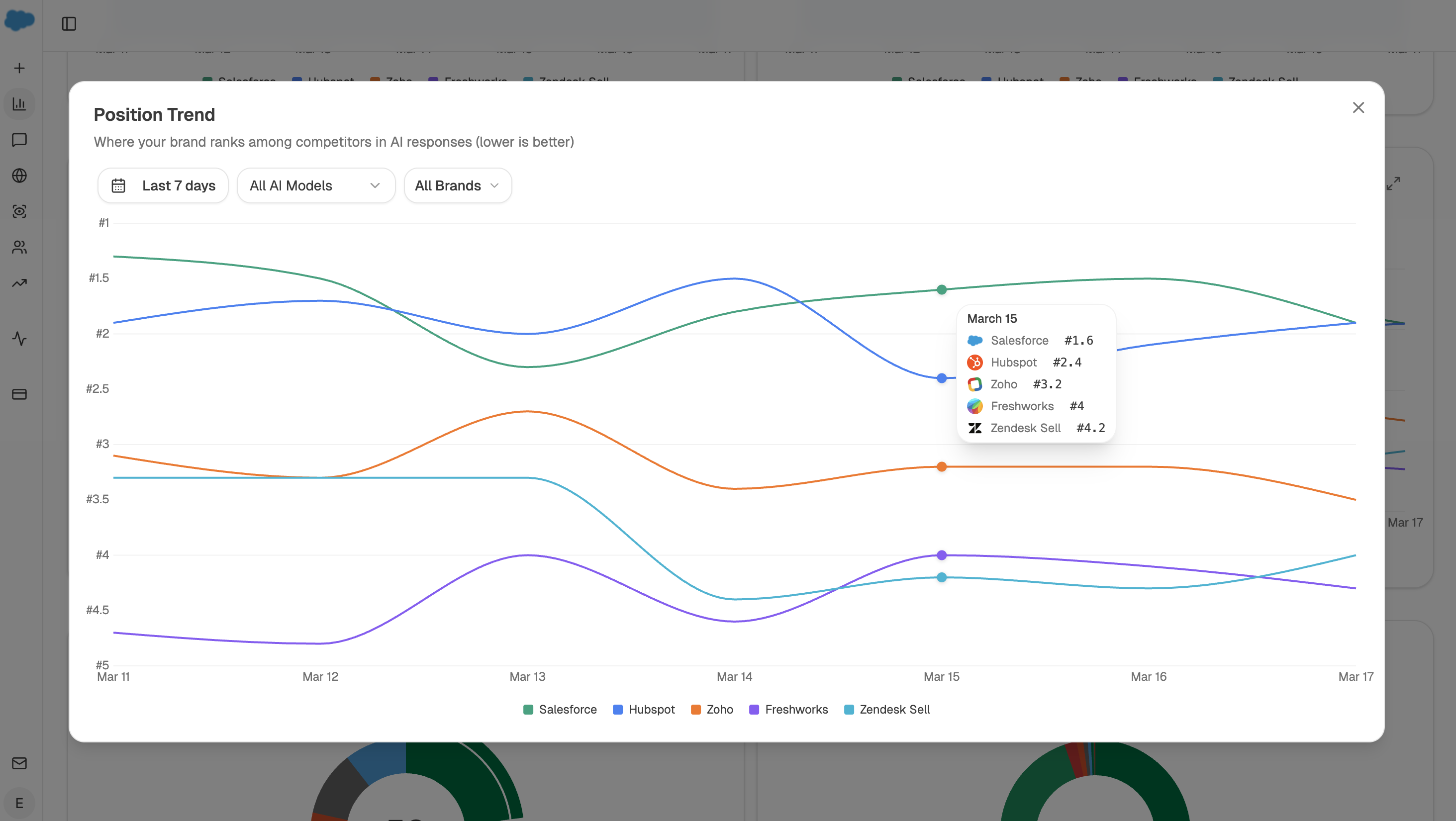 Position trend is a right-column number: it moves because of what you published, not because you published.
Replace three output numbers with three outcome numbers
You do not need a new dashboard. Swap three lines in the deck you already have.
- Posts published becomes pages that entered the top ten this quarter. Same effort measured at the other end.
- Keywords targeted becomes buyer questions where you are now named in AI answers. Analyze AI reports this as Visibility Score across your tracked questions, and the
unmentioned-promptsrecipe lists the ones you still miss. - Traffic becomes opportunities from organic, or if your CRM cannot support that yet, pages that produced at least one sales conversation.
The third swap is the one that meets resistance, and it is the one worth insisting on. How do I prove SEO is generating revenue and not just traffic covers the plumbing.
Watch for the two habits that keep output alive
Volume targets set before coverage is known. A team told to publish four a month will find four things to write about, whether or not four things need writing. Size the library from the buyer first, which is the count in how much top-of-funnel content does a company actually need.
Refreshes that do not count. If your reporting only counts new posts, nobody will rewrite anything, because a rewrite scores zero. That single quirk is why libraries decay while output stays healthy.
Google's own guidance on creating helpful content puts the same idea plainly, asking whether a page offers substantial value compared with what already ranks, and warning against writing to a target because you heard there was one. A cadence is exactly that kind of target.
Report movement, not activity
The other reason output wins is that outcome numbers move slowly and look boring month to month. So report the change rather than the level.
Analyze AI does this through scheduled digests, which send what moved since the last run rather than the full picture: visibility up or down, pages gaining or losing citations, competitors rising. A message about three pages that lost citations gets read. A dashboard link does not.
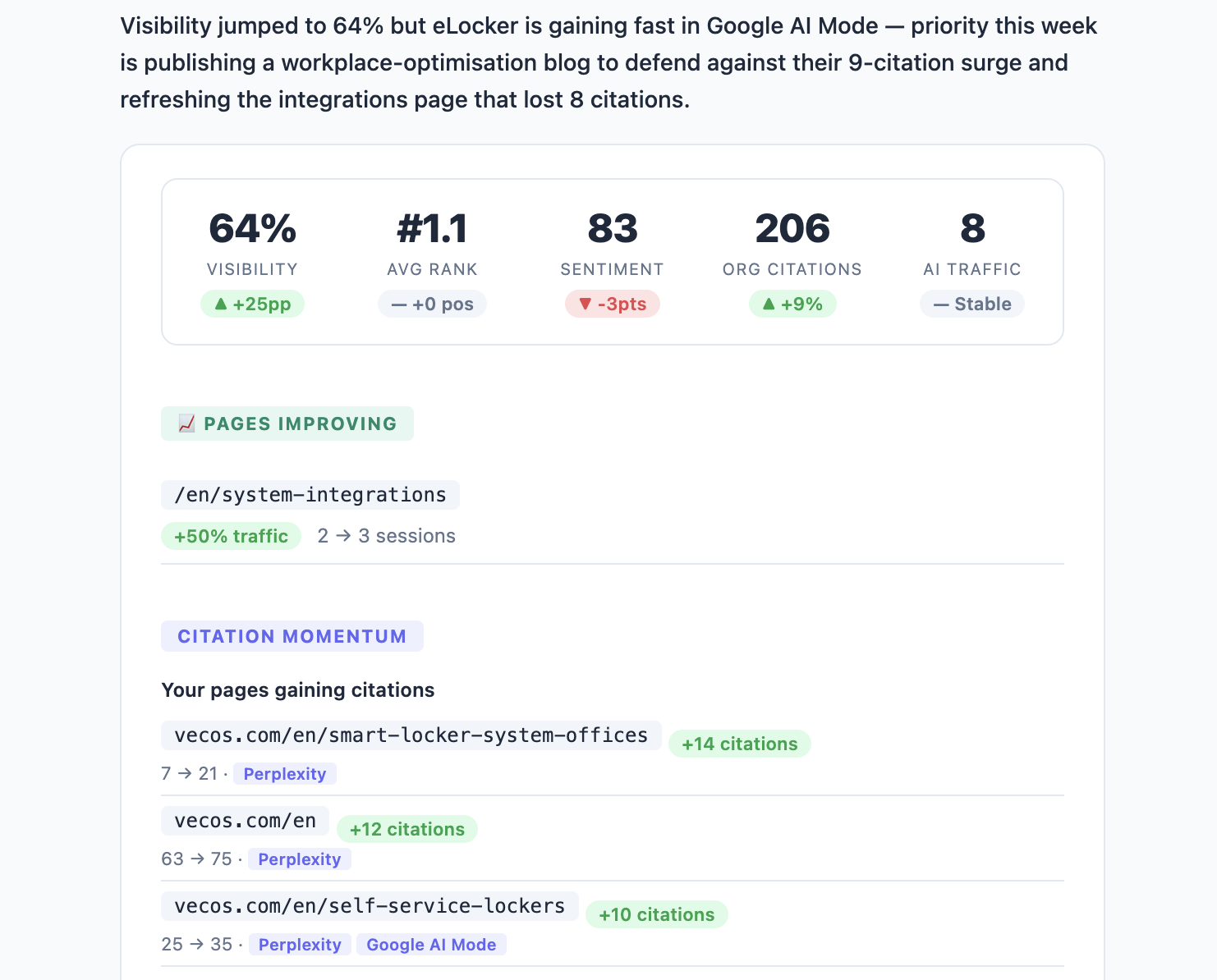 The digest reports what changed since the last run, which is the format that keeps an outcome number in front of people.
Build the swap as an agent
Start (schedule, monthly) → GSC Top Pages for Site counting pages in the top ten this month against last → Visibility Score and unmentioned-prompts for the buyer questions you are named on → HubSpot Search Deals for opportunities tied to organic landing pages → workflow-memory recipe holding last month's figures → Code node producing only the three outcome numbers and their movement → Send Notification to the same channel your output report goes to.
Sending it to the same channel is deliberate. An outcome report that lives somewhere else gets read by the people who already agree with it.
FAQ
Related answers
- How much top-of-funnel content does a company actually need?
- How do I prioritize content ideas by expected revenue and effort?
- When should an organic channel be judged on pipeline instead of traffic?
- How do I tell whether our content actually helps a buyer decide?
Report what happened, not what you did
Analyze AI tracks the questions you are named on, the pages assistants cite, and what moved since last month.
Start your free trial