
How do I measure a buyer who found us in an AI answer but came back later through Google?
Short answer
You capture the first touch at the moment it happens and store it permanently, because no analytics tool can reconstruct it weeks later. Set a first-touch cookie on the initial visit, pass it into your CRM as a hidden field on the form, and add a signup survey for the visits that arrive with no referrer at all. Last-touch attribution will always hand this deal to branded search, and that's the specific distortion you're correcting.
Why this journey breaks standard attribution
The pattern is now common in B2B. Someone asks an assistant for options, sees you named, doesn't click, and leaves. Two weeks later they search your brand in Google and convert.
Every default attribution model credits that conversion to branded organic search. The AI answer that created the awareness gets nothing, and the search that merely harvested it gets everything.
The deeper problem is that GA4's lookback works only on data it collected. If the first visit arrived with no referrer, GA4 logged it as Direct at the time, and no later analysis recovers what it never saw. That makes this a data-capture problem rather than a reporting one.
Capture first touch at the moment it happens
Step 1. Set a first-touch cookie on the first visit. Store source, medium, referrer, landing page, and timestamp. Write once, never overwrite, one-year expiry.
Step 2. Set a last-touch cookie separately, overwritten every visit. The comparison between the two is the entire insight.
Step 3. Pass both into every form as hidden fields, synced to the CRM contact record.
Step 4. Carry them to the opportunity, or you can attribute leads but not revenue.
Once this is running, a deal shows first touch AI Assistant and last touch branded organic, and the report can finally show both.
If your forms don't pass a landing page today, that's the prerequisite. See How do I map organic landing pages to the customers they eventually produce?.
The gap cookies can't close
Cookie capture works when the first visit happened and was recorded. It fails in two situations that matter a lot here.
The first visit had no referrer. Mobile app taps and copy-pasted URLs arrive as Direct, so your first-touch cookie stores "Direct" and you're no better off.
There was no first visit at all. The buyer read your name in an AI answer, never clicked, and searched your brand two weeks later. There is nothing to cookie.
The second case is the larger one. Our own state of AI search research, covering more than 22,000 answers, found Google AI Mode returns a citation-rich answer in 97.4% of matched B2B queries and Perplexity in 93.2%. Pew Research found that when an AI summary appears, users click a source link in only about 1% of visits.
So the dominant version of this journey involves no click at the awareness stage. No tracking system reaches it.
The one question that does close it
Add "how did you hear about us" at signup, with ChatGPT, Perplexity, Gemini, and Claude as explicit named options rather than folded into "other."
This is the only mechanism that captures a first touch which never produced a session. Someone who read about you in an assistant and searched your brand later will tell you so, and no cookie could have known.
Cross-reference the survey answers against the recorded first-touch channel. The pattern to look for is customers whose recorded first touch is branded organic or Direct, but whose survey answer names an AI surface. That group is your correction factor, and applying it to your branded-search cohort gives you a defensible AI-influenced number.
Report it as three columns
| Column | Definition | What it shows |
|---|---|---|
| First touch | From the first-touch cookie | Which channel created awareness |
| Last touch | From the last-touch cookie | Which channel harvested it |
| Survey-reported first touch | From the signup question | The awareness that never produced a session |
Never collapse these into one number. The disagreement between column one and column three is the finding, and it's the number that changes budget decisions.
Expect the survey to attribute meaningfully more to AI than your cookies do. That difference isn't an error in either measurement. It's the size of the zero-click layer.
Build the lagged correlation that stands in for the missing touch
Cookies capture visits. This journey's first touch was a citation that produced no visit, so the evidence has to come from the relationship between two time series rather than from a session record.
Get Visibility Events returns month-over-month visibility shifts per provider, which is the shape this analysis needs. A current-state percentage tells you where you stand, while the events series tells you what moved and when, and movement is what correlates against later branded search.
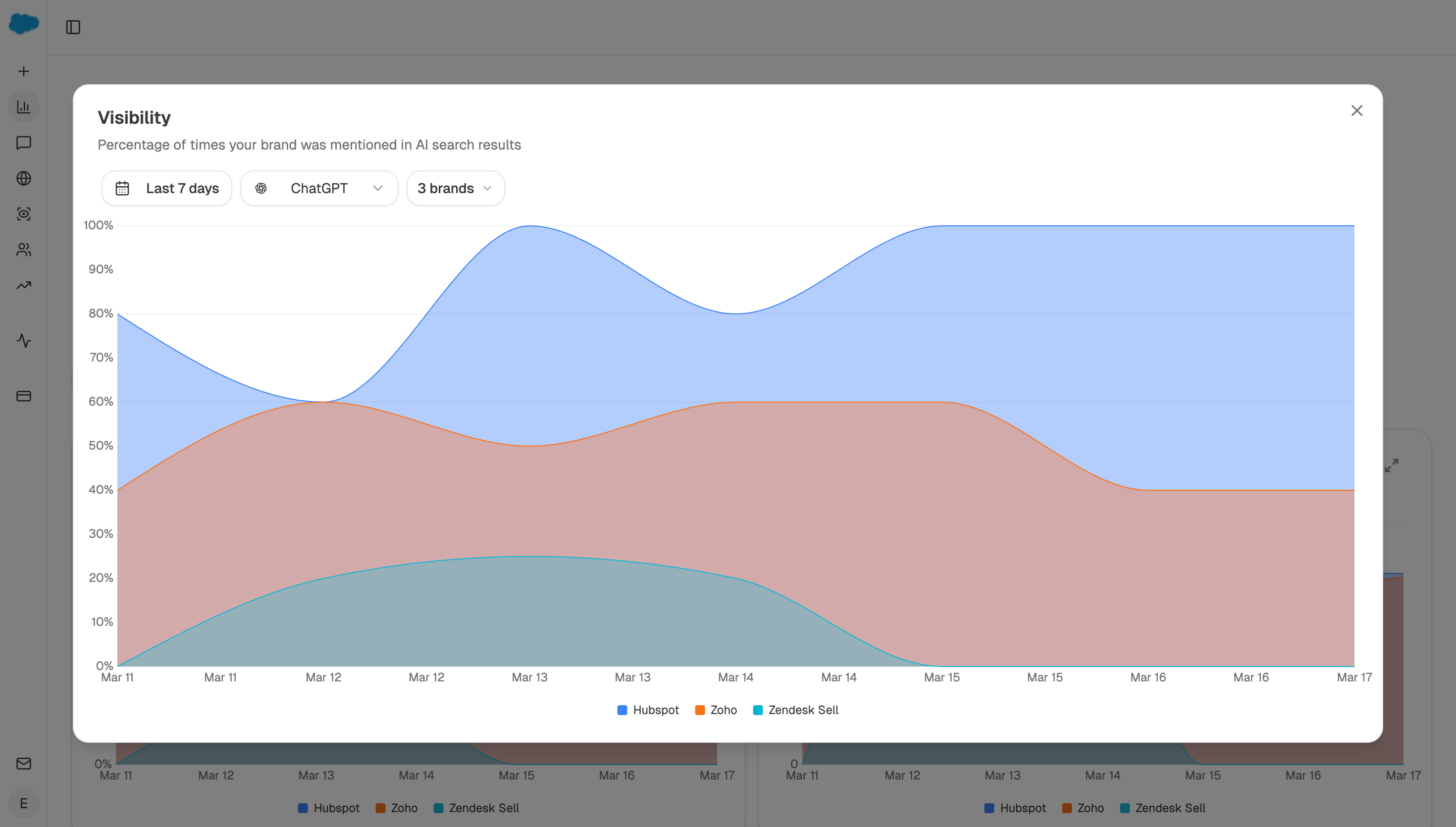
Pair it with GSC Top Keywords for Site filtered by your branded regex from the same run, so both series come from one execution rather than two exports taken on different dates that quietly drift out of alignment.
The monthly agent:
Start (schedule, 1st of month) → Get Visibility Events (per provider) → Citation Share → GSC Top Keywords for Site (branded regex, 24 months) → GA4 AI Traffic Overview → HubSpot Get CRM Objects (deals with first-touch and survey fields) → Code (cross-correlate visibility movement against branded search at 4, 8, and 12 week lags, and compare recorded first-touch channel against survey-reported channel per deal) → workflow-memory (prior runs, to check the lag holds across months) → Prompt LLM (report the three-column view and the strength of the lagged relationship) → Excel export → Send Email to CMO.
The correlation is only persuasive if it repeats, which is why workflow-memory is in the chain. A single month showing citations up and branded search up eight weeks later is a coincidence. The same relationship holding across four consecutive months is the strongest evidence this journey produces.
The other output is the per-deal comparison between recorded first touch and survey-reported first touch. Deals where your cookie says branded organic and the buyer says ChatGPT are the population this whole article exists to find, and listing them by name makes the correction concrete rather than statistical.
FAQ
Related answers
- How can I build credible evidence that AI search is sending customers when there is no referrer?
- How can I estimate how much AI-influenced traffic is hidden in my Direct channel?
- How do I separate first-touch, assisted, and last-touch organic revenue?
- How much of our organic revenue is new demand versus branded demand capture?
Want to see AI visibility and later branded search on the same timeline? Start a free Analyze AI trial and connect GA4, GSC, and your CRM.