
Which of two overlapping pages should win?
Short answer
Keep the URL with the most inbound equity and move the better content onto it. Links, age and internal links are expensive to rebuild, while words can be moved in an afternoon. That means the surviving URL is often the weaker article, and that is fine, because you are keeping the address and replacing what sits at it.
Score both pages on four things
Set the argument up so it resolves on evidence rather than on who wrote which page.
| Input | Where to get it | Why it matters |
|---|---|---|
| Referring domains | Any backlink tool | The hardest thing to rebuild |
| Internal links pointing in | Your own crawl | Cheap to change, still real |
| Best historic position and clicks | Search Console, 16 months | Proven ability to rank |
| Sales conversations produced | CRM | The only outcome that pays |
Weight referring domains heaviest. A page with 40 referring domains and mediocre copy beats a page with 2 and excellent copy, because you can fix the copy this week and you cannot fix the links at all.
If both pages are close on links, break the tie on historic position. If they are close on both, keep the shorter URL and the one with the cleaner slug.
Move the content, keep the address
Once you have picked the survivor, the work is mechanical.
- Take the best sections from both pages and assemble one better page at the surviving URL.
- Keep anything from the losing page that the survivor lacks, particularly examples, data and images.
- 301 the losing URL to the survivor.
- Update every internal link that pointed at the loser so it points directly at the survivor rather than through the redirect.
- Keep the redirect in place permanently.
Step four is the one that gets skipped, and it leaves you with a site full of one-hop chains that nobody cleans up later. How do I find internal links that went stale after site changes covers finding them.
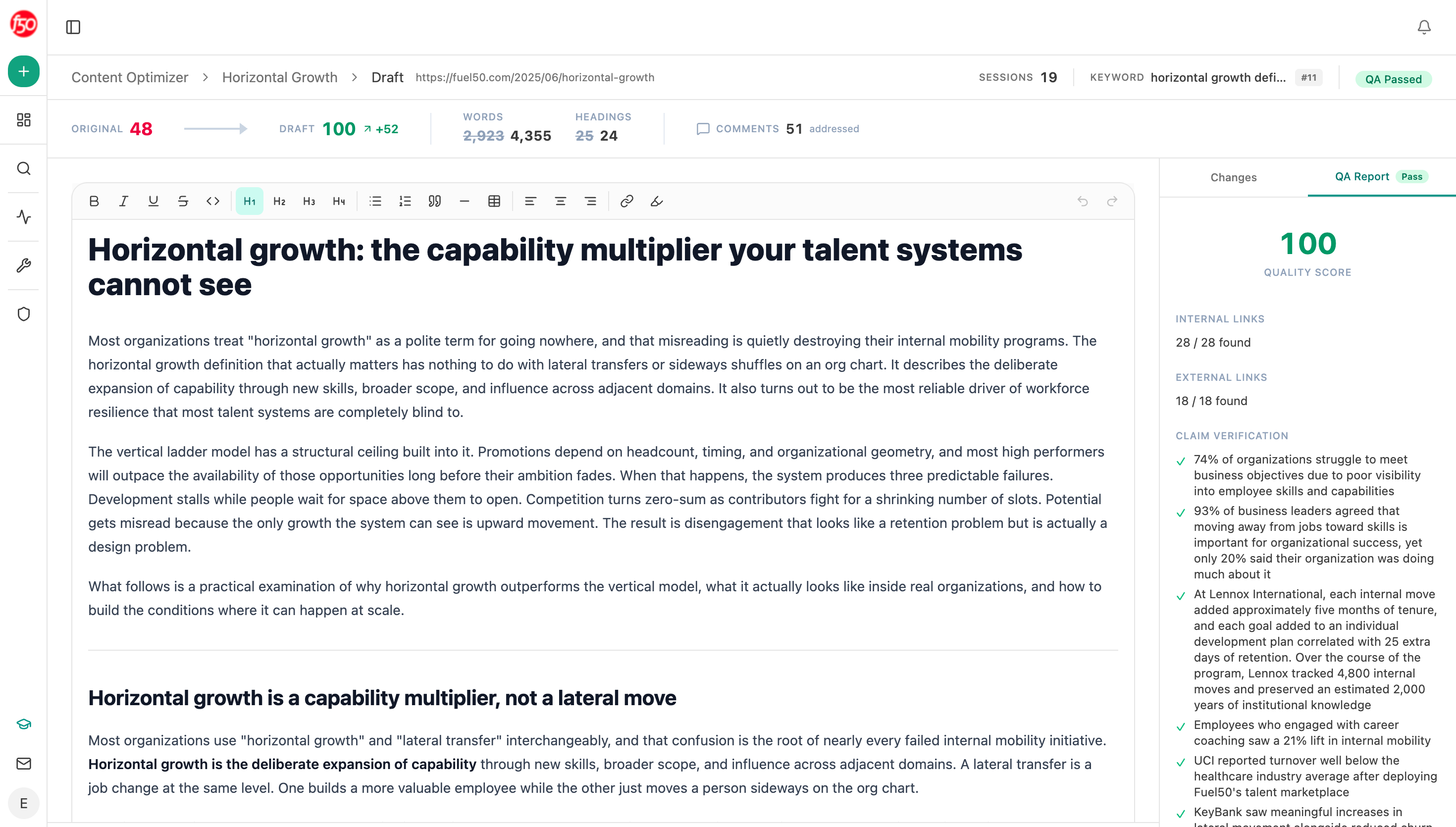 The optimizer returns a rewritten page, which is the practical way to assemble the merged version rather than pasting two drafts together.
Check which one assistants prefer before you choose
There is a fifth input that will not appear in any traditional audit, and it sometimes overturns the decision.
Analyze AI's Citation Pages view lists which of your pages assistants use as sources. If the page with fewer links is the one being cited, it is answering the question better, and that is worth knowing before you redirect it into oblivion.
Our own state of AI search research examined 4,824 cached pages and found site strength was a poor predictor of citation breadth, so the cited page is frequently not the one holding the links. When the two disagree, keep the URL with the links and make sure every element that earned the citation survives the merge.
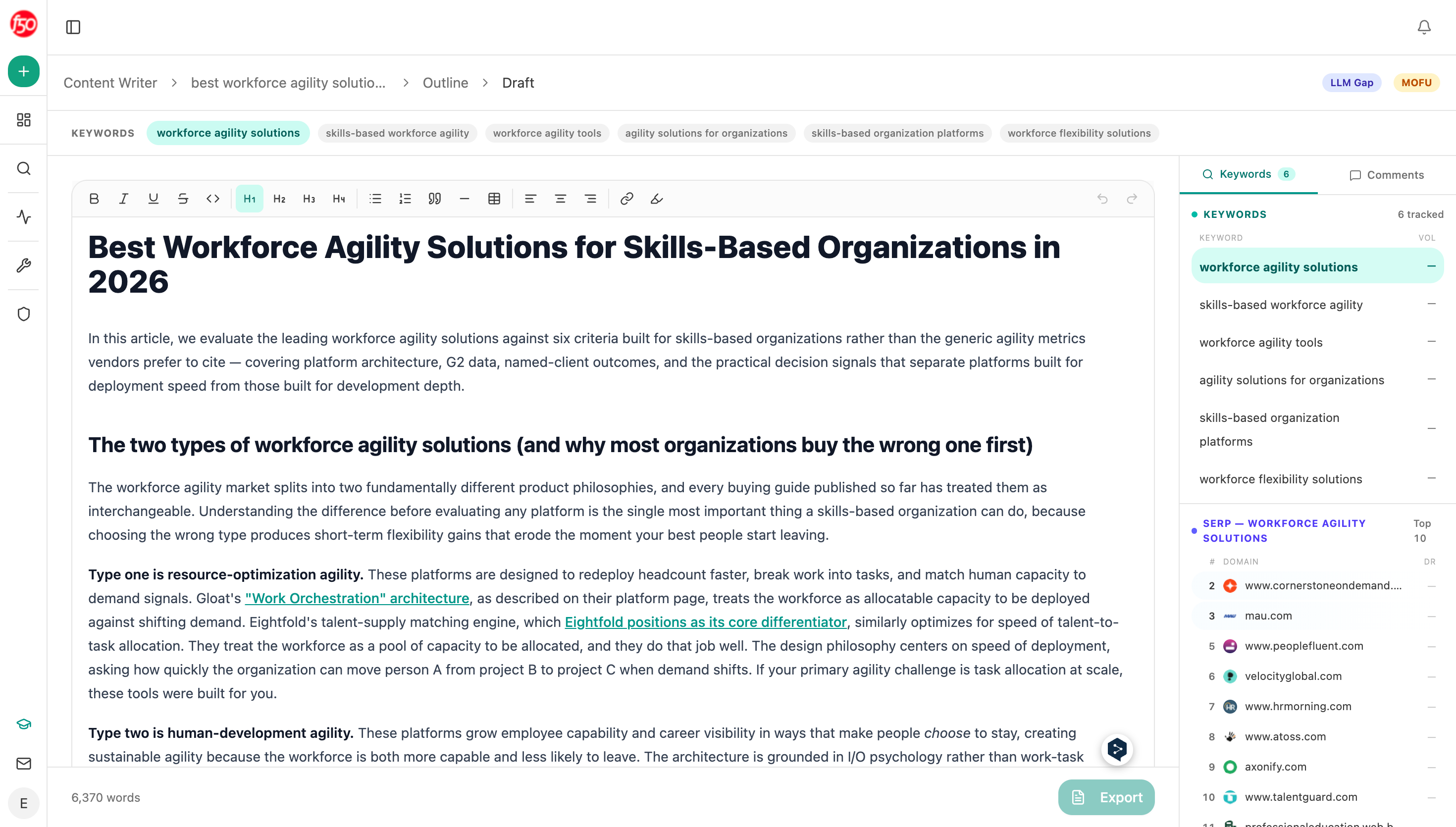 Drafting the merged version rather than pasting sections together is what stops the citation-earning parts being lost in the join.
Expect a dip, and know how long to wait
A merge nearly always dips before it recovers. Google has to recrawl both URLs, follow the redirect, and re-evaluate the combined page.
Two to six weeks is normal, and longer on large or slow-crawled sites. Do not judge the merge inside that window and do not reverse it at week three, which is the most common way a correct merge gets undone.
Set the measurement window in advance and record the before state, which is the discipline in how long after a refresh should I measure results.
Write down what you expect to happen
Before you merge, record the combined figure you are aiming at: the clicks both URLs earned together in the trailing quarter, and the position each held.
Two reasons this matters. It gives you something to measure against, since a merge that recovers 80% of combined traffic on one URL is usually a win rather than a loss. And it stops the argument three months later about whether the merge worked, which without a baseline is unanswerable.
Google's documentation on AI features is worth reading alongside this, since eligibility follows ordinary indexing and a redirected URL stops being available as a source until the survivor is recrawled. Expect the citation side to lag the ranking side.
Decide it with an agent
Start (manual, both URLs as inputs) → Semrush Backlinks Overview for referring domains on each → GSC Page-Keyword Breakdown for 16 months of position and clicks per URL → HubSpot Search Deals for sales conversations attributed to each → Citation Pages showing which one assistants cite → Web Page Scrape returning both pages' content → Prompt LLM scoring the four inputs and listing what must survive from the losing page → Export Markdown as a merge brief.
Listing what must survive is the part worth copying. Most merges lose something, usually a worked example or a data point that was the reason anyone linked to the page in the first place, and nobody notices until the links stop.
FAQ
Related answers
- How do I find pages that compete with each other?
- When is deleting or redirecting old content better than updating it?
- Should I update the old article or publish a new one?
- How long after a refresh should I measure results?
Merge on evidence, not on preference
Analyze AI scores both URLs on links, history, CRM outcomes and citations, then lists what has to survive the merge.
Start your free trial