
How do I build a topic cluster without cannibalizing my own pages?
Short answer
Compare the results for every pair of pages you plan to write, before you write either. Pull the top ten for both keywords and count how many of the same pages show up in both. Four or more and Google thinks those two searches want the same thing, so make it one page. Fewer than four and they are different enough to stand apart.
Run the overlap check before anyone writes
This takes ten minutes per pair and happens before a document is opened. If two of your pages are already fighting, how do I find pages that compete with each other is the diagnosis and which of two overlapping pages should win is the fix.
- List every page you plan to write, each with one main keyword.
- For each pair, search both keywords in a private window with the same country setting.
- Write down the top ten pages for each.
- Count how many exact URLs appear in both lists.
| Same URLs in both | What it means | What to do |
|---|---|---|
| 7 or more | The same search, different words | One page, no argument |
| 4 to 6 | Close enough that Google treats them alike | One page, covering both |
| 2 to 3 | Related but different | Two pages, linked to each other |
| 0 to 1 | Different searches | Two pages, safe |
Treat four as a working line rather than a law. It holds up because it is the point where the same pages are satisfying both searches, which is what "the same search" actually means.
Part of why two keywords that look different behave the same is mechanical. Google groups close variants together, so two rows in your research file can be one search as far as ranking goes.
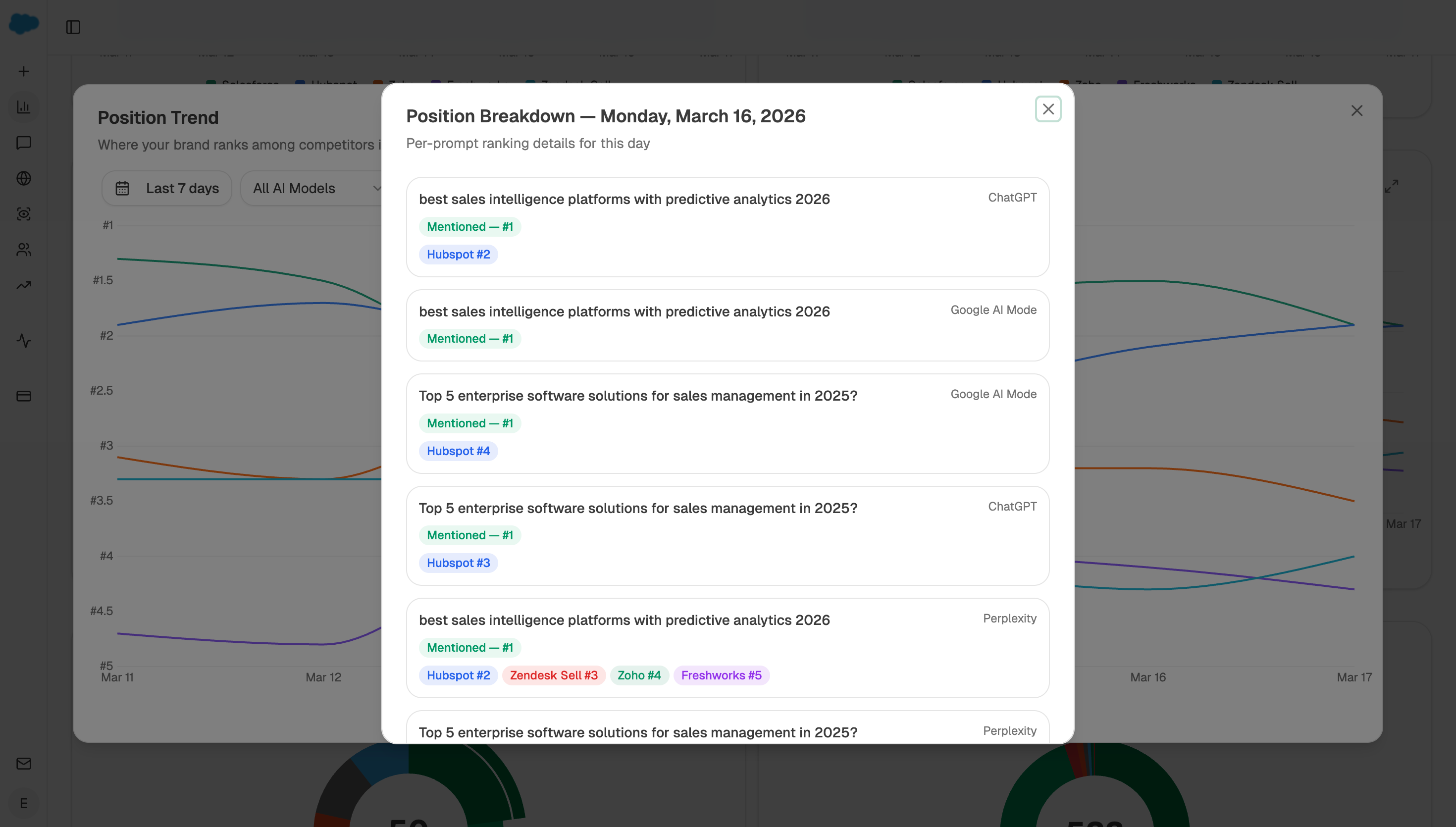 The per-prompt breakdown shows which of your pages appears on a given question, which is the AI-side check on whether two of them overlap.
Check the pages you have already forgotten
The overlap check covers new pages. The other way this goes wrong is a new page colliding with something you published two years ago and forgot.
Use the page and keyword breakdown in Search Console. For each planned keyword, list every page of yours already picking up impressions for it. If one of your pages gets more than about a fifth of its impressions from the group you are planning, that page is already in the group whether you meant it or not.
Then decide out loud. Either that page becomes the one for this search, or you narrow the new page until the overlap goes. Doing neither is how a group ends up with a fourth page quietly taking 40% of the traffic from the second.
Analyze AI does this sweep for you with the Keyword-Page Breakdown node, which lists every page you own picking up a given search.
Stop the pages drifting apart later
Three rules keep a group stable after it goes live.
- One page, one search, written down. Put the search it owns in the brief and in a field in your CMS. Drift happens when nobody can look up what a page was for.
- Links point one way. Supporting pages link up to the main one with descriptive text, and the main one links back down. Sideways links are fine unless they use the other page's main keyword.
- New questions get checked, not published. Test every new question against the pages you have before it becomes a page. When does a buyer question deserve its own article is that check.
How to build a topic cluster covers building the hub and spokes themselves.
Ask whether two of your pages can both be cited
They can, and the difference matters before you merge everything in sight.
Assistants pick passages rather than ranking one page per site, so two of your pages can both appear in the same answer without either being punished. In our own state of AI search research, answers used an average of 3.60 sources on ChatGPT, 6.71 on Perplexity and 5.33 on Google AI Mode, across 5,755 matched days. There is room for more than one page from the same site.
What still hurts is splitting your evidence. Two half-finished pages on the same question each hold half the proof, and neither is the obvious one to quote. So merging is usually right for both channels, for two different reasons. On Google you are splitting your ranking. In assistants you are splitting your evidence. Analyze AI shows you the second half through Citation Pages, which names which of your pages actually get pulled into answers.
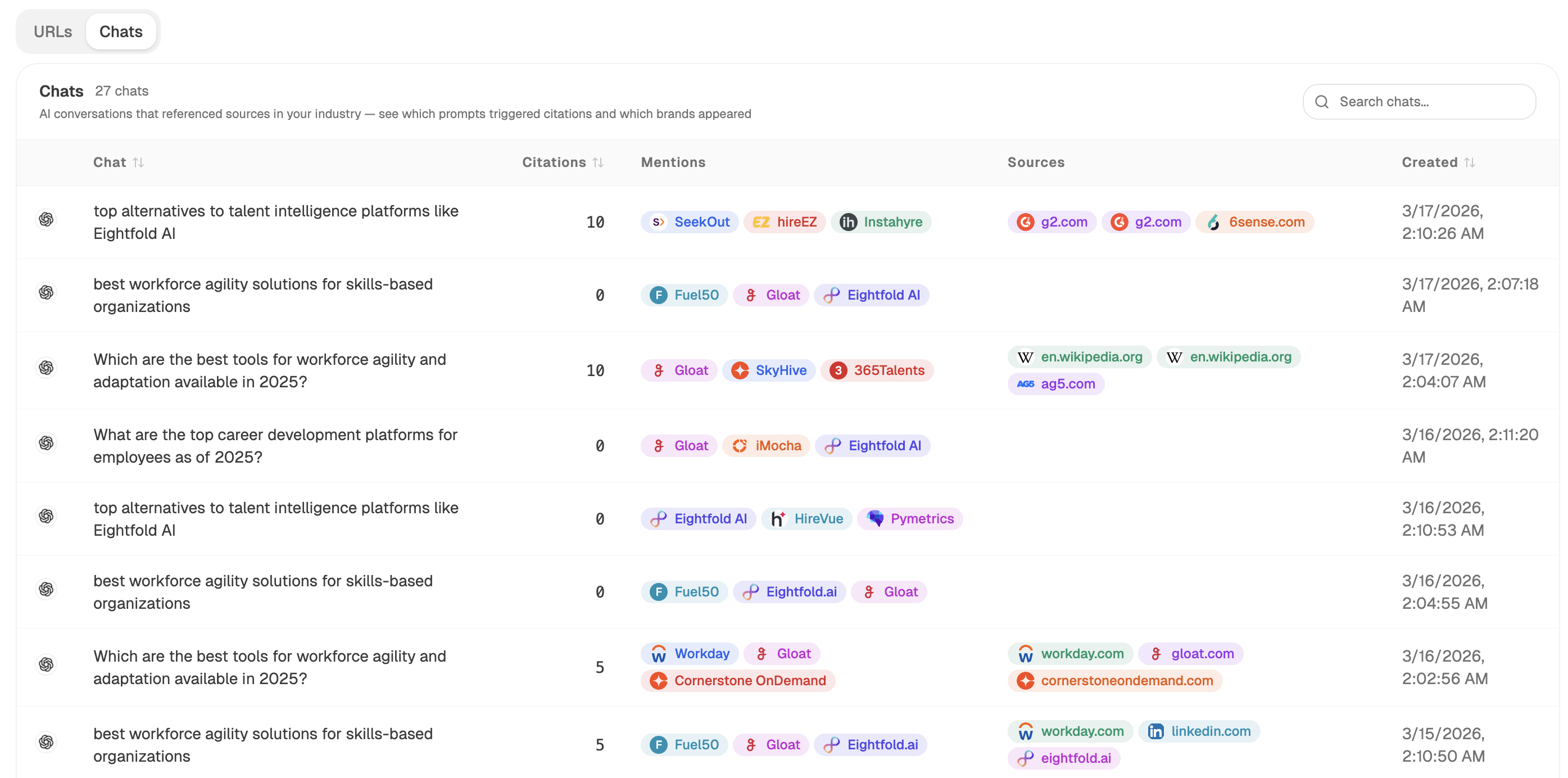 Sources shows where your evidence is concentrated, which tells you whether a second page would split it.
Run the check as an agent
Start (manual, your planned pages and keywords as a file-csv) → Loop over each pair → Google Search returning the live top ten per keyword → Code node counting the overlap per pair → GSC Page-Keyword Breakdown and Keyword-Page Breakdown for pages already picking up those searches → Conditional flagging any pair over four shared URLs or any old page over the one-fifth line → Export CSV listing merges before a single brief exists.
Notice that the Loop goes over pairs, not over pages. Cannibalisation is a relationship between two pages, so checking each page on its own will pass everything and still ship a group that fights itself. Pairs mean more calls, and it is the only shape that catches the problem.
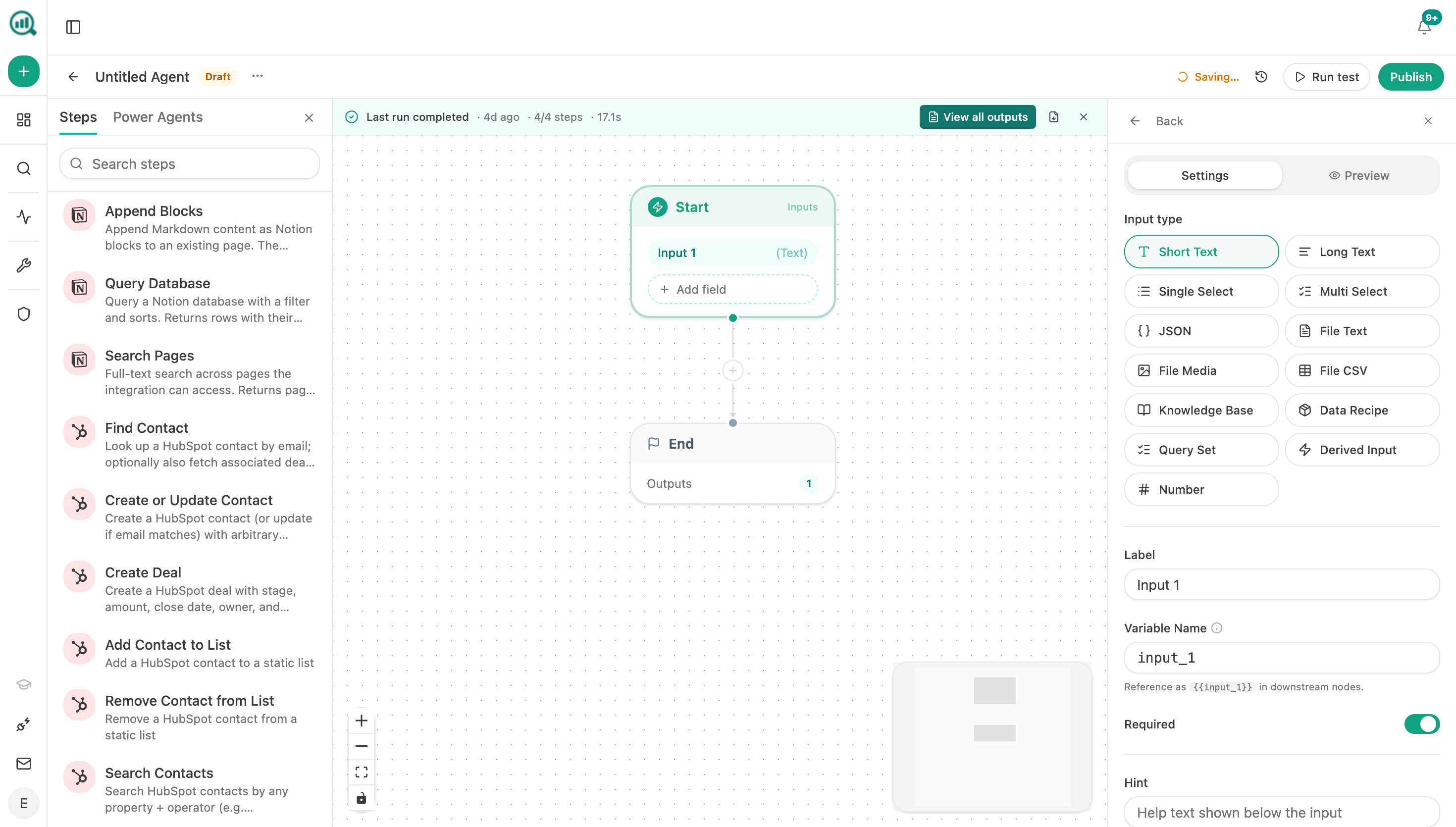 Running the pair check as an agent means it happens every time you plan a group, not only the first time.
FAQ
Related answers
- How do I find pages that compete with each other?
- Which of two overlapping pages should win?
- When does a buyer question deserve its own article instead of an answer on an existing page?
- Should this be an article, comparison page, case study, tool, or service page?
Catch the clash before you write it
Analyze AI compares the live results for every planned pair and flags the merges before a brief reaches a writer.
Start your free trial