
How do I reach decision-makers who never talk to sales?
Short answer
You reach them through the person who does talk to sales. Build one-page, ungated pieces your champion can forward without explaining them, written in the language their boss uses rather than yours. Then make sure you exist in the places that boss checks on their own, which is usually a review site, a peer conversation, or an AI assistant.
Accept that you will not meet them
In most B2B deals the person who signs never speaks to a vendor. They read a forwarded document, ask two questions, and approve or refuse based on how confident their team sounds.
That changes what you are building. You are not writing to persuade the decision-maker directly. You are equipping someone else to persuade them, and giving that person something that survives being sent without you attached to it.
Everything below follows from that.
Make one page your champion can forward
A forwardable page has four properties, and most vendor content has none of them.
- One page. A senior person will read a page. They will not read a guide, and they will not download anything.
- No gate. A form on the other side kills the forward, because your champion will not send their boss a page that asks their boss for an email address.
- Their question, not yours. The forwarded page has to answer what the boss actually asks, which is usually about cost, risk and what happens if this goes wrong. Not what your product does.
- Light on you. A page that mentions your company in every paragraph reads as a brochure and undermines the person sending it.
The strongest version is a short business case with the assumptions visible, so the boss can change the numbers rather than distrust them. What content do finance, security, and procurement need before approving a purchase covers the standing set.
Write for the objection the boss will raise
Your champion knows the product. Their boss knows the risk. The forwarded page has to speak to the second.
| What your champion cares about | What the person signing cares about |
|---|---|
| Does it do the job? | What happens if it does not? |
| Is it pleasant to use? | Will the team actually adopt it? |
| Can I get it working? | Who is doing that work, and when? |
| Does it fit my stack? | What are we locked into? |
| Is it good? | Is this defensible if it goes wrong? |
Most libraries are written entirely in the left column, which is exactly the gap the grid in which buying roles and objections are missing from our content library exposes.
Be present where they check on their own
Senior buyers do a quiet second check that nobody tells you about, and most of it leaves no trace. Pew Research found a source link was clicked in about 1% of visits when an AI summary appeared, so you will rarely see them arrive. They ask a peer, they skim a review site, and increasingly they ask an assistant.
That last one is now a real part of the process, and you can see it. Analyze AI's Ad Hoc Prompt Searches lets you ask the question the way an executive would, and the Perception view shows how you are described against rivals in the answer that comes back.
The description matters more than the mention. Being named as the cheap option to a buyer worried about risk is worse than not being named. Perception shows you which one is happening.
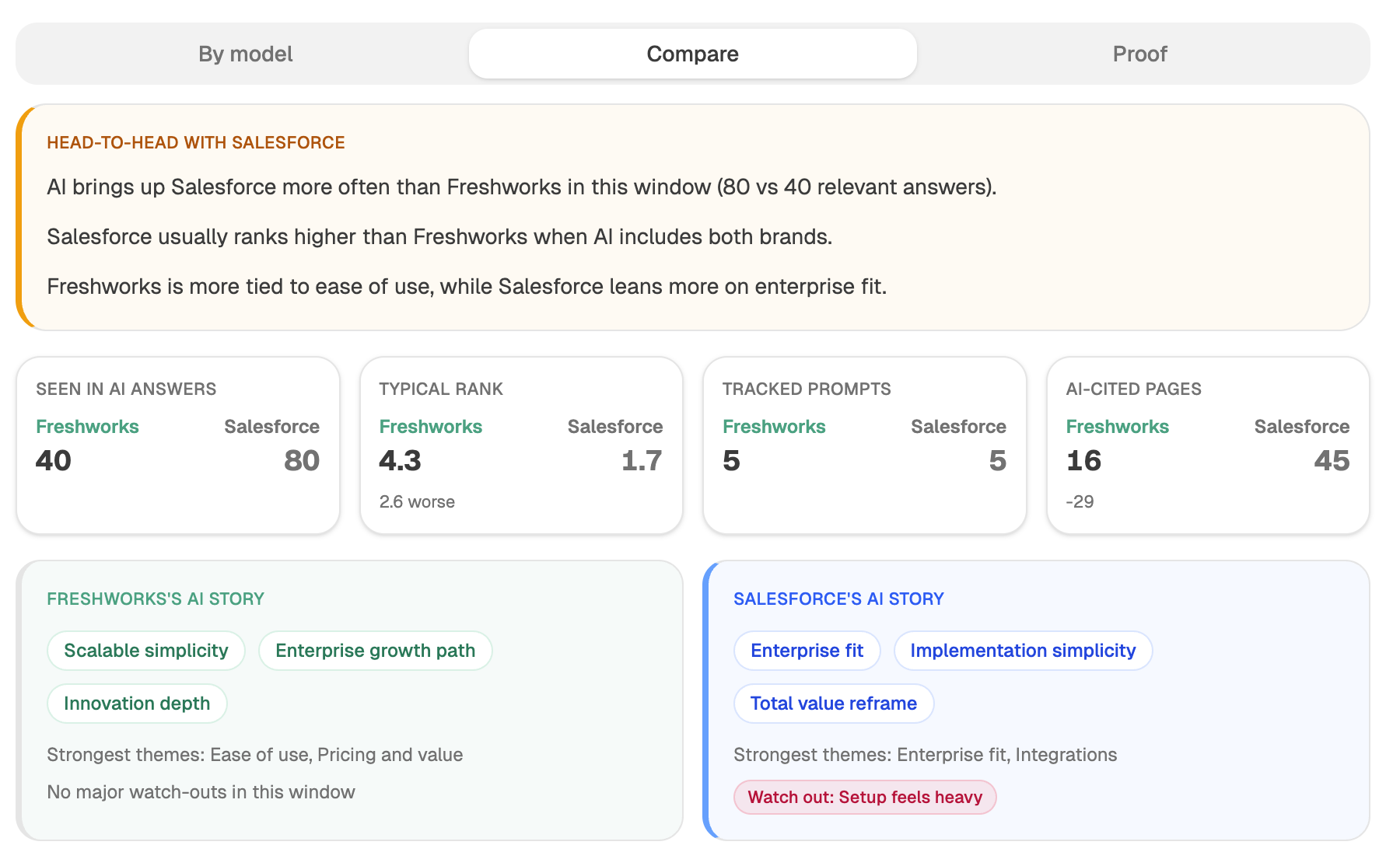 Perception shows which kind of buyer assistants associate you with, which is what a senior researcher will meet first.
Get into the sources those answers are built from
You cannot edit an assistant's answer, but you can change what it reads.
In our own state of AI search research, the source mix differed sharply by surface. Lists, comparisons and reviews made up 34.4% of what Perplexity cited and 33.1% of Google AI Mode, while on ChatGPT company sites and product pages made up 68.8%. So an executive checking on Perplexity is largely reading third-party material, and being absent from it removes you from the answer regardless of your own pages.
Analyze AI's Sources view shows which sites and content types feed the answers in your market, which turns "get more coverage" into a named list of places worth pursuing. How do I distribute content into the places buyers already learn covers working that list.
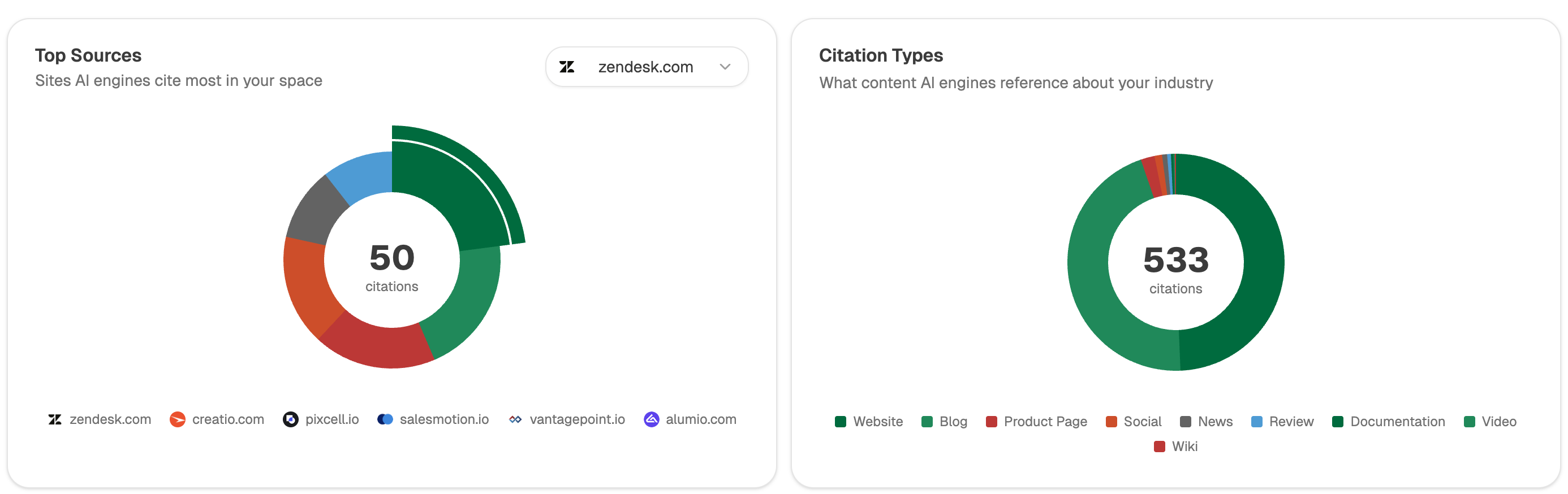 Top sources and citation types name the places an executive's own research is likely to land.
Track the executive question set separately
Start (manual, a query-set of questions phrased the way a decision-maker asks them) → Prompt Responses running each one live across providers and returning who was named and how → Get Perception Quadrant placing you against rivals on that set → competitor-sources recipe listing the pages that cite rivals and never you → Export CSV ranked by how often each source appears.
Keeping this set apart from your main tracked prompts is the point. Executive questions are shorter, more cautious and more comparison-heavy than practitioner ones, and blending them into one score hides the gap that matters here.
FAQ
Related answers
- What content do finance, security, and procurement need before approving a purchase?
- Which buying roles and objections are missing from our content library?
- What makes thought leadership useful to a hidden B2B buyer?
- How do I distribute content into the places buyers already learn?
Find out what the person signing is told
Analyze AI runs executive-shaped questions live and shows how you are described against rivals in the answers they get.
Start your free trial