
Which buying roles and objections are missing from our content library?
Short answer
Draw a grid with your buying roles down one side and their objections across the top, then map every page you have onto it. The empty squares are your gaps. Almost every B2B library comes out heavily filled for the practitioner and nearly blank for finance, security and procurement, which is why deals stall late rather than early.
Build the grid from your own deals
Do not invent the rows and columns. Pull them.
- Take your last 30 closed deals, won and lost.
- List everyone who appeared on a call or an email thread, and group them into roles.
- For each role, list the objections they actually raised, in their words.
- Keep any objection that appeared in three or more deals.
- Draw the grid.
A typical result for a mid-market SaaS looks like this.
| Does it work? | Will my team use it? | Is our data safe? | What does it cost at scale? | What if it fails? | |
|---|---|---|---|---|---|
| Practitioner | 6 pages | 3 pages | none | none | 1 page |
| Their manager | 2 pages | 1 page | none | 1 page | none |
| IT and security | none | none | 1 page | none | none |
| Finance | none | none | none | 1 page | none |
| Procurement | none | none | none | none | none |
Thirteen of the twenty-five squares are empty, and eleven of the twelve filled squares serve the top two rows. That is the shape of nearly every library we audit, and it explains a pattern most teams see: strong early engagement, deals that die in the last third.
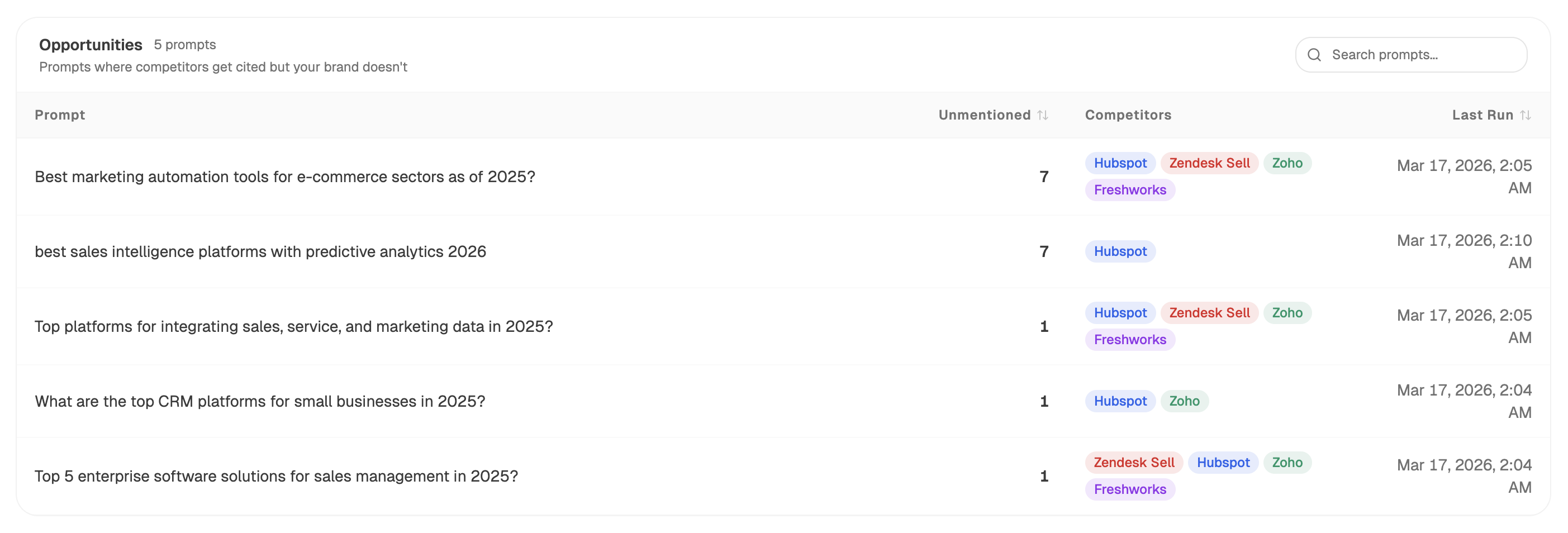 The Opportunities table lists the questions rivals get cited on and you do not, which usually maps onto the emptiest rows of the grid.
Fill the bottom rows first
The empty squares are not equally valuable. Three rules order them.
Late-stage beats early-stage. An empty square in the procurement row costs you deals you have already paid to create. An empty square in the practitioner row costs you reach.
Frequency beats importance. Fill the objection that appeared in eleven deals before the one that appeared in four, even if the second feels weightier.
Lost beats won. Objections that show up more in lost deals than won ones are where your content had a chance and missed. Those are the highest-return squares on the grid.
Applied to the table above, the first three pages to write are a security and data page, an exit and export page, and a cost-at-scale page. None of them are blog posts, and all three are covered in what content do finance, security, and procurement need before approving a purchase.
Map your pages honestly
The mapping step is where teams flatter themselves. A page counts for a square only if a person in that role could read it and stop worrying.
Two tests keep it honest. Would you send this page to that person by name, without an explanatory email? And does the page use their language rather than yours, since a security reviewer does not search for your feature names.
Analyze AI helps here through the Content Optimizer, which fetches the live page and reports what it actually covers rather than what the brief intended. Pages regularly turn out to be aimed a role above or below where you filed them.
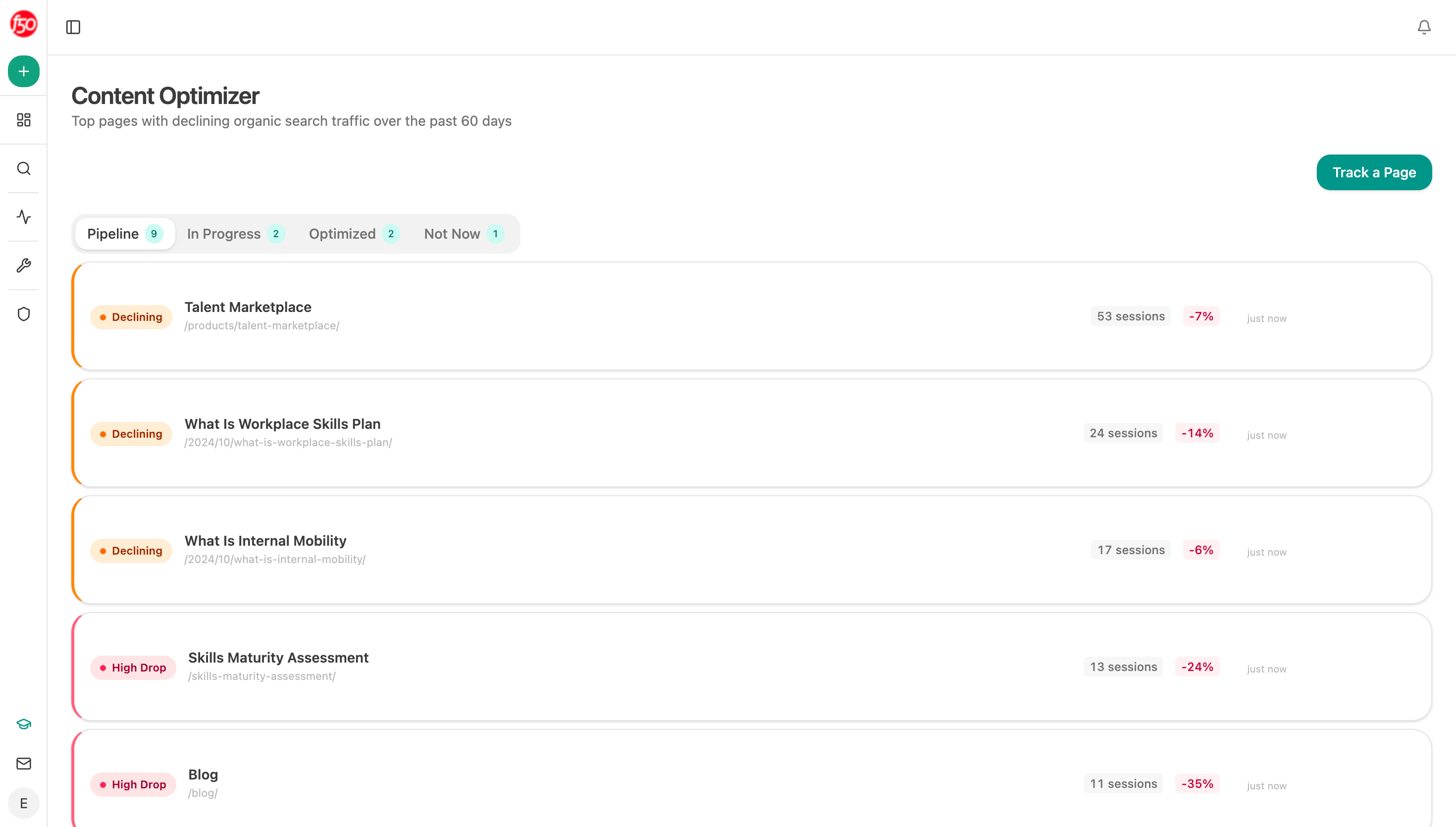 The optimizer reads the page as it stands and names what is missing, which stops a square being ticked by a page that only half covers it.
Check the grid against AI answers too
Buying committee members research quietly, and increasingly they ask an assistant rather than reading your site. Google's AI features documentation notes that eligibility follows ordinary indexing, so a page behind a form cannot fill a square at all.
Turn each empty square into a question the way that role would ask it, then run it. Analyze AI's Ad Hoc Prompt Searches runs the question live across ChatGPT, Perplexity and Google AI Mode, and unmentioned-prompts lists the buying questions where no page of yours appears at all.
The results usually sharpen the priority order. In our own state of AI search research, the mix of sources differed sharply by surface: lists, comparisons and reviews made up 34.4% of what Perplexity cited and 33.1% of Google AI Mode, against 13.9% on ChatGPT, where company sites and product pages made up 68.8%. So for some squares your own page is the answer, and for others you need to exist somewhere else entirely. Which buyer questions belong on our site, and which need third-party proof splits them.
Keep the grid alive
Start (webhook, fired when a deal closes either way) → HubSpot Get Deal with contacts, notes and engagements → Transcribe Audio on call recordings → Prompt LLM extracting each objection and the role that raised it → Code node adding it to the grid and recounting the empty squares → Conditional firing when a new objection crosses three deals → Send Notification naming the square it belongs in.
Recounting the grid on every closed deal is what stops this being an annual exercise. Objections change when competitors launch, and a grid built in January is describing last year's market by autumn.
FAQ
Related answers
- What content do finance, security, and procurement need before approving a purchase?
- How do I find the questions prospects ask during active vendor evaluation?
- How do I reach decision-makers who never talk to sales?
- How do I tell whether our content actually helps a buyer decide?
Find the squares nobody has filled
Analyze AI shows the buying questions where rivals appear and you do not, and reads your pages to check which squares are really covered.
Start your free trial