
How do I distribute content into the places buyers already learn?
Short answer
Start by finding out where the answers your buyers get are built from. Pull the sites that get cited when someone asks your category's buying questions, rank them by how often they appear and how reachable they are, and work that list. It turns distribution from a guess about channels into a named set of places with evidence behind each one.
Pull the list rather than guessing it
Most distribution plans are assembled from habit: a newsletter, LinkedIn, a couple of communities someone likes. None of it is tested against where buyers actually form a view.
There is a better source now. When a buyer asks an assistant about your category, the answer is built from specific sites, and those sites are visible.
Analyze AI's Sources view lists every domain and page cited across your tracked questions, and the top-sources-landscape recipe ranks the domains that dominate answers in your space. That is your distribution list, ordered by influence rather than by preference.
In our own state of AI search research the ecosystem was broad rather than closed. Across 7,055 cited domains, the top ten held only 12.2% of ChatGPT citations, 11.1% of Perplexity and 13.1% of Google AI Mode. So there is no small set of gatekeepers to bribe, and a mid-sized specialist site can matter as much as a famous one.
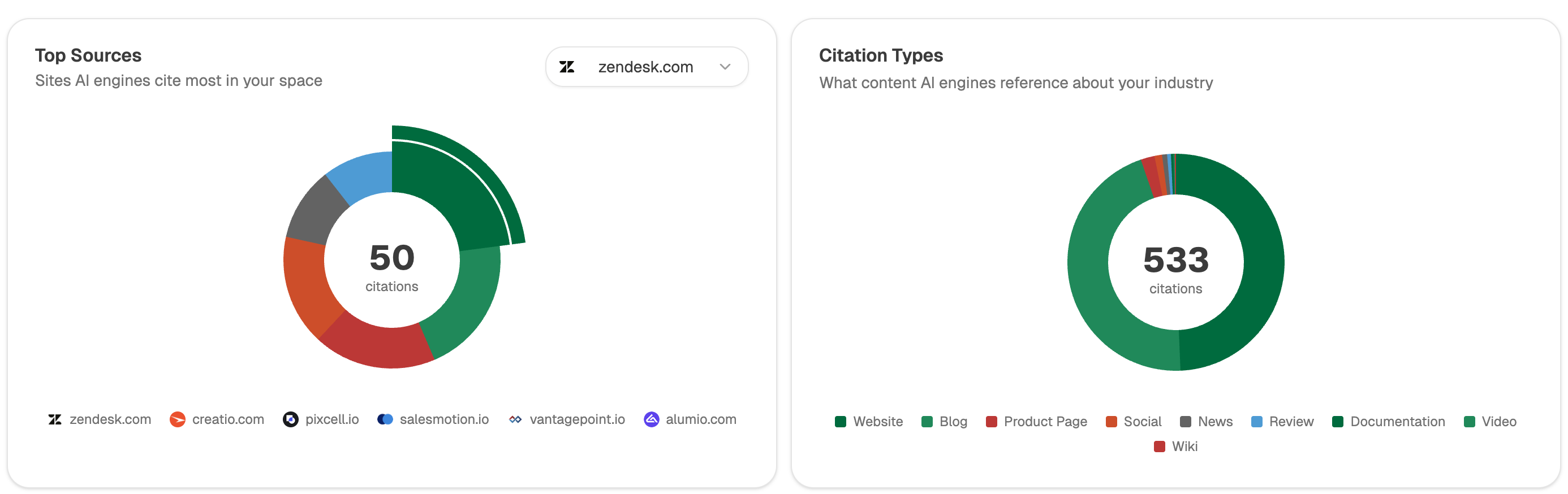 Top sources ranks the sites AI engines cite most in your space, which is the distribution list you actually need.
Sort the list by whether you can reach it
A list of influential sites is only useful once you know what you can do about each one.
| Type of source | How you get in | Effort |
|---|---|---|
| Review and comparison sites | Claim the profile, ask customers for reviews | Low, ongoing |
| Industry publications | Contributed articles, expert quotes | Medium |
| Community threads and forums | Genuine participation by someone who knows the subject | Medium, slow |
| Practitioner blogs and newsletters | Original data they can cite | Medium |
| Competitor-owned pages | Nothing, this is a gap to route around | None |
| Your own site | Publishing and keeping it current | Ongoing |
Two rows are worth acting on immediately. Review sites are the cheapest high-value slot on the list, and they carry weight precisely because you do not control them. And original data is the most reliable route into practitioner writing, since it gives someone a reason to link to you rather than a request to.
Find the pages that cite rivals and never you
The sharpest version of this list is not "where is my category discussed" but "where is my competitor discussed and I am not".
The competitor-sources recipe in Analyze AI returns exactly that: pages that cite a rival and have never cited you. Those are cheaper to win than new coverage, because the demand and the ranking already exist and only the mention is missing. Google's AI features documentation notes that eligibility follows ordinary indexing, so a placement on an already-indexed page starts working straight away. Often it is a listicle that was written before you launched, or a comparison that omitted you.
That is a specific outreach task with a specific ask, which is a very different conversation from a cold pitch.
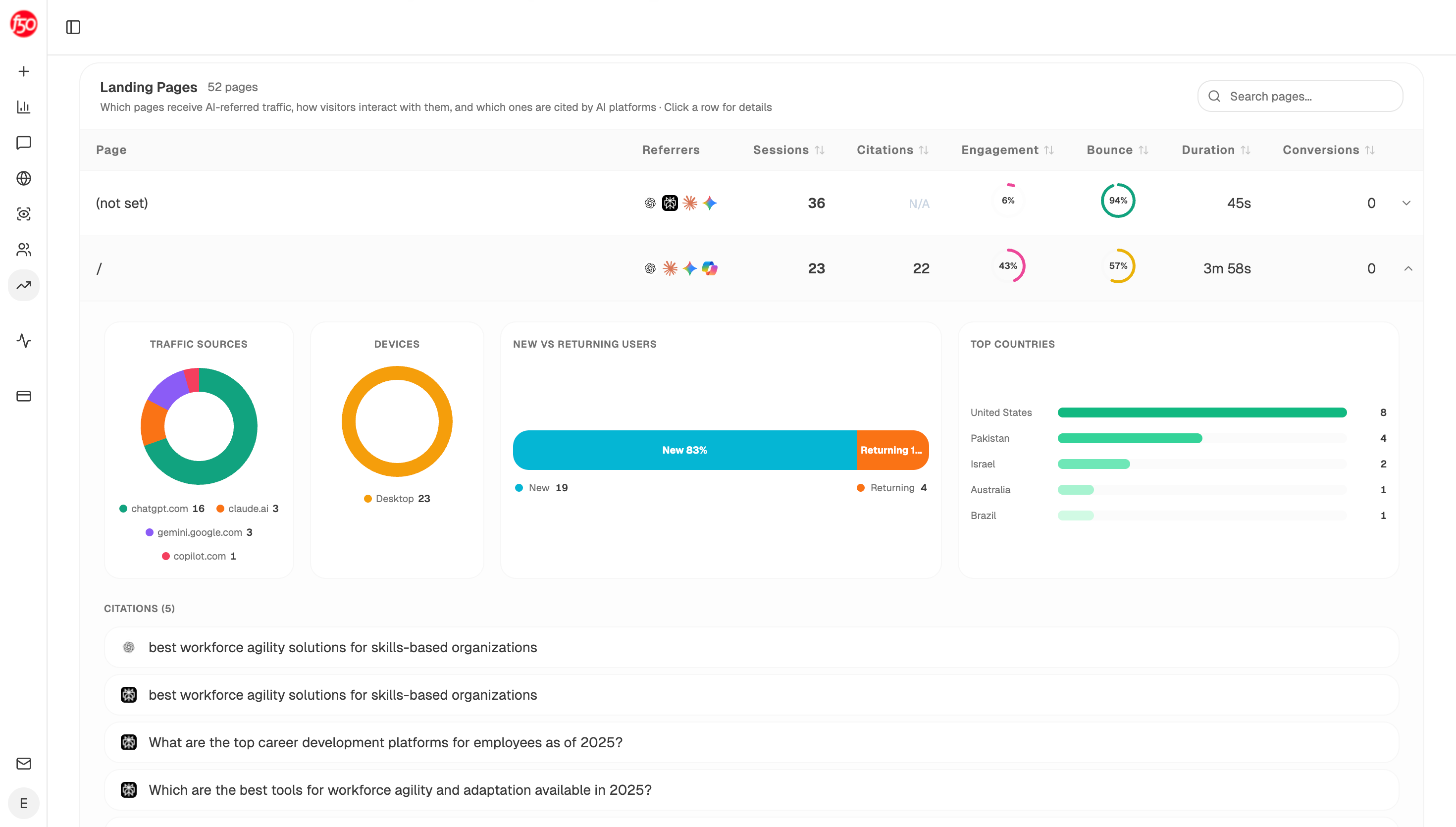 Assistant-referred sessions are reported as their own channel, so you can see when a placement starts sending people.
Publish where the format is what gets used
Where you place something should follow what that surface actually cites.
Our research found the mix differs sharply. Lists, comparisons and reviews made up 34.4% of what Perplexity cited and 33.1% of Google AI Mode, against 13.9% on ChatGPT, where company sites and product pages made up 68.8%.
The practical read is that effort on review and comparison presence pays on two surfaces, and effort on your own product pages pays hardest on the third. Both are worth doing, and knowing which is which stops you spending a quarter on the wrong one. Should this be an article, comparison page, case study, tool, or service page covers the format decision.
Make each piece reusable across places
Distribution fails when every placement needs original work. Build one piece so it can travel.
A study with a clear number gives you the study itself, a contributed article built on it, a comment in a community thread, and a quote a journalist can lift. Four placements, one piece of research. That is the practical reason what makes thought leadership useful to a hidden B2B buyer insists on evidence nobody else has.
Track the list rather than the campaign
Start (schedule, monthly) → top-sources-landscape recipe returning the domains dominating your category's answers → competitor-sources recipe listing pages citing rivals and never you → Citation Domains for the sites now citing you → workflow-memory recipe holding last month's list → Code node diffing the two → Send Notification with new sources gained and rivals' new placements.
Watching new placements by rivals is the part most teams miss. A competitor appearing on three new comparison pages in a month is a distribution move you can see and answer, months before it shows up in your pipeline.
FAQ
Related answers
- Which buyer questions belong on our site, and which need third-party proof?
- What should we publish when our brand recognition is weaker than competitors'?
- How do I reach decision-makers who never talk to sales?
Get the list of places that actually matter
Analyze AI ranks the domains feeding answers in your category and shows which ones cite your rivals and never you.
Start your free trial