
What makes thought leadership useful to a hidden B2B buyer?
Short answer
Take a position that excludes somebody. A hidden buyer is reading to work out how to think about a decision, and a piece that would offend nobody gives them nothing to hold onto. Add something only you could know, usually a number from your own operations, and publish it where a quiet reader will meet it without contacting you.
Run the exclusion test
Write your central claim in one sentence, then ask who it excludes.
If the honest answer is nobody, you have written a description rather than a position. "Content should be aligned to the buyer journey" excludes no one. "Most B2B companies should stop publishing top-of-funnel content until their comparison pages exist" excludes the agencies selling volume, the teams whose targets are output-based, and anyone whose plan depends on a blog cadence.
The second one is useful precisely because a reader can disagree with it. Disagreement is what makes a position usable: the buyer can hold it up against their own situation and decide it does or does not apply. There is nothing to hold up against a summary.
A working rule of thumb. If you cannot name a competent, well-informed person who would argue with your piece, it is not saying anything yet.
Add something only you could know
A position on its own is an opinion. What makes it credible is evidence nobody else can produce.
You have more of this than you think.
- Numbers from your own operations, such as what your customers do in month one, or how long something actually takes.
- Patterns across your customer base, phrased so no individual is identifiable.
- What you got wrong, and what changed as a result.
- The thing your salespeople hear every week that nobody has written down.
Our own state of AI search research is an example of the first kind. It exists because we could measure 22,295 answers and 115,843 citations, and because we were willing to publish the parts that constrain us, including that citation measures selection rather than clicks.
How do I prove an article adds net-new value instead of summarizing what already exists is the test for whether your evidence is really new.
Write for someone who will never reply
The hidden buyer is not going to comment, subscribe, or book anything. Pew Research found a source link was clicked in about 1% of visits when an AI summary appeared, which is the scale of the reading you will never see. They are going to read, form a view, and mention you in a meeting you are not in.
That changes three things about the writing.
Be concrete enough to be repeated. People pass on specifics. "Most libraries lose a third of their top pages in eighteen months" travels. "Content decays over time" does not.
Give them the counter-argument. A reader who has to defend your idea internally needs to know where it is weak. Handing them that is what makes the piece usable rather than promotional.
Do not make the product the point. Your product can appear once, as the natural next step. A piece that turns into a pitch halfway through stops being forwardable, which is the whole mechanism in how do I reach decision-makers who never talk to sales.
Check whether your position registers anywhere
The hard part about a hidden buyer is that you get almost no feedback. Traffic tells you people arrived, not what they took away.
Analyze AI gives you one usable signal here. The Perception view reports the themes assistants associate with your brand when someone asks about you, and the narrative-themes recipe returns those themes over time. If your position has landed anywhere, it starts showing up in how you get described.
That is a slow signal and it is honest. A piece that changed how your market talks about you will appear there over a quarter or two. A piece that changed nothing will not.
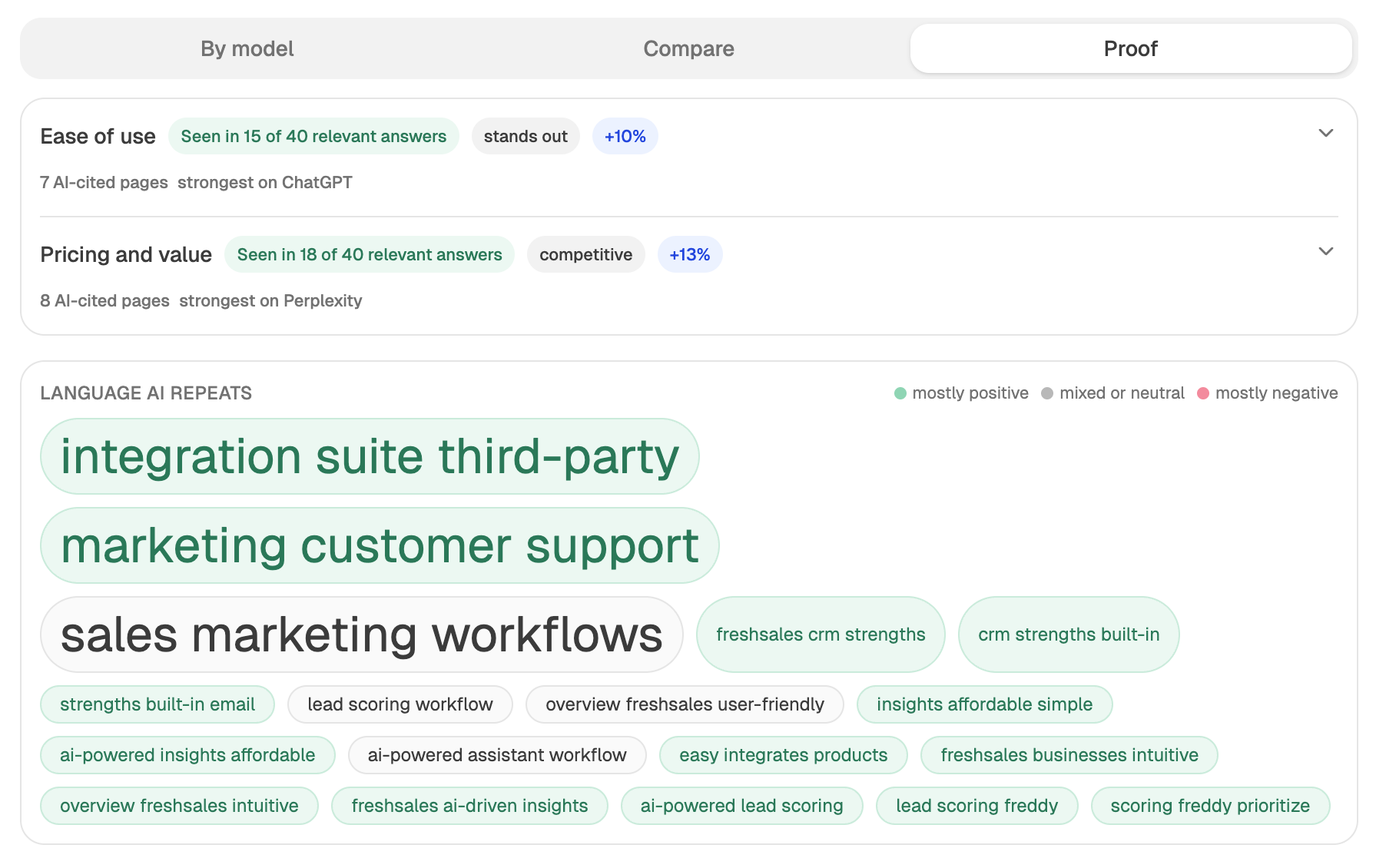 Perception themes are where a position shows up if it has landed, since they reflect how you get described rather than how often.
Publish where quiet readers already are
Being right somewhere nobody reads is a hobby. In our own research the source mix varies a lot by surface, with lists, comparisons and reviews at 34.4% of Perplexity citations and 33.1% of Google AI Mode, against 13.9% on ChatGPT where company sites dominate at 68.8%.
The practical read is that a strong piece on your own blog reaches one kind of reader, and the same argument placed in an industry publication or a comparison-heavy source reaches another. Analyze AI's Sources view names which sites are actually feeding answers in your category, so the placement list is evidence rather than a guess.
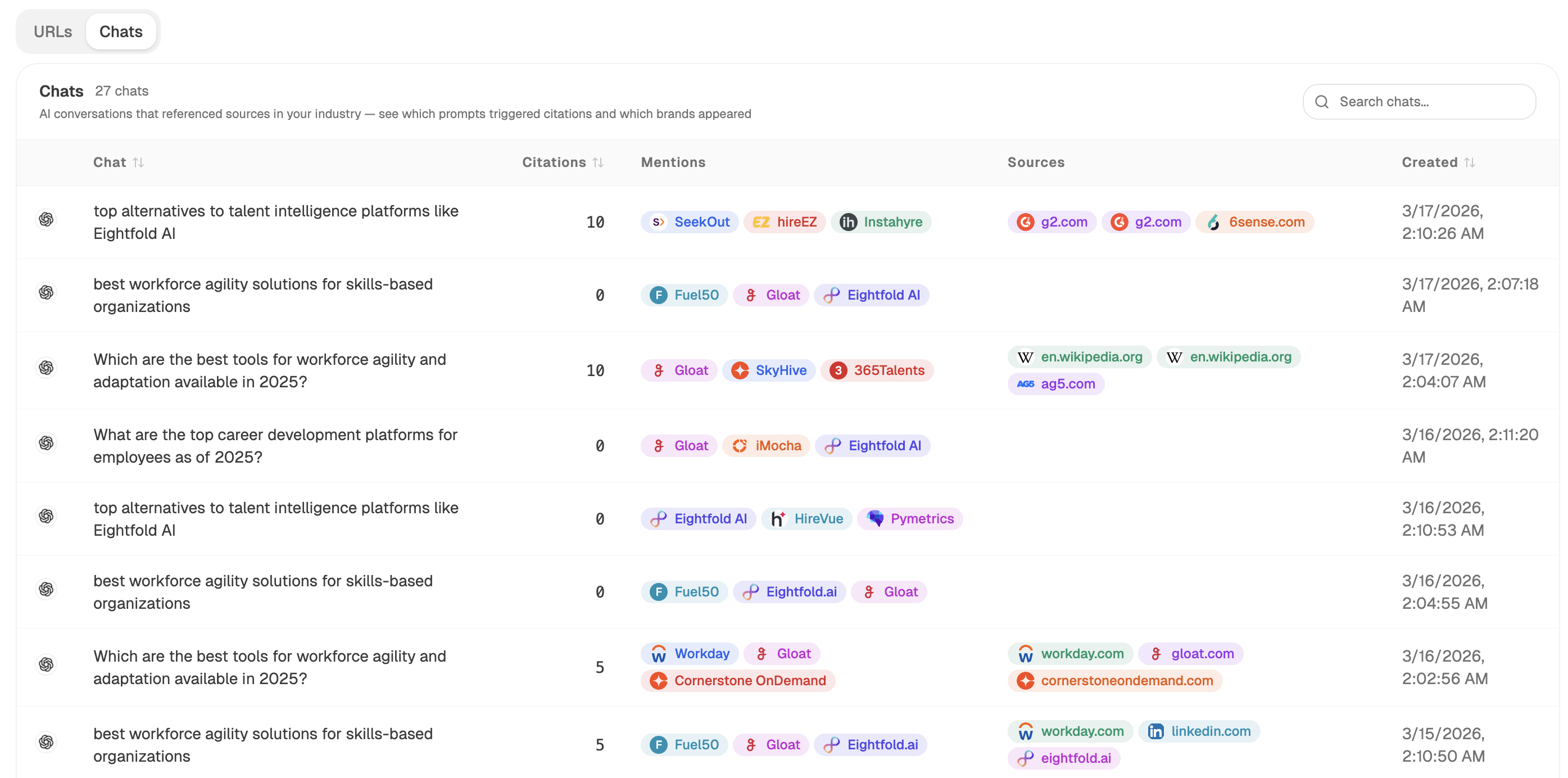 Sources shows which places feed the answers in your market, which is where a position needs to appear to be met by a quiet reader.
Watch the theme, not the traffic
Start (schedule, monthly) → narrative-themes recipe returning perception themes and how they moved → Get Perception Quadrant placing you against rivals → citation-magnets for the pieces assistants return to → Prompt LLM comparing this month's themes against the position you set out to establish → Send Notification when a new theme appears.
Comparing against the position you intended is the part worth building. Otherwise you get a list of themes with no way to tell whether it is working, and the programme gets judged on traffic again by default.
FAQ
Related answers
- How do I prove an article adds net-new value instead of summarizing what already exists?
- Why does our content sound the same as every competitor's?
- How do I measure whether thought leadership influenced a deal?
- How do I reach decision-makers who never talk to sales?
See whether your position actually landed
Analyze AI tracks the themes assistants associate with your brand, so a point of view can be measured rather than assumed.
Start your free trial