
How often should high-value pages be reviewed for freshness?
Short answer
Set the interval by how fast the subject changes, not by how much traffic the page gets. Pricing, tool comparisons and version-specific pages need reviewing every quarter. Pages about how something works can go a year or more. A single sitewide cadence either wastes effort on stable pages or leaves your most volatile ones wrong for months.
Sort pages into three volatility tiers
The sorting takes an afternoon and it holds for years.
| Tier | What belongs in it | Review every |
|---|---|---|
| Fast | Pricing, comparisons, integrations, tool lists, anything with a version number | 3 months |
| Medium | How-to guides, setup instructions, benchmarks, role-specific pages | 6 months |
| Slow | Concepts, principles, definitions, frameworks | 12 to 18 months |
Two rules keep the sorting honest.
Volatility beats traffic. A comparison page with 200 visits a month belongs in Fast, because a wrong competitor price there gets caught by a prospect. A concept explainer with 20,000 visits belongs in Slow, because nothing in it changed.
Anything sales sends is Fast, regardless of subject. Those pages are read by people who will notice an error and mention it on a call.
Measure your own decay rate rather than borrowing one
The tiers above are a starting point. Your own data will adjust them within a quarter.
Take the pages in each tier and check how many needed substantive edits at their last review. If nearly every Medium page needed changes, move that tier to four months. If almost no Slow page did, push it to eighteen.
You can compute the underlying rate directly. Take your top 50 pages by clicks from eighteen months ago and count how many are still in today's top 50. A third dropping out is roughly a fifth annually, and that is the number to plan maintenance capacity against rather than a figure from a blog post.
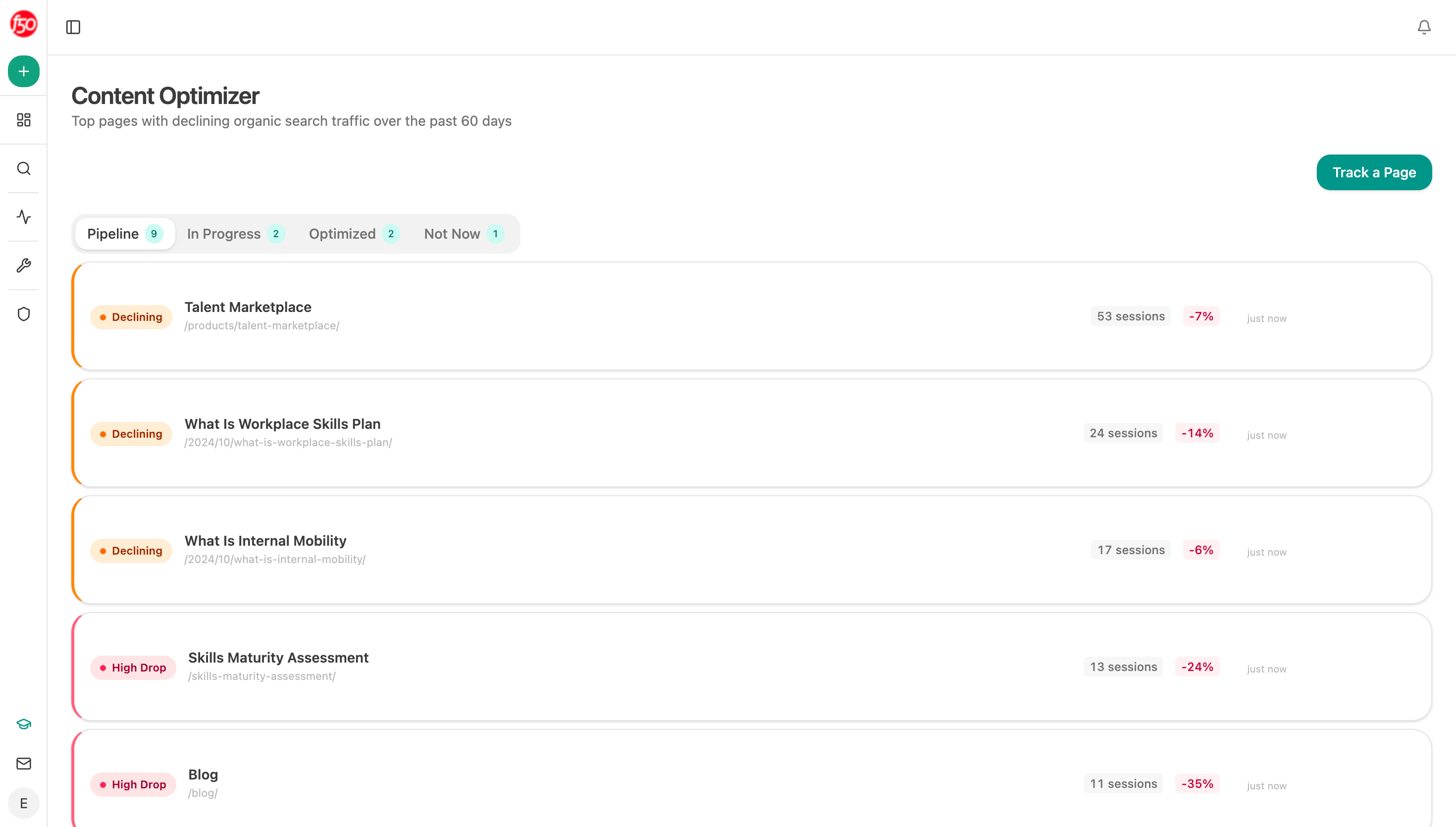 The optimizer surfaces declining pages continuously, which is how the scheduled review gets a shortlist rather than a full library sweep.
Let events override the calendar
A fixed cycle handles gradual staleness. Three events should trigger a review immediately, whatever the tier says.
- Your pricing or packaging changes. Every page mentioning cost, same week.
- A competitor you compare against relaunches. Your comparison page is now wrong.
- A page starts losing citations while traffic holds. Something newer is answering better.
The third one is the useful early signal. Analyze AI's citation-decay-alert recipe returns exactly those pages, and stale-content returns anything untouched beyond a window you set. Between them, the calendar handles the routine cases and the alerts handle the urgent ones.
Watch the AI side on a shorter clock
Citations move faster than rankings, so the AI half of a page's health needs checking more often than the tier suggests.
Google's generative AI performance report gives you impressions with no clicks and no query data, so it will not tell you which pages are being used or for what. Your own tracked prompts and Analyze AI's Citation Pages view will.
Check that monthly regardless of tier. A Slow-tier concept page that stops being cited has usually been overtaken by something newer, and that is worth knowing long before the annual review comes round.
Make the review a check, not a rewrite
A review that always turns into a rewrite will not survive its second cycle, because nobody has that much time.
Scope it to a fifteen-minute check per page: are the figures current, do the links resolve, are the product claims still true, does the page still match what the searcher wants. Most pages pass and take fifteen minutes. The ones that fail get briefed properly, which is what should a content-refresh brief contain.
Keeping the check cheap is what makes a quarterly cadence realistic on a few hundred pages.
Run the cycle automatically
Start (schedule, monthly) → stale-content recipe for pages past their tier's review window → citation-decay-alert for pages losing citations faster than traffic → Content Optimizer fetching each due page and returning what it currently claims → Code node checking dated figures and link status → Conditional separating pages that pass the check from those needing a brief → Send Notification with the month's due list and the failures marked.
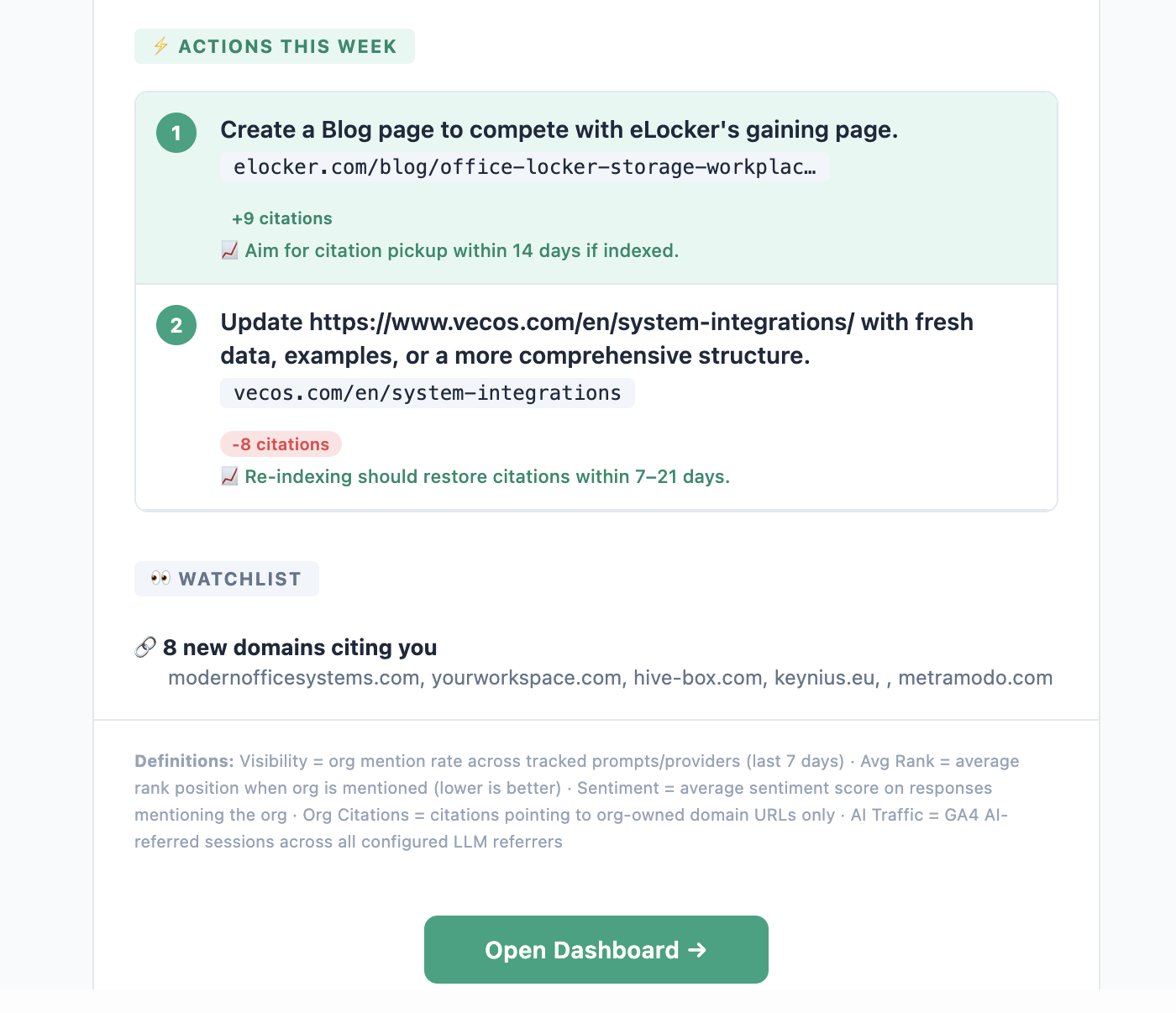 Scheduled digests are what turn a review cadence into something that arrives, rather than a policy nobody remembers in month four.
Separating passes from failures inside the agent is the design choice. A list of forty due pages is a chore. A message saying thirty-four passed and six need work is a task someone finishes.
FAQ
Related answers
- How do I spot content decay before it becomes a big traffic loss?
- How do I find the outdated stats, links, and product claims across my content?
- Who should own content maintenance after publication?
- How do I maintain hundreds of pages without giving AI full publishing access?
Review the volatile pages, not all of them
Analyze AI tracks which pages are past their review window and which are losing citations, so the monthly list stays short.
Start your free trial