
What kinds of evidence make a B2B buyer trust a vendor?
Short answer
Buyers weigh evidence by how hard it would have been to fake. A claim costs you nothing to write, so it earns nothing. A named customer of similar size, with a number and a date, is expensive to fabricate and gets believed. Rank everything on your site by that test and lead with the costly end.
Rank your evidence by what it costs to fake
Buyers do this instinctively and quickly. Making it explicit tells you what to build.
| Evidence | How hard to fake | How much trust it earns |
|---|---|---|
| "Trusted by industry leaders" | Free | None |
| Unnamed customer quote | Almost free | Almost none |
| Named logo with no story | Cheap | A little |
| Named customer, named person, real number, date | Expensive | High |
| Third-party review with volume behind it | You cannot control it | High |
| Independent data or an audit | Very expensive | Highest |
| Your own published limits and failures | Costly in a different way | Very high |
The bottom row surprises people. Publishing where you lose, or what breaks, is costly because it can be used against you, and buyers read that cost as honesty. It is the mechanism behind should a product comparison admit a competitor's strengths.
Make the four details that turn a claim into evidence
Most case studies fail because they are missing one of four things. Add all four and a soft claim becomes hard evidence.
- A name. The company, and ideally the person. Anonymous customers read as invented.
- A number. With the starting point, not just the improvement. "From 4 hours to 40 minutes" beats "83% faster".
- A date. Undated results are assumed to be old.
- A resemblance. Same size, same industry, same constraint as the reader. A 4,000-person enterprise story does not reassure a 40-person team.
The resemblance detail is the one most often missed. Three case studies from companies unlike your reader are less persuasive than one from a company exactly like them.
Publish the things that cost you something
Four pages carry disproportionate trust because publishing them is uncomfortable.
Real pricing. Not "contact us". A buyer who cannot work out roughly what you cost assumes the worst and often stops.
Your limits. What you do not do, and who you are wrong for. This is also the single most useful page for keeping bad-fit leads out.
An exit plan. How to get data out, in what format, and how long you keep it. Buyers commit more easily when they can see the way out.
What broke and what you changed. A short, specific account of an incident or a mistake. Rare enough that it is remembered.
What content do finance, security, and procurement need before approving a purchase covers the standing set these sit inside.
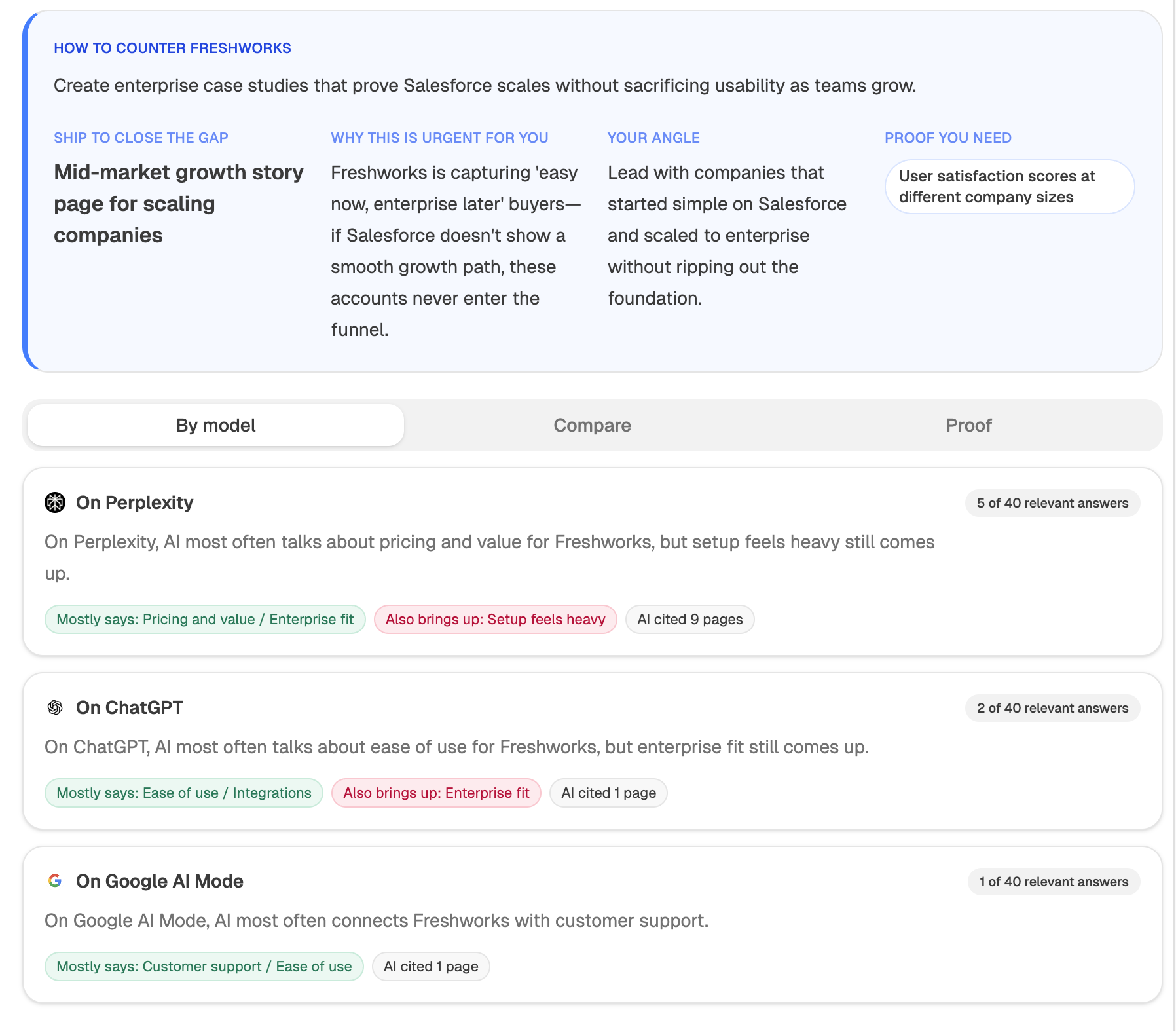 Perception shows what buyers are told about you before they arrive, which is often where a trust gap begins.
Check what the market says when you are not there
Your own evidence is only half of it. The other half is what third parties say, and that half now reaches buyers through assistants.
Our own state of AI search research put review and comparison content at 34.4% of Perplexity's citations and 33.1% of Google AI Mode's. ChatGPT was the outlier at 13.9%, leaning instead on company sites and product pages at 68.8%. So on two of the three surfaces, most of what a buyer is told about you comes from somewhere you do not control.
Analyze AI shows you both sides of that. Sources lists the sites and pages the answers were built from, so you can see whose evidence is being used. The Sentiment Score and sentiment-alerts recipe track whether the description of you is warm or cautious over time.
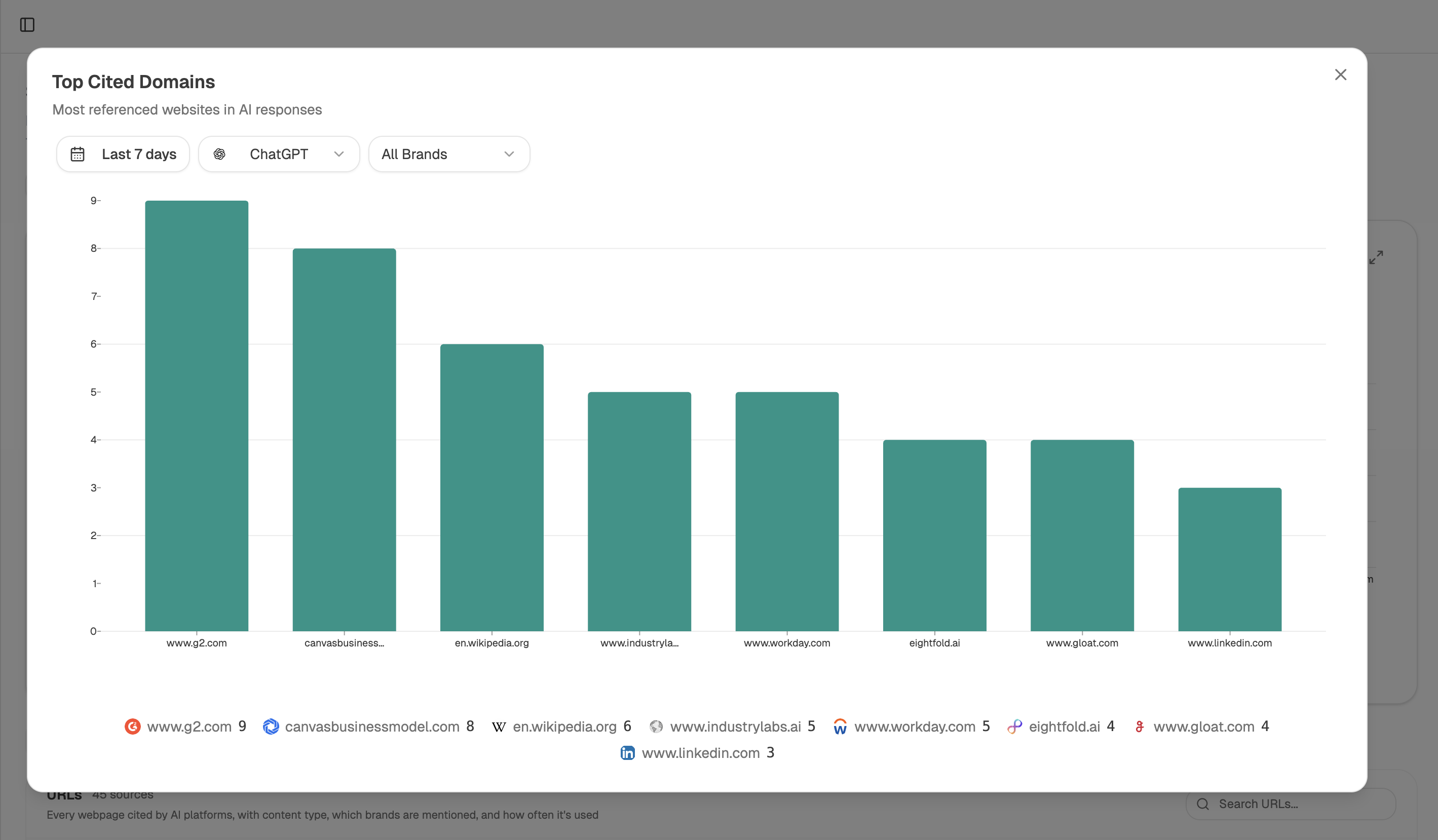 Sources names the specific pages assistants relied on, which tells you whose evidence a buyer is actually reading.
Find your unsupported claims before a buyer does
The fastest trust win is usually removal rather than addition.
Run the proof-gaps recipe in Analyze AI, which lists pages making claims with no evidence attached. Then either attach the proof or cut the claim. A page with three strong supported claims outperforms one with nine unsupported ones, because a single obviously inflated line makes a reader discount the rest.
Google's guidance on creating helpful content asks whether a page provides original information and whether it would be trusted by someone researching a purchase, which is the same test written for a different audience.
Keep proof current automatically
Start (schedule, quarterly) → proof-gaps recipe listing pages that claim without evidence → proof-point-miner recipe pulling reusable proof snippets from your vault and citations → Content Optimizer on the pages with the highest traffic among them → Conditional flagging any customer number older than 18 months → Send Notification with the claims to refresh or retire.
The date check is the part teams skip. Nothing undermines a proof page faster than a flagship result from four years ago, and nobody notices it ageing because nobody re-reads their own case studies.
FAQ
Related answers
- Should a product comparison admit a competitor's strengths?
- What content do finance, security, and procurement need before approving a purchase?
- How do I build a reusable library of approved claims and proof points?
- Which buyer questions belong on our site, and which need third-party proof?
Find the claims you cannot back
Analyze AI lists the pages making claims without evidence and shows whose proof buyers are reading about you elsewhere.
Start your free trial