
Should a product comparison admit a competitor's strengths?
Short answer
Yes, and how you do it decides whether it helps. The concession has to be specific, it has to appear early, and it has to be about something buyers actually care about. A real concession makes everything else on the page more believable. A token one placed at the bottom reads as a technique and costs you more than saying nothing.
Understand what the concession is doing
A buyer arrives at your comparison page assuming it is rigged, because it usually is. Everything they read is discounted accordingly.
A specific concession breaks that assumption. Once you have said something true that hurts you, the reader has evidence you are not simply selling, and the rest of the page gets read at closer to face value. You are not being generous, you are buying credibility with the only currency that works.
That also explains why a weak concession fails. "They have a simpler interface, but we have more depth" concedes nothing, because the concession is immediately taken back. The reader notices, and now they trust you slightly less than before you tried.
Follow the three rules that make it work
Be specific. Name the scenario. "If you need to run this across more than twenty brands, their bulk editing is better than ours today" is a concession. "They are strong in some areas" is not.
Put it early. A concession in paragraph three sets the tone for the page. One in the final section reads as a disclaimer added by legal.
Concede on something real. Pick a case where you genuinely lose and that buyers genuinely ask about. Conceding on something nobody cares about is the same as conceding nothing.
One more rule that costs nothing: name who should not buy from you. A short "you are probably better off elsewhere if..." section does more for trust than any feature table.
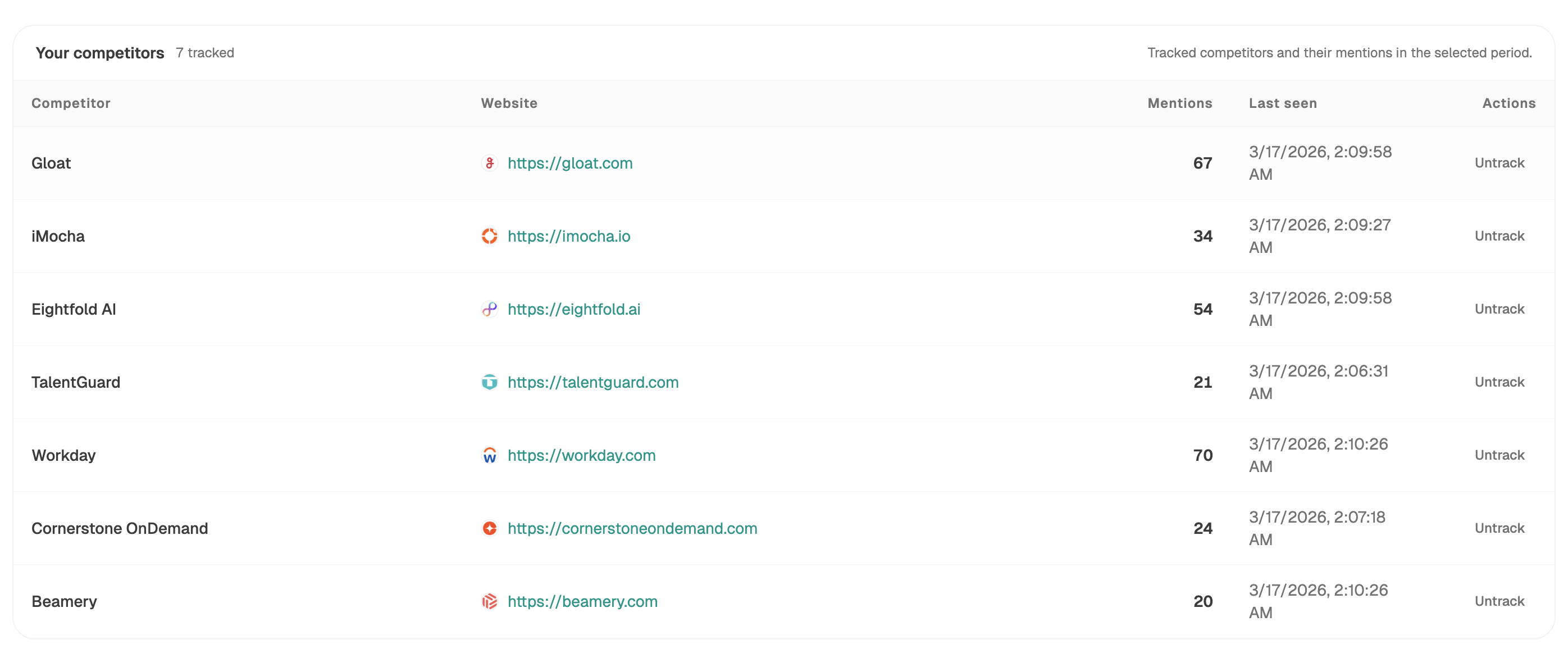 Competitor tracking shows which rivals come up alongside you, which is where a comparison page has to be honest to be believed.
Get the facts right, because errors undo everything
A comparison page with one out-of-date claim about a competitor destroys the credibility the concession bought.
Check pricing, limits and feature claims on the competitor's own site before publishing, and put a review date on the page. Anything you cannot verify today should be cut rather than softened, since a hedged inaccuracy is still an inaccuracy.
Set a calendar reminder for every quarter. Competitor pricing changes more often than most teams re-read their own comparison pages, and when is a bottom-of-funnel page worth more than another blog post makes the point that a stale comparison page is worse than none.
Know that assistants are reading it too
Your comparison page is no longer read only by buyers. It is read by the systems answering your buyers' questions.
In our own state of AI search research, lists, comparisons and reviews made up 34.4% of what Perplexity cited and 33.1% of Google AI Mode. Comparison content is a large share of what gets used to build vendor answers, and a page that reads as balanced is more usable as a source than one that reads as marketing. Google's AI features documentation confirms there is no separate format to qualify for, so what decides selection is whether the page is worth drawing from.
Analyze AI shows what that produces. The Perception view reports how you are characterised against rivals, and Get Perception Quadrant places you on the same axes as them. If assistants describe your competitor's strength accurately and describe yours vaguely, your page is not the one being drawn from.
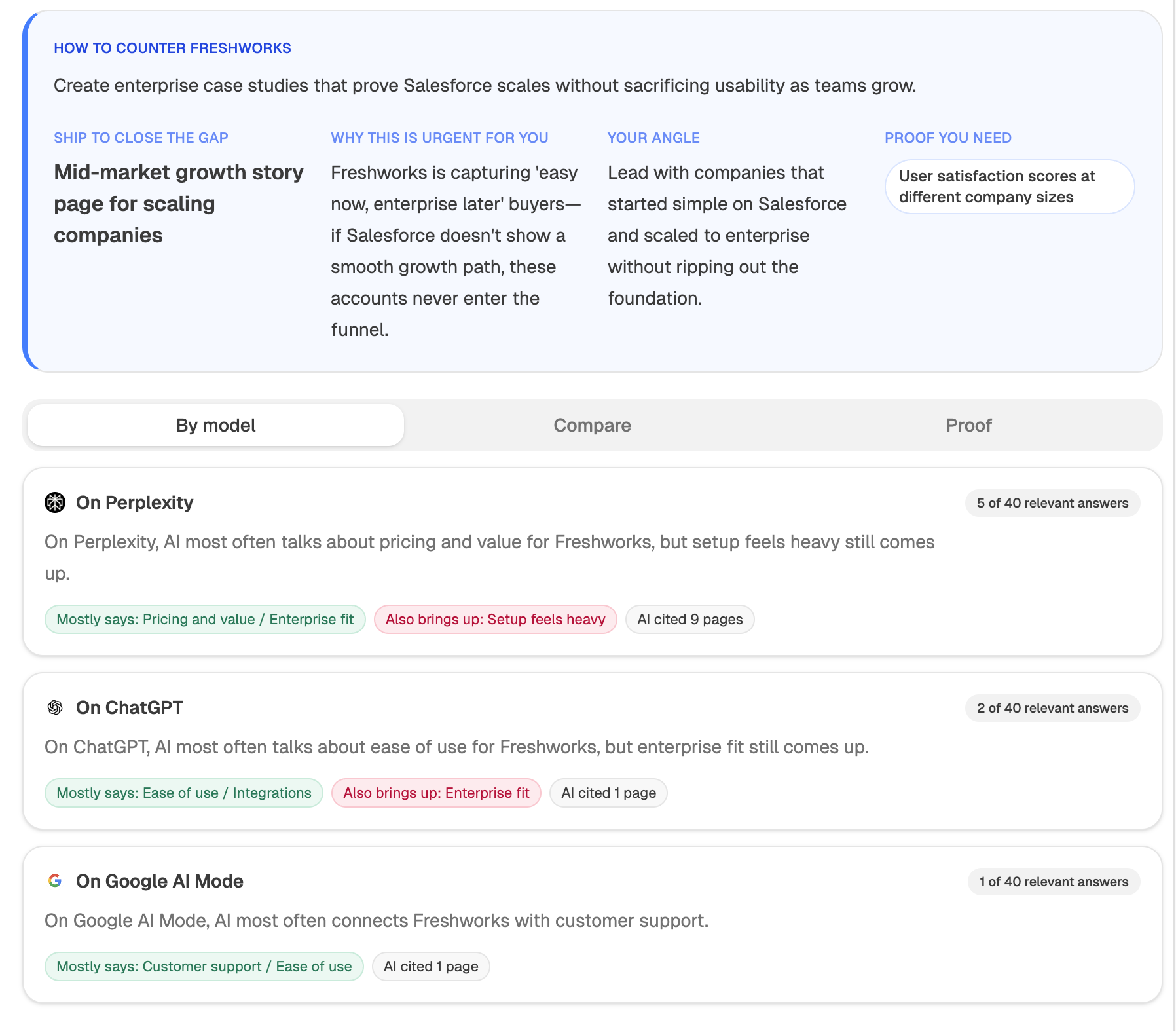 Perception shows how you and your rivals are each characterised, which is the outcome an honest comparison page is trying to shift.
Keep the honest version from being watered down
The concession usually survives the draft and dies in review, because someone senior reads it and asks why you are helping a competitor.
Two things protect it. Agree the concession before writing, so it is a decision rather than a line to be argued over later. And record it as an approved claim with its evidence, which is what a claims library is for, covered in how do I build a reusable library of approved claims and proof points.
Analyze AI's Inject Brand Context node pulls those documented claims and rules into the step that drafts the page, so the agreed concession is in the draft from the start rather than being negotiated in.
Watch how the page performs on both channels
Start (schedule, quarterly) → Content Optimizer fetching each comparison page and reporting what it currently claims → proof-gaps recipe flagging unsupported claims on those pages → Prompt Responses running "you versus that competitor" as a live question and returning how each side is described → Conditional flagging any page unreviewed in 90 days → Send Notification.
Running the head-to-head as a live question is the useful half. It tells you what a buyer asking that exact question is told today, which is a more direct read on whether your page is working than its ranking.
FAQ
Related answers
- What kinds of evidence make a B2B buyer trust a vendor?
- Which buyer questions belong on our site, and which need third-party proof?
- What should we publish when our brand recognition is weaker than competitors'?
See how your comparison actually reads
Analyze AI runs the head-to-head question live and shows how you and your rival are each described in the answer.
Start your free trial