
How do I prove an article adds net-new value instead of summarizing what already exists?
Short answer
Run the subtraction test. Take your draft and cross out every point that already appears in the top ten results for the same question. What survives is your contribution. If a page of crossings-out leaves you two sentences, you have written a summary, and the fix is more reporting rather than more editing.
Do the subtraction
It takes about an hour and it is uncomfortable the first time.
- Search your target question and open the top ten results.
- List every distinct point they make, merging duplicates. Most questions produce twelve to twenty points across ten pages.
- Print your draft and cross out every point that appears on that list.
- Read what is left.
The output is your net-new value, and you can now describe it in a sentence. "Ours adds a threshold for when to stop, three worked numbers, and the case where the advice fails."
If what survives is a better structure and clearer writing, that is worth something, but be honest that it is presentation rather than information. On a question where ten decent pages already exist, presentation alone rarely wins.
Know which kinds of new actually count
Not all survivors are equal. Four carry real weight.
| What survived | Why it counts |
|---|---|
| A number nobody else publishes | Cannot be reproduced by rewriting |
| A threshold or rule of thumb | Turns advice into a decision |
| A named case with details | Specific enough to be repeated |
| The condition where the advice fails | Everyone else states the rule unconditionally |
Two more survive the crossing-out and are usually weak: a new metaphor, and a longer list. Neither changes what a reader can do.
Google's guidance on creating helpful content asks whether a page provides substantial value compared with other pages in search results, and separately whether it offers original information, reporting, research or analysis. The subtraction test is a practical way to answer both before you publish rather than after.
Check the assistants, not just the SERP
The top ten is one bar. There is now a second one, and it is often higher.
Run your question through Analyze AI's Ad Hoc Prompt Searches, which returns live answers from ChatGPT, Perplexity and Google AI Mode. Then do the same subtraction against those answers. An assistant answer is already a synthesis of the top results, so if your draft is fully contained in it, you have written something a model can produce without you.
This matters more than it used to. In our own state of AI search research, across 4,824 pages we checked, how big and trusted a site was barely predicted whether its pages got cited. Being selected as a source has more to do with saying something the answer needs than with authority, which means a genuinely new point is one of the few things that reliably earns a citation.
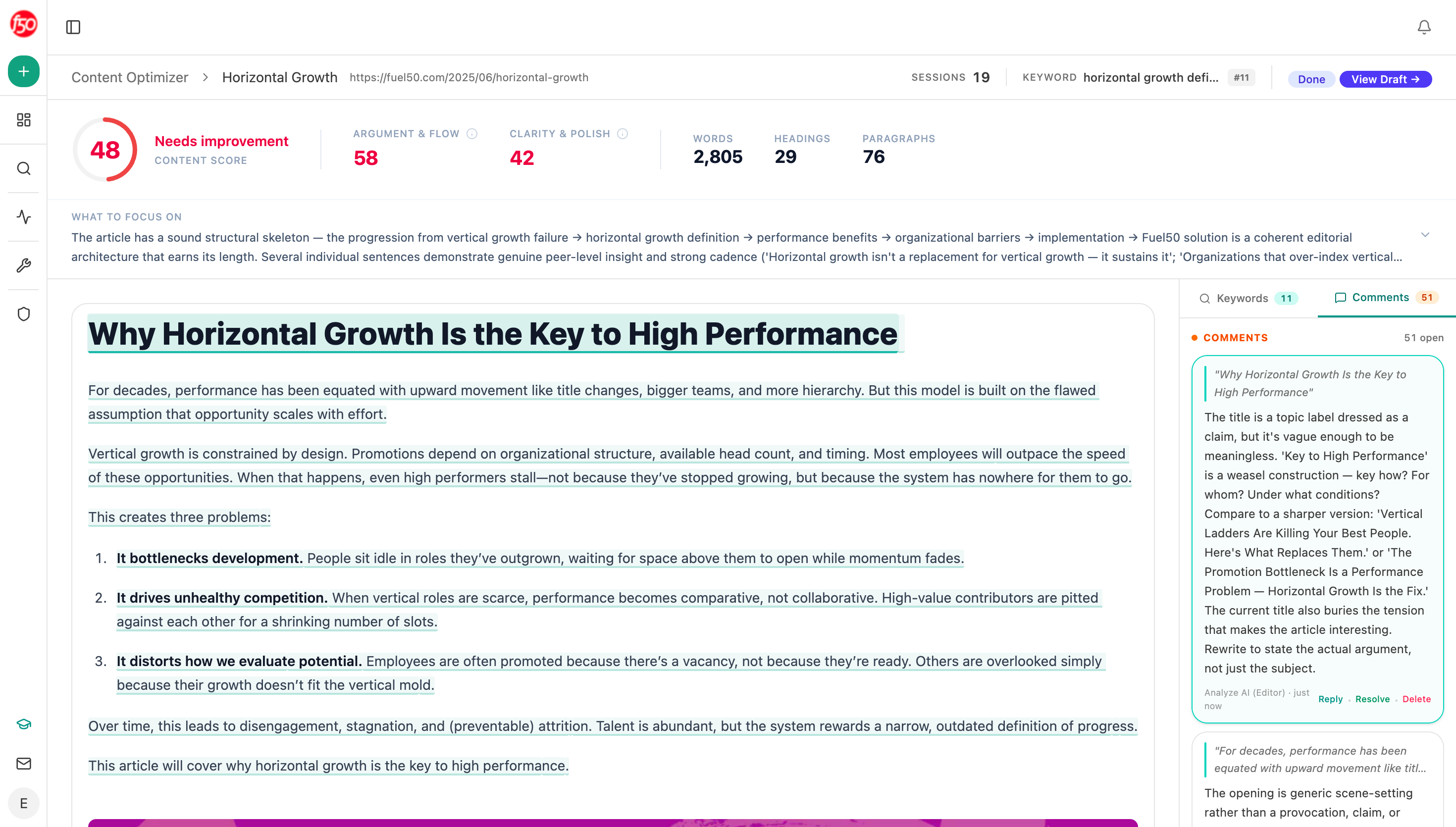 The optimizer fetches the live page and comments against specific passages, which is how you check what survived after publication as well as before.
Fix a draft that fails
There are only three real fixes, and editing is not one of them.
Go and get a number. Your own data, your customers' behaviour, or a small survey. This is the fastest route from summary to source.
Interview someone. A twenty-minute conversation with an expert produces examples that cannot be found by reading, which is the process in how do I turn internal expertise into content without making experts the bottleneck.
Narrow the question. A summary of a broad question often becomes original when applied to a specific situation. "How to run a content audit" is covered. "How to run a content audit when most of your traffic is branded" may not be.
If none of the three are available, the honest answer is not to publish. That is a real outcome and it saves the budget for a piece that can win.
Keep a record of what each page contributes
Write the survivor sentence into your brief and keep it. It gives you three things later.
You can check the published page still contains it, since specifics get sanded away in production. You can defend the piece when someone asks why it exists. And when you refresh it in eighteen months, you know what it was for.
Analyze AI's proof-gaps recipe supports the same discipline from the other direction, listing pages that make claims without evidence attached, which is usually where a summary hides.
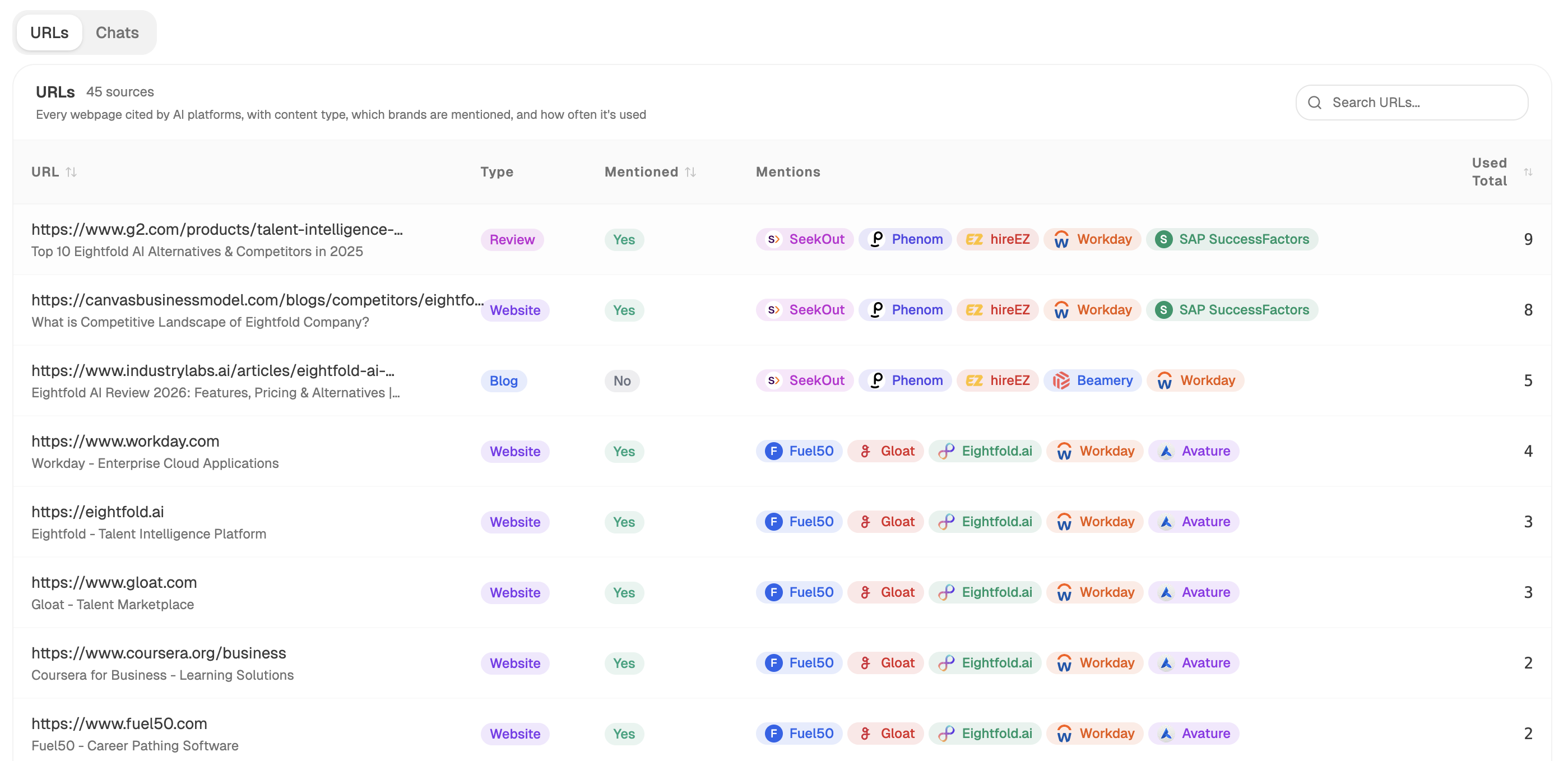 Sources shows what kind of pages get used as references, which is a useful check on whether your contribution is the sort that gets cited.
Run the subtraction as an agent
Doing this by hand for one piece is instructive. Doing it for every brief is where it needs help.
Start (manual, the target question plus your draft as file-text) → Google Search returning the live top ten → Web Page Scrape on each result → Prompt Responses asking the same question across providers → Prompt LLM listing every point the existing sources make, then diffing your draft against that list → Conditional flagging drafts where fewer than two points survive → Export Markdown with the survivors written as the piece's contribution.
The Conditional is the part to copy. A survivor list is interesting on its own, but a threshold that stops a thin draft reaching a writer is what changes the output.
FAQ
Related answers
- Why does our content sound the same as every competitor's?
- What should I ask a subject-matter expert to get genuinely original content?
- What makes thought leadership useful to a hidden B2B buyer?
- Do generic educational blog posts still deserve budget?
Check what your draft actually adds
Analyze AI runs your question live across assistants, so you can test a draft against the answer a reader already has.
Start your free trial