
What should we publish when our brand recognition is weaker than competitors'?
Short answer
Compete where the answer gets built from evidence rather than from familiarity. Broad questions reward the names everyone already knows. Specific questions, with a role, a constraint or a named tool attached, get answered from whichever page addresses them best, and that page can be yours. Publish for the specific end and let the big names have the broad one.
Pick the questions where size matters least
Recognition wins the general question. "Best CRM" is answered with the brands the market already repeats, and no amount of writing changes that this quarter.
Specific questions behave differently. "CRM for a three-person agency that bills hourly" has no famous default answer, so whoever addressed it properly gets used.
Our own state of AI search research supports building here. Across 4,824 pages we checked, how big and trusted a site was barely predicted whether its pages got cited. And the citation ecosystem was broad rather than closed: across 7,055 cited domains, the top ten held only 12.2% of ChatGPT citations, 11.1% of Perplexity and 13.1% of Google AI Mode.
That is the opening. Selection is not a popularity contest to the degree that ranking is, and Google's AI features documentation confirms eligibility follows ordinary indexing rather than any separate authority gate.
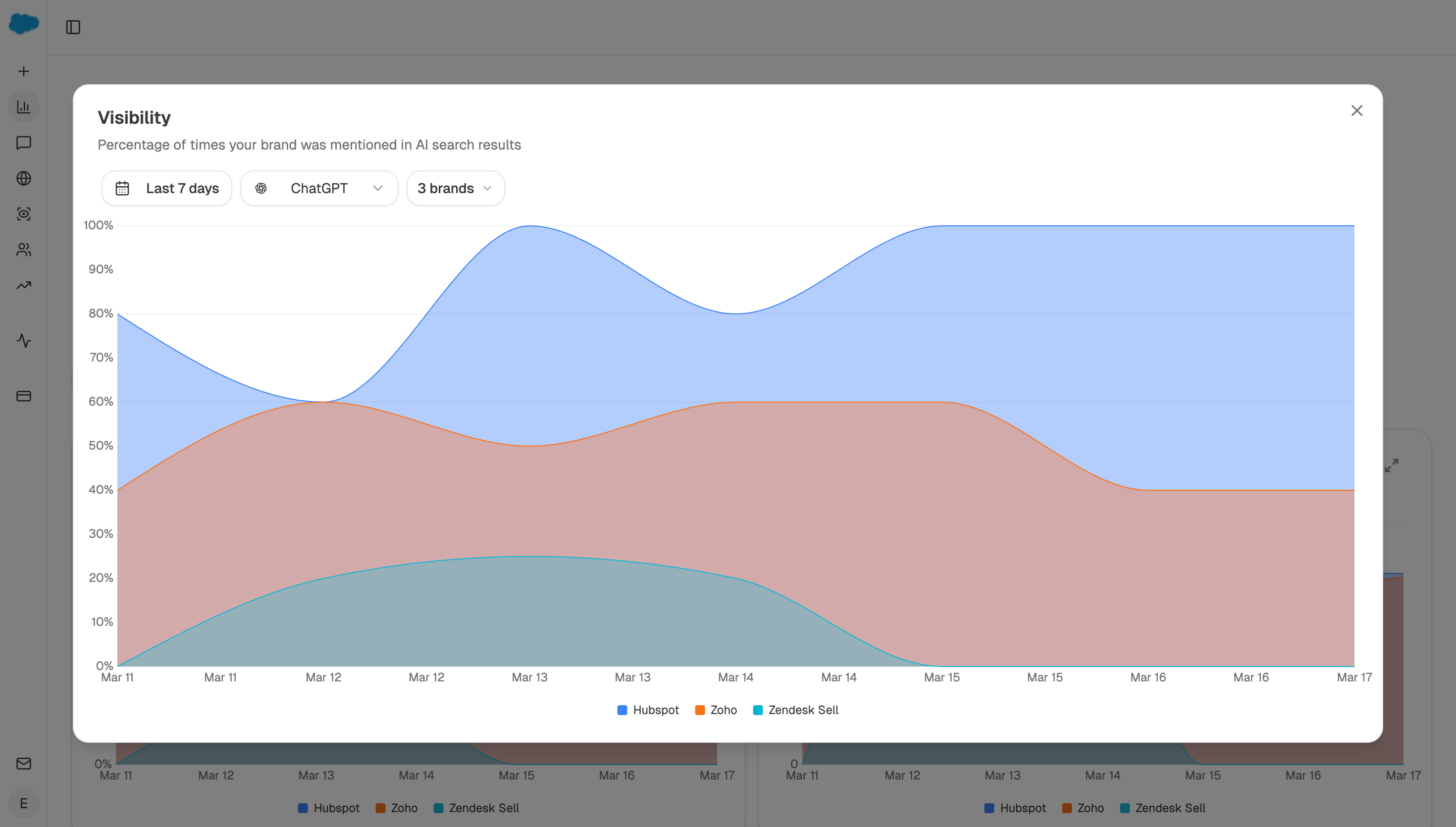 Visibility over time shows where you already appear alongside larger rivals, which is where the specific questions are usually hiding.
Find the questions where nobody is entrenched
Do not guess which questions are open. Check.
Analyze AI's unmentioned-prompts recipe lists the buying questions where your brand never appears, and the Opportunities view shows the ones where competitors are cited and you are not. Run both, then look at what the answers were built from.
You are hunting for a specific pattern: a question where the answer is assembled from forum posts, thin listicles or general explainers rather than from a well-known vendor's page. That means nobody has written the good version, and being unknown costs you very little.
Compare that against a question answered from three big vendors' own pages, which is a fight for later.
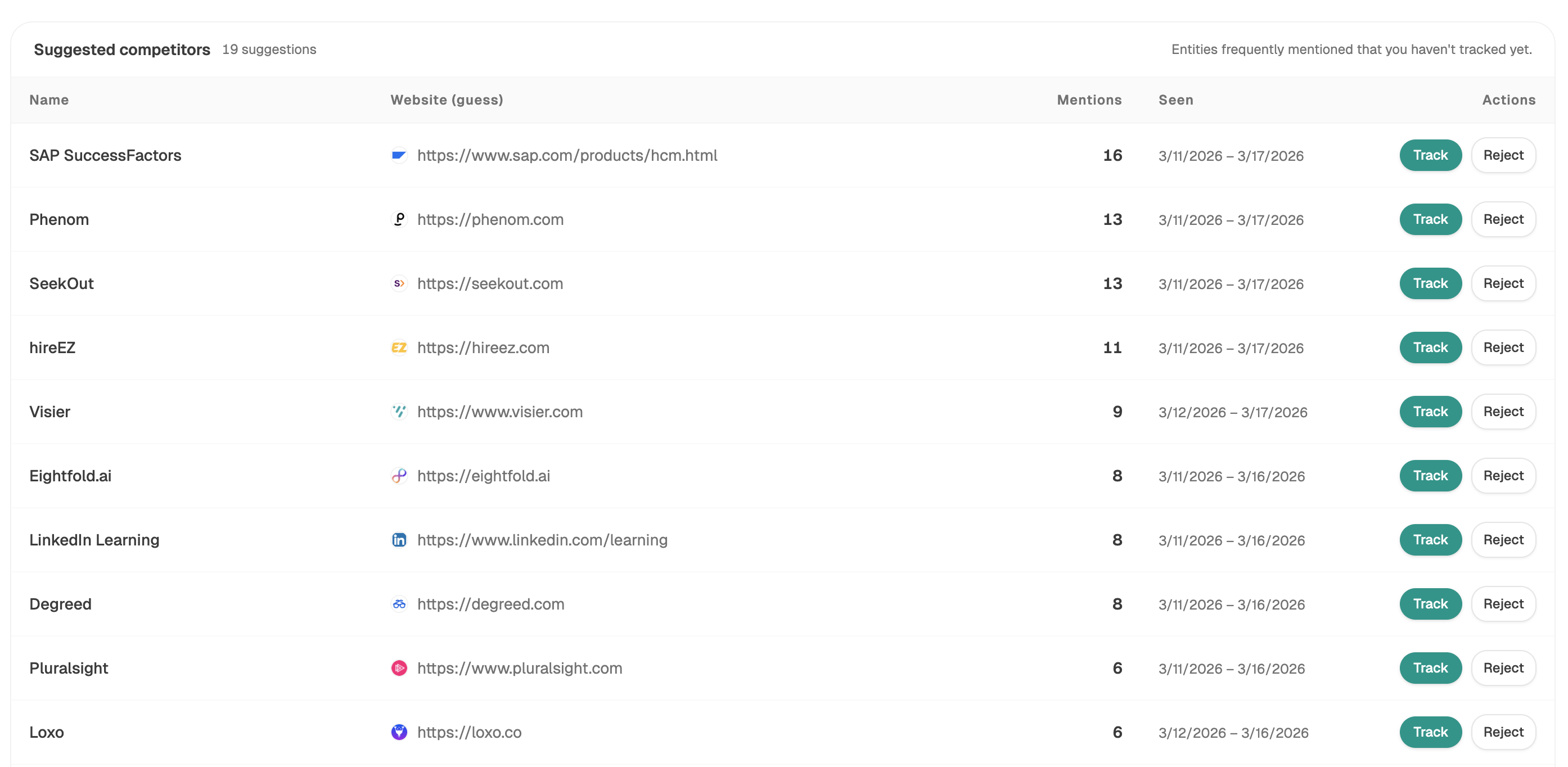 Competitor tracking shows which rivals hold which questions, which separates the contested ones from the open ones.
Publish the three things recognition cannot substitute for
When you cannot win on familiarity, win on the things a bigger competitor is unwilling or unable to publish.
Specificity they will not go near. A large vendor writes for everyone, which forces them general. You can write the page for one segment, one stack, one constraint, and it will be better for that reader than anything they have.
Numbers from your own operations. A figure nobody else publishes cannot be outranked by brand strength. It is also the most reliable route to being cited, which is the argument in what makes thought leadership useful to a hidden B2B buyer.
Honesty they cannot afford. Naming who you are wrong for, publishing real pricing, and describing what breaks. Large competitors get slower at all three as they grow. It is the trust ladder in what kinds of evidence make a B2B buyer trust a vendor.
Get named where the comparisons happen
Your own pages are only part of it, and for an unknown brand the third-party half matters more.
In our research the source mix differed sharply by surface: lists, comparisons and reviews were 34.4% of what Perplexity cited and 33.1% of Google AI Mode, against 13.9% on ChatGPT where company sites and product pages made up 68.8%. For a brand nobody knows, being absent from the comparison ecosystem is the single biggest hole, because that is where a buyer forms a shortlist without ever meeting you.
The competitor-sources recipe lists pages that cite rivals and have never cited you. Those are the cheapest wins available, since the page already ranks and already gets used, and how do I distribute content into the places buyers already learn covers working that list.
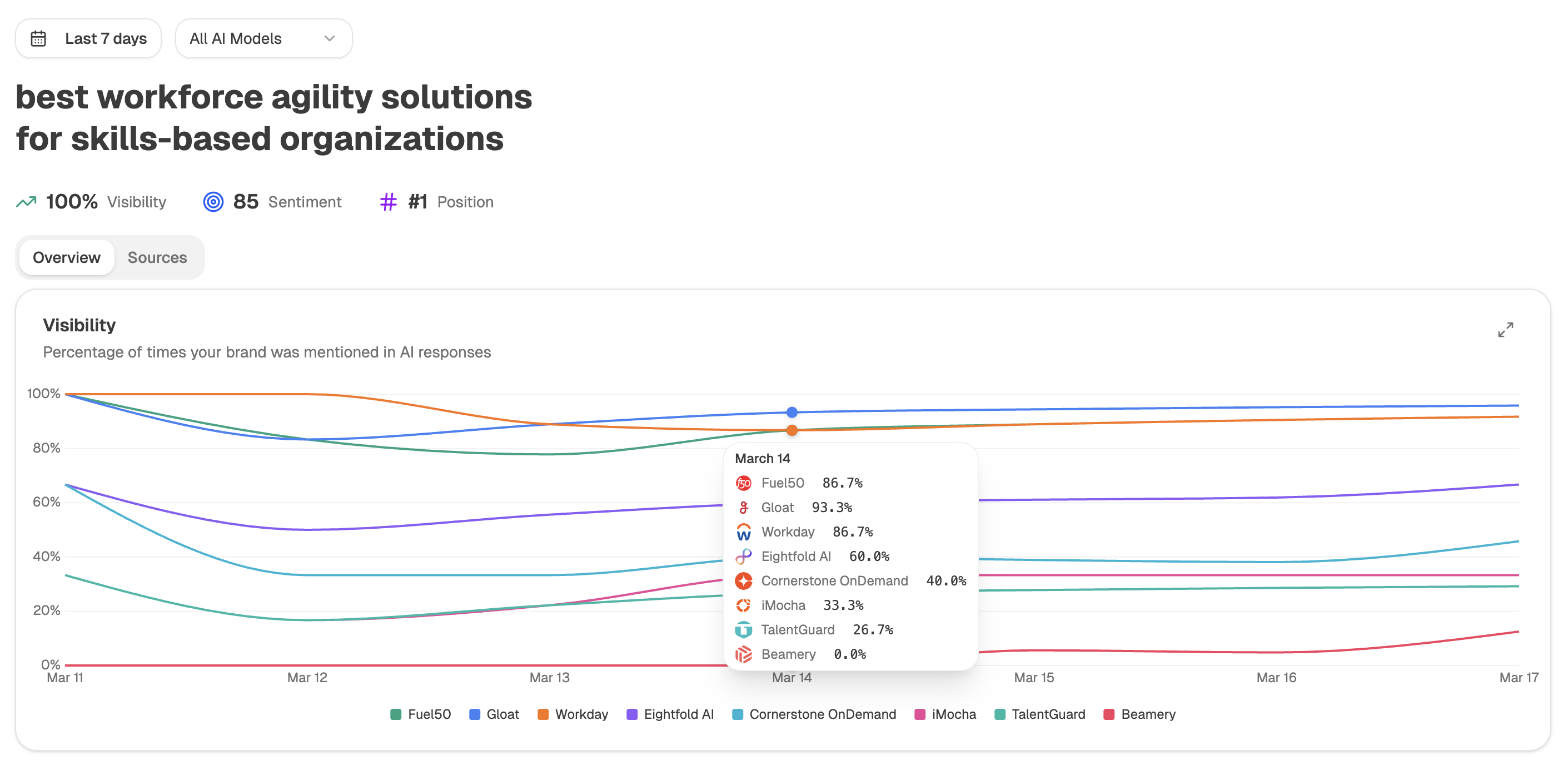 Tracked questions show which brands get named on each one, so you can tell an open question from a settled one.
Expect it to compound, and check that it is
There is one finding worth planning around. In our research, mentions were sticky: once a brand had been named in an answer, the next observation named it again about 83% of the time across all three assistants. After a miss, the next observation named it only 10% to 12% of the time.
Two consequences follow for a smaller brand. Winning a question tends to stay won, so a narrow question you take is worth more than it first looks. And absence persists, so waiting for recognition to arrive on its own is not a strategy.
Start (schedule, monthly) → unmentioned-prompts recipe for questions where you never appear → Citation Share classifying what each of those answers was built from → Prompt LLM sorting them into open, contested and settled → Visibility Score and Get Visibility Events to track movement on the ones you have started working → Send Notification when a previously unmentioned question names you for the first time.
Alerting on a first mention is the part worth building. It is the earliest evidence that a narrow bet worked, and it arrives months before anything shows up in pipeline.
FAQ
Related answers
- How do I find non-brand demand we can realistically win?
- How do I distribute content into the places buyers already learn?
- What kinds of evidence make a B2B buyer trust a vendor?
Find the questions nobody has taken yet
Analyze AI lists the buying questions where you never appear and shows which of them are genuinely open rather than settled.
Start your free trial