

![Featured image for Domain Authority Does Not Predict AI Citations [2026 Study]](/_next/image?url=https%3A%2F%2Fwww.datocms-assets.com%2F164164%2F1785857675-04-authority.png&w=3840&q=75)

Summarize this blog post with:


We analyzed 22,295 AI answers across ChatGPT, Perplexity, and Google AI Mode to test the assumption most SEO teams still act on. Does a higher website authority score make a page more likely to get cited by AI engines?
The dataset covers 115,843 citation events, 460 distinct B2B prompts, and 37 tracked organizations. For this piece we look at the 4,824 pages in our enriched cohort where we have both a live website authority score and at least one AI citation. That covers 20,451 citation events, or roughly 17.7% of the full citation dataset. The enrichment is partial and skews toward recent, cached pages, so we frame this as “in the pages we could enrich” rather than a universal claim.
Here are the questions we set out to answer:
- Does a higher page authority score correlate with more AI citations?
- If a correlation exists, how strong is it?
- How do citation counts differ between the lowest-authority pages and the highest-authority pages?
- What signals actually predict AI citations if authority does not?
- What should marketers do with their content budget if the DR shortcut does not work?
The Spearman correlation between page authority score and citation count in the enriched cohort is -0.17. That number is statistically significant because the sample is large, but the effect size is small and slightly negative. Higher-authority pages do not earn more AI citations on average, and the lowest-authority band and the highest-authority band both have a median of 1 to 2 cited answers per page. The domain-authority shortcut that most SEO teams learned in the Google era does not carry over to AI search in this data.
Table of Contents
TL;DR
- Does page authority correlate with AI citation count? No. Page-level Spearman rho is -0.17 (p = 4.13e-31), which is statistically significant but effectively no correlation.
- What is the sample? 4,824 cached pages that AI engines cited at least once and that we could match to a live website authority score. That covers 20,451 citation events, about 17.7% of the full citation dataset.
- How does citation count vary by authority band? Pages in the 0 to 19 authority band get a median 2 cited answers each. Pages in the 80 to 100 band get a median 1. High authority is not a shortcut to more citations.
- How is this different from the Google era? In Google, high domain rating predicts higher rankings. In AI search, high domain rating does not predict more citations. Different retrieval mechanism, different signal.
- What predicts AI citations then? Brand mentions (Ahrefs finds Spearman 0.664), topical fit, extractable content, and content freshness. Backlinks alone sit at 0.218 in the Ahrefs data.
- What should marketers do about this? Stop treating DR growth as an AI-visibility strategy. Invest in content extractability, topical depth, and brand mentions on pages that already exist.
Page Authority Doesn’t Predict AI Citations
We took every enriched cited page in our dataset, matched it to a current website authority score, and computed the Spearman rank correlation with the number of distinct AI answers that cited it.
Spearman correlation compares ranks rather than raw values, so it is robust to outliers and non-linear relationships. A Spearman of 1 means perfect positive correlation. A Spearman of -1 means perfect negative correlation. A Spearman near zero means the two variables move independently.
Our result is -0.17. The p-value is 4.13e-31, which sounds impressive but only means “we are confident this is not zero.” The effect size itself is small. A -0.17 correlation explains less than 3% of the variance in citation counts. The other 97% is driven by something other than authority score.
In plain terms, if you rank the 4,824 pages in our sample from lowest to highest authority, the page ranking has almost no relationship with the citation count ranking. A page at authority score 15 has essentially the same chance of getting cited as a page at authority score 85, once you control for how AI engines actually select citations. The slight negative sign in the -0.17 is more likely a compositional artifact than a real signal that authority hurts you.
The Top-Authority Pages Get Cited Slightly Less Per Page
The band-level view makes the same finding easier to see.
| Authority band | Pages in band | Total cited answers | Median cited answers per page |
|---|---|---|---|
| 0 to 19 | 794 | 3,204 | 2 |
| 20 to 39 | 542 | 3,035 | 2 |
| 40 to 59 | 578 | 2,924 | 2 |
| 60 to 79 | 809 | 4,622 | 2 |
| 80 to 100 | 2,101 | 6,115 | 1 |
The median column stays at 2 across every band except the top one, where it drops to 1. And the top band has more pages than any other band even though each page gets cited less often on median.
The compositional reason is that the 80 to 100 authority band contains a lot of high-authority pages that get cited once and never again. These are often homepages, category pages, or “about” pages of enterprise sites. AI engines cite these pages when the query is broad enough to warrant a link to the vendor’s main site, but they do not cite them repeatedly across the specific long-tail prompts our tracked panel captures. A narrower page from a niche source, in the 0 to 19 or 60 to 79 band, is more likely to get cited across multiple related prompts because it is the best available match for those queries.
For a marketer, the takeaway is that raising a page’s authority score from 40 to 70 is unlikely to make it get cited more by AI. The intervention that moves citations sits at the page-content level. Changing the authority score alone does not.
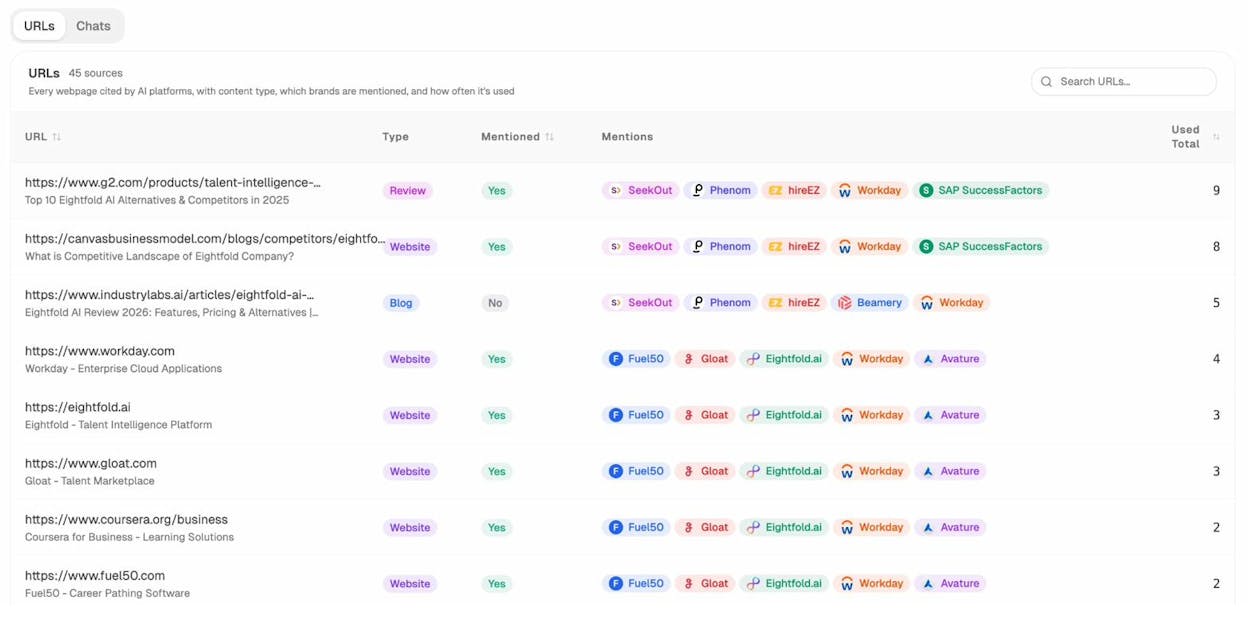
Citation Analytics view showing per-page cited answer counts alongside the type and mention status of each cited URL
Why Authority Doesn’t Predict AI Citations
Google’s ranking algorithm treats a domain’s link graph as a strong signal because the algorithm was built on the link graph. AI engines do not have that architecture. Perplexity and Google AI Mode retrieve pages at answer time from a search index that filters primarily on topical relevance to the query. ChatGPT uses a mix of training-data knowledge and live retrieval, and neither layer weights the link graph the way Google Search does.
The unit of selection also matters. Google’s algorithm selects entire URLs to rank based on aggregated site-level signals. AI engines select passages of text to include in an answer, based on how well the passage matches the query’s semantic intent. A high-authority page with a wordy, brand-heavy intro loses to a lower-authority page with a clean, extractable answer to the specific question. The page-level authority does not enter the selection function in a heavy way. What enters instead is the retrievability of the specific paragraph the engine wants to cite.
Freshness is a second lever that authority does not capture. Ahrefs’s separate content-age analysis found that AI-cited URLs are on average 25.7% fresher than the URLs Google ranks organically, and ChatGPT specifically cites content that runs about 458 days newer than organic results on the same queries. A page with high authority and a five-year-old publish date is competing against a mid-authority page that was updated last month, and the fresher page often wins the citation slot. Authority does not decay. Content date does. AI engines respond to both, and authority alone does not tell you which page is fresh.
This is where the “AI search is not another Google” framing lands practically. It does not mean SEO is dead, and it does not mean backlinks are dead. It means the signal SEO teams have spent 15 years optimizing for is not the signal that decides AI citations. Investing more in DR does not move AI visibility. Investing in the content structure of the pages that already have DR does.
How This Compares to Other Public Studies
The relationship between authority-style metrics and AI citations has been studied a lot in the last year. Our page-level Spearman -0.17 sits inside a broader picture. Here is where our number fits.
Ahrefs analyzed 75,000 brands across ChatGPT, AI Mode, and AI Overviews and found that brand mentions correlate with AI citations at Spearman 0.664, while backlinks land at 0.218 and content volume at 0.194. Their unit of analysis is the brand and their signal is backlink count. Our unit is the page and our signal is a page-level authority score. Our finding sits alongside theirs. Ahrefs shows that at the brand level, backlinks predict AI citations weakly (0.218 is not zero, but it is small). We show that at the page level, authority score predicts AI citations even more weakly, essentially at zero. The two studies point at the same conclusion from two different slices.
Clairon reported that Domain Authority correlates with AI citation probability at r=0.18, which squares to r²=0.032, meaning DA explains roughly 3% of the variance. That matches our -0.17 almost exactly in magnitude. The sign flip between -0.17 and +0.18 is the compositional difference between page-level breadth (our measurement) and brand-level probability (theirs). Both numbers say the same thing. Authority is not the shortcut.
SE Ranking analyzed 129,000 unique domains across 216,000 pages and reported a stronger positive pattern. Domains with fewer than 300 referring domains averaged 2.5 citations. Domains with over 24,000 referring domains reached 6.8. That is a real difference, and it appears to contradict our finding. It does not. Their measurement is at the extreme ends of the domain distribution, where the very largest publishers pull ahead of the smallest ones. Our -0.17 is on the enriched cohort of pages that already earned at least one citation. Both can be true. In aggregate, very large domains get cited more than very small ones. Within the pool of pages that already get cited, authority does not predict how often each page gets cited.
Semrush analyzed 1,000 domains and reported an Authority Score correlation with AI mentions at Pearson 0.65. That number is much higher than either our -0.17 or the Ahrefs 0.218 for backlinks. The reason is that Semrush’s finding only holds above a certain authority tier. Below the threshold, more backlinks do not move the needle. The Semrush 0.65 is telling us that if you are already a top-tier publisher, additional authority still tracks with additional AI mentions. If you are a mid-market B2B brand with a page-level authority score in the 40 to 60 band, the -0.17 in our data and the 0.218 in Ahrefs are the relevant numbers for you. The 0.65 threshold effect applies to Wikipedia, TechCrunch, Forbes-class domains and does not describe the intermediate range.
AuthorityTech found that only 7.2% of domains appear in both Google AI Overviews and LLM citation lists across a 22,410-domain study. Their conclusion is that “generalist high-DA sites with broad coverage are underrepresented” in AI citations, and niche vertical experts with deep topical depth take their place. That is consistent with our compositional finding on the 80 to 100 band. High-authority pages often get cited once and moved on from. Niche pages get cited repeatedly because they match specific long-tail queries.
The pattern across all five studies is consistent once you separate the units. At the brand level, backlinks and authority have a weak positive relationship with AI citations (Ahrefs 0.218, Clairon 0.18). At the page level within the cited cohort, the relationship is near zero (our -0.17). At the extreme ends of the domain distribution, the very largest publishers get cited more than the smallest (SE Ranking), and above a top-tier authority threshold, additional authority still tracks with additional mentions (Semrush 0.65). But the effect is compositional and does not scale linearly across the mid-range. If you are a mid-market B2B brand with a mid-range authority score, moving from DR 40 to DR 60 buys you almost no AI citation growth on its own.
What This Means For How You Allocate Content Budget
Three things follow from the -0.17 finding.
The first is that DR-driven link building is not an AI-visibility strategy. If you are running a link-building program specifically to increase AI citations, the data says the return on that program is small. Link building still matters for Google rankings, and Google rankings still matter for a large share of buyer discovery. But treating DR as a proxy for AI visibility is measuring the wrong metric. The Citation Analytics view shows the actual page-level citation counts on your tracked prompt panel, so a marketer can see whether the DR investment is producing citation growth or just moving a rankings number that does not translate.
The second is that content-level structure is where the AI-citation budget actually moves. Pages that are extractable, dense with concrete claims, and topically focused earn more citations than pages that are broad, brand-heavy, or narratively long. The AI Content Optimizer audits pages against the specific extractability signals that AI engines use to select citations, which is a different audit than a traditional SEO score.
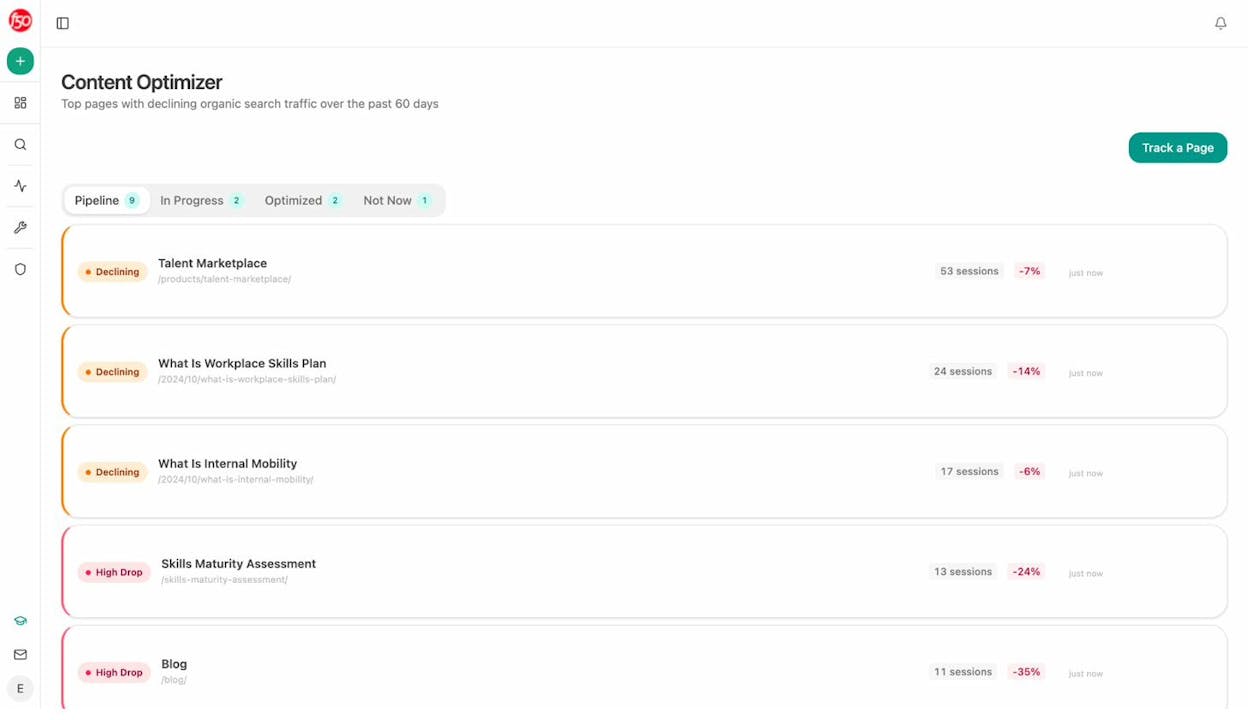
AI Content Optimizer showing per-page optimization ideas based on the gaps between the page’s current content and the extractable structure AI engines cite
The third is that brand mentions are the highest-yield investment for AI citation growth. Ahrefs’s 0.664 correlation between brand mentions and AI visibility is roughly three times the 0.218 for backlinks. A Reddit thread that names your brand without linking is worth more for AI citations than a backlink from a mid-authority blog. That reframes the digital PR budget. The point is not to earn links. The point is to earn mentions on sources AI engines already retrieve from.
The three implications compound. A page you rewrote for extractability, on a domain where you have mid-range authority, mentioned in a Reddit thread about your category, is closer to the AI-citation profile than a high-DR page with narrative marketing copy and no third-party mentions.
The Bigger Story
Most SEO teams still open a project with “let us grow the DR.” That instinct built the last 15 years of the discipline, and it still works for Google. It does not work for AI citations. The signal AI engines use to select which pages to cite is not the same signal SEO teams have been optimizing for.
This is compatible with the SEO-plus-AI-search framing we use across our work. SEO is not dead. Traditional link building still moves rankings. Rankings still drive a large share of buyer discovery. And the same brand signals that build strong rankings, when they take the form of unlinked mentions and citation-ready content, also happen to build AI visibility. The two channels compound when the work is done at the content-and-mention layer rather than the link layer alone. Chasing DR alone does not compound into AI visibility. Chasing content structure and brand mentions compounds into both.
The rest of this State of AI Search series unpacks the other structural patterns we found in the same dataset. Later pieces look at how broad the citation ecosystem is (7,058 unique cited domains, top-10 share only 11 to 13%), how the engines differ on YouTube and Reddit citations, and how the specific answer content shifts when the same brand is mentioned by ChatGPT versus Perplexity versus Google AI Mode.
The finding to hold onto from this piece is the simple one. Page authority score does not predict AI citations in our data. If you are building an AI visibility program, treat the pages you already have as the asset. Improve their extractability. Earn mentions on the third-party sources AI engines already trust. Skip the DR chase.
This research was conducted using Analyze AI, which tracks brand visibility, citation share, and page-level citation performance across ChatGPT, Perplexity, Google AI Mode, and every other major AI engine.

Ernest

Ibrahim
![Featured image for The State of AI Search in B2B [2026]](/_next/image?url=https%3A%2F%2Fwww.datocms-assets.com%2F164164%2F1785857899-16-state-of-ai-search-b2b-2026.png&w=3840&q=75)

![Featured image for Top 10 Sites Cover Only 12% of AI Citations [2026 Study]](/_next/image?url=https%3A%2F%2Fwww.datocms-assets.com%2F164164%2F1785857692-05-top-domains.png&w=3840&q=75)
![Featured image for Source Type Shifts AI Mention Rate 33 Points [2026]](/_next/image?url=https%3A%2F%2Fwww.datocms-assets.com%2F164164%2F1785857866-14-source-family-transfer.png&w=3840&q=75)