
What should I ask a subject-matter expert to get genuinely original content?
Short answer
Ask for the specific instance, not the principle. Four question types produce almost all the original material: the last time this happened, the case where the usual advice fails, the number they know that nobody publishes, and the argument they keep losing internally. General questions get you a summary of what is already online, because that is what a general question invites.
Understand why the usual questions fail
"What should people know about X" produces a textbook answer. Not because the expert is holding back, but because a broad question is answered from the broad part of memory, which is the part that already matches what everyone else has written.
Specific questions reach a different place. Asking about last Tuesday produces details, constraints and numbers that exist nowhere else, because nobody has written up last Tuesday.
So every question below is engineered to be hard to answer generically.
Use the four question types
| Type | The question | What it produces |
|---|---|---|
| The instance | "When did you last see this go wrong? Walk me through it." | Details and sequence nobody else has |
| The exception | "When is the standard advice here actually wrong?" | A position with an edge |
| The number | "What is a figure you know that most people would guess wrong?" | Proprietary evidence |
| The lost argument | "What do you believe about this that colleagues disagree with?" | A genuine point of view |
Four questions is enough for a twenty-minute conversation. More than that and you are collecting rather than digging, which is how you end up with six shallow answers instead of two deep ones.
Follow up with the three that get the detail
The first answer is almost never the useful one. Three follow-ups do most of the work.
"What did you expect to happen?" The gap between expectation and outcome is where the insight sits.
"How did you know?" This surfaces the signal they read, which is usually the practical thing a reader can copy.
"What would you do differently?" This turns a story into advice without you having to invent the advice.
Sit through the pause after each one. Experts often produce the best material on the second attempt, after they have rejected their own first answer as too obvious.
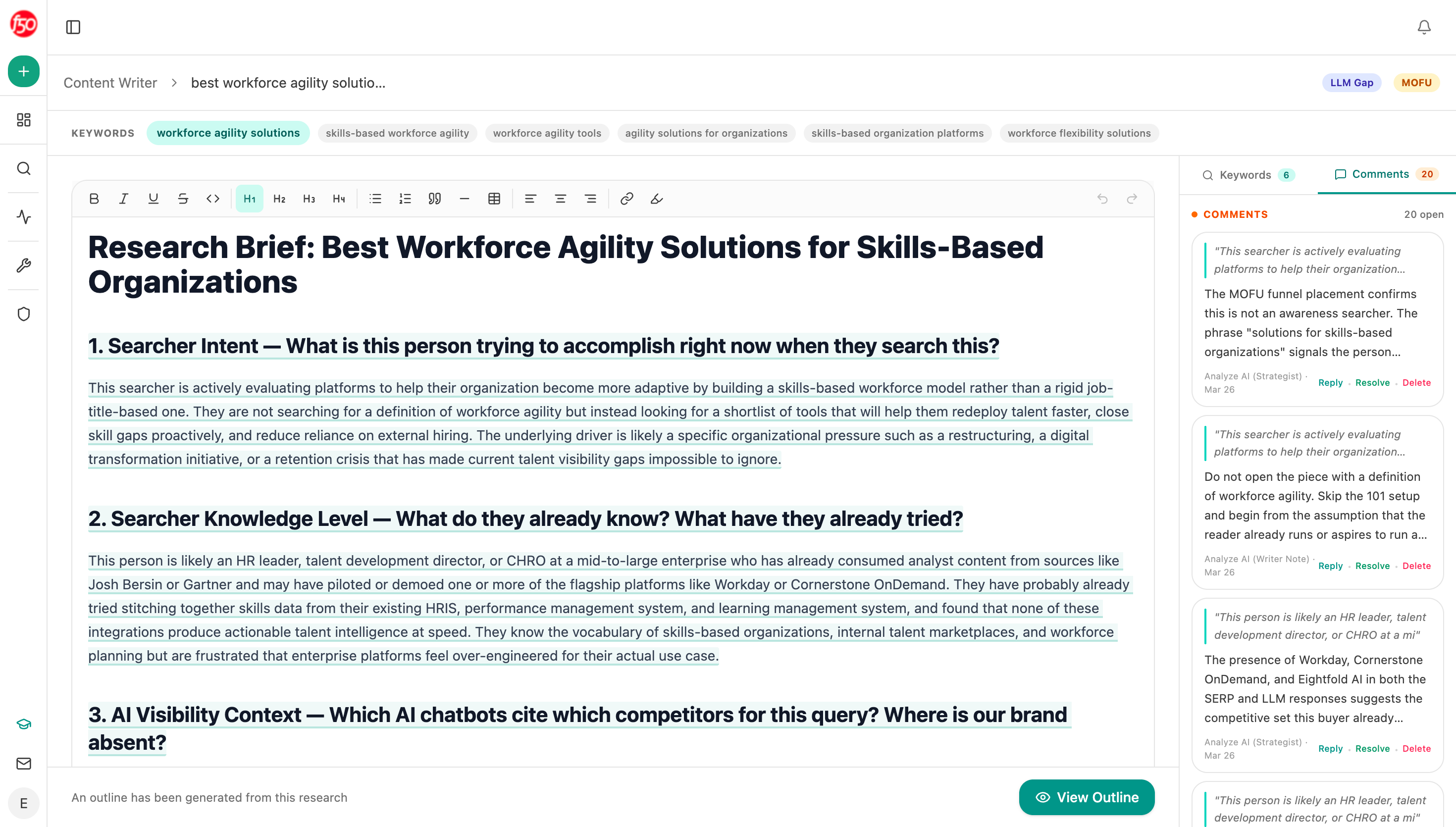 Keeping comments attached to specific passages is how an expert's details survive from conversation to draft.
Ask the four questions the whole market avoids
Some questions produce original content because everyone else is too cautious to publish the answer.
- "Who should not buy from us?" A real answer here is worth more than three case studies, and it is the basis of a comparison buyers believe.
- "What does this actually cost in time, not money?" Nobody publishes the honest setup burden.
- "What breaks most often?" This is the material for what should an implementation guide include for a risk-conscious buyer.
- "What did we get wrong last year?" Rare enough that it stands out on its own.
You will need internal permission for some of these, which is a good reason to build an approved claims library, covered in how do I build a reusable library of approved claims and proof points.
Check the answer is really new before you build on it
Experts sometimes offer something they believe is proprietary and is in fact widely written up. Check before you commit a piece to it.
Two quick checks. Search the claim and read the top five results. Then run it as a question in Analyze AI's Ad Hoc Prompt Searches, which returns live answers across ChatGPT, Perplexity and Google AI Mode. If assistants answer your expert's insight fluently and completely, it is not new, and the piece needs a different angle.
This is the same subtraction test as how do I prove an article adds net-new value instead of summarizing what already exists, just applied at the interview stage where it is cheap.
Turn the answers into an outline they will recognise
The failure mode after a good interview is a draft that keeps the structure and loses the specifics.
Build the outline directly from the answers rather than from a template. Analyze AI's Content Writer produces an outline from research, and pairing it with Inject Brand Context keeps your documented tone and claim rules in the same step, so the expert's phrasing is not smoothed into house style.
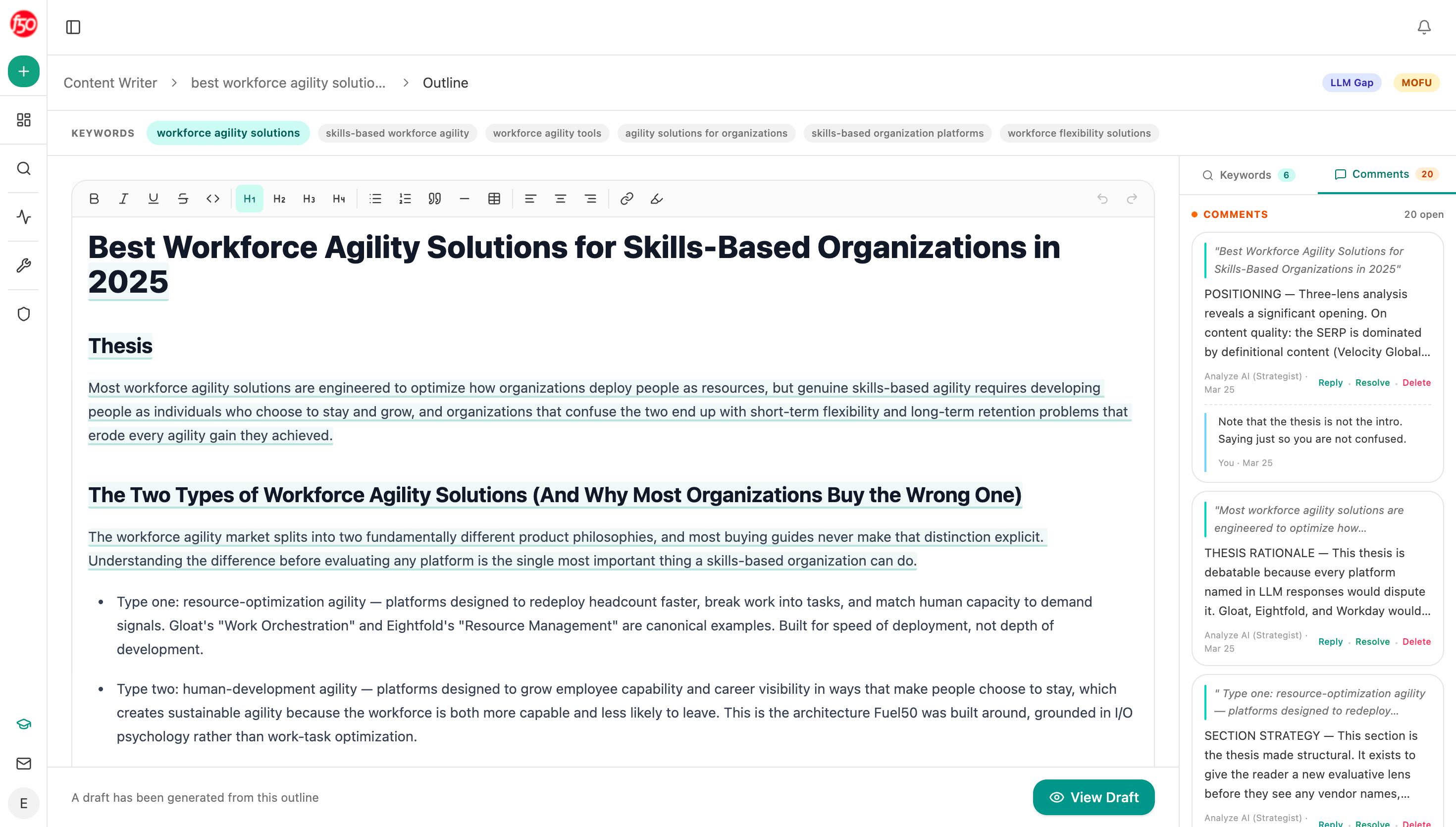 Building the outline from the research stage keeps the expert's examples as the structure rather than as decoration.
Google's guidance on creating helpful content asks whether a page provides original information, reporting, research or analysis. An interview built on these four question types is original reporting, provided the specifics survive to publication.
Check a batch of claims at once
When you come out of an interview with eight claims, checking each one by hand is where the discipline breaks.
Start (manual, the expert's claims as a file-csv) → Loop over each claim → Google Search returning the current top ten for it → Prompt Responses asking the same claim as a question across providers → Prompt LLM judging whether the claim is already fully covered → Conditional keeping only the claims nothing else answers well → Export CSV listing what is genuinely yours.
Running this before the outline is what stops a piece being built on the one claim in the batch that everybody already publishes.
FAQ
Related answers
- How do I turn internal expertise into content without making experts the bottleneck?
- How do I prove an article adds net-new value instead of summarizing what already exists?
- Why does our content sound the same as every competitor's?
- How can sales-call language improve my topic research?
Keep the expert's specifics all the way to publication
Analyze AI builds the outline from your research and holds your tone and claim rules in the same step, so nothing gets smoothed away.
Start your free trial