
Should AI traffic count as organic, referral, or its own channel?
Short answer
Its own channel. AI traffic behaves differently enough from both organic search and referral that folding it into either destroys the signal you need. It has a different intent profile, a different conversion pattern, and a click rate low enough that sessions understate its contribution by a wide margin. Give it a channel, then add a separate visibility metric, because the channel only measures the small share of AI exposure that produces a click at all.
The case against filing it under Organic Search
The tempting argument is that AI assistants are search engines, so their traffic is organic. Three things break it.
Different intent shape. Organic search visitors arrive mid-question. AI-referred visitors arrive after the assistant has already answered the question, so they click for something the answer didn't give them: pricing, a demo, a specific integration detail. That's a bottom-funnel profile sitting inside a channel you're used to reading as mixed-funnel.
Different optimisation levers. Ranking work and citation work overlap but aren't the same job. If both live in one channel, you can't tell which effort moved the number, and you'll keep funding the wrong one.
Google's own AI is already in there. AI Overviews and AI Mode clicks are filed as Organic Search by GA4. Adding assistant traffic to the same bucket means Organic Search contains three different behaviours with no way to separate them.
The case against filing it under Referral
Referral is a bucket for sites that link to you: partners, press, directories, forums. AI assistants aren't linking to you in that sense. They're answering a question and citing a source, which is closer to a search result than a backlink.
Practically, Referral is also where AI traffic goes to die. It sits alongside dozens of low-volume domains, nobody segments it, and the trend is invisible. That's exactly what happened before GA4 added a dedicated channel: all AI chatbot traffic landed in the Referral bucket by default.
What "its own channel" should actually mean
GA4 now has a native AI Assistant channel, which settles the mechanical question. But treating it as one row understates the problem, because AI traffic splits into four populations that behave differently:
| Population | Where GA4 puts it | Why it matters separately |
|---|---|---|
| Recognised assistant referrals | AI Assistant | Your only clean, countable AI traffic |
| Assistants Google doesn't recognise | Referral | Needs a custom channel group to surface |
| Google AI Overviews and AI Mode | Organic Search | Largest reach, invisible as AI |
| Referrer-less AI visits | Direct | Usually the biggest group of all |
A reporting structure that survives contact with a CFO uses four lines, not one. See What does GA4's AI Assistant channel measure — and what does it miss? for the mechanics of each gap.
The reason the channel debate is secondary
Even a perfectly configured channel measures clicks, and clicks are a small tail of AI exposure.
Our own state of AI search research, covering more than 22,000 answers and 115,000 citation events, found Google AI Mode returns a citation-rich answer in 97.4% of matched B2B queries and Perplexity in 93.2%. Pew Research found that when an AI summary appears, users click a source link in only about 1% of visits.
So the honest structure is two metrics, not one channel. Sessions for the traffic that arrives, and citation share for the exposure that doesn't. Reporting only the first tells your leadership that AI is a rounding error, which is the wrong conclusion drawn from a correctly configured dashboard.
Set it up properly
In GA4. Keep a custom channel group running alongside the native channel, ordered above Referral so its rules fire first, and add OR Session default channel group exactly matches AI Assistant so you capture both definitions. Google publishes a working regex example in its channel group documentation.
In your reporting layer. Split Direct by landing page depth and carry deep-page Direct as a fifth line. Method in How can I estimate how much AI-influenced traffic is hidden in my Direct channel?.
In your executive view. One sessions number and one citation-share number, side by side, never averaged together.
How Analyze AI structures this
Analyze AI treats the two halves as two connected surfaces rather than one blended metric.
The Monitor side reads your GA4 property and separates AI referrals from Direct and Organic, giving you the countable half without building custom explorations. Landing Pages shows which pages receive AI-referred sessions and, in the same row, whether those pages are being cited by AI platforms, so you can see the click and the citation against the same URL.
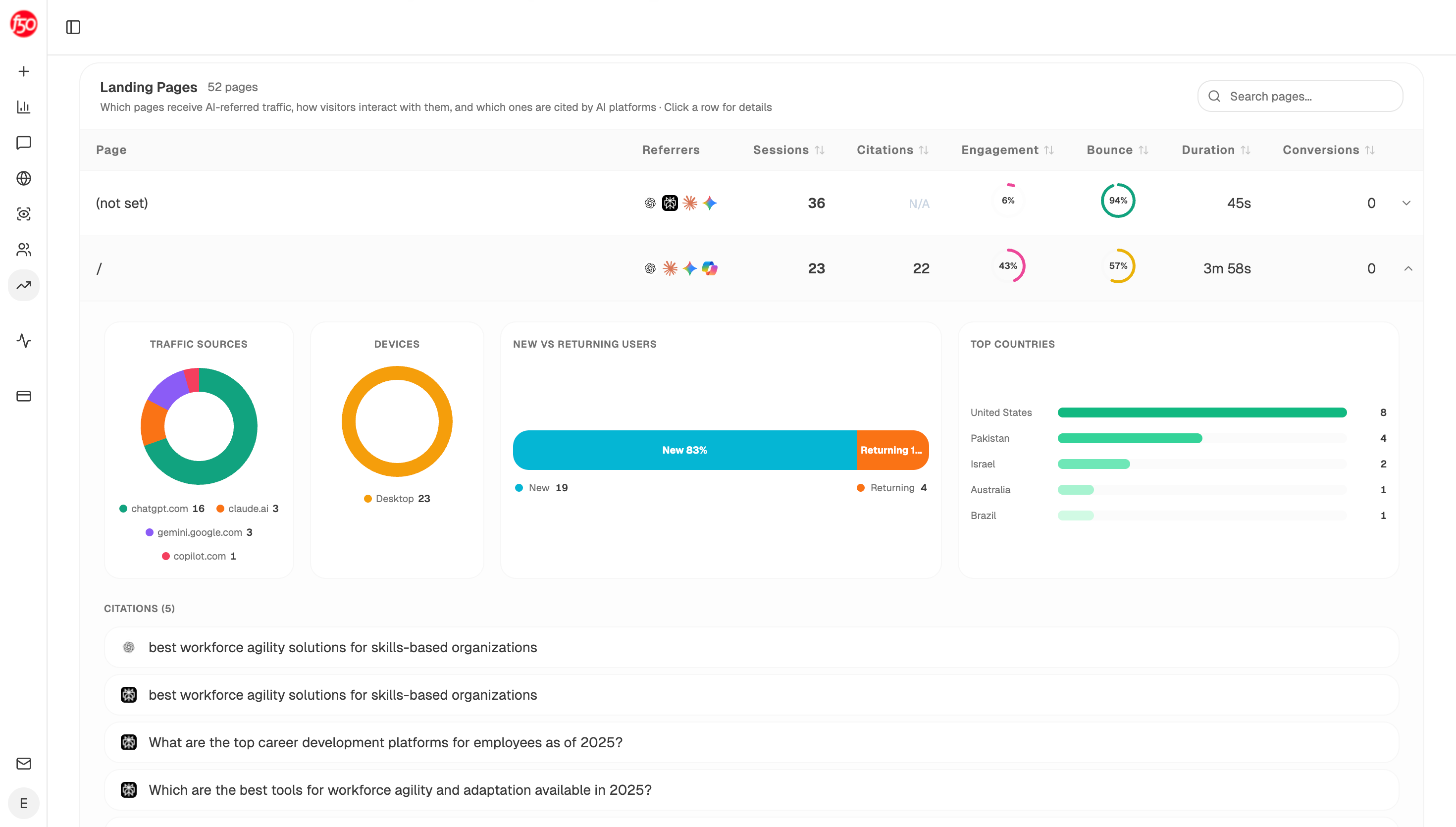
The Discover side covers the uncountable half through prompt-level tracking, so a page cited on twelve commercial prompts that sends four sessions reads as a win rather than as underperformance.
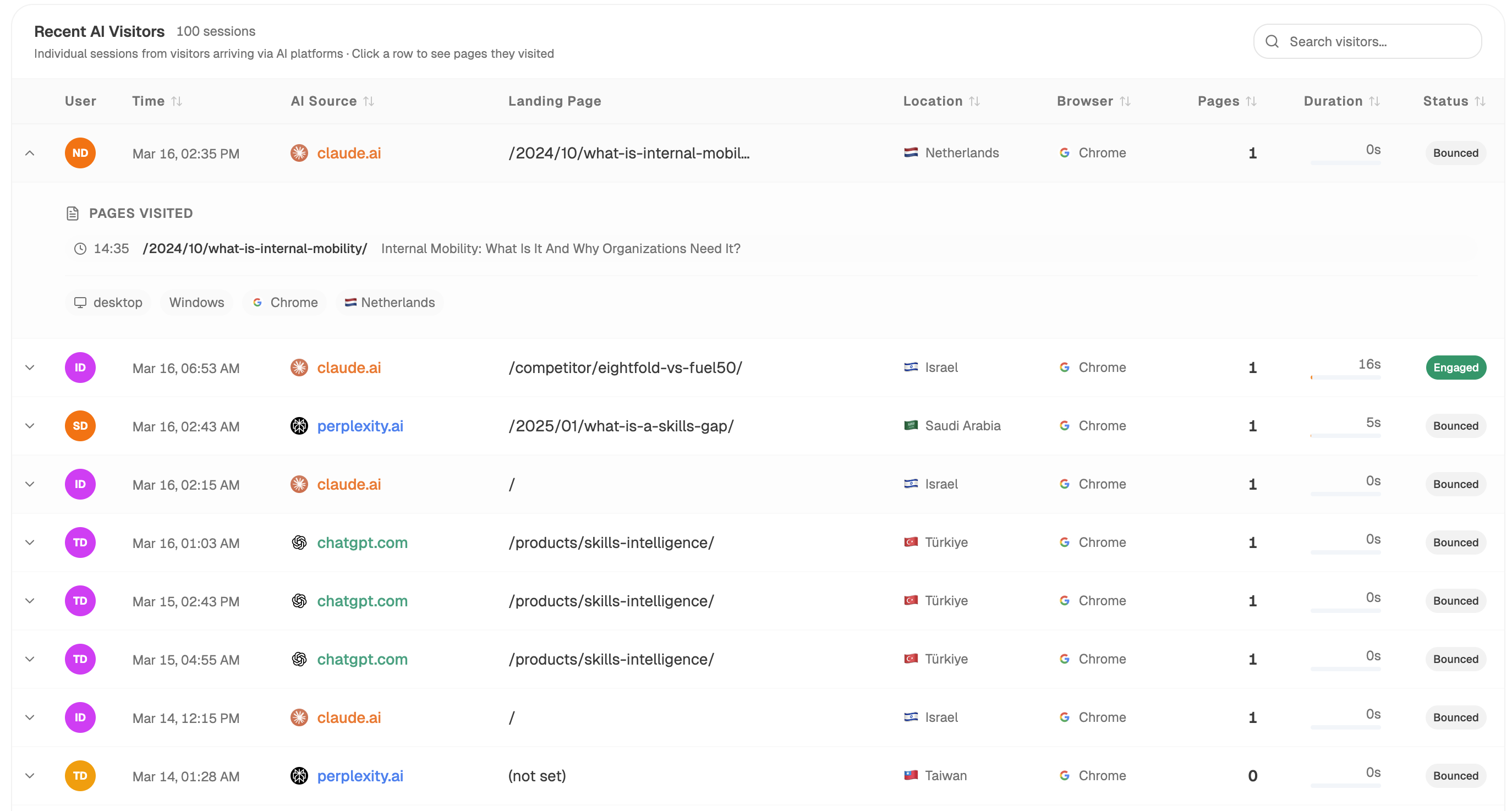
Where this gets useful for the channel question specifically is the Recent AI Visitors view, which shows individual sessions with the AI source, landing page, and engagement status. Scanning it tells you in minutes whether your AI traffic is genuinely bottom-funnel or whether it's bouncing off blog posts, which is the evidence that settles whether the channel deserves its own budget line.
FAQ
Related answers
- What does GA4's AI Assistant channel measure — and what does it miss?
- How do I track ChatGPT traffic in GA4?
- Why does AI traffic show up as Direct in Google Analytics?
- How do I report direct versus assisted value from AI search?
Want AI sessions and AI citations against the same pages? Start a free Analyze AI trial and connect GA4 in about ten minutes.