
What does GA4's AI Assistant channel measure — and what does it miss?
Short answer
It measures sessions where GA4 recognised the referrer as an AI assistant on Google's list, and assigns them the medium ai-assistant. It misses four things: history before the May 2026 rollout, assistants Google hasn't added, Google's own AI Overviews and AI Mode clicks, and any AI visit arriving without a referrer. Treat the number as a floor, and keep a custom channel group alongside it.
What it actually does
When GA4 detects a referrer matching a recognised AI assistant, three dimensions change at once. The medium becomes ai-assistant, the campaign becomes (ai-assistant), and the session is filed under the AI Assistant channel in Default Channel Group reports. All three happen automatically with no configuration from the property owner.
That's the entire mechanism. One referrer match, three dimension writes. Everything the channel misses follows from the fact that a referrer match is all it can do.
Gap 1: it isn't retroactive
GA4 processes forward only, so the channel doesn't reclassify history. AI traffic from before the rollout stays wherever it originally landed, mostly Referral and Direct.
The practical consequence is that native year-over-year and month-over-month comparisons for AI traffic aren't possible from the default grouping. Any comparison spanning the rollout date will show AI Assistant appearing from nothing and Referral dropping, which is a reporting artefact rather than a change in behaviour.
Annotate the rollout date in your property. It saves the next analyst from investigating a phantom spike.
Gap 2: the source list is Google's, and it has moved
Google named ChatGPT, Gemini, and Claude in the launch announcement, and the live documentation has since listed a somewhat different set. Notably, Perplexity has not been part of the native definition, so those sessions continue to land in Referral despite Perplexity being one of the higher-intent AI sources.
You can't fix this inside the default grouping, because default channel groups are not editable. The only route is a custom channel group.
Rather than trusting any published list, including the ones in blog posts, check the current definition in Google's channel group documentation before you report the number.
Gap 3: Google's own AI isn't in it
AI Overviews and AI Mode clicks are filed under Organic Search, not AI Assistant. From Google's perspective this is consistent, since the click originated on a Google search results page.
From your perspective it means your AI number excludes the AI surface with the largest reach. If someone asks "how much traffic comes from AI," the AI Assistant row answers a narrower question than they think they're asking.
Google's documentation on AI features and websites covers how these surfaces work and confirms standard SEO requirements still apply to them.
Gap 4: no referrer, no classification
The largest gap. Native mobile apps, in-app browsers, strict referrer policies, and copy-pasted URLs all produce sessions with no referrer header, and those fall to Direct regardless of where the visitor actually came from.
This is structural rather than a Google oversight. No referrer-based system can classify a visit that arrives without one. See Why does AI traffic show up as Direct in Google Analytics?.
What the four gaps add up to
| What you want to know | Does the channel answer it |
|---|---|
| How many sessions came from recognised chatbots since May 2026 | Yes |
| How that compares to last year | No, not retroactive |
| How much came from every AI assistant | No, list is partial |
| How much came from Google's AI surfaces | No, filed as Organic |
| How much AI exposure produced no click at all | No, out of scope entirely |
The last row is the one that matters most strategically. Our own state of AI search research, analysing more than 22,000 answers, found Google AI Mode returns a citation-rich answer in 97.4% of matched B2B queries. Most of that exposure never becomes a session in any channel, so no analytics configuration will ever surface it.
What to do about it
Keep a custom channel group running. It catches omitted sources and applies retroactively. Order it above Referral, or rules below Referral never fire. Include OR Session default channel group exactly matches AI Assistant so you capture both definitions without double-counting.
Split Direct by landing page depth. Deep-page Direct is your proxy for referrer-stripped AI visits. Method in How can I estimate how much AI-influenced traffic is hidden in my Direct channel?.
Add citation tracking for the zero-click layer. No GA4 setup reaches it.
Cover the layer GA4 structurally cannot reach
The four gaps above are all variations of one limit: GA4 classifies sessions, and a citation that produces no session is not a session. No configuration reaches it.
That layer has its own data model in Analyze AI. Citation Pages returns the pages on your site that AI systems cite. Citation Domains returns which domains get cited across your tracked prompts, including the ones cited instead of you. Citation Watched Pages tracks a specific set of URLs you care about, and Citation Share returns the percentage of citations pointing to your domain versus competitors.
The domain view is usually the uncomfortable one, because it shows which third-party sites are answering questions about your category more often than you are.
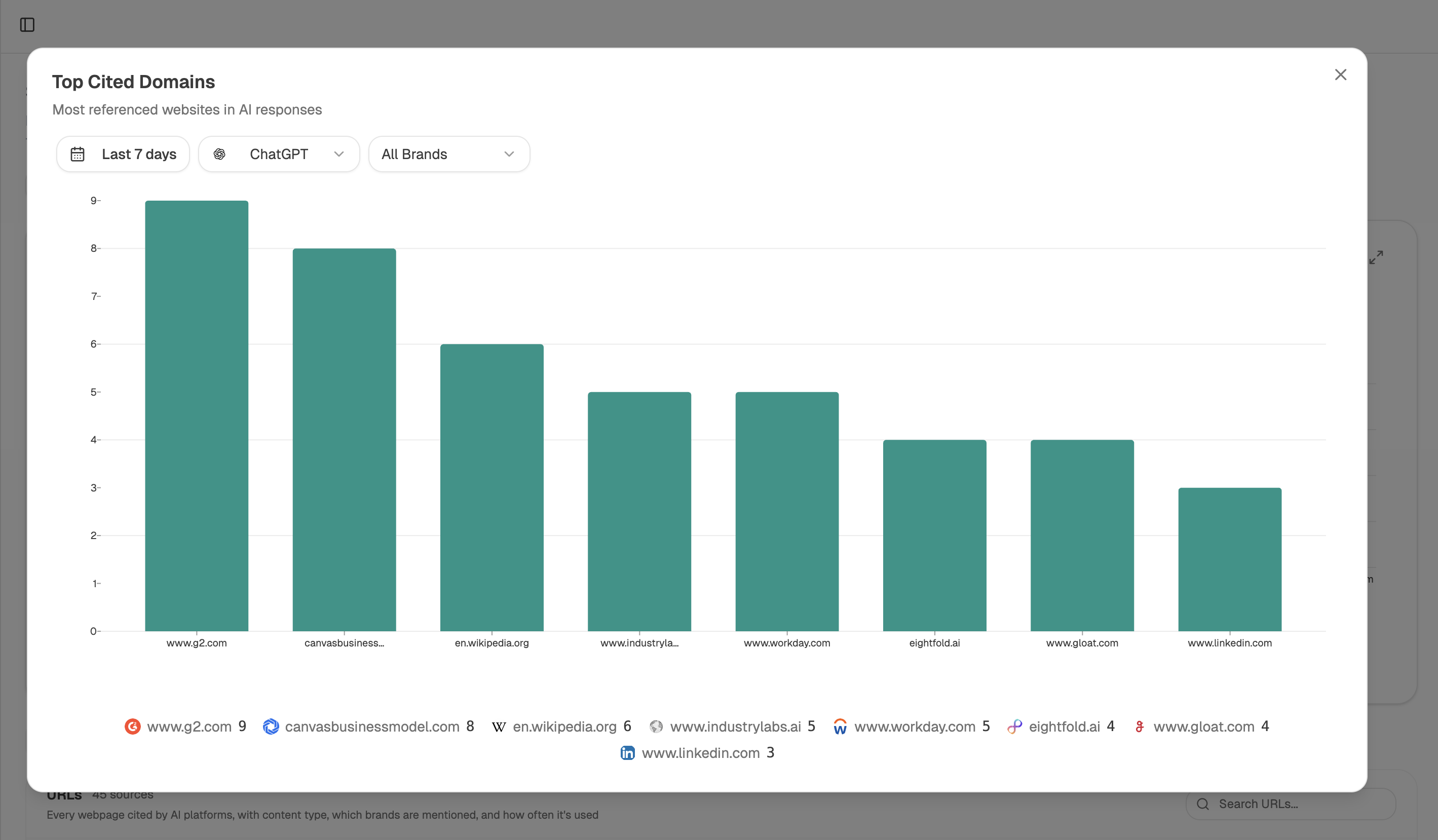
Our research found the citation ecosystem is broad rather than concentrated, with the top ten domains accounting for roughly 12% of citations on ChatGPT, 11% on Perplexity, and 13% on Google AI Mode across more than 7,000 unique cited domains. Earned visibility is a portfolio problem across your own content, editorial sites, platforms, and communities, which is exactly what a domain-level view surfaces and a channel report never will.
To report both layers together every week:
Start (schedule, weekly) → GA4 AI Traffic Overview → AI Landing Pages → Citation Share → Citation Domains (top 25) → uncited-pages recipe → Code (compute sessions per cited page, and list cited domains where you never appear) → Prompt LLM (report the countable channel alongside the citation layer, name the domains answering your category questions) → Excel export → Send Email to the SEO lead.
The output that matters is the second list: domains cited on your prompts where your brand never appears. That's a digital PR and content target list derived from actual AI behaviour rather than from a domain authority score.
FAQ
Related answers
- How do I track ChatGPT traffic in GA4?
- Why do some AI referrals show up in GA4 while others don't?
- Why does AI traffic show up as Direct in Google Analytics?
- Should AI traffic count as organic, referral, or its own channel?
Want an AI number that includes the zero-click layer? Start a free Analyze AI trial and see clicks and citations in one dashboard.