



Summarize this blog post with:


Brand Radar is good at one thing. It tells you whether your brand showed up in an AI answer. That is useful, and it is also where the product stops. Once you know you lost a prompt to a competitor, Brand Radar will not write the page that wins it back, will not flag the citation pattern you need to copy, and will not run the GA4 attribution that connects the win to revenue.
The cost makes the gap worse. The Brand Radar AI bundle is priced at $199 per month per index, or $699 per month for all six AI engines, and you still need the base Ahrefs subscription on top, which starts at $129 per month. Full AI coverage starts at $828 per month, climbs to $948 on the Standard plan, and reaches $1,148 on Advanced. Agency math is worse, because Ahrefs prices it per domain.
That money buys you a dashboard, not a workflow. The five tools below are what I would buy instead, with trade-offs spelled out so you can pick the one that fits your stack.
In this article, you’ll see five Ahrefs Brand Radar alternatives that solve the workflow gap Brand Radar leaves behind, the exact pricing each one charges in 2026, and the moment in your buying process when each one starts to pay you back.
Table of Contents
TLDR: 5 Ahrefs Brand Radar alternatives compared
|
Tool |
Built for |
Where it beats Brand Radar |
Starting price |
The catch |
|---|---|---|---|---|
|
Analyze AI |
Teams that want monitoring, content creation, and workflow automation under one bill |
Agent Builder with 180+ nodes, AI Content Writer and Optimizer, GA4 attribution, flat pricing |
$99/mo (3 engines) |
Built around AI search first, traditional SEO sits inside the agent layer |
|
Scrunch AI |
Mid-market brands that want a token-light shadow site for AI agents |
Agent Experience Platform (AXP) serves a parallel AI-readable version of your site at the CDN |
$250/mo (brands), $500/mo (agencies) |
AXP is gated behind the Enterprise tier |
|
Writesonic |
Teams that want SEO and GEO from one product and will use the article writer |
Action Center turns gaps into draft articles, bot crawler analytics |
$49/mo (writing only), $249/mo (GEO unlocked) |
GEO depth lives on the $249 tier and above |
|
Profound |
Enterprise teams that want panel-data prompt volumes and shopping visibility |
Conversation Explorer with real consumer query panels, Agent Analytics at the CDN level |
$499/mo (Lite, ChatGPT only) |
Multi-engine coverage requires Enterprise pricing in the low thousands |
|
Promptwatch |
Marketers who care more about how AI bots crawl their site than about prompt volume claims |
Real crawler logs for GPTBot, ClaudeBot, PerplexityBot, with daily refresh |
$99/mo (Essential) |
Seat caps and steeper learning curve at higher tiers |
What Ahrefs Brand Radar gives you, and what it does not
Brand Radar tracks branded mentions inside Google AI Overviews, ChatGPT, Perplexity, Gemini, Copilot, and Google AI Mode. It runs those checks against a database of over 271 million organic prompts and overlays mention counts on familiar SEO metrics like backlinks, search demand, and domain authority.
That scale is real. So are the gaps.
Brand Radar is a measurement tool. There is no content writer attached. There is no optimizer that takes a losing page and rewrites it for the prompt you missed. There is no AI Traffic Analytics view that ties an AI citation back to a session, a conversion, and a deal in your CRM. Independent audits have also shown the AI tracking modules can be directional rather than precise, with one widely cited test reporting 3 ChatGPT mentions globally versus an actual count of 123.
The pattern that follows is predictable. You see a number you do not fully trust, pay for it monthly, then export the data to another tool to do something with it. The five alternatives below close that loop in different ways.
1. Analyze AI: The agentic SEO and content platform you would otherwise stitch from four products
Analyze AI is positioned closest to where Ahrefs Brand Radar leaves you. Where Brand Radar measures, Analyze AI measures, writes, optimizes, and automates the rest of the workflow you would normally hand off to your team.
Standout features
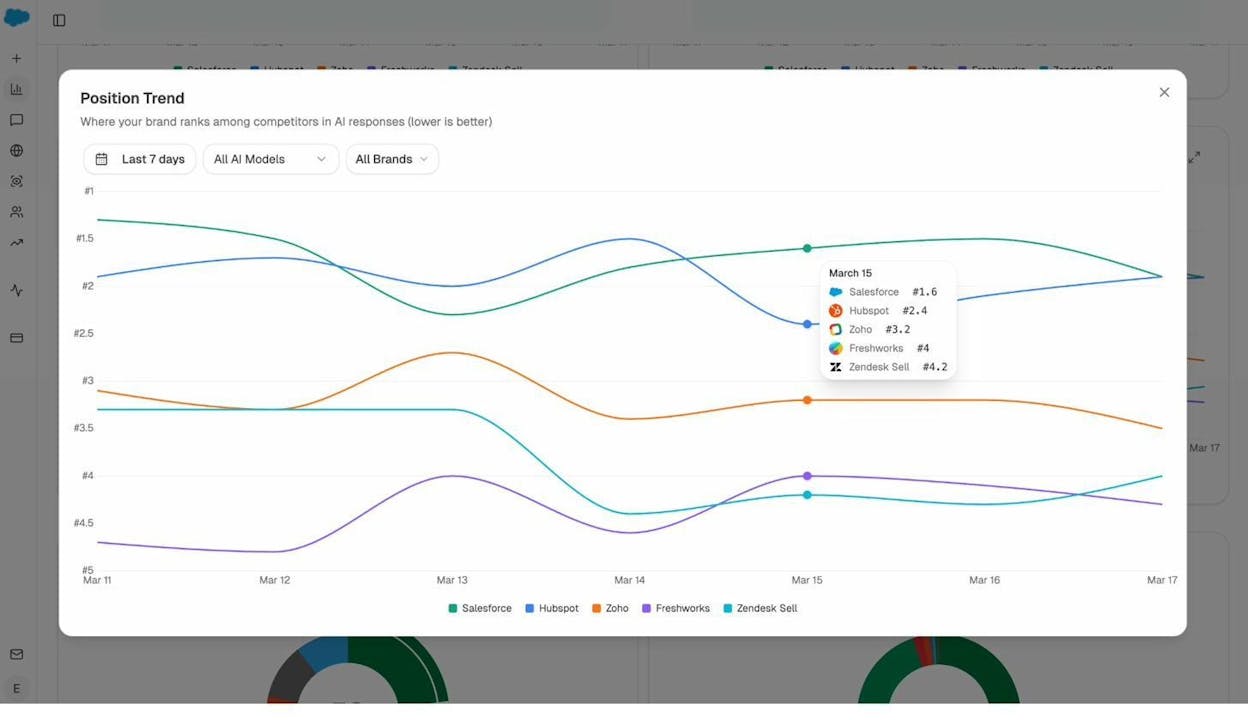
The platform runs across four pillars.
Discover and Monitor. AI Visibility Tracking measures your share of voice across ChatGPT, Google AI Mode, Perplexity, Gemini, Copilot, Claude, Grok, DeepSeek, and Meta AI. Prompt Tracking lets you run prompts on a daily refresh, with ad hoc prompts on top for one-off competitive checks. The AI Search Explorer is the equivalent of running Brand Radar’s custom prompt feature, except you are not paying $50 extra per month to access it.
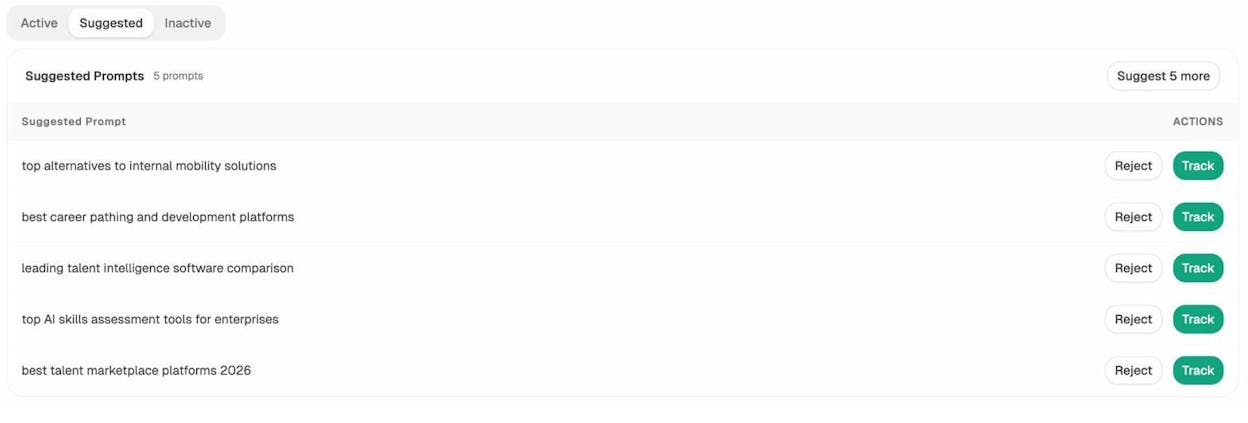
Competitor Intelligence shows side-by-side visibility, citation share, and sentiment against every brand you track. You see the prompts where competitors win, the domains AI cites for them, and the share-of-voice drift over time.
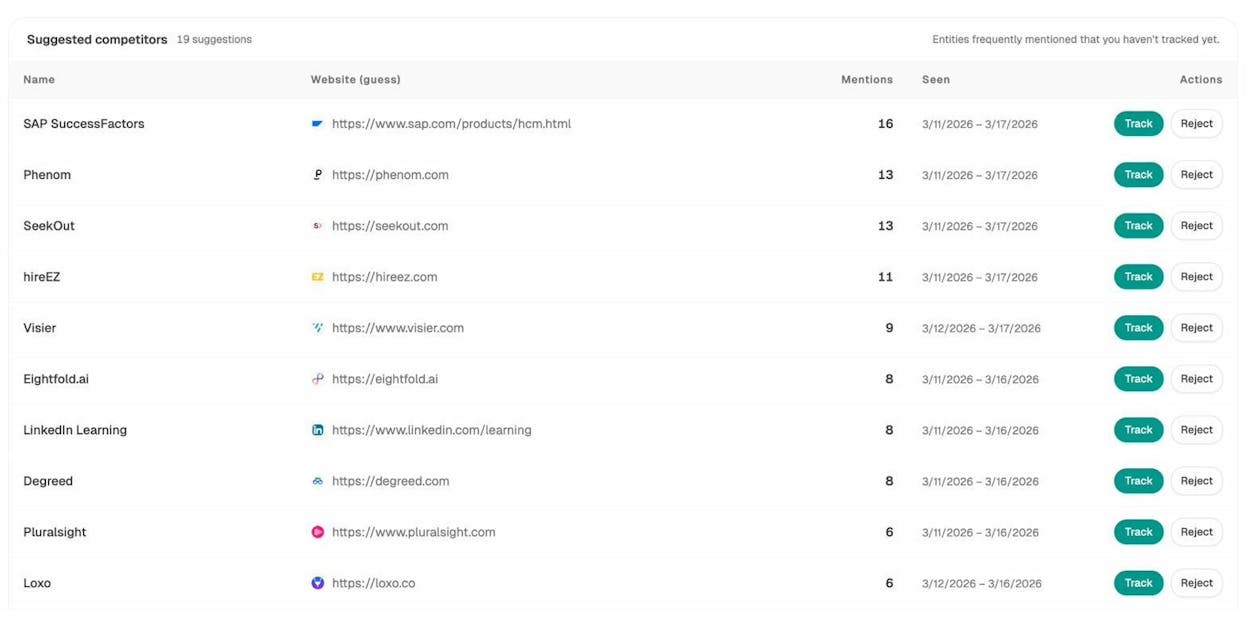
Citation Analytics surfaces the exact URLs AI models cite when they talk about your category. You see which third-party domains shape answers about you and where your own pages are being skipped over.
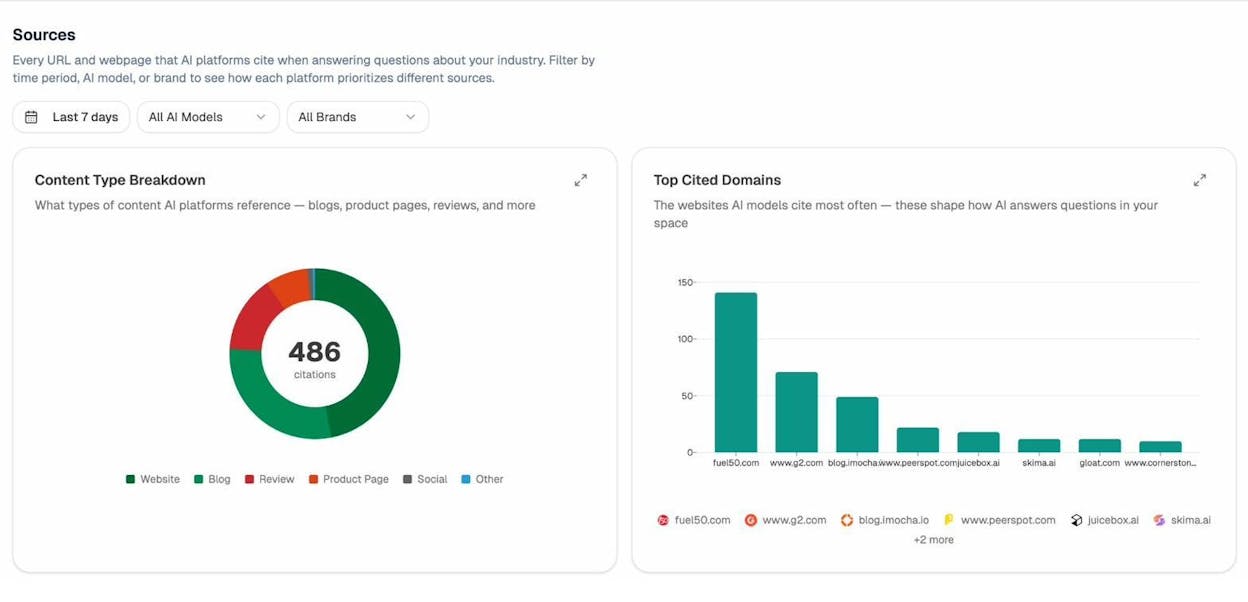
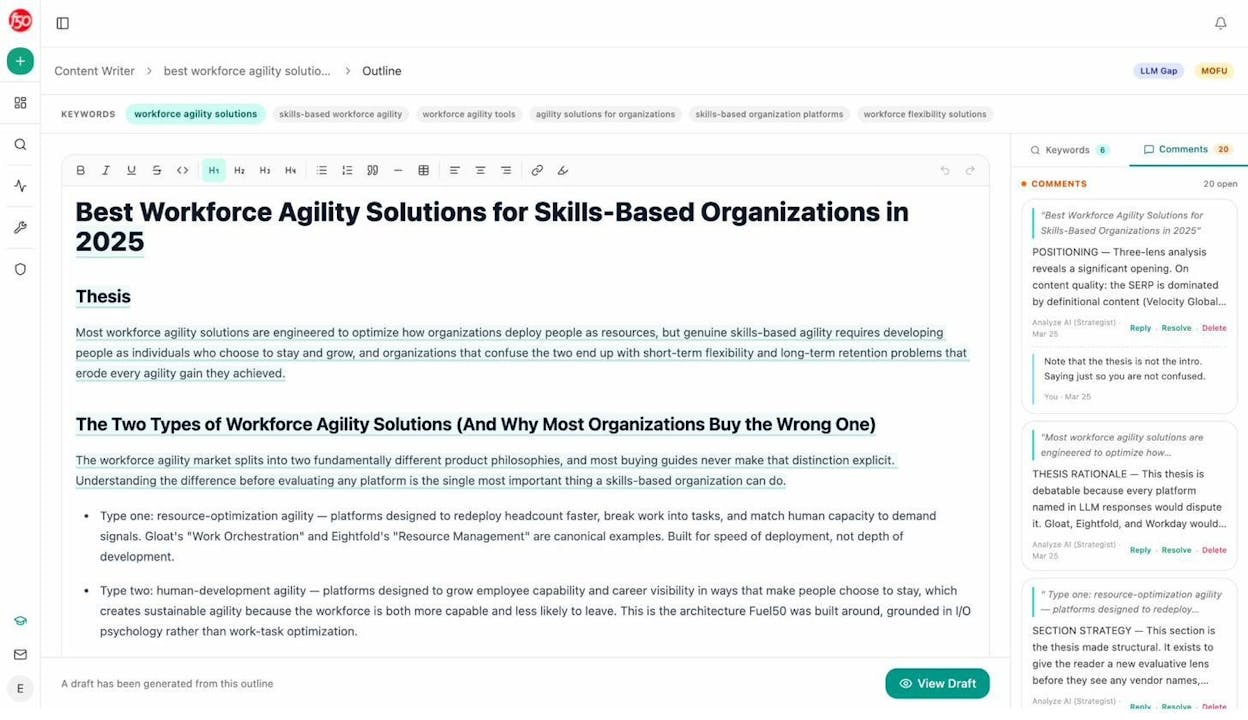
Improve. This is where Analyze AI separates from every visibility tool in the category. The AI Content Writer runs a four-step pipeline (research, outline, draft, refinement) where each step is editable, and each step injects your Brand Vault, which holds your tone, claims, disallowed phrases, and proof points.
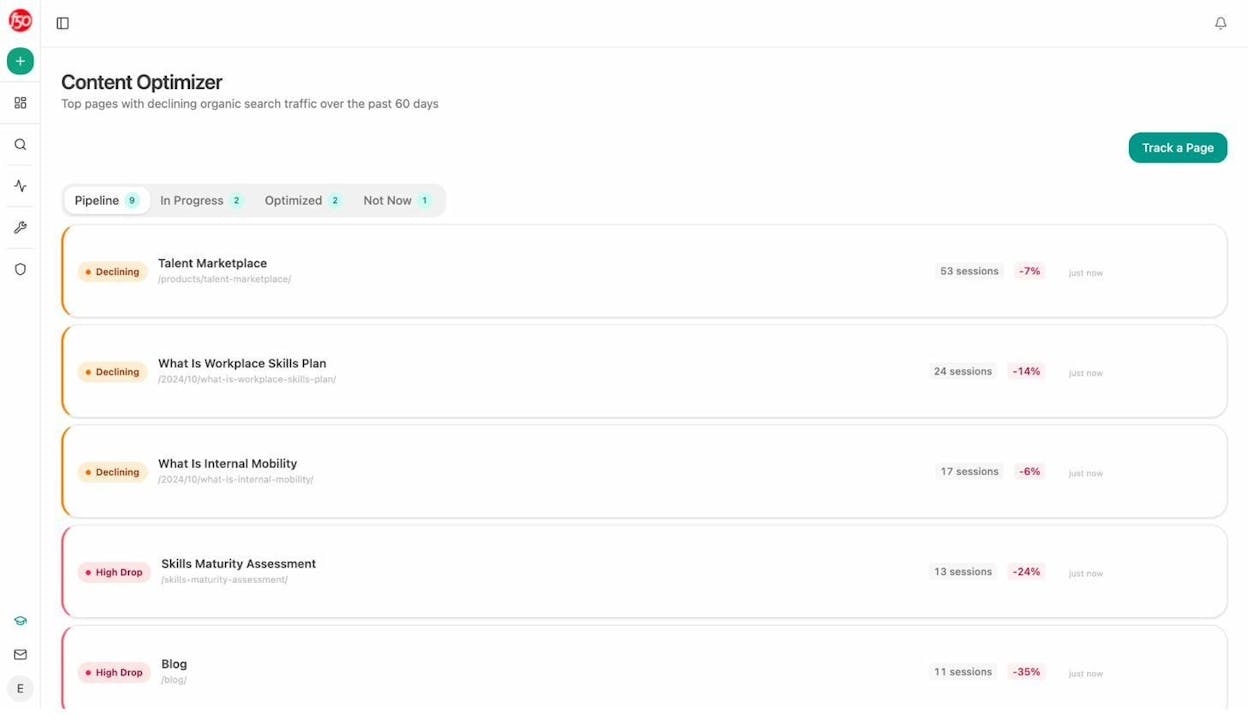
The AI Content Optimizer takes an existing URL, audits it against the prompts where you are underperforming, and produces edits an editor can review inline before they ship.
Govern. Perception Map, Sentiment Monitoring, AI Battlecards, and Weekly Email Digests round out the layer that goes to leadership. None of these are add-ons.
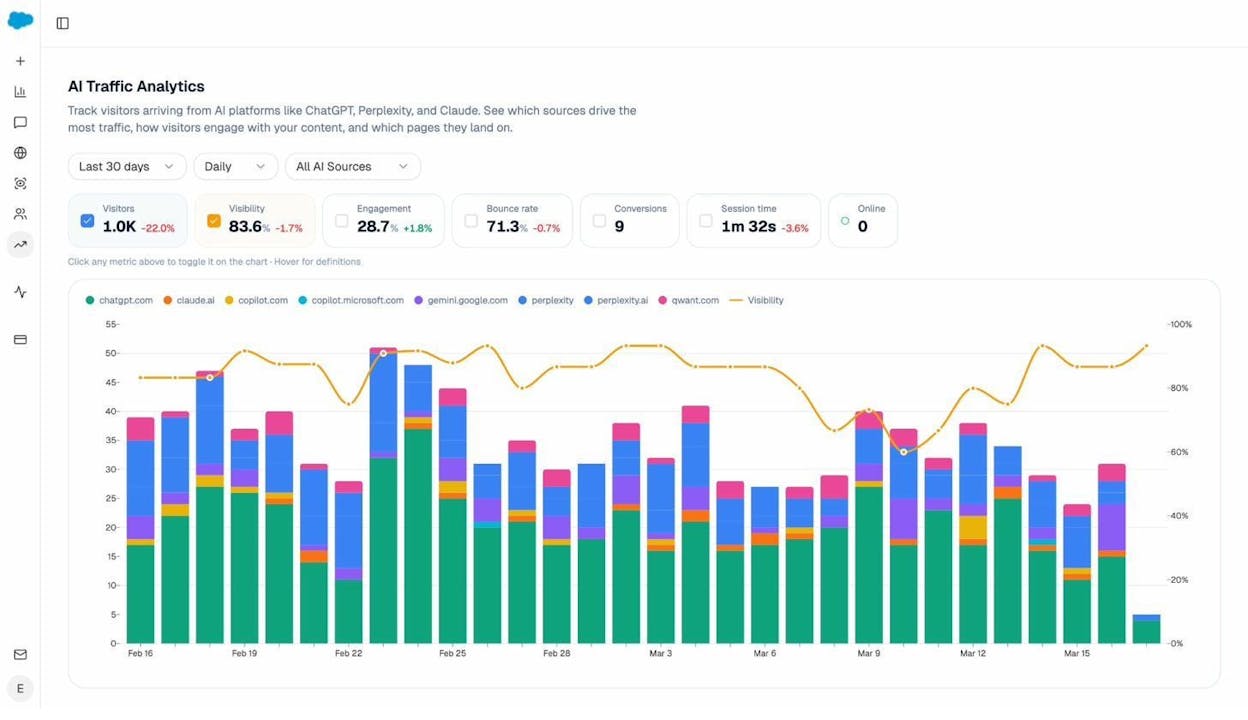
AI Traffic Analytics. This is the one Brand Radar does not have. Connect GA4 and you see real sessions arriving from ChatGPT, Perplexity, and the rest, the pages those sessions land on, and the conversions tied to each landing page.
Why Analyze AI is more than a Brand Radar alternative
The underestimated piece of the platform is the Agent Builder. It is the reason Analyze AI is positioned as an agentic SEO and content platform rather than a visibility dashboard.
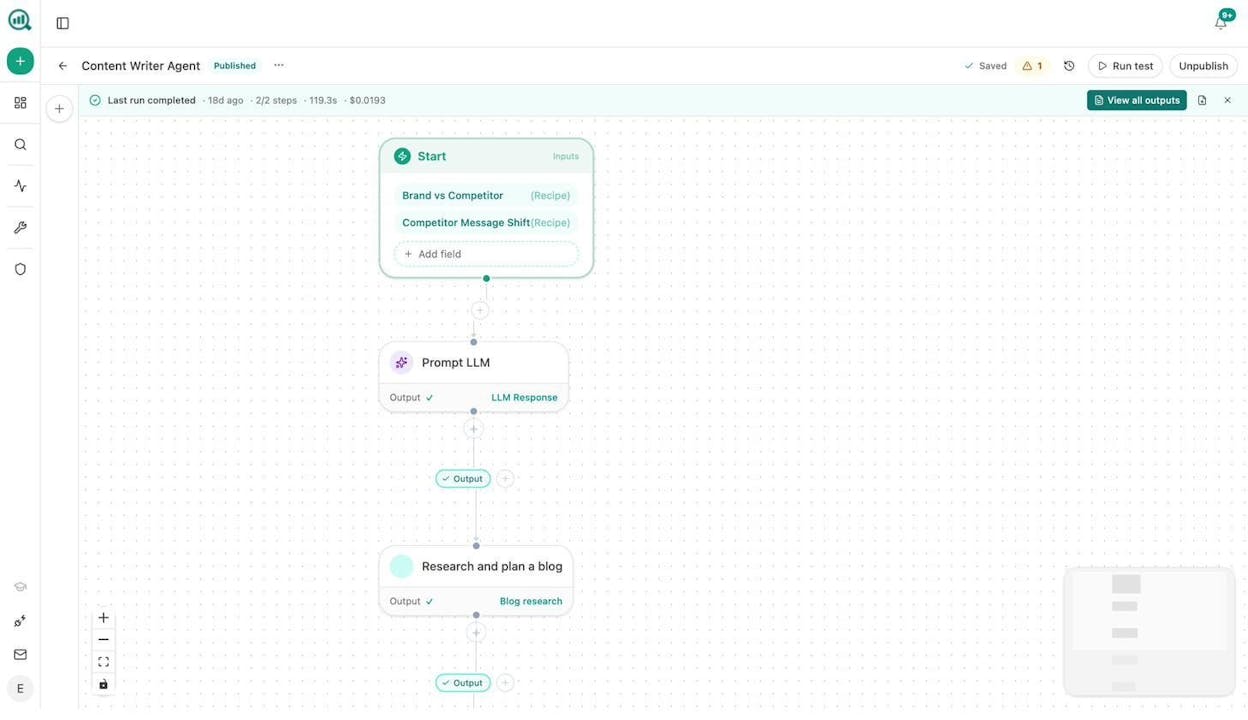
Under the hood, the Agent Builder ships with 180+ production-ready nodes, 34 pre-built data recipes, and three trigger modes (manual, scheduled, webhook). The nodes cover what you would expect from a marketing substrate and a lot you would not. GA4. Google Search Console. DataForSEO. Semrush. HubSpot. Notion. WordPress. Sanity. Contentful. Mailchimp. Hunter. Tomba. Exa. Perplexity. GPT. Claude. Gemini. And every Analyze AI native node for visibility, citations, sentiment, and perception.
What that means in practice is that the workflows Ahrefs Brand Radar leaves you stuck with become background processes.
-
Monday board prep. A scheduled agent assembles your share of voice, your competitor delta, your top AI-cited pages, new HubSpot deals, and ships a DOCX brief to leadership at 7am.
-
Citation decay alerts. A webhook agent fires when a tracked page loses citations faster than traffic, drafts a brief for the writer, and posts it to Slack.
-
Editorial calendar autopilot. Every Sunday night, the agent pulls uncovered prompts from the last 14 days, generates briefs, runs them through the Content Writer pipeline, scores each draft, and publishes the ones that pass an AEO threshold.
-
Crisis early warning. Every 15 minutes, the agent runs brand sentiment and news monitoring through DataForSEO, filters for low-sentiment high-reach mentions, and emails the PR lead.
Any Ahrefs data you already pay for can flow into these agents through the Semrush and DataForSEO nodes. You keep the SEO research you trust and bolt the AI visibility, content production, and workflow layer around it.
What it costs and where the limits sit
Analyze AI is priced flat. Growth is $99 per month for three engines, 25 tracked prompts daily, 50 ad hoc prompts, one Content Writer and one Content Optimizer workflow, AI Traffic Analytics with GA4, weekly recommendations, unlimited seats, and unlimited competitor tracking. Pro is $250 per month for four engines, 35 tracked prompts daily, 100 ad hoc prompts, 10 Content Writer and 5 Content Optimizer workflows. Custom unlocks all engines, unlimited workflows, daily recommendations, and a dedicated account manager.
That puts the highest self-serve tier at $250 per month against Brand Radar’s $828 floor.
The trade-off is that Analyze AI is built AI-search-first. If you want crawler-log depth beyond what the Agent Builder pulls, Promptwatch handles that natively. If your organization needs SOC 2 Type II compliance baked into a flagship dashboard product, Profound is the safer procurement story. For most marketing teams, those edges do not change the math.
Kylian AI used Analyze AI to audit how often they appeared in high-intent AI prompts, then acted on the gaps. Inside six weeks, AI SEO traffic grew 800%, and AI search now converts at around 5% for them.
2. Scrunch AI: For teams that want to serve AI agents a different version of your site
Scrunch AI is the second-most ambitious tool in the category. Where Analyze AI puts the workflow inside the dashboard, Scrunch puts it at the CDN.
Standout features
Scrunch tracks visibility, sentiment, and citation share across more than seven AI engines, with strong GA4 integration that ties AI mentions back to real referral sessions. The differentiator is the Agent Experience Platform (AXP). AXP sits at the edge (think Cloudflare Workers) and detects when an AI crawler requests a page. When it does, it serves that crawler a token-light, machine-readable version of your site without changing what humans see. JavaScript-heavy pages that LLM crawlers normally skip suddenly become readable.
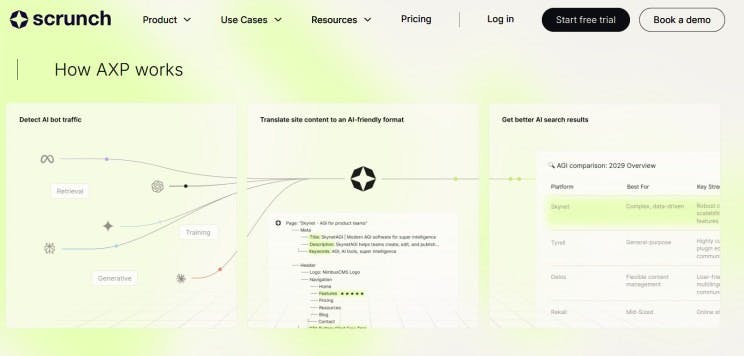
That is the closest thing in this category to a structural fix. If your tech stack is React-heavy or your content sits behind hydration that Googlebot handles but GPTBot does not, AXP is the only product on this list that touches the layer where the problem actually lives.
Where Scrunch wins against Brand Radar
Brand Radar tells you that you lost a prompt. Scrunch tells you that your page is technically invisible to the bot that generates the answer. Those are different problems, and Scrunch is built around the second one.
What it costs
Scrunch starts at $250 per month for brand plans and $500 per month for agency plans. AXP is gated to Enterprise. For mid-market teams the realistic working tier sits in the $500 to $1,000 range, which is roughly where the AXP wait list begins. The Insights features remain newer than the Monitoring layer, and there is no writer attached.
3. Writesonic: For teams that want SEO and GEO in one product and will use the article writer
Writesonic started as an AI content platform and grew a GEO product around it. The result is the one tool in this list that runs SEO and GEO out of the same workspace, where the GEO insights feed straight into the article writer that turns them into published pages.
Standout features
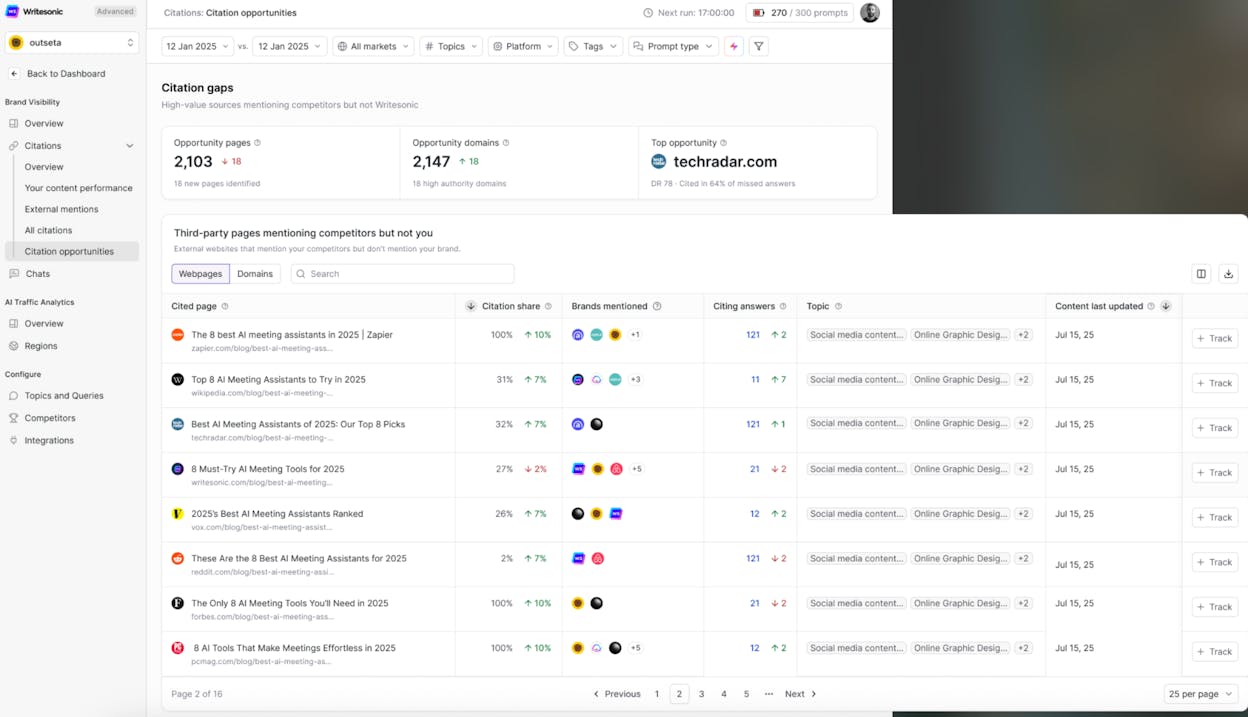
The platform tracks visibility across 10 AI engines (ChatGPT, Perplexity, Gemini, Claude, Google AI Overviews, AI Mode, Copilot, Grok, Meta AI, DeepSeek). The Action Center is the closest equivalent to Brand Radar’s “here is a gap” view, except every gap comes with a specific draftable action. Refresh this article. Add this schema. Target this citation. Run this outreach. Bot crawler analytics monitor GPTBot, PerplexityBot, and ClaudeBot at the page level. Sentiment analysis is included on Professional and above.
Where Writesonic wins against Brand Radar
Brand Radar shows you the gap and ends. Writesonic shows you the gap, drafts the article that closes it, optimizes the existing pages around it, and tracks whether the bot crawls the new content. It is the more end-to-end SEO-plus-GEO offering of the alternatives here.
What it costs
The Lite plan is $49 per month and gives you the content writer with no GEO features. Standard is $99 per month. The Professional plan at $249 per month is the entry point where the Action Center, AI visibility tracking, sentiment, and citation gap analysis unlock. Advanced is $499 per month. Enterprise is custom.
For a small in-house team, $249 is reasonable. For an agency running multiple clients, per-brand pricing adds up quickly, and the AI visibility data sits one layer behind the content tooling rather than at the center of the product.
4. Profound: For enterprise teams that need consumer-panel prompt volume data
Profound is the platform Fortune 500 procurement teams keep buying. It is also the closest competitor to Ahrefs Brand Radar on raw analytical depth, with a different philosophy.
Standout features
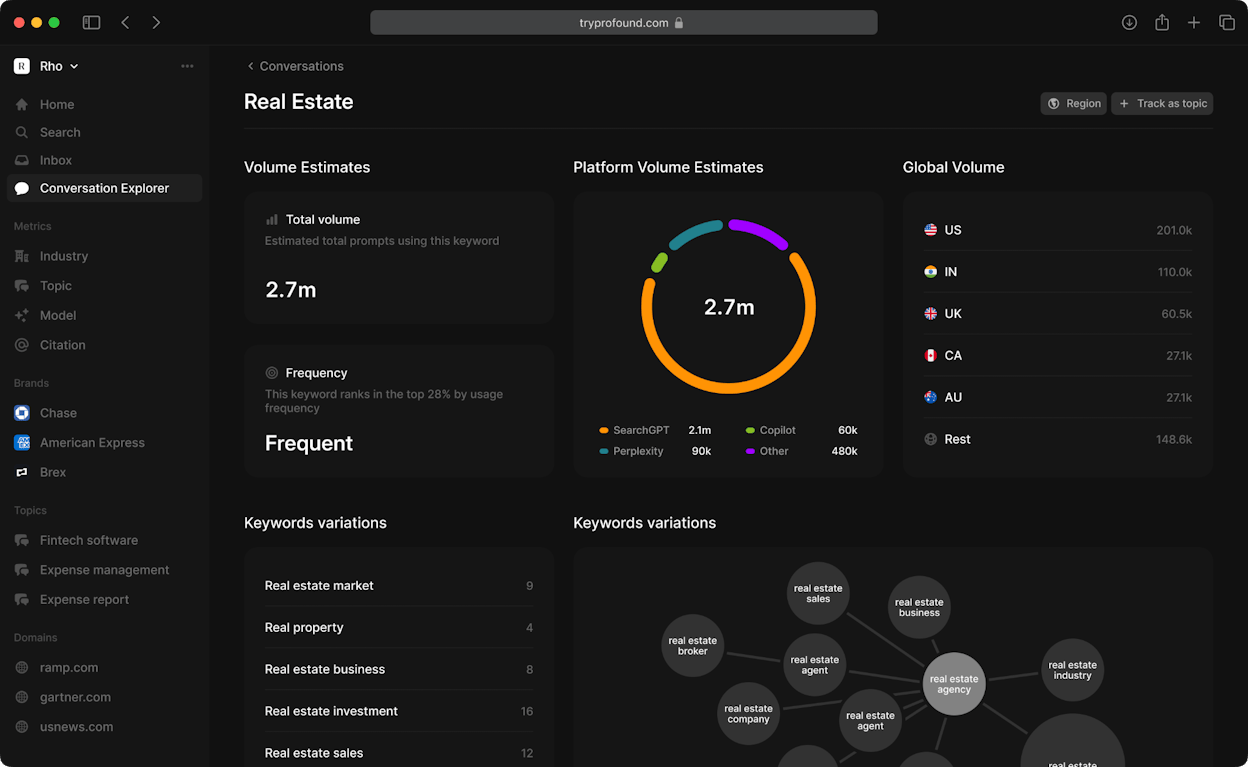
Conversation Explorer is the headline. It is built on consumer panel data showing what real users (not synthetic queries) ask AI platforms, broken down by region, age, and income. This is credible AI-era “search volume” data with a methodology you can defend in a procurement review. Agent Analytics connects to your CDN (Cloudflare, Akamai, Fastly, AWS, Vercel) and pulls bot logs directly, showing which AI crawlers visit which pages, how often, and whether they hit errors. ChatGPT Shopping Visibility monitors how your products surface inside AI commerce environments.
The compliance posture is also strong. SOC 2 Type II. HIPAA. SSO. Audit trails.
Where Profound wins against Brand Radar
Brand Radar uses keyword data to approximate AI prompt volume. Profound uses real consumer panels. For category-defining decisions in a Fortune 500 environment, the difference matters. Add the panel data, the shopping visibility, and the agent-level CDN analytics, and you are buying intelligence Brand Radar cannot replicate at any tier.
What it costs
The Lite plan is $499 per month and limits you to ChatGPT only. The Growth plan is $399 per month with 100 prompts and three engines. Full multi-engine coverage and Prompt Volumes panel data sit behind Enterprise pricing, typically in the low thousands per month.
If you need monitoring and execution from the same vendor, you will be assembling Profound plus another tool. If you need procurement-grade compliance, panel-grade data, and your engineering team can build the action layer on top, the math works.
5. Promptwatch: For marketers who want crawler truth without enterprise pricing
Promptwatch came at the problem from the technical side. Most platforms started as visibility trackers and bolted on crawler analytics. Promptwatch started as a crawler-logs product and added visibility around it. That order changes what the tool does well.
Standout features
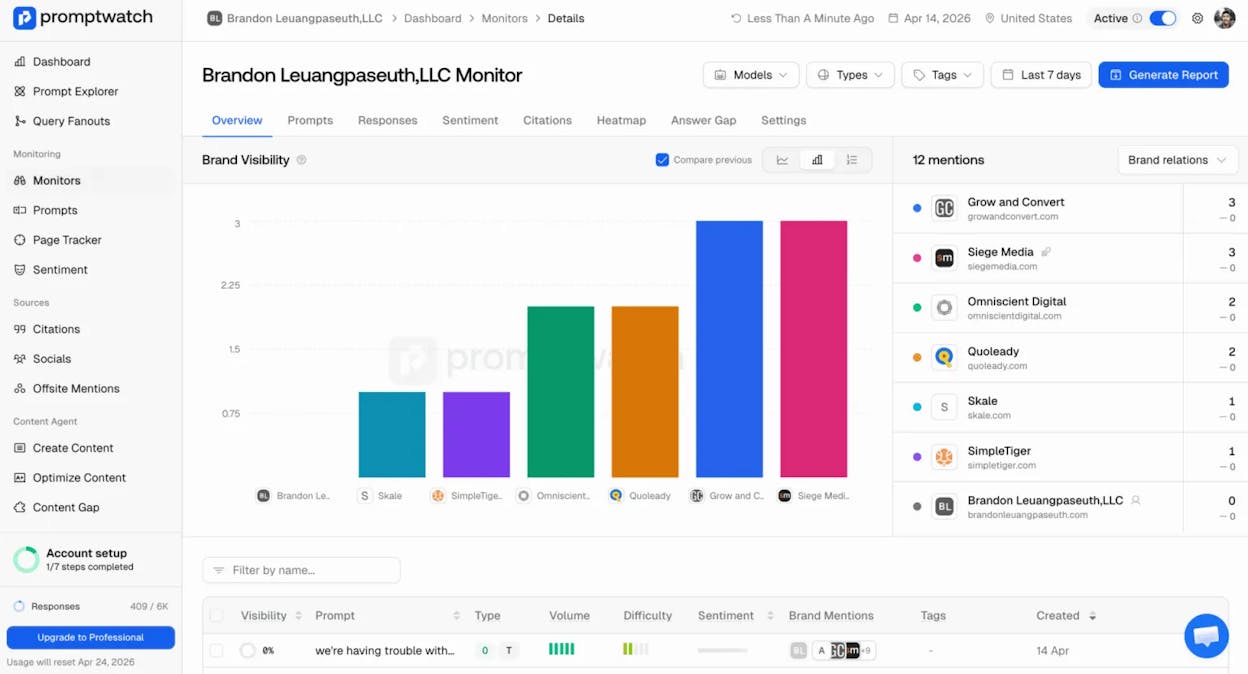
Crawler log analysis is the core. Promptwatch detects GPTBot, PerplexityBot, ClaudeBot, CCBot, and GoogleOther at the network level. You connect via Cloudflare or paste a JS snippet, then route your server events through Promptwatch. You see which pages each bot reads, at what cadence, and where they fail. The Answer Gap report identifies prompts where competitors appear and you do not, then generates content recommendations to close the gap. Looker Studio integration means the data lives inside the BI reports your leadership already reads.
Where Promptwatch wins against Brand Radar
If your bottleneck is technical, your site is rendering oddly to LLM crawlers, or your priority pages are not getting read at all, Brand Radar will not catch it. Promptwatch will. It is also one of the more BI-friendly platforms in the category, which matters if your reporting lives downstream of Looker.
What it costs
Promptwatch Essential is $99 per month for one website, 50 prompts, and one seat. Professional is around $249 per month for 150 prompts, two websites, and the full analytics suite. Business is $499 per month with API access. The seat caps and project caps at lower tiers are tight, which makes Promptwatch better suited to in-house teams than agencies juggling multiple client domains.
How to choose between these five
The right answer depends on what is breaking in your workflow right now.
If you are tired of Brand Radar showing you a gap and leaving you to fix it manually, Analyze AI is the closest one-platform replacement. You replace the visibility dashboard, the content writer, the optimizer, the GA4 attribution layer, and a chunk of your marketing-ops automation at a fraction of the cost.
If your engineers will own the fix and you want a CDN-level intervention, Scrunch AI on Enterprise is the technically deeper option.
If your team writes more than it monitors, Writesonic Professional is the natural pick.
If you are a Fortune 500 or close to it and you need real consumer-panel data plus procurement-grade compliance, Profound is the safe choice once you accept the price.
If your primary unknown is how AI bots crawl your site, Promptwatch Professional gives you a clean read.
None of these tools are perfect. All of them earn their price more honestly than the $828 floor Brand Radar requires before it does anything useful.
Take the next step
You can run a free check of where you stand in AI search today with the AI Visibility Checker, or generate an llms.txt file if your site is not yet exposing the right signals to LLM crawlers. When you are ready to compare side by side, the Analyze AI vs. Ahrefs Brand Radar comparison page lays out the feature-by-feature breakdown in detail.

Ernest

Ibrahim


