



Summarize this blog post with:


In this article, you’ll learn how to build a niche affiliate site from scratch—choosing a profitable niche, finding the right keywords, setting up your site, writing content that ranks, building links, and scaling your way to $1,000+ per month. You’ll also learn how to position your niche site for AI search visibility, a channel that most new site owners completely ignore but that is already driving real traffic for those who get it right.
Table of Contents
What Is a Niche Site?
A niche site is a website focused on a specific topic or audience. It can cover anything from hiking gear to espresso machines to mechanical keyboards. The narrower the focus, the easier it is to build topical authority—both in Google’s eyes and in AI search engines like ChatGPT, Perplexity, and Gemini.
There are many types of niche sites (informational blogs, community forums, local directories), but this guide focuses specifically on niche affiliate sites—ones that earn revenue by recommending products and earning commissions on each sale.
How Do Niche Affiliate Sites Work?
The business model is simple. You create content around products people are searching for—reviews, comparisons, buying guides. Inside that content, you place affiliate links that send readers to a retailer’s website. When a reader clicks your link and buys the product, you earn a commission.
For example, a site about home coffee equipment might publish an article titled “The 7 Best Espresso Machines Under $500.” Each machine recommendation includes an affiliate link to Amazon or a specialty retailer. If someone clicks through and purchases, the site owner earns a percentage of that sale.
The content types that drive most affiliate revenue fall into three categories:
|
Content Type |
Example |
Why It Works |
|---|---|---|
|
General comparisons |
“Best wifi routers for large homes” |
High search volume, strong buying intent |
|
Branded comparisons |
“MacBook Air vs. MacBook Pro” |
Readers are close to a purchase decision |
|
Product reviews |
“Breville Barista Express review” |
Very specific intent, high conversion rates |
The key insight here: you are not selling anything. You are helping people make better purchase decisions. The affiliate commission is a byproduct of genuinely useful content.
How Much Can You Earn From a Niche Affiliate Site?
This depends on three things: the niche you choose, the quality of your foundations, and how consistently you produce content and build links.
Sites built on a solid foundation—right niche, strong keyword research, quality content—typically see their first commissions within four to eight weeks. Hitting the $1,000/month mark usually takes 9 to 12 months of consistent effort.
But the ceiling is much higher. Established niche sites regularly earn $5,000 to $15,000 per month. And because niche sites are digital assets, they can be sold. The current market rate for niche site acquisitions hovers around 30 to 35 times one month’s net profit. A site earning $1,000 per month could realistically sell for $30,000 to $35,000.
There is a catch. These numbers assume you pick a niche with products worth promoting (high-ticket items), you do the keyword research properly, and you actually put in the work. Most niche sites fail not because the model doesn’t work, but because the owner gives up before the compounding effect kicks in.
Here’s the other thing most guides won’t tell you: niche site traffic is no longer just about Google. People now ask ChatGPT for product recommendations. They use Perplexity to research purchases. If your niche site creates content that AI models reference and cite, you are building a traffic channel that most of your competitors don’t even know exists yet.
That said, SEO is not dead. AI search is an additional organic channel that works alongside Google—not a replacement for it. The smartest niche site owners are optimizing for both.
Six Steps to Build a Profitable Niche Site
Here is the step-by-step process. We will cover each step in detail, with enough specifics that you can take action immediately after reading.
-
Choose the right niche
-
Find the right keywords
-
Build your site
-
Write content that ranks and converts
-
Build links
-
Track, optimize, and scale
Step 1. Choose the Right Niche
Choosing the right niche is the single highest-leverage decision you will make. A bad niche choice means every hour of work that follows delivers a fraction of the results. A good niche choice means the work compounds faster.
There are three factors to evaluate before committing to a niche: your personal interest, the available affiliate programs, and long-term viability.
Do You Have Genuine Interest in the Topic?
You don’t need to be an expert. In fact, being too passionate about a niche can actually hurt you—site owners who are deeply invested tend to want to write every word themselves, and that is incredibly hard to scale.
What you need is enough interest to stay engaged during the first six months when revenue is minimal. If you are bored by the topic before you have published your tenth article, you will almost certainly quit before the site gains traction.
The sweet spot: choose a niche that genuinely interests you but doesn’t consume your identity. You should be curious enough to research it, but detached enough to delegate content production later.
Are There Profitable Affiliate Programs?
Your niche needs products to promote. Specifically, it needs products with affiliate commissions worth your time.
Look for niches where at least one of these is true:
-
High-ticket items (products that sell for $200+, so even a small commission percentage adds up)
-
Affiliate programs with commissions above 10%
-
A mix of Amazon Associates (easy to join) and private affiliate programs (higher commissions)
Amazon Associates is the easiest program to join, which makes it a good starting point. But Amazon’s commissions are low—between 1% and 4% for most product categories. The long-term play is to use Amazon as proof of concept, then approach private affiliate programs with your traffic and conversion data to negotiate higher rates.
Here is a rough comparison of commission structures across common affiliate models:
|
Affiliate Model |
Typical Commission |
Pros |
Cons |
|---|---|---|---|
|
Amazon Associates |
1%–4% |
Easy to join, massive product catalog |
Low commissions, 24-hour cookie |
|
Private affiliate programs |
5%–20% |
Higher commissions, longer cookies |
Harder to get accepted |
|
SaaS affiliate programs |
20%–40% recurring |
Recurring commissions each month |
Requires a different content approach |
The ideal scenario: find a niche where high-ticket items exist, Amazon has decent commissions for the category, and there are private affiliate programs you can graduate to once your site has traffic.
Will the Niche Work Long Term?
Trending niches are tempting because they feel exciting, but a topic that is hot right now may not have enough search demand in 18 months to sustain your site.
Before committing, check Google Trends for your niche’s core keywords. You are looking for stable or growing demand over the past five years—not a spike followed by a decline.
![[Screenshot: Google Trends showing a stable or growing keyword trend over 5 years vs. a spike-and-decline trend]](https://www.datocms-assets.com/164164/1776704407-blobid1.png?auto=format,compress&w=1248&fit=max)
Also consider seasonality. Golf, skiing, and swimming pool equipment are all viable niches, but earnings will fluctuate throughout the year. If you want consistent monthly income, choose an evergreen niche or plan for seasonal variation in your budgeting.
How AI Search Changes Niche Selection
Here is something most niche site guides miss entirely. AI search engines like ChatGPT and Perplexity are now a meaningful source of product recommendations. When someone asks ChatGPT “what’s the best espresso machine under $500,” it generates an answer—and sometimes cites specific websites as sources.
This means niche selection now has a fourth dimension: how likely is your niche to generate AI search queries?
Niches with complex purchase decisions—where buyers need to compare options, weigh tradeoffs, and understand technical specifications—tend to generate more AI search queries. Think electronics, outdoor gear, home appliances, and software tools. Niches centered around simple, impulse purchases generate fewer.
You can use Analyze AI to research how often AI models discuss products in a given niche. The Prompts dashboard shows you the actual questions people ask AI engines about your market, and the Sources dashboard reveals which websites AI models cite most frequently when answering questions in that space.
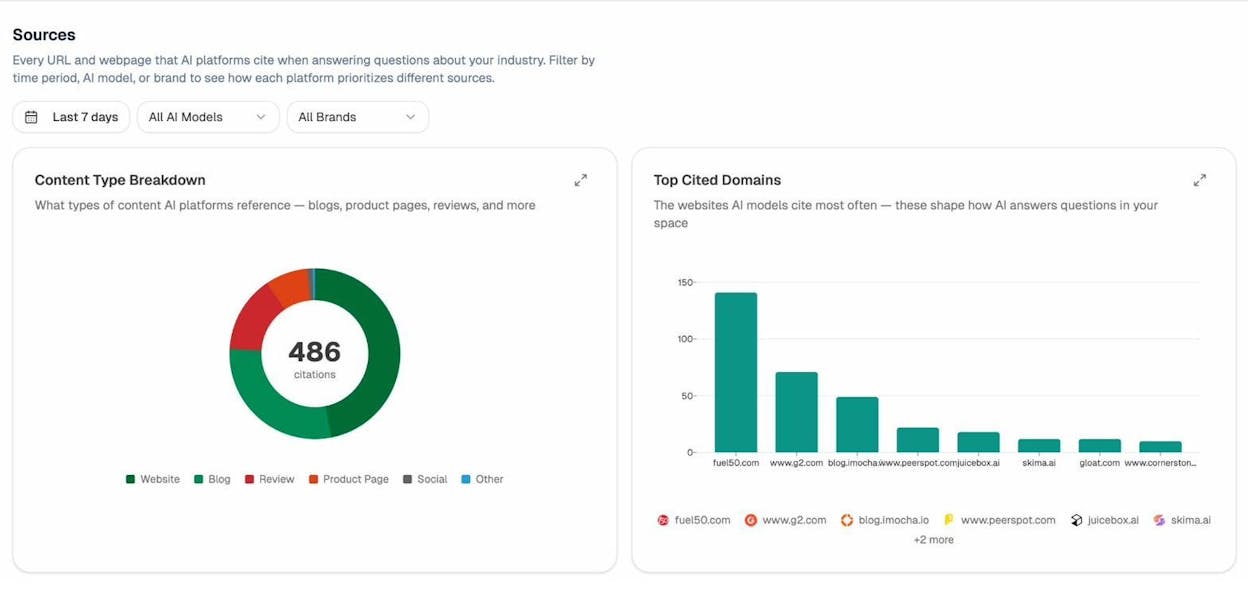
This data tells you two things: whether there is meaningful AI search activity in your niche, and who the current authorities are. If AI models are already citing niche sites (not just major retailers), that is a strong signal that a well-built niche site can capture AI referral traffic.
Step 2. Find the Right Keywords
Keyword research is where your content strategy takes shape. There is no point writing articles that nobody is searching for—you will get no traffic, no affiliate clicks, and no commissions.
For niche affiliate sites, you are primarily looking for three types of keywords:
General comparisons — “Best wifi router,” “best protein powder for beginners.” These have the highest search volume and attract readers who are actively shopping but haven’t decided on a specific product yet.
Branded comparisons — “MacBook Air vs. MacBook Pro,” “Breville vs. DeLonghi.” These target readers who have narrowed their options and want help making a final decision.
Product reviews — “MacBook Pro M3 review,” “Breville Barista Express review.” These have the most specific intent and often the highest conversion rates, but lower search volume.
How to Find Affiliate Keywords Using Free Tools
You do not need expensive tools to start. Here are three approaches that work:
Google Autocomplete: Type your niche seed keyword followed by “best,” “vs,” or “review” into Google and note the suggestions that appear. Each suggestion represents a real query that people search for.
![[Screenshot: Google Autocomplete showing suggestions for “best espresso machine” with modifiers like “under 500,” “for beginners,” “2024”]](https://www.datocms-assets.com/164164/1776704418-blobid3.png?auto=format,compress&w=1248&fit=max)
Google’s “People Also Ask” box: Search for a primary keyword in your niche and expand the “People Also Ask” section. These are additional questions your content can answer, and they reveal the full scope of what your audience wants to know.
![[Screenshot: Google “People Also Ask” section for a product-related query]](https://www.datocms-assets.com/164164/1776704423-blobid4.png?auto=format,compress&w=1248&fit=max)
Analyze AI’s Keyword Generator: Enter your seed keyword and get a list of related keyword ideas along with search volume estimates. This is a good starting point for building out your initial keyword list.
![[Screenshot: Analyze AI Keyword Generator tool results page]](https://www.datocms-assets.com/164164/1776704425-blobid5.png?auto=format,compress&w=1248&fit=max)
How to Prioritize Keywords
Not all keywords are worth targeting, especially when your site is new. A brand-new niche site will struggle to rank for high-competition keywords like “best laptops”—you need to build authority first.
Use the Analyze AI Keyword Difficulty Checker to assess competition. As a general rule, new sites should target keywords with low to medium difficulty scores. Higher-difficulty keywords can come later, once your site has built some backlink authority.
![[Screenshot: Analyze AI Keyword Difficulty Checker showing a keyword with difficulty score]](https://www.datocms-assets.com/164164/1776704429-blobid6.png?auto=format,compress&w=1248&fit=max)
Here is a simple prioritization framework:
|
Priority |
Keyword Type |
Search Volume |
Difficulty |
Example |
|---|---|---|---|---|
|
High |
Long-tail comparison |
100–1,000 |
Low |
“Best ceramic pour-over dripper” |
|
Medium |
Branded comparison |
500–5,000 |
Medium |
“Chemex vs. Hario V60” |
|
Lower (for now) |
Head terms |
10,000+ |
High |
“Best coffee maker” |
Start with 15 to 20 low-difficulty keywords. Write and publish content for those first. As your site gains authority and backlinks, gradually move up to more competitive terms.
Finding Keywords That AI Search Engines Care About
This is where most niche site owners leave money on the table. Beyond traditional keyword research, you should also understand what questions people are asking AI models about your niche.
With Analyze AI, you can track the exact prompts people use when asking ChatGPT, Perplexity, Gemini, and other AI engines about your market. The Prompts dashboard shows you:
-
Tracked prompts with visibility scores, sentiment, and which competitors are mentioned
-
Suggested prompts that Analyze AI identifies based on your industry
-
Ad hoc searches where you can test any prompt in real time
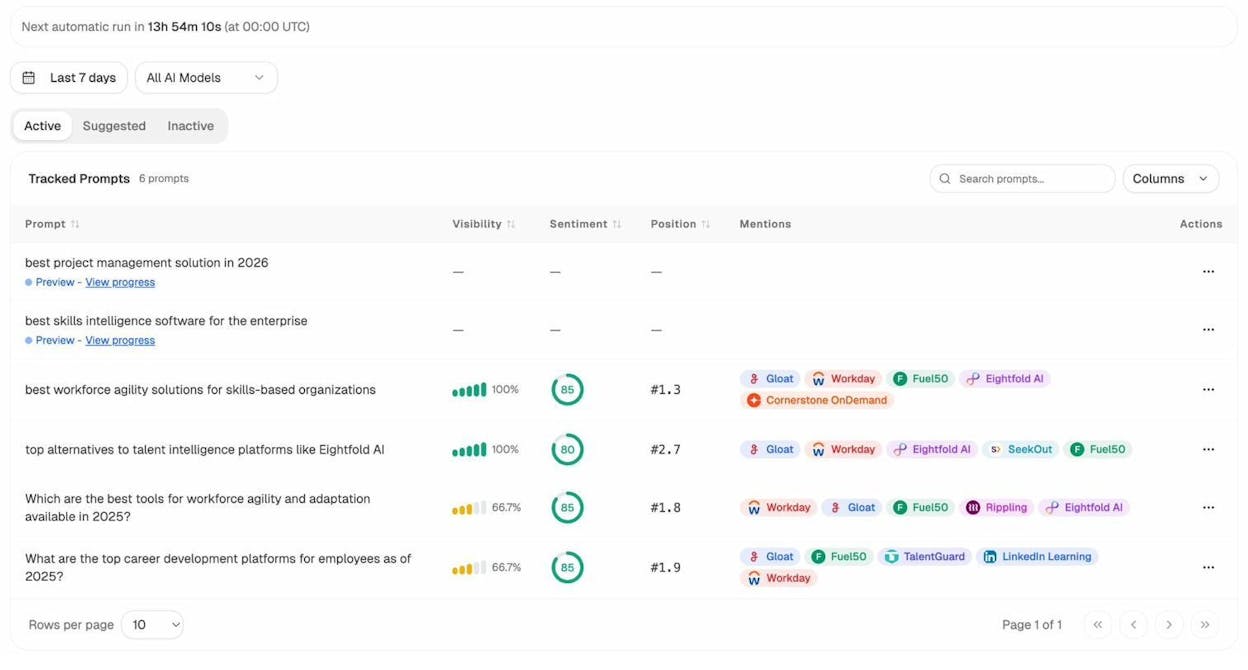
Why does this matter for a niche site? Because the questions people ask AI models often map to content opportunities. If users frequently ask ChatGPT “what’s the best budget espresso machine for beginners,” and no niche site is being cited in the response, that is a gap you can fill.
You can also run ad hoc searches to test how AI models respond to prompts related to your niche, and see which sources they cite.
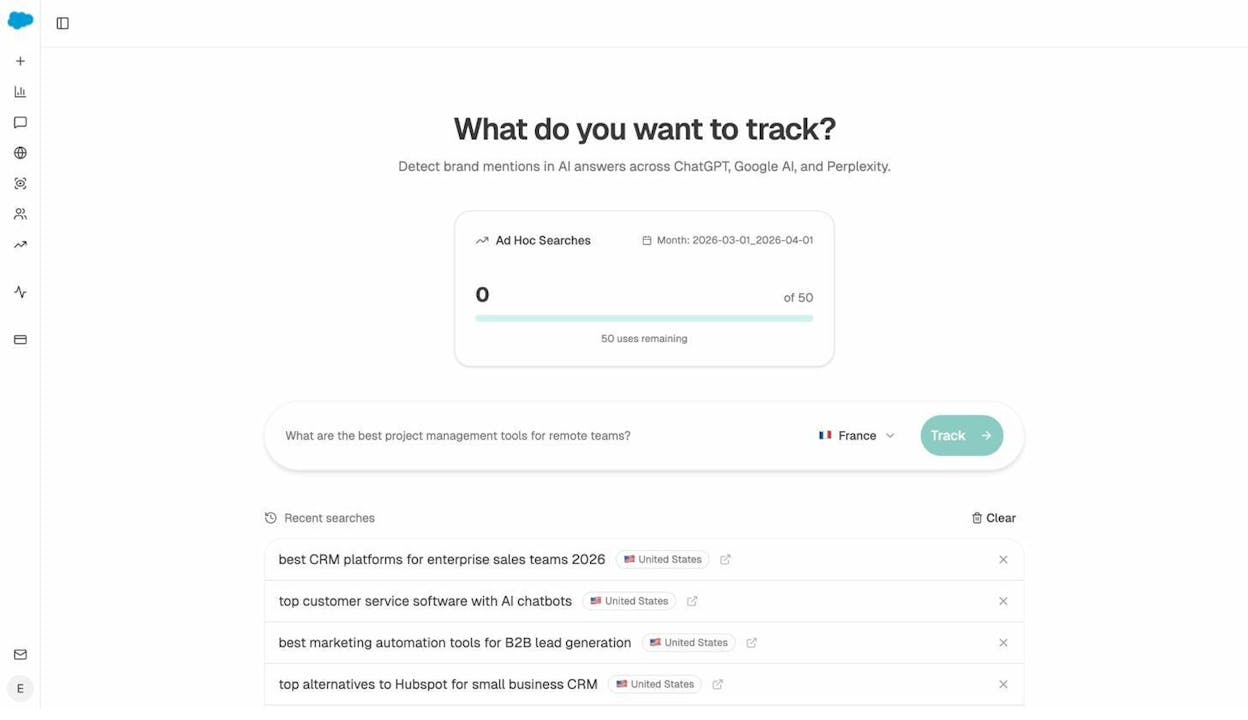
The action step here: create content that directly answers the questions people ask AI models, not just the keywords they type into Google. There is significant overlap between the two, but there are also gaps—and those gaps represent content opportunities with almost zero competition.
Step 3. Build Your Site
Now that you have a niche and a keyword list, it’s time to build. This step is where many beginners overcomplicate things. You do not need a perfect website to start earning. You need a functional, trustworthy-looking site that loads fast and makes it easy for readers to find and click your affiliate links.
Register a Domain and Choose Hosting
Pick a brandable domain name. Avoid exact-match domains like “bestcoffeemakersreviews.com”—they look spammy and limit your long-term options. Instead, choose something memorable and broad enough to expand into. “BrewCraft.com” or “DailyGrindGear.com” are better choices.
For hosting, any reputable provider works. The specifics matter less than people think. What matters is reliability (minimal downtime) and speed (fast page loads). Don’t overthink this step.
Use WordPress
WordPress powers over 40% of the web for a reason: it is free, endlessly customizable, and supported by a massive ecosystem of themes and plugins. For niche affiliate sites specifically, WordPress is the standard.
Install WordPress, pick a lightweight theme, and move on. You can refine the design later. Right now, you need to start publishing content.
Choose the Right Theme
Your theme determines how your site looks and how fast it loads. These two things directly affect trust (visitors judge credibility by design) and rankings (Google considers page speed).
A good affiliate site theme should:
-
Load fast without requiring a bunch of performance plugins
-
Include built-in page builder functionality for custom layouts
-
Support mobile responsiveness out of the box
-
Make it easy to add comparison tables, pros/cons boxes, and CTA buttons
Avoid heavy page builders like Elementor unless you know how to optimize them. They add significant code bloat that drags down site speed. Instead, look for themes with built-in builder tools—Astra, GeneratePress, or Kadence are all solid options that balance design flexibility with performance.
Set Up Clear CTAs From Day One
A call-to-action (CTA) is what turns a reader into a click, and a click into a commission. Every product recommendation on your site should have a clear, visible CTA—typically a button that says something like “Check Price on Amazon” or “View on [Retailer].”
Don’t bury your CTAs at the bottom of long articles. Place them after each product in a comparison, at the top of a review for readers who want to skip straight to the product, and again at the conclusion.
Build E-E-A-T From the Start
E-E-A-T stands for Experience, Expertise, Authoritativeness, and Trustworthiness. Google uses these signals to evaluate content quality, and they are especially important for affiliate sites because Google has historically been skeptical of thin, low-quality affiliate content.
Here is what to set up from day one:
About page — Explain who runs the site, why you started it, and what qualifies you to write about this topic. Be specific. “We’ve tested over 50 espresso machines in the past two years” is better than “We love coffee.”
Author bios — Every article should have a visible author with a bio that establishes credibility. If your lead writer is a certified personal trainer writing for a fitness site, say so prominently.
Affiliate disclosure — Required by law (FTC guidelines) and also builds trust. Place a clear disclosure at the top of every article containing affiliate links.
Contact page — A real contact page with an email address. This signals that there is a real person behind the site.
These are not just nice-to-haves. Google’s quality evaluators specifically look for these signals when assessing niche and affiliate sites. Setting them up at launch is significantly easier than retrofitting them later.
Step 4. Write Content That Ranks and Converts
Content is the engine that drives everything on a niche affiliate site. It is what attracts organic traffic from Google, it is what AI models reference when answering product questions, and it is where your affiliate links live. If your content is mediocre, nothing else you do will matter.
Most niche site guides gloss over this step with vague advice like “write quality content.” That is not helpful. Here is what actually makes affiliate content effective.
Structure Your Content for Readers, Not Search Engines
The best affiliate content follows a consistent structure that helps readers make decisions. Here is a template for a “best X” comparison article—the bread and butter of affiliate sites:
-
Opening paragraph — State what the article covers, who it is for, and why the reader should trust your recommendations. Keep it short. Two to three sentences.
-
Quick picks table — A summary table at the top with your top 3 to 5 recommendations, the key differentiator for each, and a CTA link. This is for readers who want a fast answer without reading 3,000 words.
-
How we tested / how we chose — Explain your evaluation criteria. What factors did you consider? Did you physically test the products? Did you analyze hundreds of customer reviews? Specificity builds trust.
-
Individual product reviews — One section per product with a subheading. For each product, cover what it is, who it is best for, key specs, pros, cons, and a verdict. Include affiliate links.
-
Buying guide — A section that helps readers understand what to look for when buying this type of product. This adds informational depth, builds E-E-A-T, and captures long-tail search queries.
-
FAQ section — Answer common questions pulled from Google’s “People Also Ask” and from AI search prompts. This serves double duty: it helps with featured snippet rankings in Google and provides the structured answers that AI models are likely to cite.
Write for Humans, Then Optimize for Search
Your articles should read like they were written by a knowledgeable friend who happens to have tested a bunch of products—not like they were assembled by someone stacking keywords into a template.
Here are the principles that separate great affiliate content from generic content:
Be specific. “This blender is powerful” means nothing. “This blender can crush ice in under 10 seconds and pulverize frozen fruit without adding liquid” tells the reader something useful.
Include real details. If you tested the product, describe what happened. If you analyzed customer reviews, cite specific patterns. If you compared specs, show the comparison. Details are the sign of genuine expertise. As the team at Grow and Convert puts it: details are what make a post worth reading. They give it life.
Show tradeoffs. Every product has drawbacks. Mentioning them builds trust. A recommendation that only says positive things feels like an ad. A recommendation that says “the DeLonghi has the best build quality in this price range, but the water tank is smaller than the Breville, so you’ll refill it more often” feels like honest advice.
Use simple language. Your readers are not SEO professionals. They are people trying to buy a good espresso machine or a reliable hiking backpack. Write the way you would explain something to a friend.
How to Make Your Content Visible in AI Search
This is where niche site owners can gain a serious edge in 2026. AI search engines are now a meaningful traffic source, and the sites that appear in AI-generated answers share specific characteristics.
Answer questions directly. AI models pull from content that provides clear, direct answers. Structure your sections with the question as a heading and the answer in the first one to two sentences. Then elaborate.
Use structured formatting. Comparison tables, pros/cons lists, specification lists, and FAQ sections are all formats that AI models can easily parse and reference. If your content is structured clearly, it is more likely to be cited.
Build topical depth. AI models prioritize sources that demonstrate comprehensive coverage of a topic. A site with 30 well-written articles covering every angle of home coffee equipment is more likely to be cited than a site with 5 generic posts.
Create content that answers AI-specific prompts. People ask AI models questions differently than they type into Google. “What espresso machine should I buy if I’m a beginner and don’t want to spend more than $400?” is a very different query than “best espresso machine under 400.” Your content should answer both types of questions.
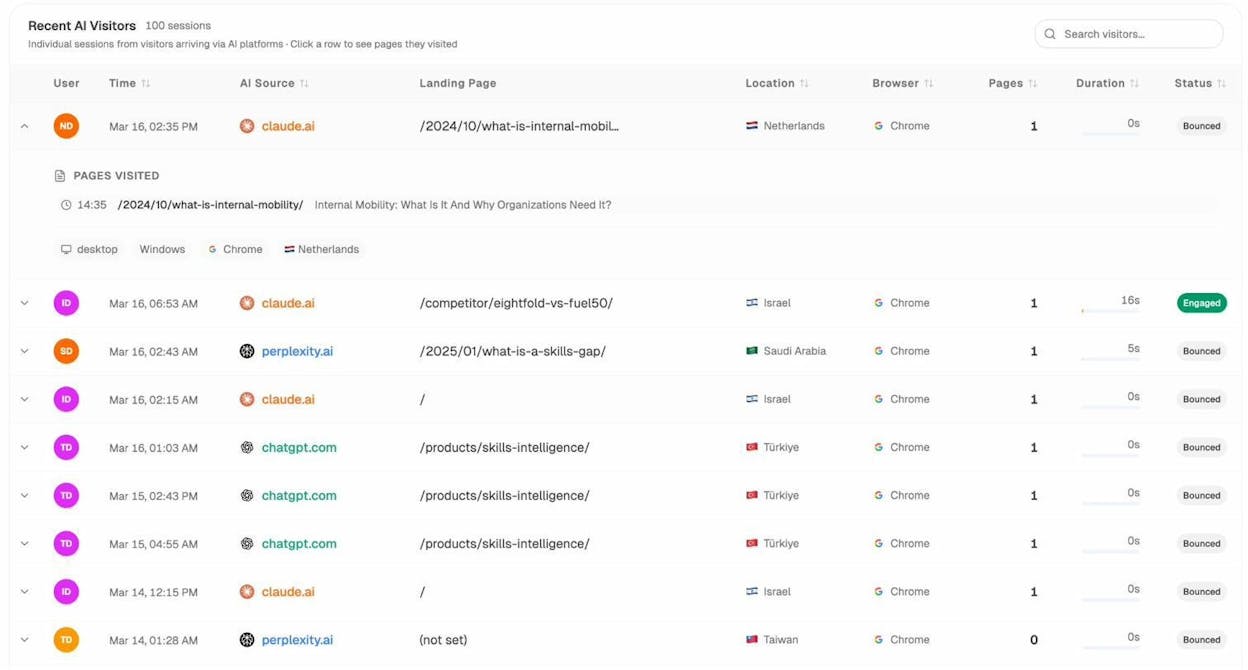
You can use Analyze AI’s AI Traffic Analytics to see which of your pages are already receiving traffic from AI platforms like ChatGPT, Perplexity, and Claude. The Landing Pages report shows exactly which pages get cited by AI models, how visitors from AI platforms engage with your content, and whether they convert.
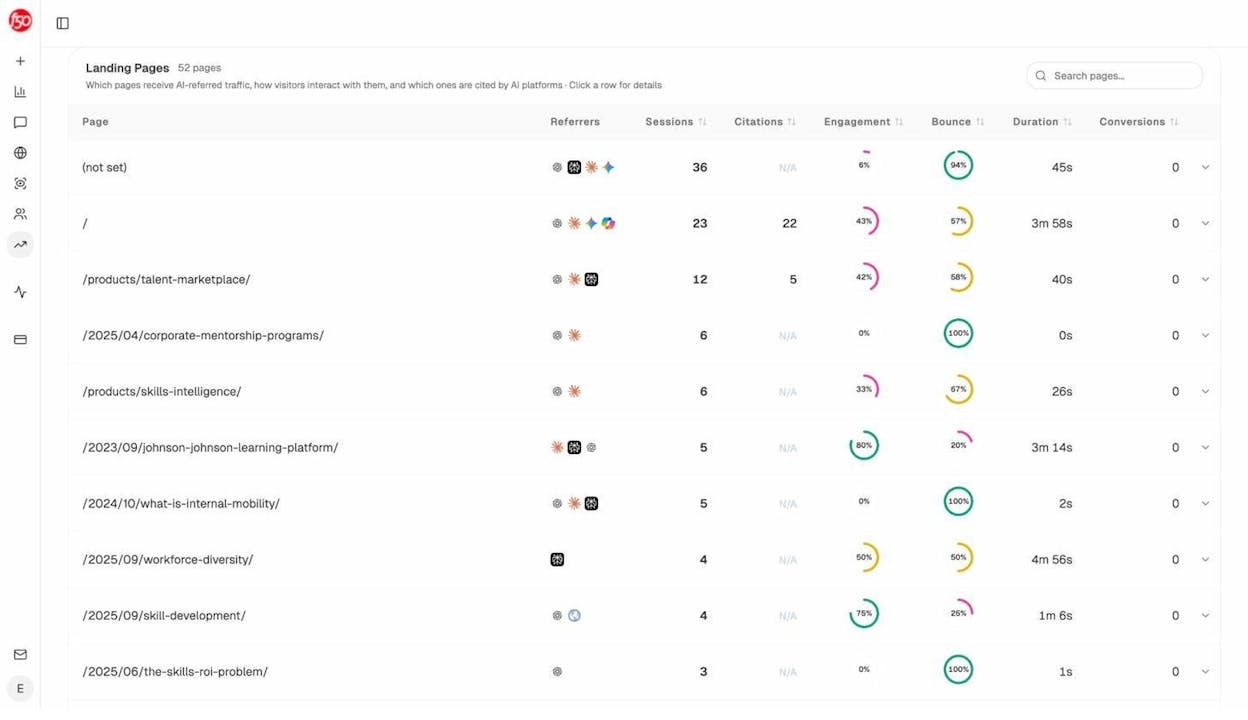
This data is gold for content strategy. If you notice that your “Best Pour-Over Coffee Makers” article is getting cited by AI engines but your “Best Espresso Machines” article is not, you can analyze what makes the first article more AI-friendly and apply those patterns to the second.
You can even drill down to individual AI visitor sessions to see which AI platform sent them, what page they landed on, and how long they stayed.
Step 5. Build Links
Backlinks remain one of the strongest ranking signals in Google’s algorithm. For niche sites, they are especially important because your site starts with zero authority. Without links from other websites pointing to your content, it will take much longer (or be impossible) to rank for competitive keywords.
Here is the reality: link building is the hardest part of running a niche site. It requires outreach, relationship-building, and persistence. But the payoff is enormous.
Earned Media and Digital PR
This is the highest-quality link building strategy for niche sites. Platforms like Connectively (formerly HARO), Featured, and Qwoted connect journalists with expert sources. When a journalist is writing about a topic in your niche, you can pitch yourself as a source.
If your quote gets included, you typically get a backlink from a high-authority publication—think Forbes, Business Insider, or niche industry publications. These links carry significant weight with Google, and they also boost your site’s E-E-A-T because they position you as an expert.
The key to success here: respond to relevant queries quickly (within an hour if possible), provide genuinely useful quotes (not generic fluff), and include your credentials.
Broken Link Building
Broken link building is a technique where you find broken links on other websites in your niche and offer your content as a replacement.
Here is the process:
-
Find resource pages or articles in your niche that link to external content
-
Use the Analyze AI Broken Link Checker or a similar tool to identify which of those links are broken (returning 404 errors)
-
Create content on your site that covers the same topic as the broken link’s original destination
-
Reach out to the site owner and let them know about the broken link, offering your content as a replacement
![[Screenshot: Analyze AI Broken Link Checker showing results with broken links identified on a website]](https://www.datocms-assets.com/164164/1776704443-blobid11.png?auto=format,compress&w=1248&fit=max)
This works because you are solving a problem for the site owner (fixing a broken link) while also getting a backlink for yourself. It is a win-win, which is why it tends to have a higher response rate than cold outreach.
Guest Posting
Writing articles for other websites in your niche—or in adjacent niches—is still an effective way to build links and establish authority. The key is to target reputable sites that your audience actually reads, not random blogs that exist solely for link exchanges.
A guest post on a respected fitness publication, for example, builds your reputation as an authority in the fitness niche. And the byline typically includes a link back to your site.
A few rules for effective guest posting:
-
Pitch topics that provide genuine value to the host site’s audience
-
Write the guest post to the same quality standard as your own site’s content (or higher)
-
Include your bio with relevant credentials and a link to your site
-
Avoid sites that openly sell guest post placements—Google devalues links from these
Monitor Your AI Search Visibility
Here is where things get interesting for niche site owners in 2026. As you build links and publish content, you should also be tracking how your site appears in AI search results.
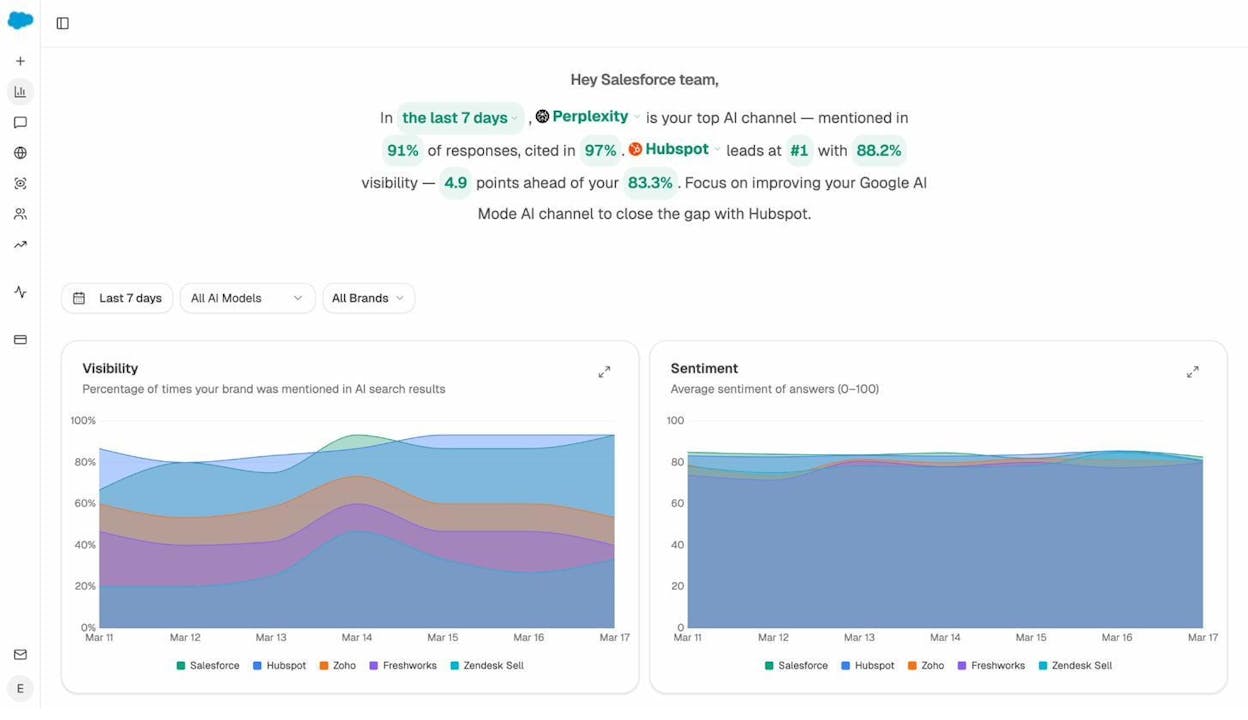
With Analyze AI, you can monitor your brand’s visibility across ChatGPT, Perplexity, Gemini, Copilot, and other AI engines from a single dashboard. The Overview gives you a real-time snapshot of how often your brand is mentioned, how sentiment compares to competitors, and which AI platforms are your strongest channels.
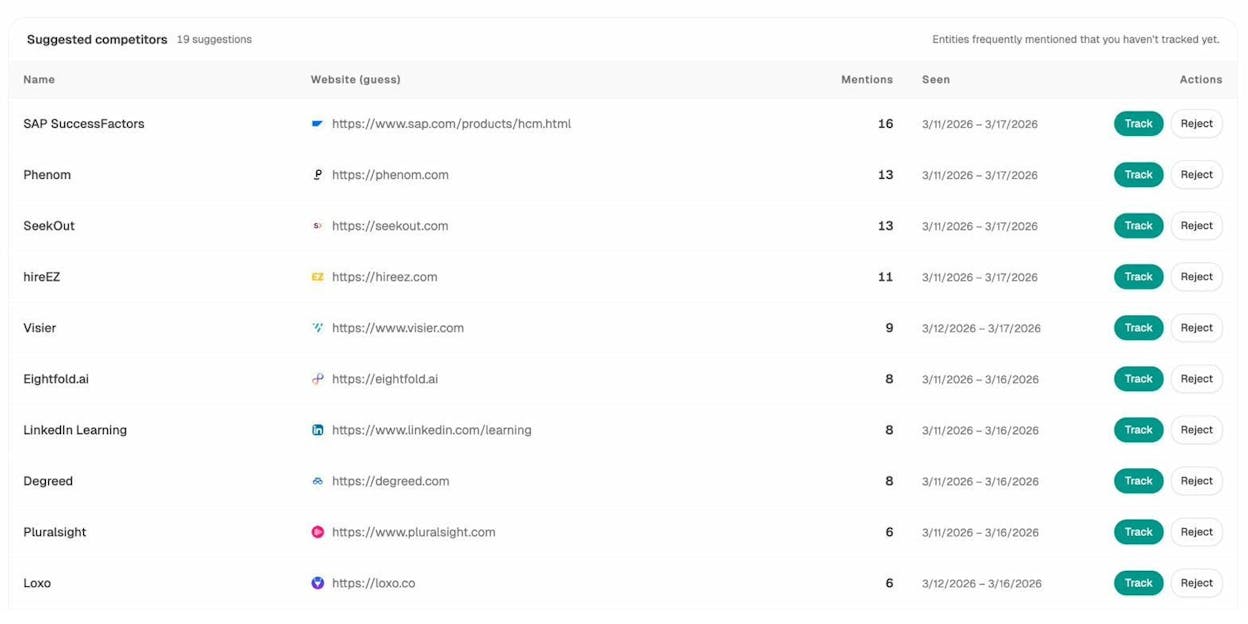
The Competitors dashboard is especially useful. It automatically identifies which competitors AI models mention alongside your brand, so you can see exactly who you are competing against in AI search—which may be different from your Google competitors.
And the Perception Map shows how AI models perceive your brand compared to competitors across different attributes. This tells you where your brand stands out and where it falls short in AI-generated responses.
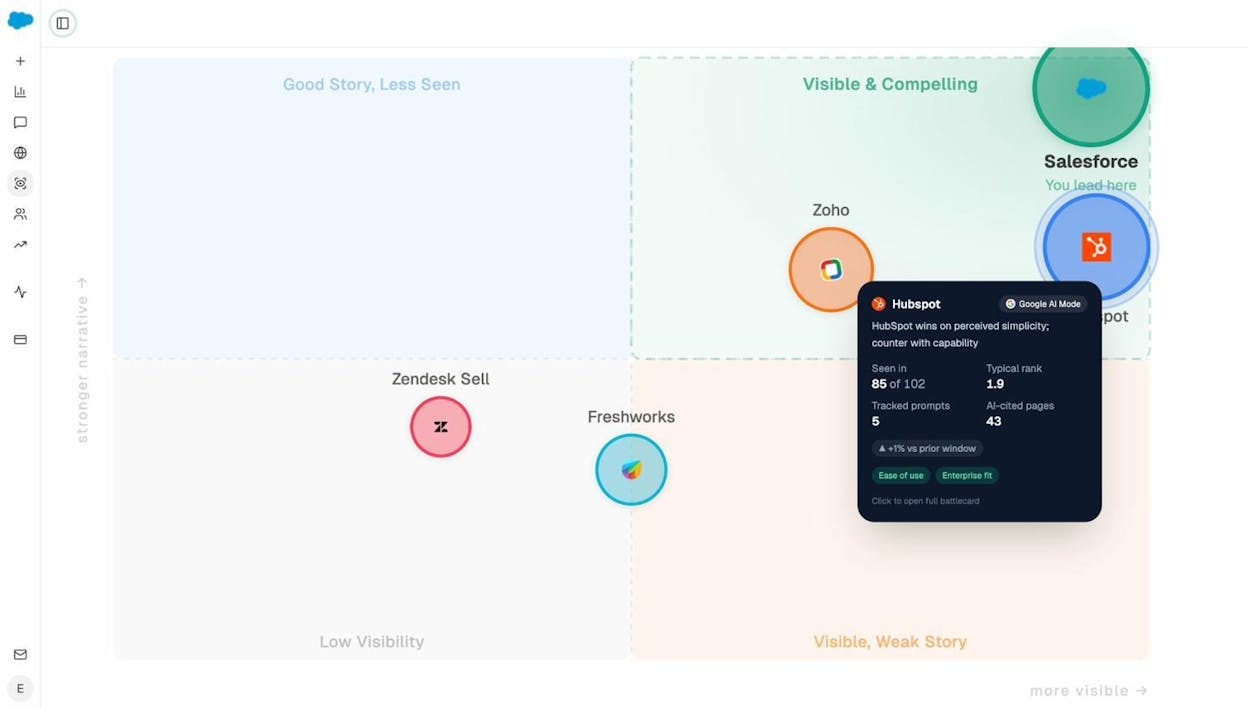
Why does this matter for a niche site? Because if AI models are recommending your competitors’ products but not yours, you now know exactly which gap to close. You can create better content around those specific products and topics, build more authority in those areas, and track your progress over time.
Step 6. Track, Optimize, and Scale
The original version of this step in most niche site guides is “rinse and repeat.” That is not actionable advice. Here is what you should actually do once your site is live and producing content.
Track What Is Working
Set up Google Analytics and Google Search Console from day one. These are non-negotiable.
Google Analytics tells you how many people visit your site, which pages they read, and how long they stay. Search Console tells you which keywords your site ranks for, how many impressions and clicks each keyword generates, and whether Google has detected any technical issues.
Use the Analyze AI SERP Checker to monitor your rankings for target keywords and see how you stack up against competitors on the search results page.
![[Screenshot: Analyze AI SERP Checker results showing ranking positions for a keyword]](https://www.datocms-assets.com/164164/1776704457-blobid15.png?auto=format,compress&w=1248&fit=max)
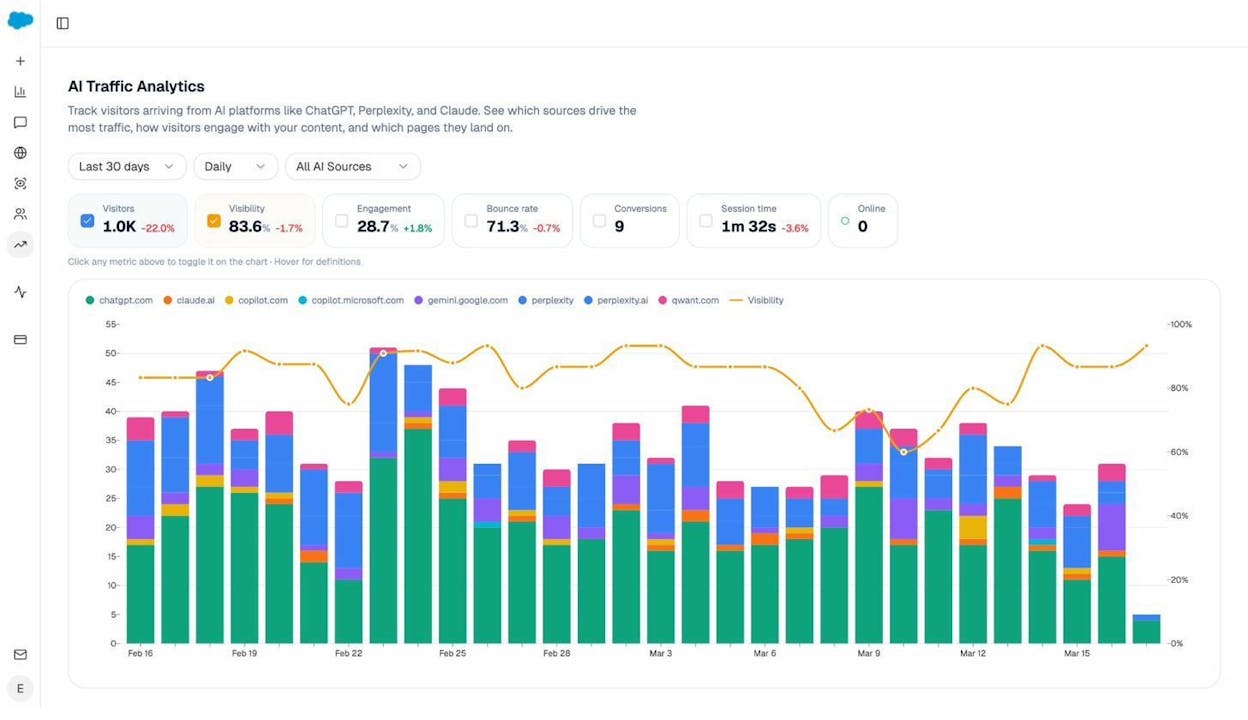
Beyond Google, use Analyze AI’s AI Traffic Analytics to track traffic arriving from AI platforms. This report shows you total visitors from AI sources, which AI platforms drive the most traffic, engagement metrics (bounce rate, session time) for AI-referred visitors, and conversions.
Double Down on What Works
After three to six months of publishing, patterns will emerge. Some articles will rank faster than expected. Some will convert at higher rates. Some will attract AI citations.
This is where you shift from “publish everything” mode to “optimize and expand” mode:
-
Expand top performers. If your “Best Ceramic Pour-Over Drippers” article is ranking on page one and converting well, create supporting articles around it—“How to Use a Ceramic Pour-Over Dripper,” “Ceramic vs. Glass Pour-Over: Which Is Better,” “Best Filters for Ceramic Drippers.” This builds a topical cluster that reinforces your authority.
-
Update underperformers. If an article is ranking on page two, it might just need more depth, better structure, or a few internal links to push it to page one. Don’t abandon it—improve it.
-
Fill content gaps. Use the Competitors view in Analyze AI to see which prompts and topics your competitors rank for in AI search where you do not. These gaps are content opportunities.
Scale Content Production
In the beginning, you will write most of the content yourself. This is fine and even beneficial—it helps you develop your site’s voice and understand what resonates with your audience.
But at some point, you need to scale. You cannot build a $5,000/month affiliate site by writing one article per week yourself. The math doesn’t work.
Options for scaling:
Hire freelance writers. Give them detailed briefs based on your keyword research and content templates. Edit aggressively. Your standards should not drop just because someone else is writing.
Use AI as a writing assistant. AI writing tools can help with research, outlines, and first drafts. But the final content needs a human editor who understands your niche and can add the specific, experience-based details that make content credible.
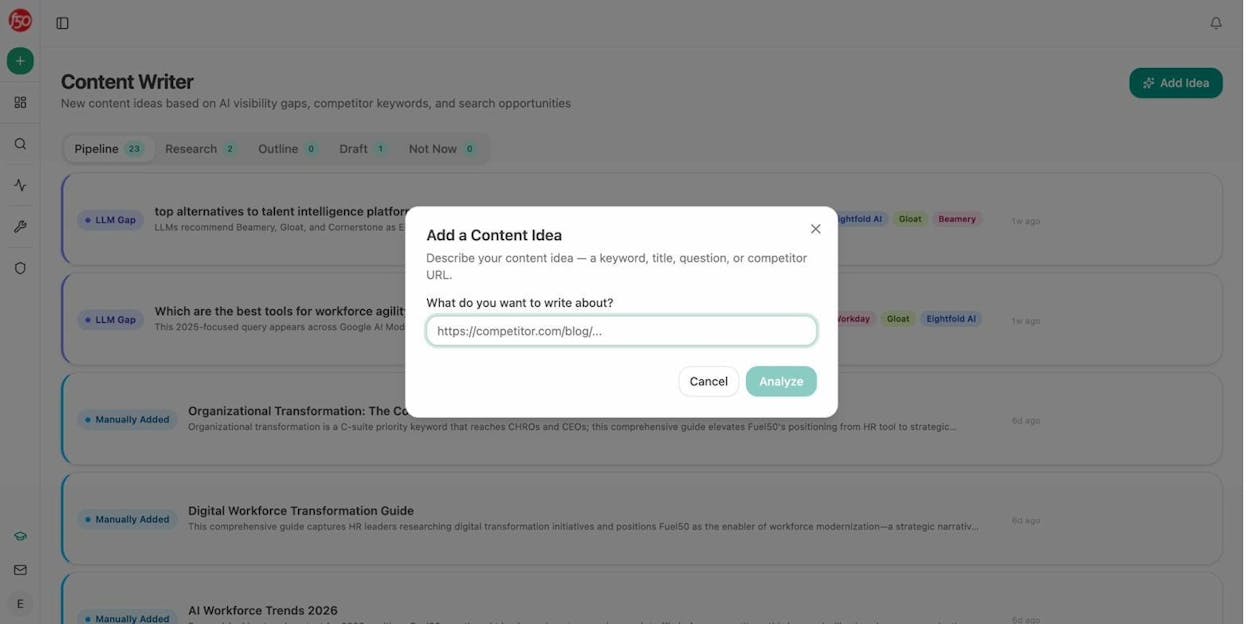
Analyze AI’s Content Writer feature can help with this process. It generates content ideas based on your tracked keywords, researches the topic across competing articles, creates outlines, and produces drafts that you can then edit and refine.
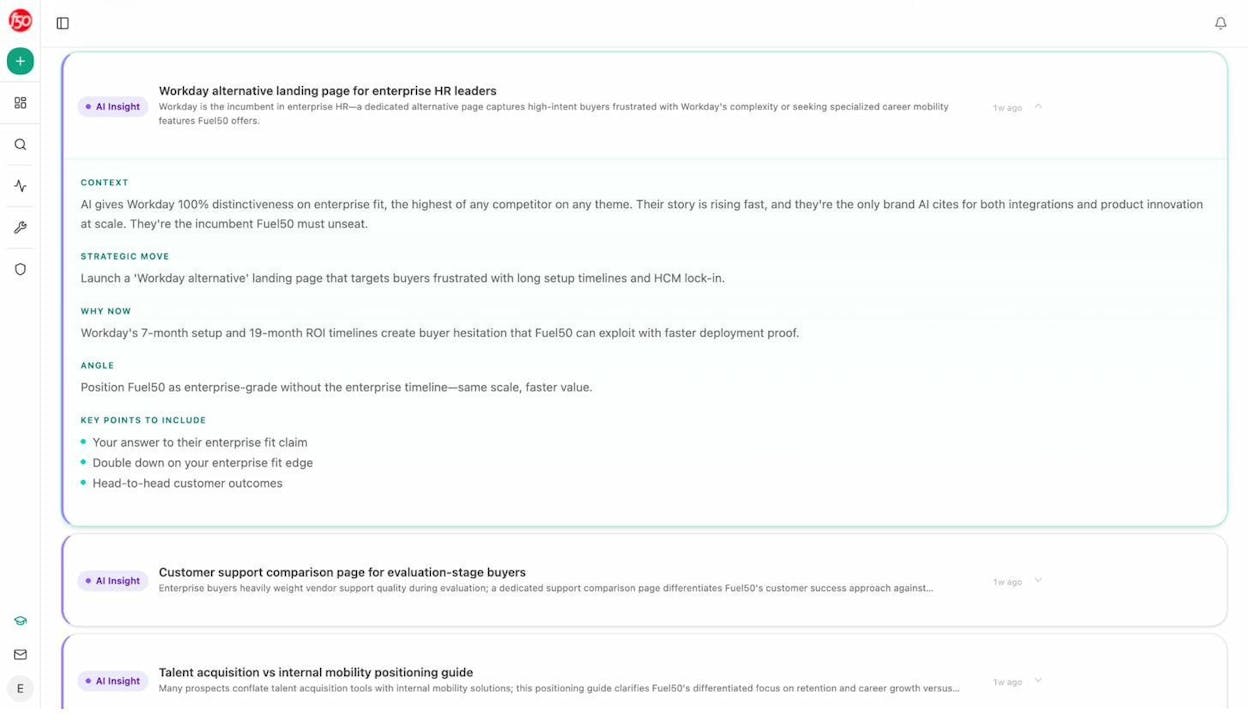
The key is to treat AI-generated content as a starting point, not a finished product. The details, personal experience, specific product knowledge, and editorial judgment need to come from you.
Set Up Weekly Monitoring
Consistency matters more than intensity. Set up a weekly routine:
-
Check Google Search Console for new ranking keywords and any crawl issues
-
Review affiliate dashboard for commission trends
-
Check Analyze AI’s Overview dashboard for AI visibility changes
-
Review the Weekly Email digest from Analyze AI for a summary of your brand’s AI search performance
This takes 30 minutes per week and keeps you informed without becoming a full-time analytics operation.
Final Thoughts
Building a profitable niche site is not complicated, but it does require patience and consistency. Choose a niche with high-ticket items and real demand. Do keyword research that covers both Google search and AI search queries. Build a clean, fast, trustworthy site. Write content that genuinely helps people make purchase decisions. Build links from reputable sources. And track everything so you know what is working.
The niche site playbook in 2026 has one major addition compared to previous years: AI search is now a real traffic channel. The site owners who recognize this early and create content that AI models cite and recommend will have a significant advantage over those who optimize only for Google.
That does not mean SEO is dead. It means SEO is evolving, and the smartest niche site builders are evolving with it.
Start today. Your first $1,000 month is closer than you think.

Ernest

Ibrahim


