
Which of my old posts should I update first?
Short answer
The ones that lost the most value you can realistically win back. That is not the same as your biggest losers. A page that fell from tenth to thirtieth on a dying topic is a bad bet, while a page that slipped from second to sixth on a topic you still sell into is worth a morning. Rank by recoverable value, not by size of drop.
Build the shortlist in twenty minutes
This is the quick version. If you want the fuller model with effort and conversion weighted properly, that is how do I prioritize refreshes by past value, demand, conversion, and effort.
- Export Search Console for the last 3 months and the same 3 months a year ago.
- Compute clicks lost per page, in absolute numbers rather than percentages.
- Sort descending and keep the top 30.
- Drop anything where the topic itself is dead, meaning total impressions across everyone have collapsed rather than yours.
- Drop anything now ranking below about position 20, since those are rewrites rather than refreshes.
What is left is your shortlist, and it is usually eight to fifteen pages.
The two filters are what make this useful. Absolute clicks lost puts a page that fell from 4,000 to 2,500 above one that fell from 90 to 20, which is correct even though the second looks worse in percentage terms. And the position filter separates a page that needs an afternoon from one that needs a fresh start.
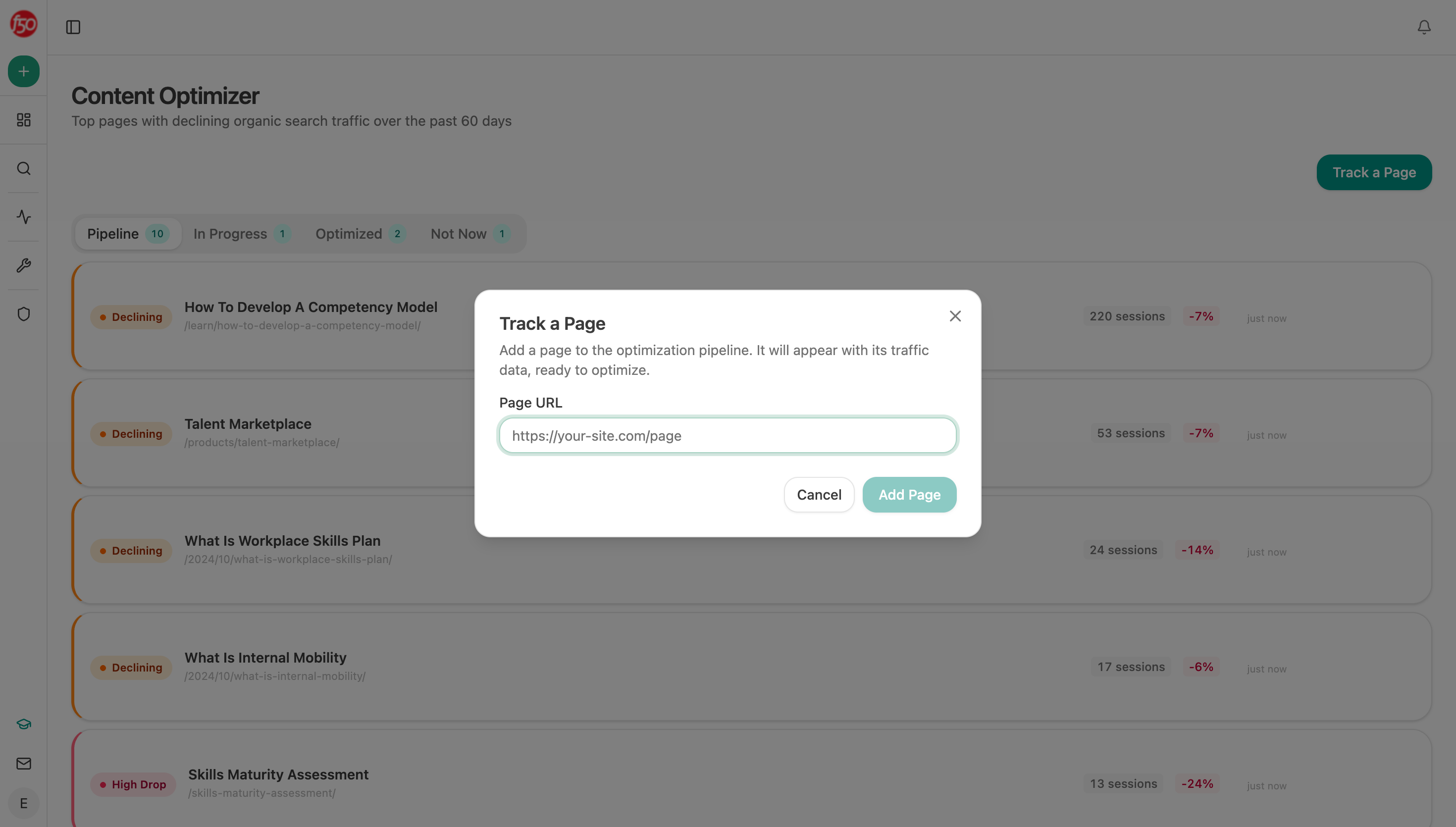 The optimizer already tracks declining pages with their session change and drop severity, which is the shortlist in one screen.
Order the shortlist by what you can win back
Now rank the survivors. Three questions, quick to answer.
| Question | Why it matters |
|---|---|
| How far did it fall, and from where? | Second to sixth is recoverable. Sixth to twenty-fifth usually is not |
| Does the page still match what the searcher wants? | If the result now shows tools and you have an article, this is a rebuild |
| Did it ever produce anything? | A page that never converted is worth less back than one that did |
Anything that falls a short distance, still matches intent, and used to produce sales conversations goes to the top. That combination is common and it is the cheapest work available in content.
Add the pages that lost citations but not traffic
There is a second shortlist most teams never build, and it is often the more urgent one.
Analyze AI's citation-decay-alert recipe returns pages losing citations faster than they lose traffic. Those pages look fine in Search Console and are already being passed over as a source in AI answers. Because AI answers react faster than rankings do, that list is a preview of your Search Console report in two or three months. Google's AI features documentation notes that eligibility follows ordinary indexing, so this is about being passed over rather than being blocked.
Merge it into your shortlist and treat those pages as urgent even when their traffic looks stable. Why did my page lose its AI citations, and how do I win them back covers what to do with them.
Skip the three that look tempting and are not
Three kinds of page climb any decline list and waste the effort.
The seasonal dip. Compare against the same months last year rather than last quarter, or you will rewrite pages that were always quiet in August.
The cannibalised pair. Two of your own pages splitting one query looks like decay on both. Fixing that is a merge, not a refresh, and how do I find pages that compete with each other is the check.
The dead topic. If everyone's impressions fell, the market moved and your page did nothing wrong. Retire it rather than rewriting it.
Turn the shortlist into a standing queue
Start (schedule, monthly) → GSC Top Pages for Site for the last 3 months and the same period a year earlier → Code node computing absolute clicks lost and current position per page → citation-decay-alert recipe merged in → intent-mismatches recipe flagging pages whose content no longer matches the search → Conditional dropping anything below position 20 or with collapsing category impressions → Export Excel as a ranked queue.
 Returning the shortlist as a working queue rather than a spreadsheet is what keeps it from ageing between reviews.
The Conditional doing the dropping is what makes this list short enough to act on. An unfiltered decline report has 200 rows and gets skimmed. Twelve rows with a reason attached to each gets worked through.
FAQ
Related answers
- How do I prioritize refreshes by past value, demand, conversion, and effort?
- How do I spot content decay before it becomes a big traffic loss?
- How do I diagnose why a page declined before rewriting it?
- When is deleting or redirecting old content better than updating it?
Work the pages you can actually win back
Analyze AI ranks your declining pages by recoverable value and merges in the ones quietly losing AI citations.
Start your free trial