



Summarize this blog post with:


In this article, you’ll see exactly what Ahrefs Brand Radar and the Semrush AI Visibility Toolkit do today, what they cost once you read past the headline price, and where each one stops being useful the moment you try to act on the data. You’ll also see how Analyze AI approaches the same problem from a different shape. Not as an AI search layer bolted onto SEO, but as an agentic SEO and content platform that pulls your visibility data, writes the briefs, runs the optimizations, and wires the whole loop to a schedule.
Table of Contents
What we compared, and how
This review evaluates Ahrefs Brand Radar and Semrush AI Visibility Toolkit on five criteria that decide whether a tool earns a seat in your stack.
-
AI visibility tracking. Does the tool show where your brand appears in answers from ChatGPT, Perplexity, Gemini, and Copilot, and how that compares to competitors?
-
AI bot and crawler insights. Can either platform tell you what large language models are pulling from your site, even directionally?
-
Competitive benchmarking. Which one produces share of voice and sentiment data clean enough to put in front of leadership?
-
Integration with traditional SEO. How well does the AI layer connect to the keyword, backlink, and ranking data the same team already uses?
-
The real cost. What does a working monthly bill look like once you include domains, users, prompts, and the SEO base plan?
Alongside both, we cover how Analyze AI fits a different shape. An agentic platform running visibility, content production, and automation in one place.
Ahrefs Brand Radar vs Semrush AI Visibility Toolkit at a glance
|
Capability |
Ahrefs Brand Radar |
Semrush AI Visibility Toolkit |
|---|---|---|
|
AI platforms tracked |
ChatGPT, Gemini, Perplexity, Copilot, AI Overviews, AI Mode (6) |
ChatGPT, Gemini, Perplexity, Google AI Mode (4) |
|
Claude or Grok tracking |
No |
No |
|
Prompt database |
199M to 260M+ search-backed prompts |
Simulated queries based on keyword data |
|
Daily prompt monitoring |
Snapshot intervals |
Daily checks (50 to 500 depending on tier) |
|
Custom prompt monitoring |
+$50/mo for 2,500 prompts |
Included with limits, +$60 for 50 more |
|
Share of voice and sentiment |
Yes |
Yes |
|
AI traffic attribution (GA4) |
No |
No |
|
Content writer in same workflow |
No |
Add-on ($60/mo Content Toolkit) |
|
Workflow automation |
No |
No |
|
Starting price for AI visibility |
$129 base + $199 per index OR $699 bundle |
$99 per domain per month |
|
Realistic full-coverage cost |
$828 to $1,148 a month |
$258+ per month, climbs from there |
Three things stand out that the marketing pages of either company tend to soften.
Neither tool covers Claude or Grok. Citation volumes between major engines can differ by orders of magnitude for the same brand, so missing two engines is not a footnote.
Both tools price per domain or per index. If you manage multiple brands, the bill compounds fast.
Neither tool ties AI visibility to traffic in GA4. You can show you appear in answers. You cannot show those answers brought anyone to your site.
AI visibility tracking, depth versus pragmatism
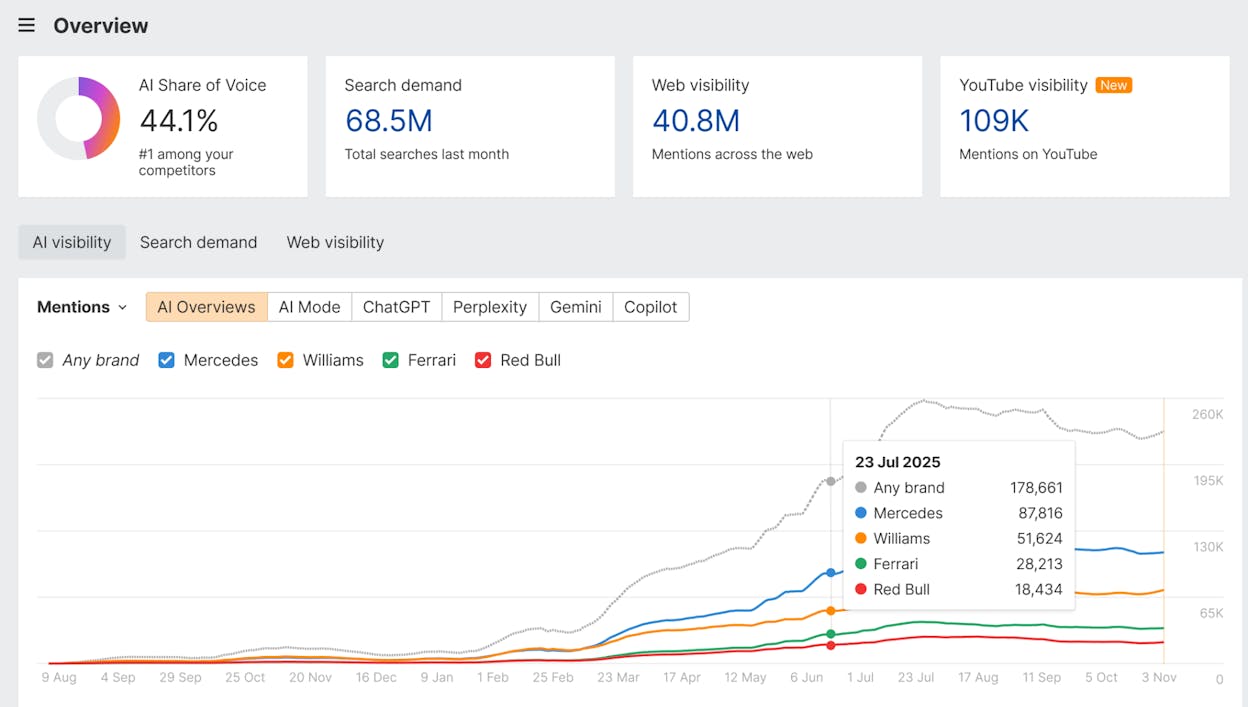
Ahrefs Brand Radar’s pitch is breadth. It pulls from around 199 million monthly search-backed prompts and runs them against six AI platforms at scheduled intervals. The output is share of voice per platform, a list of prompts where your brand appears, and the citing domains driving those mentions.
Where Ahrefs earns credit is methodology. Search-backed prompts feel more grounded than fabricated ones, and historical visibility data is a real differentiator mid-tier tools cannot match yet.
Where it loses credibility is accuracy. Independent testing has flagged gaps between what Brand Radar reports and what manual inspection finds, particularly in the ChatGPT and Perplexity modules. The snapshot methodology captures responses at intervals rather than continuously, missing the rapidly changing answers between sweeps.
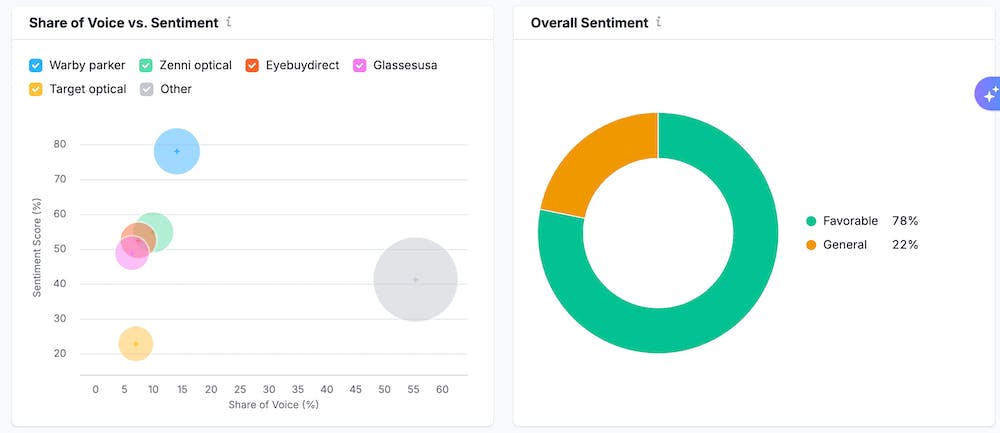
Semrush takes the opposite approach. Instead of a giant prompt index, the AI Visibility Toolkit centers on dashboards your stakeholders can read in a meeting. Brand Performance gives you share of voice, sentiment, and perception drivers. Prompt Tracking monitors up to 500 prompts daily at higher tiers. Prompt Research treats prompts the way Semrush treats keywords, with topic difficulty, volume estimates, and competing brands shown side by side.
Semrush is cleaner for executive reporting. The trade-off is data sourcing. Reviews have noted Semrush relies on simulated queries rather than verified real-user queries, which produces what one reviewer called “probabilistic guesswork” for low-volume brands.
If your job is to prove your brand appears in AI answers and you want historical depth, Ahrefs gives you more raw surface area. If your job is to put a clean dashboard in front of a CMO every Monday, Semrush wins on presentation. Neither closes the loop on whether the visibility produced revenue.
How Analyze AI handles this differently
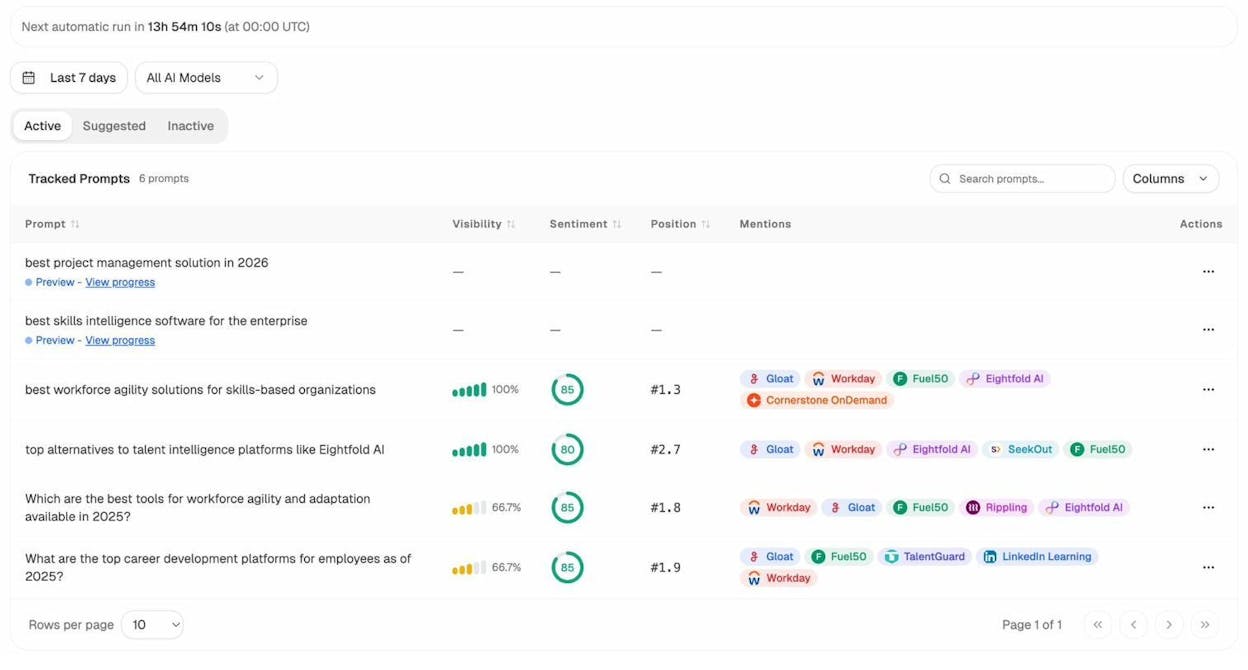
Analyze AI’s AI Visibility Tracking covers ChatGPT, Perplexity, Gemini, Claude, Copilot, Google AI Mode, and the rest of the engines that matter, all in one dashboard, at the base $99 a month price.
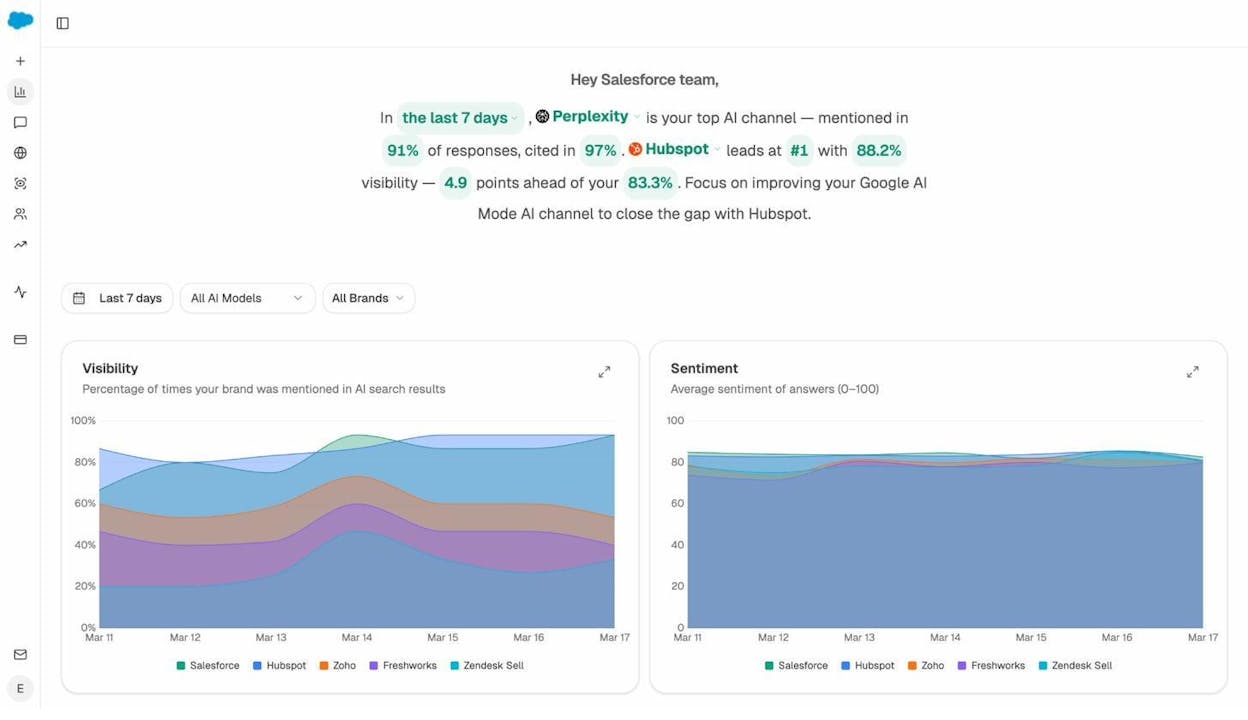
The piece legacy tools miss is on-demand exploration. The AI Search Explorer lets you run any query against every model in seconds, so you can stress-test a category narrative without waiting for the next scheduled crawl.
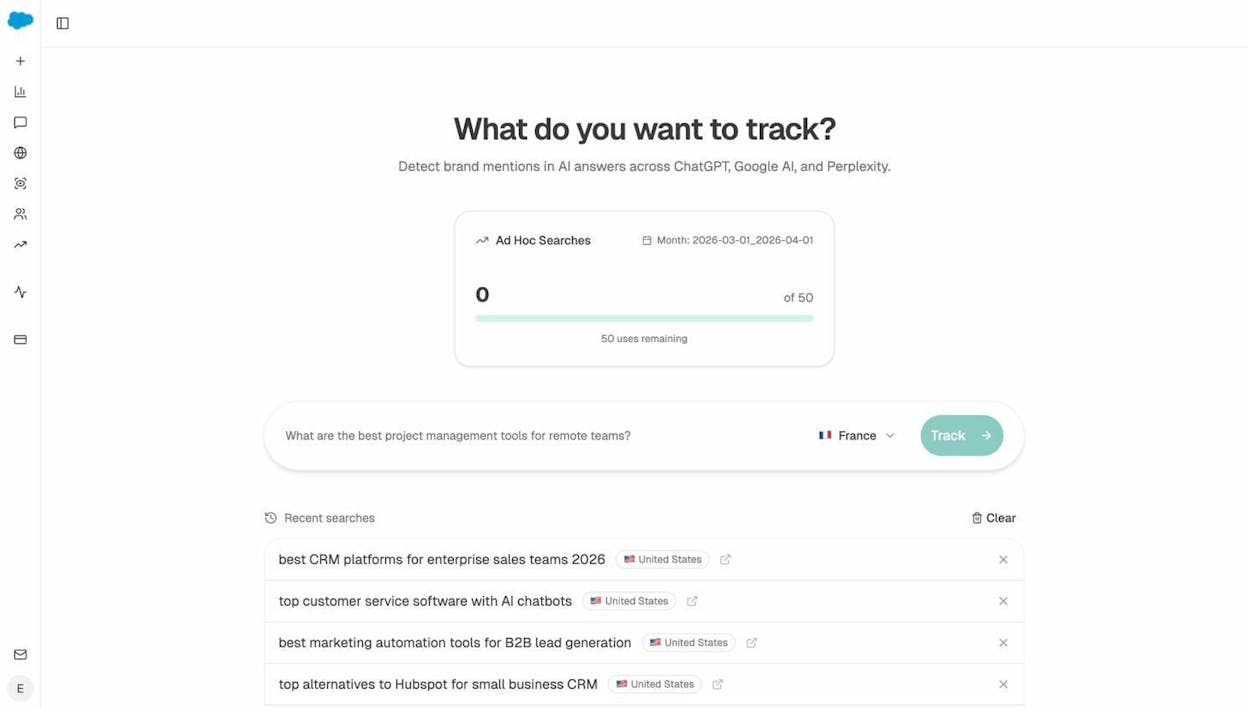
The Prompt Tracking dashboard groups tracked prompts, suggested prompts, and ad hoc explorations into one view. The prompts you monitor evolve with the category, not with a paid add-on quota.
AI bot and crawler insights, inference rather than logs
Neither Ahrefs nor Semrush gives you an actual log of which LLMs crawled your site. That technology does not exist yet at the level marketing teams need, because crawls from AI companies are sparse, anonymous, and frequently routed through cached intermediaries.
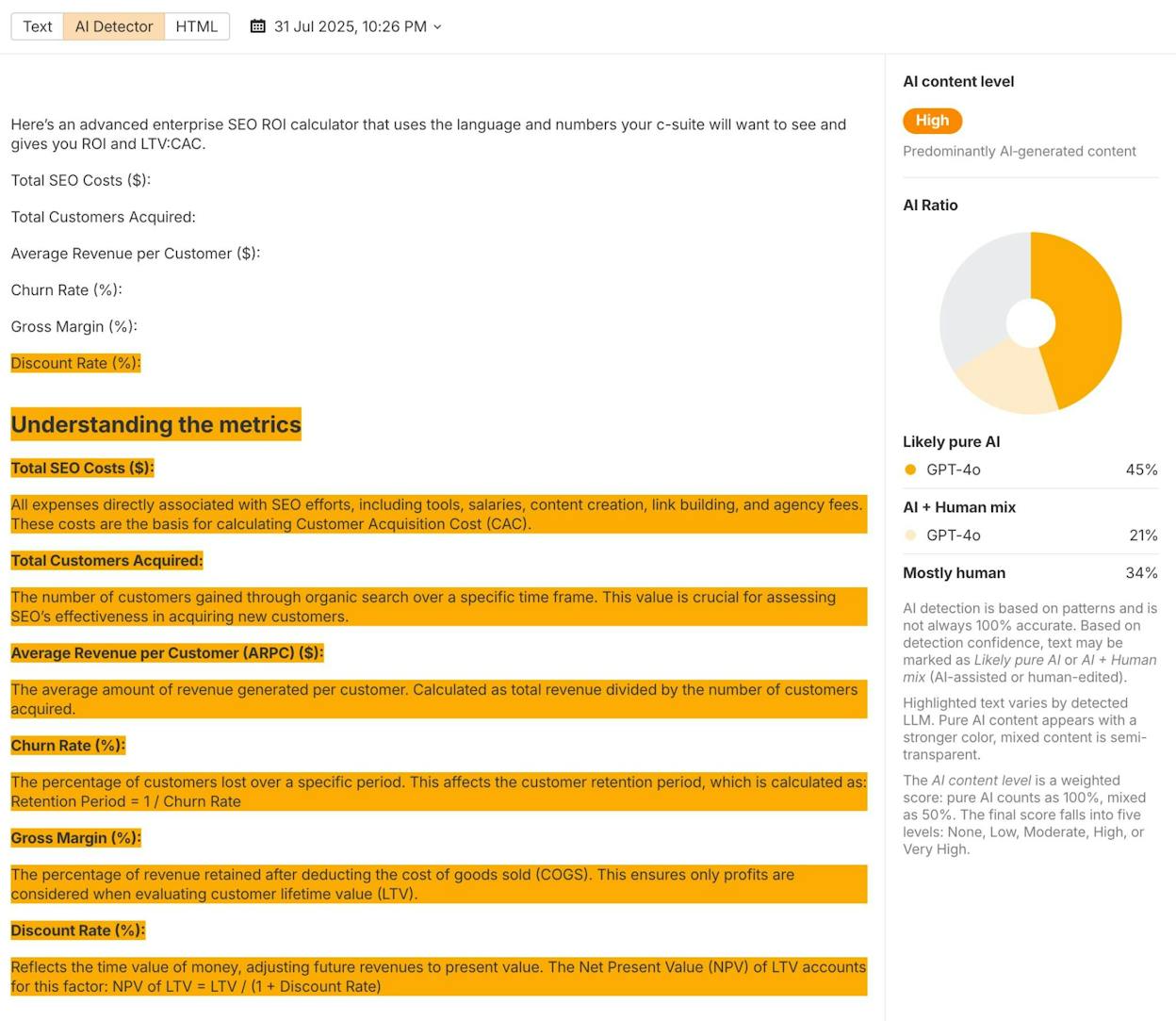
Ahrefs leans on its established crawler and layers AI detection on top. Site Audit pulls in AI bot user agents where it can identify them. AI References ties citation data back to Site Explorer, so you see which pages surface in AI answers alongside their backlink profiles. Useful when it works. Not a crawl log.
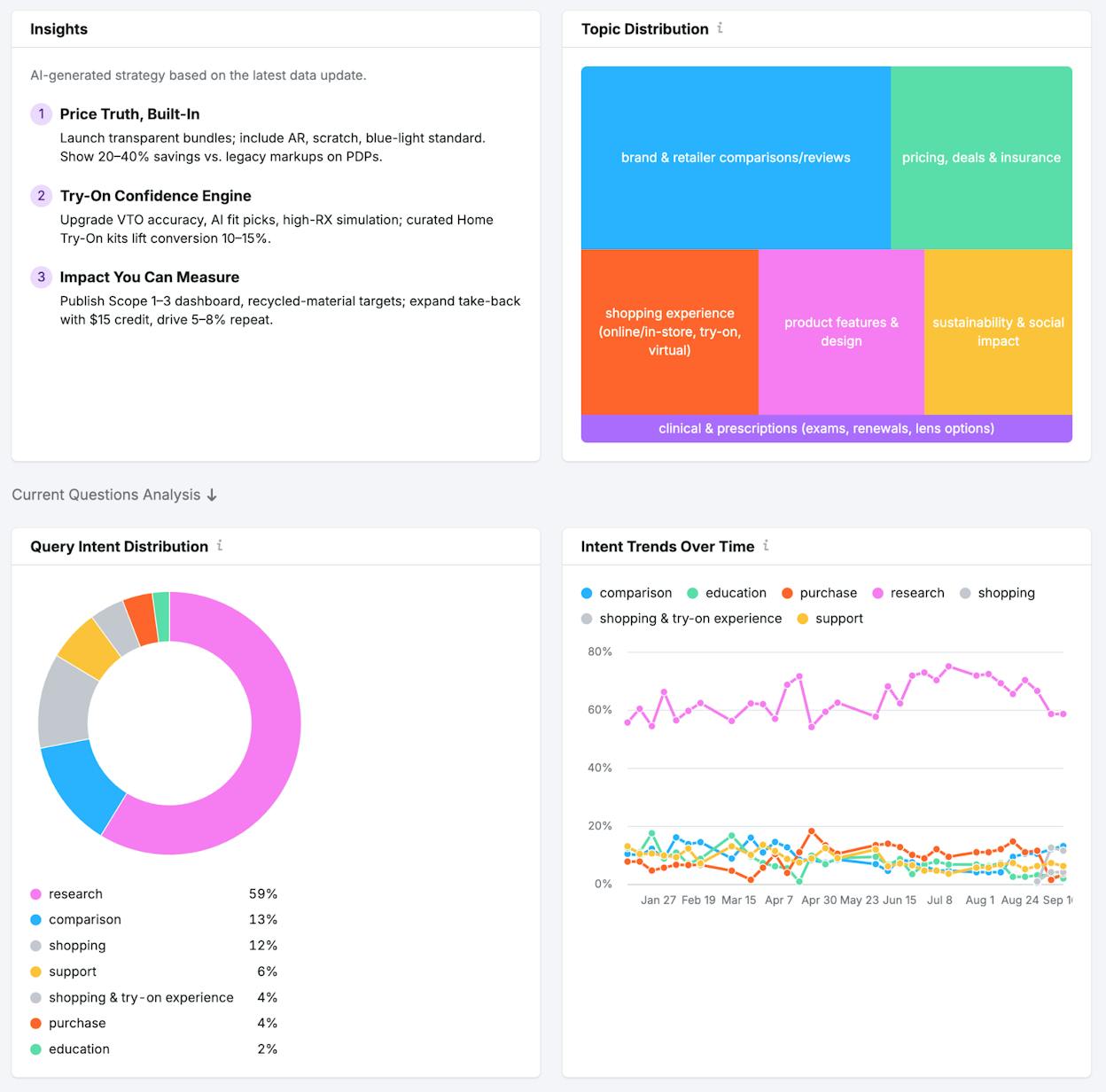
Semrush goes through Otterly AI Search Monitoring for similar visibility into Google AI Overviews and citation patterns, with an audit that flags technical issues blocking AI crawlers (robots.txt blocks on GPTBot, missing structured data, slow render times for JavaScript-heavy pages).
Semrush is stronger on Google AI specifically. Ahrefs is broader across engines but produces less actionable output.
Analyze AI’s Citation Analytics takes a more useful angle. Instead of inferring crawler behavior, it tracks the URLs AI engines actually cite, broken down by engine, page, and competitor.
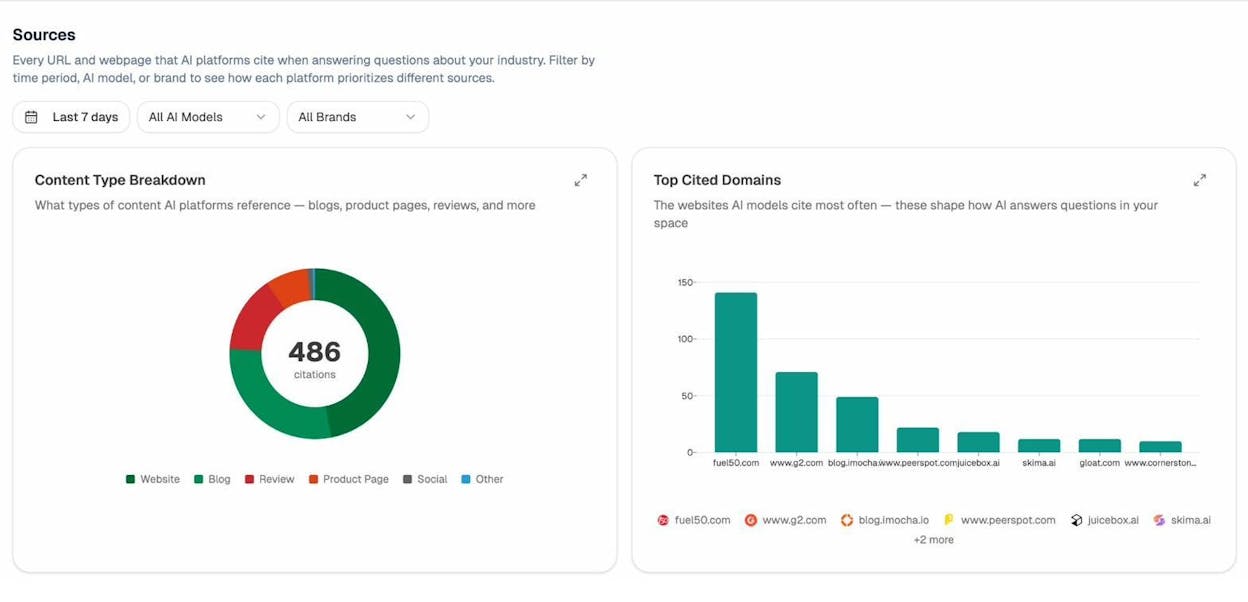
You see which of your pages get cited where, which of your competitors’ pages get cited instead, and which third-party domains the engines lean on most. That is what you can actually optimize against.
Competitive benchmarking, dashboards versus evidence
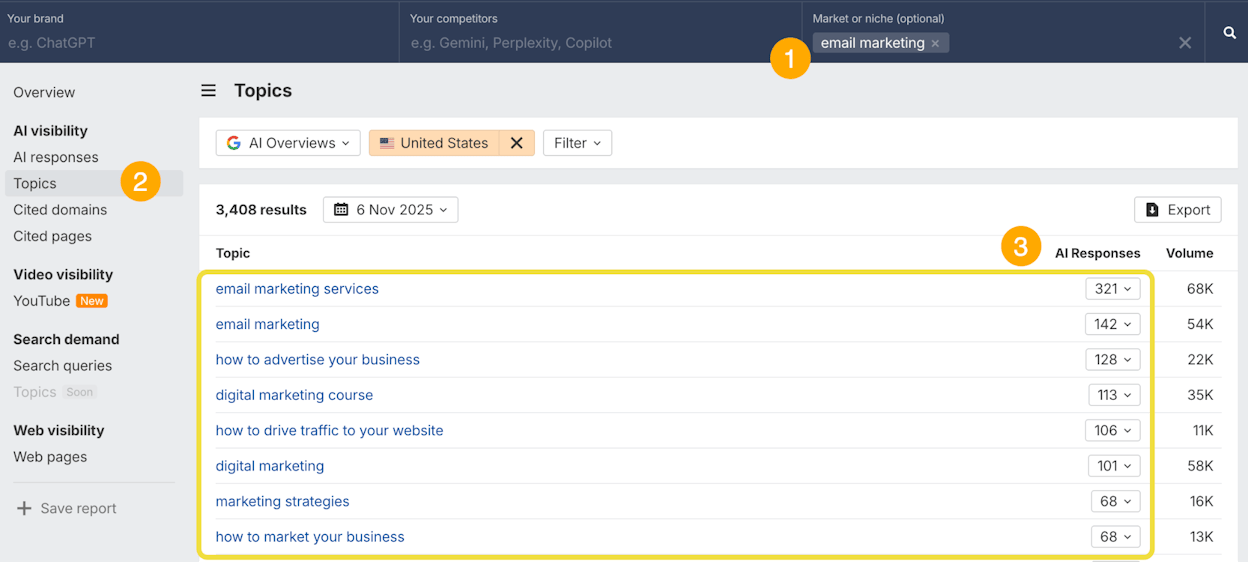
Ahrefs Brand Radar clusters prompts and reports your share of voice against tracked competitors. The granularity is real. You can drill into which prompts your competitor wins on, which sources cite them, and what content type drives those citations. The trade-off is the output is hard to compress into a single executive view, and the manual analysis falls on you.
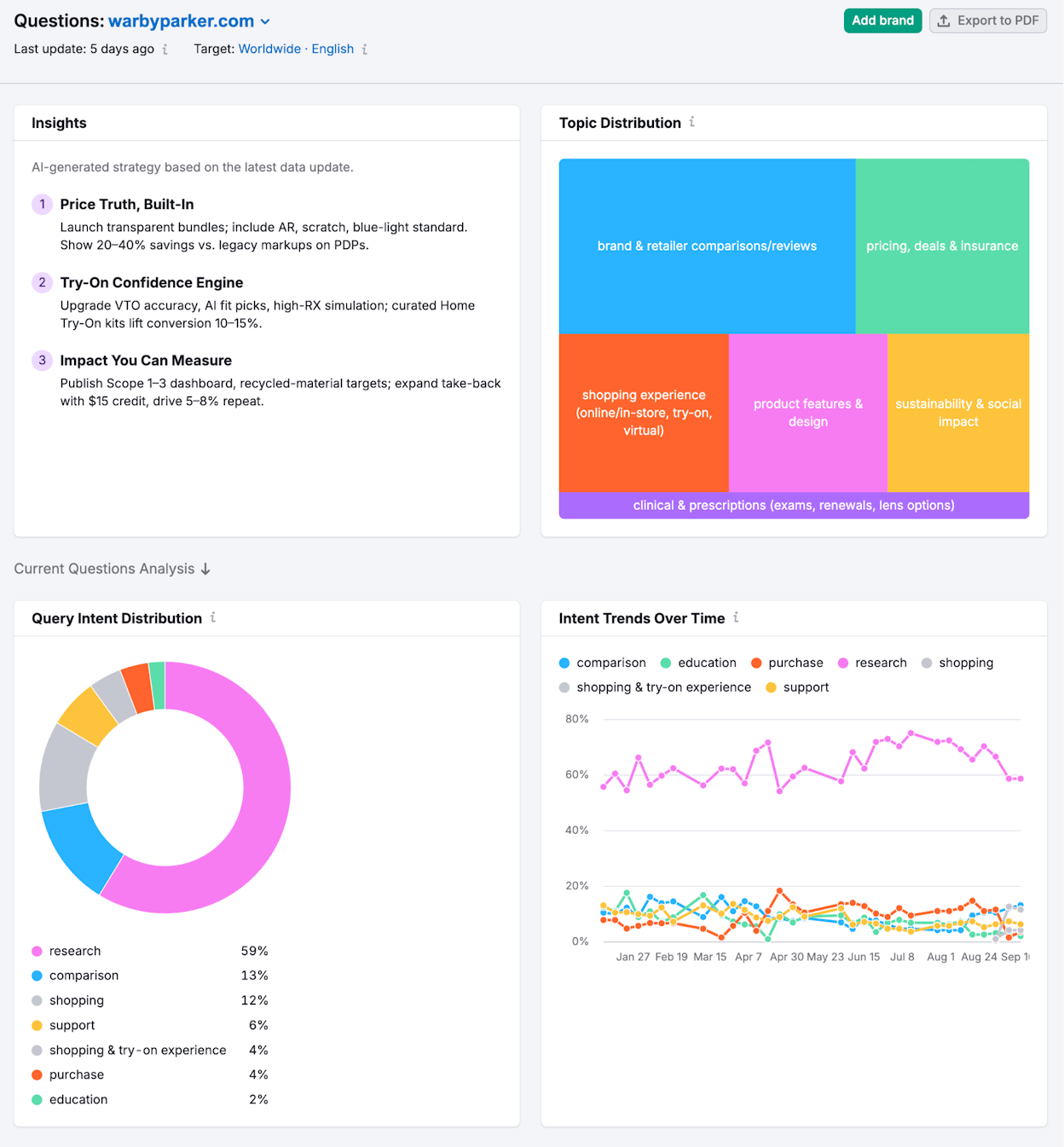
Semrush Brand Performance is the cleaner exec output. You get share of voice, sentiment, perception drivers, and a Key Business Drivers metric pointing at where your brand earns or loses mentions against up to 50 tracked competitors. Sentiment is presented well. The “what to do about it” still requires interpretation.
Where Analyze AI changes the math
Competitor Intelligence in Analyze AI surfaces both tracked and suggested competitors automatically, based on which entities the engines actually mention alongside yours.
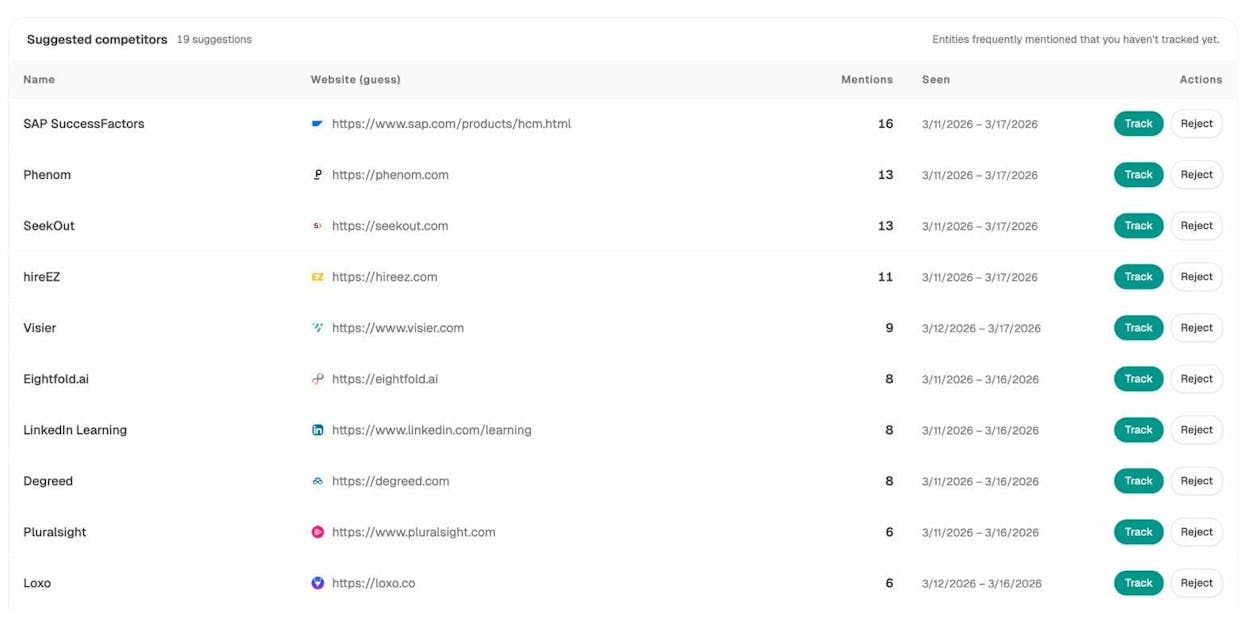
That solves the silent problem in both Ahrefs and Semrush, which is that you only track competitors you already know about. AI engines surface adjacent players you didn’t add to your watchlist, and Analyze AI brings them into view.
The Perception Map plots every tracked brand on a two-dimensional grid by presence and narrative strength, so you see at a glance whether the engines describe you as a category leader, a challenger, a niche player, or an afterthought.
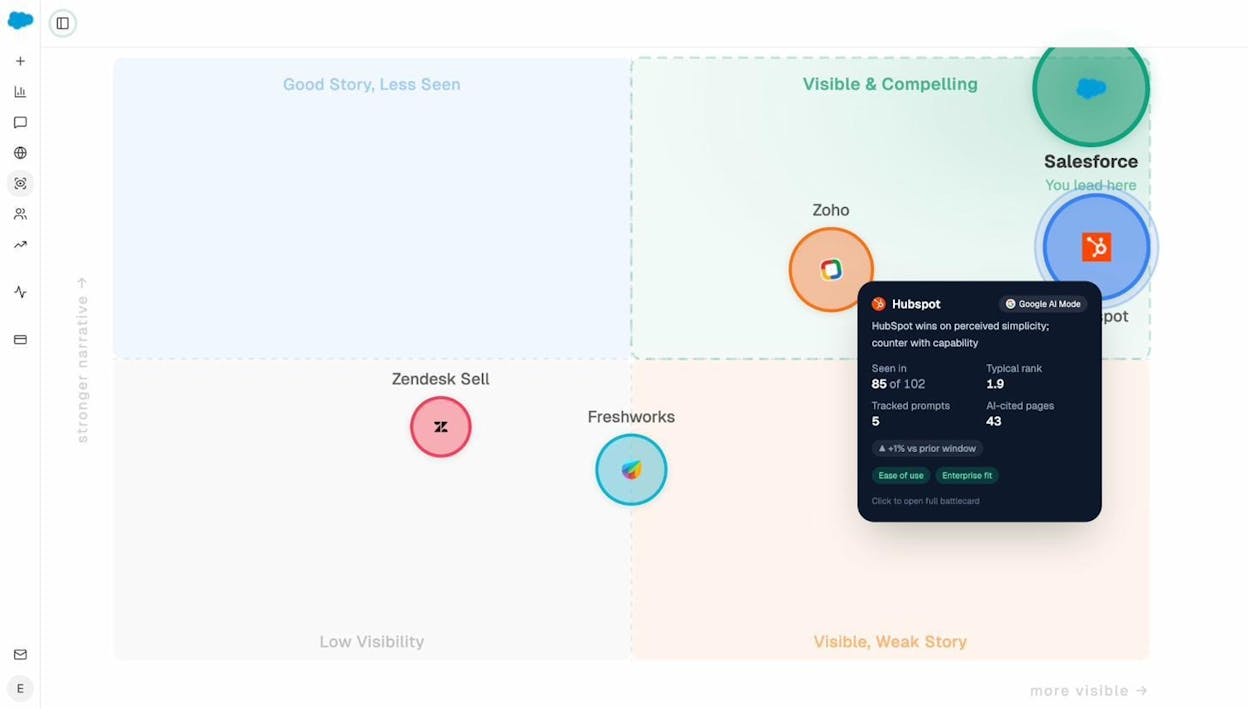
If you have ever tried to assemble an “AI category landscape” slide from raw competitor data, you know what this saves. One screenshot away from a board deck.
Integration with traditional SEO and content
Ahrefs is tighter in pure SEO workflows. Brand Radar and AI References live inside Site Explorer, so AI mentions appear next to backlink data, organic traffic estimates, and keyword rankings. If you already run SEO inside Ahrefs, this is the path of least resistance.
The catch is the integration is visual, not workflow-based. Seeing AI citations next to ranking keywords does not produce a brief, an outline, or a draft. Turning the data into content still happens elsewhere.
Semrush goes wider. The AI Visibility Toolkit sits alongside the SEO Toolkit, Content Toolkit ($60 a month extra), Traffic and Market Toolkit, Local, Social, Advertising, and AI PR. If your team operates across all those channels, you get a unified suite. If you don’t, you pay for a footprint you do not use.
The content side of Semrush is where the gap shows. The Content Toolkit generates articles from prompt research, but the output reads like AI-generated keyword content from 2024. It does not run a brief through research, outline, and revision the way a human editorial process would.
How Analyze AI changes the content side
The AI Content Writer in Analyze AI runs the same process a senior content strategist would. Research first, then outline, then draft, with editorial comments at every stage you can review and edit before the next step kicks off.
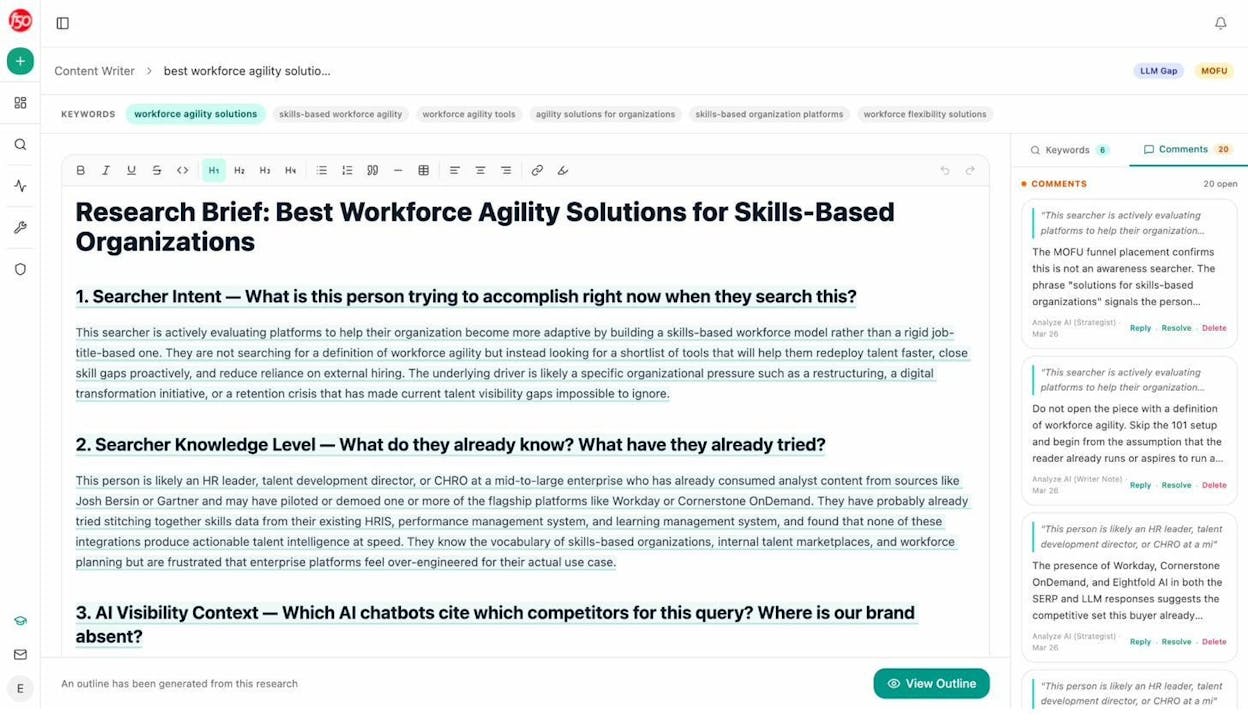
The output is closer to what you would commission from an agency than what a “generate article” button produces. It pulls from your tracked AI visibility data, the gaps your competitors are filling, and the brand voice you set in your Knowledge Base.
The Content Optimizer does the same on existing pages. It scrapes the URL, identifies gaps against the queries driving AI citations in your category, and suggests revisions structured around real reader intent.
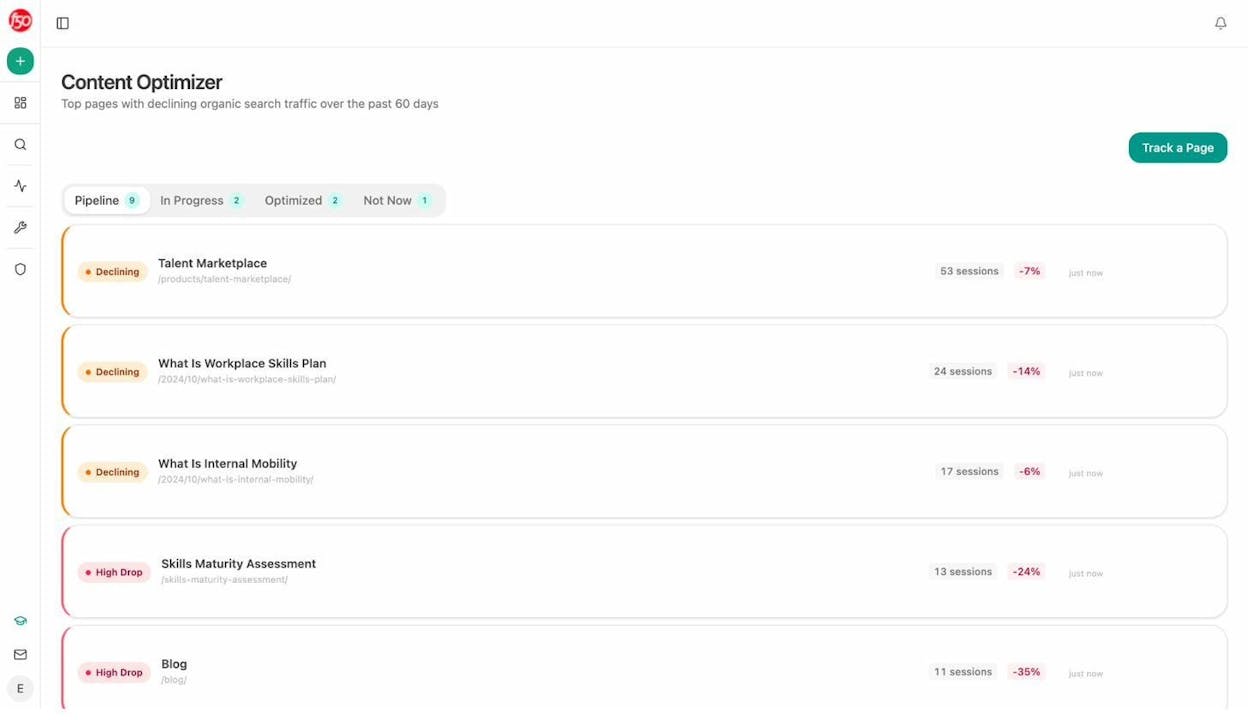
This is the layer Ahrefs and Semrush do not have at all. They tell you where you are not appearing. Analyze AI tells you, and writes the response.
The real cost, what you actually pay
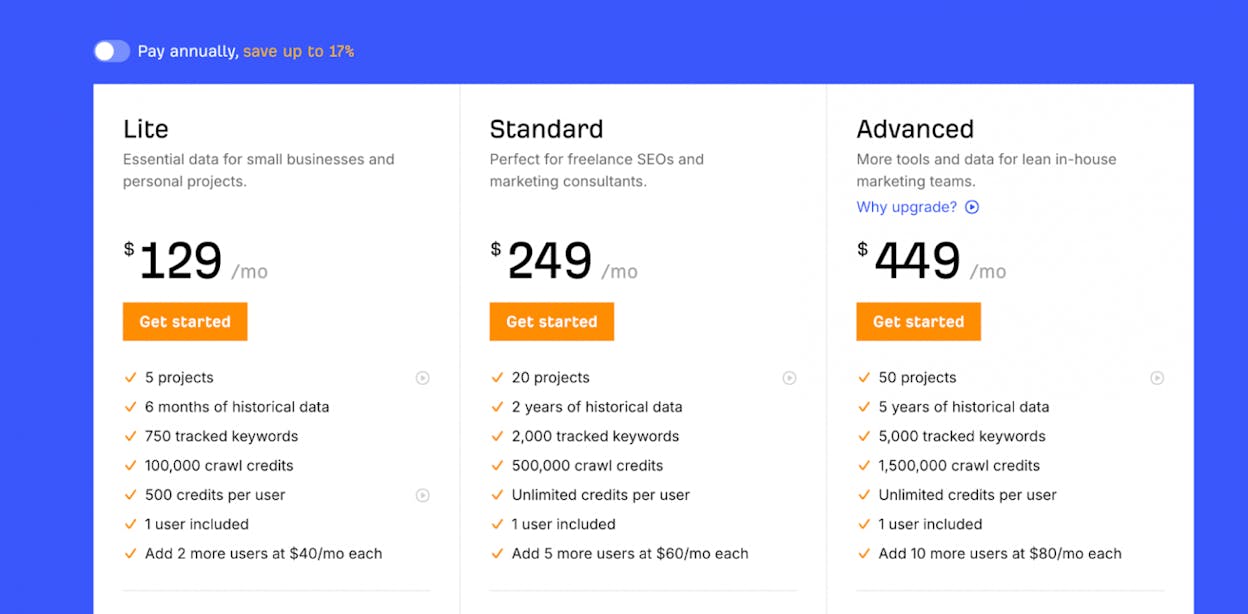
Ahrefs Brand Radar pricing in 2026 follows a layered model that pushes the bill higher than most teams expect. The base Lite plan is $129 a month. Brand Radar AI indexes are $199 a month per platform individually, or $699 a month for all six bundled. A realistic minimum to monitor your brand across all six platforms is $828 a month. On higher tiers, that climbs to $1,148.
Custom prompts, the ones you actually want to track for your category, are a separate $50 a month add-on for 2,500.
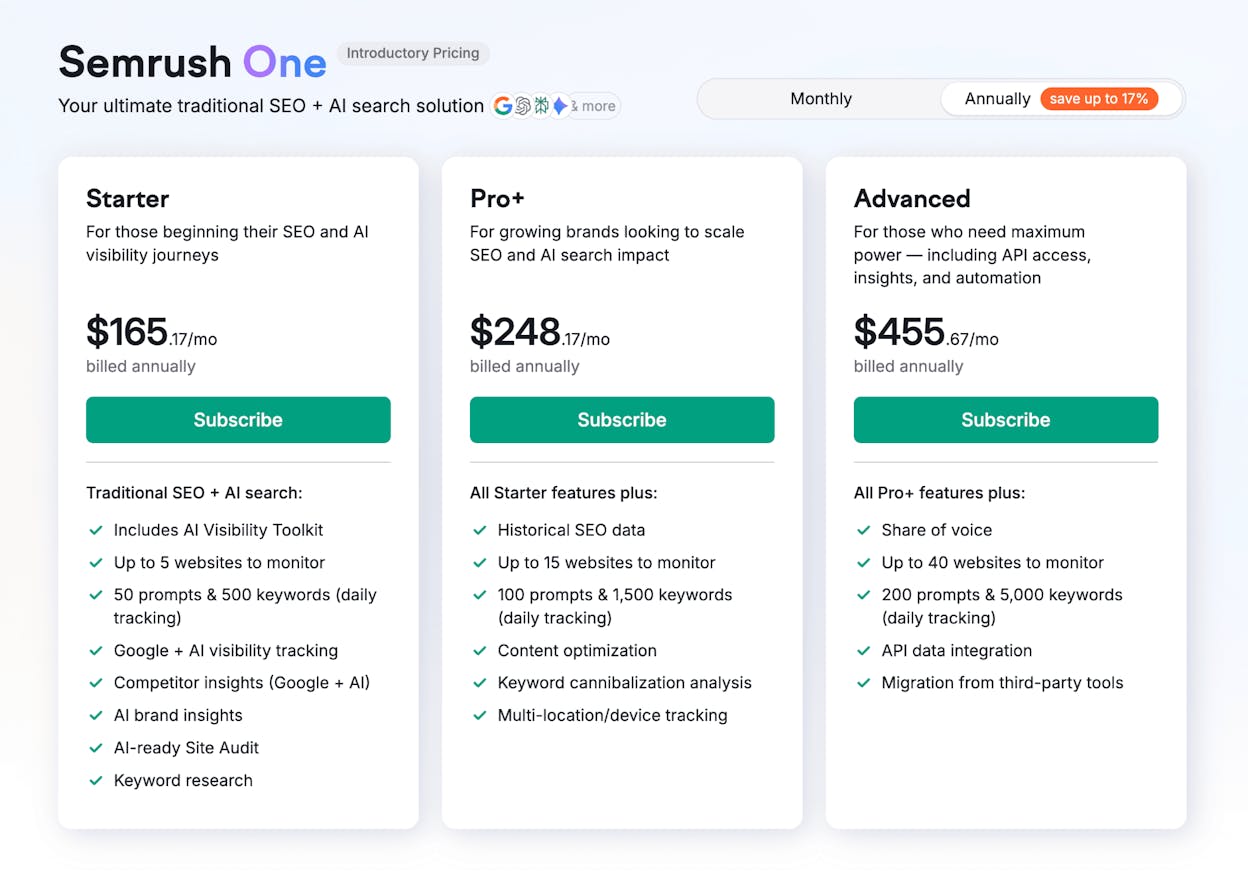
Semrush is more transparent at entry but layered in its own way. The AI Visibility Toolkit standalone is $99 a month per domain. Add a second user with AI access for another $99. Add 50 more prompts for $60. Add an additional domain for $99 more. If you also need SEO data, the SEO Toolkit Pro is $139.95 a month, or the Semrush One bundle starts at $199 and climbs to $549.
A working agency stack on Semrush with two users and three client domains lands around $500 to $700 a month before SEO features. On Ahrefs Brand Radar, the same agency lands closer to $1,000 to $1,400.
Analyze AI is $99 a month flat. Visibility, prompt tracking, content writer, content optimizer, perception map, traffic attribution, and Agent Builder included. No domain surcharges. No prompt overages. No add-on toolkits.
The layer neither legacy tool has, an agentic substrate
Both legacy tools are reasonable visibility choices for the right team. What changes the equation is what happens after the data lands.
Analyze AI ships with an Agent Builder that gives you 180+ nodes, 34 pre-built data recipes, and three trigger modes (manual, scheduled, webhook). The same surface area as Zapier, Retool, Make, and n8n combined, except every node is pre-wired to the data you already pay for. Your GA4, GSC, Semrush, DataForSEO, HubSpot, and CMS.
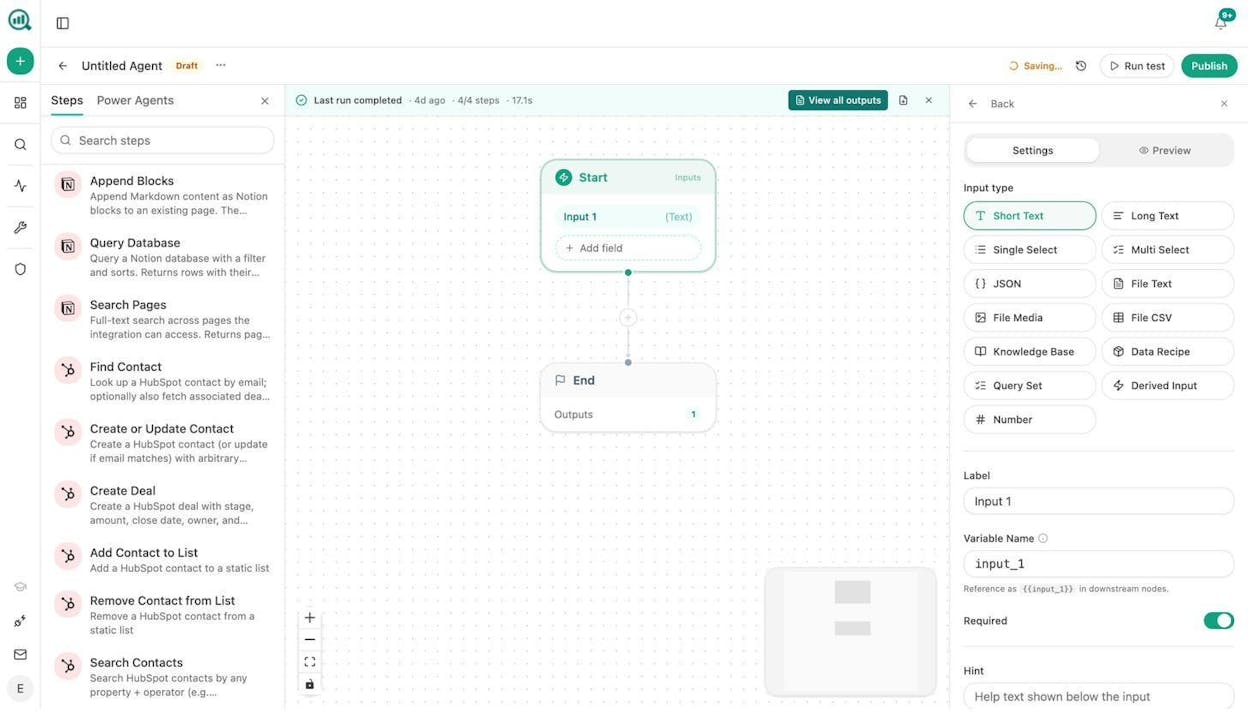
Pick any workflow your team currently does by hand, and an agent runs it.
A Monday board prep agent pulls share of voice from the last seven days, GA4 sessions, AI traffic by engine, new HubSpot deals, and competitor visibility shifts. It composes the summary in your brand voice, exports a DOCX, and emails leadership. Every Monday at 7am. The four-hour analyst chase becomes a 30-second open of an email.
A content refresh fleet runs every Friday. It pulls stale or declining pages, scrapes each one, rewrites for freshness and AEO using your Brand Vault, then either pushes the update to WordPress directly (if the AEO score clears your threshold) or Slacks the writer the gaps.
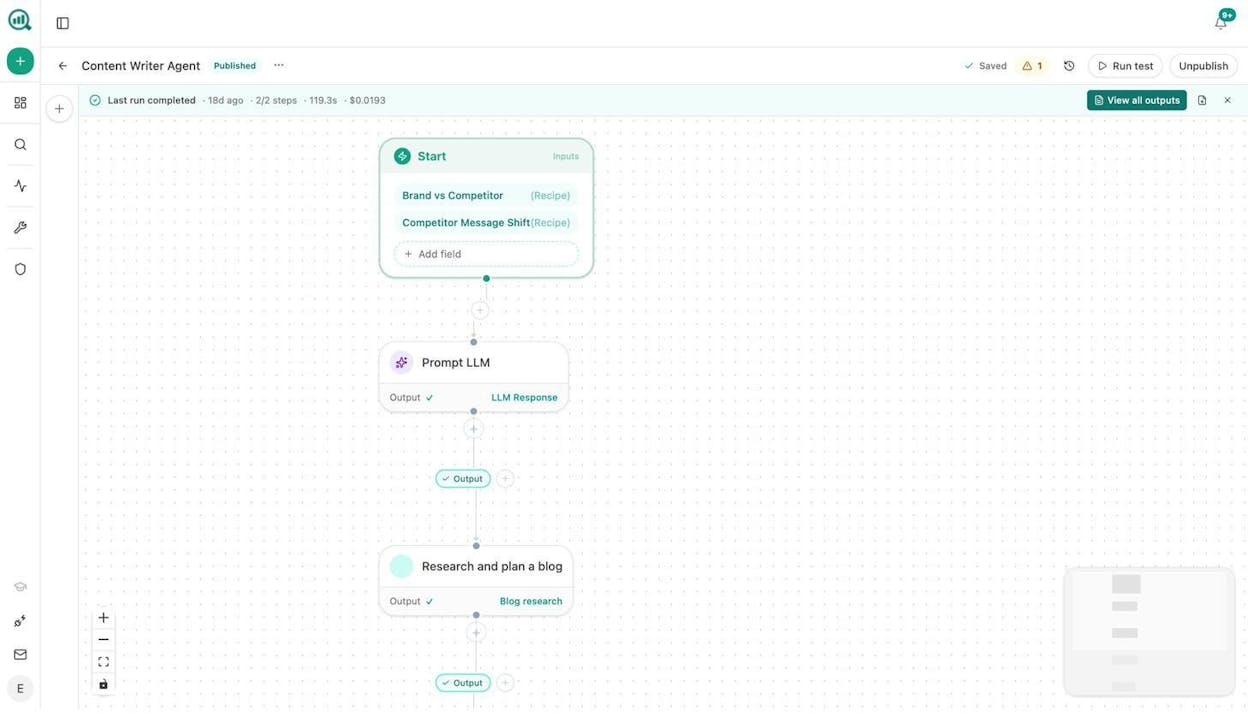
A daily visibility regression alert checks for drops in your tracked prompts overnight. If visibility on “best CRM for startups” tanked, the agent surfaces it in Slack by 8am with a draft counter-content brief attached.
For agencies, this is where margins live. Per-client agents loop over your client list, generate each report in parallel, and email the right PMs. Reporting day stops existing as a calendar event.
For content teams, a brief-to-publish pipeline turns a Notion brief into a published draft with a QA gate that blocks anything below your AEO threshold. For PR teams, an early-warning agent runs every 15 minutes and Slacks the PR head before the CEO finds out. For sales, inbound forms arrive as enriched leads attached to a HubSpot deal with research drafted before an AE has clicked anything.
None of this sits on a roadmap. It is the same $99 a month, and it turns “AI visibility tool” into “marketing operations substrate.”
Ahrefs and Semrush are powerful research tools. Neither runs your marketing operations on a schedule. Analyze AI does both.
So which one should you actually pick
Pick Ahrefs Brand Radar if you already pay for Ahrefs Standard or higher, your team needs the deepest historical visibility data on the market, your AI analyst can handle the manual interpretation, and the $828 to $1,148 a month bill is comfortable for your category. The most credible tool if your concern is depth.
Pick Semrush AI Visibility Toolkit if your team already lives inside Semrush, you need the cleanest executive dashboards for share of voice and sentiment, and you can absorb the per-domain, per-user, per-prompt pricing. The most polished tool if your concern is reporting.
Pick Analyze AI if you want the full picture for a flat $99 a month. Visibility tracking, prompt exploration, citation analysis, perception mapping, AI traffic attribution from GA4, a content writer that researches before drafting, a content optimizer that fixes the gaps it finds, and an Agent Builder that turns every recurring marketing workflow into a scheduled job.
If you are an agency lead tired of stitching tools together, a CMO who wants Monday morning intelligence without an analyst, a content director who wants a publish pipeline with an AEO gate, or an SEO head who wants the AI search layer integrated with the content layer, this is the platform that fits.
For deeper takes, see the Ahrefs Brand Radar comparison, the Semrush AI Toolkit comparison, the Ahrefs Brand Radar review, and the Semrush AI Toolkit alternatives roundup.
SEO is not dead. AI search is another organic channel alongside it. The tool that wins for your team is the one helping you compound what works in both, on a budget your CFO can sign off on, with automations that mean the work happens whether you click the button or not.
Analyze AI built that. Ahrefs and Semrush are still figuring out where to put the AI tab.

Ernest

Ibrahim


![6 AthenaHQ Alternatives That Skip the Credit Math [2026]](/_next/image?url=https%3A%2F%2Fwww.datocms-assets.com%2F164164%2F1778742681-blobid0.png&w=3840&q=75)
![50 GEO Statistics From Tracking 83,670 AI Citations [2026 Data]](/_next/image?url=https%3A%2F%2Fwww.datocms-assets.com%2F164164%2F1779314907-blobid0.png&w=3840&q=75)